Autor: Michael Eßig

Transforming Customer Impulse into Procurement Action

Transforming Customer Impulse into Procurement Action

How digital twins strengthen customer orientation in supply management
Dominik Oehlschläger, Andreas H. Glas, Michael Eßig
Supply management provides an organization with the resources that it needs but does not produce itself. However, intraorganizational needs are not isolated. They ultimately serve to fulfill the demands of external (end) customers. Traditionally, supply management receives information from its internal customers, i.e. from other functional areas such as production planning, logistics, or marketing. Information on (end) customer demands reaches supply management, if at all, indirectly via these other functional areas, which often pass on information after interpreting it. This article discusses how digital twins of (end) customer demands can provide all functional areas with precise, near-real-time data.
Industry 4.0 Science | Volume 41 | Edition 3 | Pages 118-124
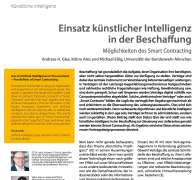
Use of Artificial Intelligence in Procurement

Use of Artificial Intelligence in Procurement

Possibilities of smart contracting
Andreas H. Glas, Kübra Ates, Michael Eßig
Procurement has the task to supply an organization with required but not self-produced goods. The goods vs. payment exchange with suppliers is laid down in contracts. “Electronic contracts" or “Smart Contracts” represent the logic digitally and thus enhance transparency. This can still evolve. In the future, improved algorithms and artificial intelligence will not only be able to administer contracts, but also to design them. This article presents the status quo of "Smart Contracting", places it in the "Legal Tech" topic and shows how artificial intelligence could be used in procurement.
Industrie 4.0 Management | Volume 39 | 2023 | Edition 1 | Pages 14-18
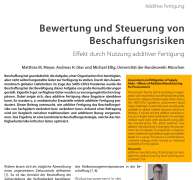
Assessment and Mitigation of Supply Risks

Assessment and Mitigation of Supply Risks

Effects of Additive Manufacturing for Procurement
Matthias M. Meyer, Andreas H. Glas, Michael Eßig
Procurement has the task of providing an organization with required but not self-produced goods. Due to the collapse of global supply chains during the SARS-COV2 pandemic, procurement faced major challenges. Goods that were actually easily available on global markets became critical bottlenecks. It turned out that additive manufacturing can mitigate these bottlenecks. For example, medical spare parts were produced using additive manufacturing. This article examines how additive manufacturing is changing the procurement risk of materials. A comparison is made between traditional and additive supply possibilities based on a survey. The result is a combined procurement strategy, which ensures an improved availability of critical goods.
Industrie 4.0 Management | Volume 37 | 2021 | Edition 2 | Pages 61-65
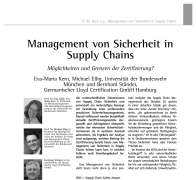
Management of Security in Supply Chains

Management of Security in Supply Chains

Möglichkeiten und Grenzen der Zertifizierung?
Eva-Maria Kern, Michael Eßig, Bernhard Ständer
Management of security nowadays is a central task of supply chain management. This contribtion analyses and characterises different dimensions of supply chain security and develops a multi-stage concept to create a comprehensive proactive security management.
Industrie Management | Volume 23 | 2007 | Edition 5 | Pages 63-66
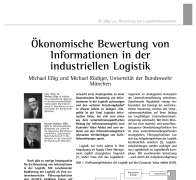
Economic Evaluation of Information in Industrial Logistics

Economic Evaluation of Information in Industrial Logistics

Challenges and first thoughts about value orientation in information logistics
Michael Eßig, Michael Rüdiger
Up to now there are few approaches to an evaluation of information in logistics. However, with the increasing establishment of logistics as a corporate leadership function and a visible increase of the focus on company spanning control of supplier-buyer relationships as part of Supply Chain Management, we also see an increase in the need for an evaluation of information. This article attempts to give first thoughts about an economic evaluation of information in logistics and also attempts to substantiate the need for continued research in this subject area. The presented approach is the Total Logistics Information Value which consist of the company specific contributions of information logistics to the Economic Value Added on the one hand, and the information logistically relevant value added by the suppliers on the other hand.
Industrie Management | Volume 23 | 2007 | Edition 4 | Pages 45-48