Sustainability

Intellectual Capital: Your Future Assets

Intellectual Capital: Your Future Assets

Reporting and Development of Intangible Assets
Katja Pook
Corporate success depends increasingly on immaterial assets. These are hard to assess, evaluate and shape. Only a few companies manage them systematically. Intellectual Capital Reporting provides a framework and opens the way for sustainable management of intangible assets.
Industrie Management | Volume 22 | 2006 | Edition 6 | Pages 45-46
Cooperation in Reverse Logistic Networks

Cooperation in Reverse Logistic Networks

Grit Walther, Thomas Spengler
New legal regulations require subsequent organisational and structural changes within the field of recycling complex discarded products (electronic scrap, end-of-life vehicles). Horizontal networks of small and medium sized companies are regarded to be especially suited for the resulting tasks. However, analyses of existing networks show a high diversity of company and network types. Therefore, empirical studies were carried out with the goal of determining characteristics, targets, and measures of existing recycling networks.
Industrie Management | Volume 22 | 2006 | Edition 3 | Pages 49-52
Cooperating Routing Protocols for Autonomous Controlled Transport Processes

Cooperating Routing Protocols for Autonomous Controlled Transport Processes

Bernd Scholz-Reiter ORCID Icon, Henning Rekersbrink, Michael Freitag ORCID Icon
For the implementation of autonomous control of transport processes it is tried to transfer well known and approved routing protocols from data communication to transport problems. Here structural differences between data and transportation networks prevent a direct transfer of the protocols, so that several different, particularly adapted protocols with different targets must cooperate in transportation networks. In the following a concept for autonomous controlled transport networks, called “Distributed Logistics Routing Protocol”, is introduced, developed at the CRC 637 “Autonomous Control of Logistic Processes” in Bremen.
Industrie Management | Volume 22 | 2006 | Edition 3 | Pages 7-10
Medium-Sized Businesses and Cooperations

Medium-Sized Businesses and Cooperations

Success by Systematical Outsourcing
Jens Gericke
Many companies have difficulties managing the recent situation of competition. Some companies achieve only small cost savings through the use of rationalization strategies. Network cooperations, however, offer many possibilities to successfully take advantage of efficiency increasing synergy effects. All participating companies can concentrate harder on their core business and achieve other features in cooperation with partner companies. This development concerns major enterprises as well as medium-sized businesses. While Outsourcing can be seen as a routine job for major enterprises, it poses problems for medium-sized businesses. These companies are lacking the necessary experience as well as tools to evaluate Outsourcing. This contribution points out the problems, that are related to Outsourcing in medium-sized businesses and demonstrates solutions.
Industrie Management | Volume 22 | 2006 | Edition 3 | Pages 45-48
Increasing Efficiency in Production Networks with Future Logistics

Increasing Efficiency in Production Networks with Future Logistics

Effizienzsteigerung von Produktionsnetzen durch Logistik der Zukunft
Jonas Schöfer
Industrial companies as well as small and medium sized enterprises engage themselves more and more in international production networks. Each networkpartner aims on building and maintaining business relationships to the best partner for any specific task. This leads to an increasing amount of goods being transported from partner to partner and leads to an immense logistics effort. These logistics tasks are responsible for major cost blocks in most companies. Organisations will have to react to the increasing demand for on time delivery with organisational as well as technological solutions to maintain their competitive advantage.
Industrie Management | Volume 22 | 2006 | Edition 1 | Pages 44-46
Management of Production and Logistics Under External Dynamics

Management of Production and Logistics Under External Dynamics

Carl Marcus Wallenburg, Jürgen Weber
Producing companies are increasingly facing external dynamics. To remain successful in the long run their management will have to keep up to this challenge. Thus it is important to choose and implement the right concepts and instruments to deal with dynamics. This article offers an overview on different approaches and a closer insight into the concept of Supply Chain Event Management.
Industrie Management | Volume 21 | 2005 | Edition 5 | Pages 45-48
Modular Logistics – An Innovative Service Concept for Manufactures

Modular Logistics - An Innovative Service Concept for Manufactures

Raimund Klinkner, Axel Mayer, Alexander Thom
The globalization of markets and the increasing connectivity of IT enhance the dynamic and complexity of worldwide competition. Logistics becomes and essential competitive differentiator. But small and medium sized enterprises (SME) have difficulties to implement innovative solutions. This article shows how service provider can increase the competitiveness by taking over logistics modules from SME.
Industrie Management | Volume 21 | 2005 | Edition 5 | Pages 33-336
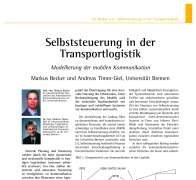
Autonomous Control in Transport Logistics: Modelling Communication

Autonomous Control in Transport Logistics: Modelling Communication

Modellierung der mobilen Kommunikation
Markus Becker, Andreas Timm-Giel
High dynamics and structural complexity in current and future logistic systems are complicating central planning and control. For enabling a more decentralised and autonomous control, communication between the elements of the logistical network are necessary for the provisioning of the information needed. This article details the modelling of the communication between the components. This modelling contains source and sink of the information as well as the amount of data, frequency of transmission, quality of service and the moment of transmission for a reasonable usage of the information. The technical feasibility with current and upcoming communication systems is evaluated under consideration of the model.
Industrie Management | Volume 21 | 2005 | Edition 5 | Pages 71-74
Adjustments in Automotive Networks

Adjustments in Automotive Networks

A Players’ Assessment
Willibald A. Günthner, Julia Boppert, Michael Scheuchl, Menno Hooites Meursing
The dynamic business environment is a logistical challenge for the automotive industry. Original Equipment Manufacturers, suppliers and logistics service providers are dealing within a complex network, which makes adjustments of a single company still essential, but stresses the necessity of optimised cooperation in the automotive industry for efficient reaction. The main questions for the members of ForLog are to which situations with an impact on the logistics system players in the automotive network have to adjust and how important these situations are for each single player.
Industrie Management | Volume 21 | 2005 | Edition 5 | Pages 65-67
From Management of Process Chains to Management of Value Added Networks

From Management of Process Chains to Management of Value Added Networks

Helmut Baumgarten, Ingo Beyer, Markus Richter
Nowadays, logistics is seen as a strategic management instrument in order to gain and sustain competitive advantages. New information and communication technologies have substantially changed the way value chains are designed and managed. The research center InterVal analyses internet technologies in the context of supply chain collaboration. One focus is on the evaluation of appropriate management concepts and related investments in technologies.
Industrie Management | Volume 20 | 2004 | Edition 5 | Pages 9-12
1 16 17 18