Autor: Frank Straube

Digital Twins in Logistics

Digital Twins in Logistics

Opportunities and barriers during implementation
Benjamin Gorgas ORCID Icon, Jan Kliewer ORCID Icon, Tobias Marc Wringe, Maximilian Bähring ORCID Icon, Frank Straube, Rüdiger Zarnekow
Digital Twins offer great potential for increasing efficiency in logistics. Digital supply chain twins (DSCT) enable data-driven decisions and optimize processes at location and network level. A study conducted during an expert workshop shows that companies are interested in DSCT, but challenges such as data quality, cross-actor data exchange and interoperability are hindering their widespread implementation. While pilot projects exist, market penetration remains low. Successful implementation requires standardized interfaces and contractual frameworks for data exchange. As a result, DSCT can make logistics networks more resilient and sustainable in the long term.
Industry 4.0 Science | Volume 41 | Edition 3 | Pages 34-40 | DOI 10.30844/I4SE.25.3.34
The Path from Automation to Autonomy

The Path from Automation to Autonomy

Evolutionary Steps of a Fully Autonomous Logistics Process in Manufacturing Companies
Benjamin Nitsche, Tobias Marc Wringe, Frank Straube
The automation of informational logistics processes is already one of the core challenges of manufacturing firms on their way to autonomous logistics systems. It is quite realistic that the majority of informational logistics processes will be running autonomously by the end of this decade. However, the path to this goal is still uncertain. Therefore, this article aims at defining the evolutionary stages of autonomy of logistics processes with the involvement of industry experts, describing prerequisites for reaching individual stages and discussing challenges along the way. In addition, the most important informational logistics processes with high autonomization potential are identified and an estimate is made of when the autonomy levels can be expected to be reached industry-wide.
Industrie 4.0 Management | Volume 37 | 2021 | Edition 6 | Pages 15-19
Blockchain in Logistics: Status Quo and Implications

Blockchain in Logistics: Status Quo and Implications

Anna Lisa Junge, Oliver Grunow, Frank Straube
BC has just passed the peak of inflated expectations. This article aims to assess the status quo of the technology in terms of logistics and to identify initial implications. To this end, the basics of BC are explained and the existing scientific literature is summarized. Subsequently, examples from practice and research projects are presented and compared with the previously presented findings in order to allow a systematization of the application potentials. Possible implications as well as opportunities and risks for logistics conclude the article.
Industrie 4.0 Management | Volume 34 | 2018 | Edition 2 | Pages 57-61
Setup and Deployment of a Learning Factory

Setup and Deployment of a Learning Factory

Close-to-production lean trainings in the process and pharmaceutical industry
Stefan Doch, Sara Merker, Frank Straube, Daniel Roy
The sustainable implementation of efficient processes requires a corporate culture that ensures continuous optimization. In order to achieve this level of operational excellence employees’ capabilities must be developed with regard to the identification and active pursuit of improvements. For this purpose, lean management principles and tools have to be implemented at all hierarchy levels (lean thinking). In many instances, learning factories have proved to be an appropriate platform to support this process of transformation. For the first time in Germany, this concept has now been transferred to the process industry with its special requirements by realizing a learning factory within a pharmaceutical company. The procedure of planning and deploying this industry-specific learning environment with the identified success factors are discussed in this paper.
Industrie Management | Volume 31 | 2015 | Edition 3 | Pages 26-30
Intelligent Controlling of Logistics Networks

Intelligent Controlling of Logistics Networks

Frank Straube, Daniel Roy, Jan Reipert
Cyber-Physical Systems and the internet of things change the way we see management, production and even logistics processes. The research project “Smart Logistic Grids” uses a decentralized cloud-based management concept to reduce the risk of disruptions in logistics networks.
Industrie Management | Volume 30 | 2014 | Edition 6 | Pages 39-42
Sustainability in Logistics

Sustainability in Logistics

Measurability of ecological and social criteria and the integration of supply chain partners
Frank Straube, Sebastian Wutke, Stefan Doch
Increasing customer demand and legislative regulations on sustainability lead to growing pressure on companies to provide transparency on the negative social and ecological effects of their business activities and those of their suppliers and service providers. A broad strategic integration of sustainability, incorporating economic, social and ecological aspects, enables companies to gain a competitive advantage. Several standards provide support for the measurement and reporting of ecological and social indicators, though the quantification of social sustainability still remains a challenge. For improving sustainability effectively, the scope of measurement and target setting has to include supply chain partners like suppliers or service providers. Top performing companies include sustainability criteria in their procurement processes for logistics services to reduce their transport-related emissions effectively.
Industrie Management | Volume 29 | 2013 | Edition 5 | Pages 7-10
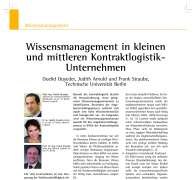
Knowledge Management in Small and Medium-Sized Enterprises in Contract Logistics

Knowledge Management in Small and Medium-Sized Enterprises in Contract Logistics

Ouelid Ouyeder, Judith Arnold, Frank Straube
Knowledge management can be an important competitive advantage for many companies. Small and medium-sized enterprises (SMEs), which often have limited access to capital. The challenge in contract logistics is to identify an appropriate knowledge management approach. In particular, the process of proposal preparation is characterized by a high complexity and intensity of specific knowledge. This article presents a knowledge management approach for the tender preparation process of SME in contract logistics.
Industrie Management | Volume 29 | 2013 | Edition 3 | Pages 66-68
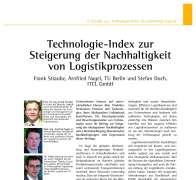
Technology-Index for Developing Sustainability in Logistics Processes

Technology-Index for Developing Sustainability in Logistics Processes

Frank Straube, Arnfried Nagel, Stefan Doch
The evidence of the ecological sustainability of logistics systems is increasingly expected by customers inside and outside the supply chain. Companies can affect their carbon footprint at different strategic levels: products, structures, processes and technologies. The potential use and evaluation of technologies and their contribution to improve ecological sustainability while taking into account economic conditions are the subject of this paper.
Industrie Management | Volume 27 | 2011 | Edition 6 | Pages 61-64
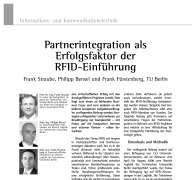
Partner Integration as a Key Success Factor for RFID Implementation

Partner Integration as a Key Success Factor for RFID Implementation

Frank Straube, Philipp Bensel, Frank Fürstenberg
sperous technology - until 2010 79 % of the users plan to extend the usage of RFID in logistics. However, the majority of users lacks in economic success with their current RFID applications. The reasons lie in the difficulties of building a solid business case and the complexity of the implementation itself. This article presents strategies of successful companies - focusing on partner integration - to cope with this complexity.
Industrie Management | Volume 25 | 2009 | Edition 5 | Pages 18-22
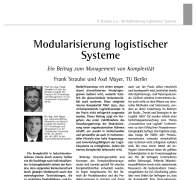
Modularisation of Logistics Systems

Modularisation of Logistics Systems

A Contribution to Complexity Management
Frank Straube, Axel Mayer
Complexity of industrial enterprises increases. Responsible for this trend are external drivers like the individualisation of products, the fierce global competition and the speed of technological developments which lead to reduced product life and innovation cycles. Companies react to external complexity by building internal complexity, logistics as a cross functional unit is especially affected. For example, a great number of different customers demand a heterogenic product program which results in operating an increasing quantity of variants. Because of the growing internal complexity a lot of promising logistical solutions are not realised. This article shows an approach how to create an organisational framework - based on the formal principle “Modularisation” - which allows logistics to regain adaptability and mutability by reducing internal complexity.
Industrie Management | Volume 23 | 2007 | Edition 6 | Pages 53-55
1 2