Product Development

Optimizing Energy Flows the Smart Way

Optimizing Energy Flows the Smart Way

EnyFlow-App optimiert Energieströme intelligent in produzierenden Gewerben
Gerrit Posselt, Jan Füllemann
The world’s rising energy and raw material costs are a reason for many companies to reduce energy and resource waste in their own production. Based on this plan, the Federal Ministry of Education and Research (BMBF) initiated in 2009 the project EnHiPro. Until May, 2012 the Technische Universität Braunschweig and three other research partners developed a system to make the energy demand of machines tangible by utilizing smart metering strategies. For the analysis and visualization of the energy flows, the c4c Engineering company was brought into the team in order to engineer the EnyFlow app that makes the energy flows and states of machines transparent on an tablet PC.
Industrie 4.0 Management | Volume 32 | 2016 | Edition 1 | Pages 55-57
Between Corporate Claims and Operational Reality

Between Corporate Claims and Operational Reality

The development of more sustainable products
Moritz Petersen, Sebastian Brockhaus, Wolfgang Kersten ORCID Icon
This article demonstrates results of a qualitative study in the consumer goods industry. The study shows that translating sustainability into measurable and actionable requirements is a crucial prerequisite for developing products that are more sustainable and successful in the marketplace. However, most companies still struggle with this translation due to a lack of codification of sustainability in their development process.
Industrie 4.0 Management | Volume 32 | 2016 | Edition 1 | Pages 7-10
Supplier Integration in Product Development Projects of Automotive Manufacturers

Supplier Integration in Product Development Projects of Automotive Manufacturers

Implications of Self-induced Mono-polies and Inherent Pie Sharing Challenges
Pan Theo Grosse-Ruyken, Joachim Wölfel
Automotive manufacturers increasingly use the concept of supplier integration. However, the concept often is attached with an increased dependency of the buyer towards his suppliers, which generates self-induced monopolies. The inherent erosion of efficient market mechanisms, combined with an increased supplier power due to consolidation processes, can lead for the manufacturer to a disfavoring profit redistribution. Recurring controversy in current buyer-supplier relationships show that pie sharing approaches need to be adopted to the concepts of supplier integration.
Industrie Management | Volume 31 | 2015 | Edition 6 | Pages 56-59
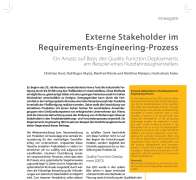
External Stakeholders in the Requirements-Engineering Process

External Stakeholders in the Requirements-Engineering Process

Ein Ansatz auf Basis des Quality Function Deployments am Beispiel eines Nutzfahrzeugherstellers
Christian Koot, Nail Bugra Akyüz, Manfred Rössle, Matthias Matejov
At the beginning of the 20th century Henry Ford has revolutionized the industrial production by the implementation of the assembly line within the automobile industry. Through this technique it was possible to produce high quantities of similar products with a small number of variants in an economically way. Today the development of the production technology enables the realization of products with a high number of variants in the flow production. As a result, the development of attractive products with a high benefit for different user groups represents a key competence for successful companies. That’s why the intense examination and involvement of requirements from various stakeholders into the product development and innovation process is crucial. The content of the following paper is therefore the introduction of a RE approach using the example of a commercial vehicle manufacturer.
Industrie Management | Volume 31 | 2015 | Edition 2 | Pages 49-52
Self-Optimization in Mechanical and Plant Engineering

Self-Optimization in Mechanical and Plant Engineering

Durch Selbstoptimierung intelligente technische Systeme des Maschinen- und Anlagenbaus entwickeln
Jürgen Gausemeier, Peter Iwanek, Mareen Vaßholz, Felix Reinhart
Mechatronic systems have to fulfill increasingly advanced functions and requirements to serve future customer needs and create reliable, resource-efficient and user-friendly systems. To realize tomorrow’s technical systems, solutions in context of self-optimization can be used. Thus, intelligent behavior can be integrated in technical systems. These systems are able to adapt their behavior autonomously and react to outer influences. The Leading-Edge Cluster “Intelligent Technical Systems OstWestfalenLippe (it’s OWL)” focuses on the described innovation leap from mechatronics to intelligent technical systems. Within this contribution we explain the capabilities of solutions in context of self-optimization on the example of machine learning methods. Furthermore, an approach for the identification of potentials for the integration of self-optimization in mechatronic systems will be introduced.
Industrie Management | Volume 30 | 2014 | Edition 6 | Pages 55-58
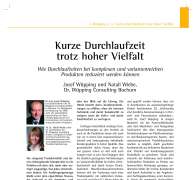
Low Lead-Time despite High Diversity

Low Lead-Time despite High Diversity

Wie Durchlaufzeiten bei komplexen und variantenreichen Produkten reduziert werden können
Josef Wüpping, Natali Wiebe
The increasing product variety and complexity is a problem which, more or less pronounced, applies almost every company. The output quantity remains below the actual level, the effort in the quotation and order processing is higher than necessary, and the customer satisfaction with the delivery reliability could be better. Intuitively, these companies often know why that is. The complexity of processes and changing bottlenecks hide the view of the solution. To counteract this, all business areas are looking for intelligent and effective methods. The hurdle is to meet customer requirements without increasing the internal complexity and costs, to act lean, flexible and value-oriented.
Industrie Management | Volume 30 | 2014 | Edition 4 | Pages 25-28
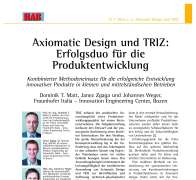
Axiomatic Design and TRIZ

Axiomatic Design and TRIZ

A winning duo for product engineering
Dominik T. Matt, Janez Zgaga, Johannes Weger
This paper describes the successful combination of the two methods Axiomatic Design and TRIZ based on the practical use case in a product development project at a small enterprise. The task included the design and prototypical implementation of a small tractor for viticulture. The major challenge in developing the concept was the requirement that the tractor must move in the narrow streets between closely lying pergolas as well as in steep terrain. The application example underpins the performance of the combined application of Axiomatic Design and TRIZ for the identification and resolution of technical and physical contradictions and shows how even small businesses can bring innovative and sophisticated product ideas targeted for implementation in close cooperation with research institutions.
Industrie Management | Volume 30 | 2014 | Edition 3 | Pages 57-61
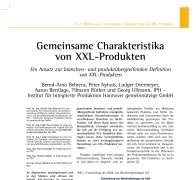
Common Characteristics of XXL-Products

Common Characteristics of XXL-Products

Ein Ansatz zur branchen- und produktübergreifenden Definition von XXL-Produkten
Bernd-Arno Behrens, Peter Nyhuis ORCID Icon, Ludger Overmeyer, Aaron Bentlage, Tilmann Rüther, Georg Ullmann
In this paper common characteristics of XXL-products are shown and a potential basis for the definition of XXL-products is derived. The proposed definition is based upon the hypothesis that man encounters his technical, organizational and economic limits with the methods and tools available at the time of observation, in the context of the creation of a XXL-product. The proposed definition will provide a clear distinction between conventional products and XXL-products. This enables precise discussions and the development of product-spanning solutions to overcome common challenges of XXL-products.
Industrie Management | Volume 30 | 2014 | Edition 2 | Pages 27-30
Cost Reduction of Filing Applications for Patents Abroad

Cost Reduction of Filing Applications for Patents Abroad

Bis zu 10.000 Euro Ersparnis pro Erfindung mithilfe einer globalen Auftragsplattform
Nina Braun, Wolfgang Danner
Regarding PCT-applications, Germany has the third most PCT-applications worldwide and the single most in Europe - 15.000 a year. ThyssenKrupp as well has several hundred PCT-applications a year. For this purpose the company is using the services of inovia since 2011. It provides a system for filing applications for patents abroad electronically. Not only is ThyssenKrupp using the inovia-platform for admittance of the PCT-applications in the national phase but also for the regionalization of granted european patents. This way, they are able to save a lot of time and money in the process.
Industrie Management | Volume 30 | 2014 | Edition 2 | Pages 53-56
Sidewall for a Hybrid Dump Truck Study

Sidewall for a Hybrid Dump Truck Study

Effizienzsteigerung im Gütertransport durch hybriden Leichtbau
Peter Middendorf, Marko Szcesny, Reinhardt Kreis
The increasing cost of fossil fuels and environmental regulations have increased the need for energy efficiency in the transport sector. Increasing the efficiency of good shipped overland can be achieved by increasing the efficiency of the motor and aerodynamics of the vehicles and by decreasing the mass of the vehicle through lightweight design allowing for a greater shipment capacity. The transport of goods in by truck is limited by the volume of the goods for cargo, but for bulk goods such as scrap materials or construction excavation the weight of the vehicle and cargo is often at the allowable limit. This article describes the design and manufacturing of a lightweight dump truck sidewall made of CFRP. In addition, an estimation of possible solutions for serial production of this part is given as well as an outlook to further investigations on this project.
Industrie Management | Volume 30 | 2014 | Edition 2 | Pages 11-14
1 3 4 5 16