Product Development

Approaches for Dealing with the Demographic Change in Supply Chains

Approaches for Dealing with the Demographic Change in Supply Chains

Meike Schröder, Carolin Singer, Wolfgang Kersten ORCID Icon
In the context of risk management the demographic change is reflected in demand and environmental risks. On the one hand, the requirements of products’ target groups are changing. On the other hand, the labour bottleneck is increasing due to the shift in population and age structure. When choosing strategies and measures for dealing with the demographic change in supply chains, companies should consider organizational as well as technological and personnel management-related aspects. In this connection, the integral examination of the complete product line as well as the company’s and the supply chain partners’ development of capabilities are essential.
Industrie Management | Volume 29 | 2013 | Edition 3 | Pages 69-72
Manufacturing for Design

Manufacturing for Design

Laseradditive Fertigung ermöglicht neuartige Funktionsbauteile
Claus Emmelmann, Dirk Herzog, Jannis Kranz, Christoph Klahn, Maximilian Munsch
The possibilities and limitations of conventional manufacturing processes strongly determine the design process and often lead to devices and products that do not fully exploit their theoretical potentials, e.g. their resistance to flow. Laser Additive Manufacturing is a manufacturing process to produce parts out of metallic powder materials. The technology is on the threshold to industrial maturity and has the potential to enable novel approaches for production and engineering. Thus, a shift from production-oriented design towards a design-oriented selection of the manufacturing process is possible.
Industrie Management | Volume 29 | 2013 | Edition 2 | Pages 58-62
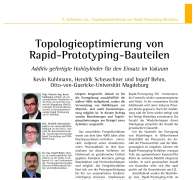
Topology Optimization of Rapid Prototyping Parts

Topology Optimization of Rapid Prototyping Parts

Additive Formed Hollow Cylinder for Use in Vacuum
Kevin Kuhlmann, Hendrik Scheuschner, Ingolf Behm
For the production of pyrolysis models (wax models), which are used in the process of vacuum differential pressure casting, often silicone molds are used. These casting molds are manufactured by using rapid prototyping solid bodies. However, for the shaping only the outer shell is necessary. So the use of hollow bodies to the material and cost savings is possible. In this paper calculations and topology optimizations are presented at the example of a cylinder.
Industrie Management | Volume 29 | 2013 | Edition 2 | Pages 53-57
A Method to Design Process Chains in Micro Manufacturing

A Method to Design Process Chains in Micro Manufacturing

Bernd Scholz-Reiter ORCID Icon, Daniel Rippel
In the field of micro manufacturing, a highly precise adjustment of relevant process parameters is of major importance. The continuing miniaturization of work pieces and machines leads to very small tolerances. The occurrence of so called size-effects interferes with a direct application of knowledge and experiences from macro manufacturing. Moreover, the high specialization of manufacturing technologies and processes in micro manufacturing requires a careful review of each process’s suitability with respect to the involved materials and components. This article presents a method that supports process designers with structured procedures and notations, to model and evaluate technological as well as logistic dependencies along the process chain. Thereby, it supports the selection and configuration of suitable processes for a given process chain.
Industrie Management | Volume 29 | 2013 | Edition 2 | Pages 15.19
Intelligent Technical Systems OstWestfalenLippe

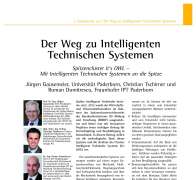
Intelligent Technical Systems OstWestfalenLippe

Mit Intelligenten Technischen Systemen an die Spitze
Jürgen Gausemeier, Christian Tschirner, Roman Dumitrescu ORCID Icon
The leading-edge Cluster Intelligent Technical Systems OstWestfalenLippe (it’s OWL) focuses on the innovation leap from mechatronics to systems with inherent intelligence. Within this paper we explain the technological evolution and its drivers for such intelligent technical systems. This leads to a technological concept which has been chosen as basis for the leading-edge cluster’s technology platform. Finally we present the cluster’s structure and its projects.
Industrie Management | Volume 29 | 2013 | Edition 1 | Pages 49-52
Secure Product Development with PLM

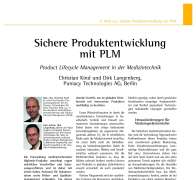
Secure Product Development with PLM

Christian Kind, Dirk Langenberg
The development of medical high-tech products is associated with high costs for documentation as well as for risk and quality management. In addition, they are subject to tight regulations and licensing procedures. To meet these challenges, the use of new methods and information technology tools is worthwhile, especially in the medical device industry. The product life cycle management approach, which was developed in other industries, offers med-tech companies the potential of being sustainably innovative in the global competition.
Industrie Management | Volume 28 | 2012 | Edition 6 | Pages 23-26
Electric Mobility from an Extended Products Perspective

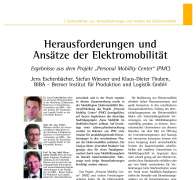
Electric Mobility from an Extended Products Perspective

Ergebnisse aus dem Projekt „Personal Mobility Center“ (PMC)
Jens Eschenbächer, Stefan Wiesner, Klaus-Dieter Thoben ORCID Icon
Electric mobility is currently subject to intensive discussions. New business models, products and services, as well as innovation concepts are developed by R&D and tested in real-life. In this context, the project “Personal Mobility Center” has been carried out in the Bremen/Oldenburg model region for electric mobility. On the basis of the Product Life-Cycle, first approaches for product-related services in the different phases of electric mobility have been worked out. Analysis of these “Extended Products” has shown that battery electric vehicles have to overcome several challenges before new mobility offers based on them can compete on the market.
Industrie Management | Volume 28 | 2012 | Edition 5 | Pages 25-28
Change Management in Technical Communication

Change Management in Technical Communication

Marita Tjarks-Sobhani
Professionally developed technical documentation is not available since a long time and restricted to only a small range of products. Nevertheless requirements change quickly. Due to mighty tools like content management systems, translation memory software or editorial systems, being a technical editor becomes a high-tech job. Users expect information to be suited for different mobile devices like iPad or IPhone as well as for paper form. Manufacturers expect the creation process to be economical and legally reliable. How could this work out?
Industrie Management | Volume 28 | 2012 | Edition 4 | Pages 33-37
Modelling and Analysis of Technological Chains

Modelling and Analysis of Technological Chains

A New Approach for the Effective Generation of Technological Knowledge
Knut Großmann, Hajo Wiemer, Michaela Helbig
Complex technologies of all industrial ranges require increasingly a holistic view of the entire technological process chains. In many methods processes are illustrated as already established and approved technological processes. The way up to an executable technological process is not supported. Straight in the technologically oriented R&D the know-how which is necessary for reproducible quality-assuring production is developed. In this paper new methods for the technologically oriented modelling and analysis of process chains are described which allow to effectively generate operational technology knowledge.
Industrie Management | Volume 28 | 2012 | Edition 4 | Pages 38-42
Instruction Manuals from the Customers and Technical Procurements Point of View

Instruction Manuals from the Customers and Technical Procurements Point of View

Mängel an gelieferten Betriebsanleitungen aufdecken
Ulrich Thiele
User information for safe and efficient use must be supplied by the manufacturer or supplier along with the product. Especially when dealing with the products without appropriate instructions the user needs to be warned if there are residual risks or the expectations of the user regarding the quality or safety of the product could not be met. Technical writers write such user information but not all of them are trained and experienced to create standardized and user optimized instructions. The resources and documentation processes for the product manufacturers are not always ideal to meet the requirements. Especially, the buyer of machinery and equipment would be well advised to verify the suppliers’ documentation by conducting his own usability tests.
Industrie Management | Volume 28 | 2012 | Edition 4 | Pages 43-46
1 4 5 6 16