Autor: Jürgen Gausemeier

Determining a Promising Industry 4.0 Target Position

Determining a Promising Industry 4.0 Target Position

Decision-making for companies taking into account external influences
Christoph Pierenkemper, Jannik Reinhold, Roman Dumitrescu ORCID Icon, Jürgen Gausemeier
Using industry 4.0 maturity models, companies can systematically record their performance in the context of industry 4.0. When the status quo is determined, the question “Where do we want to be in future?” is usually associated at the same time. However, companies are not always in a position to introduce what is fundamentally possible. Therefore, this question is not trivial. If a company is supposedly aware of its I4.0 target position, external influences often lead to the fact that the achievement of the target is made more difficult or hindered. It is therefore important to take these circumstances into account. This paper shows how environmental developments can be taken into account when determining a promising I4.0 target position. The target position forms the starting point for the implementation of industry 4.0 in the company.
Industrie 4.0 Management | Volume 35 | 2019 | Edition 5 | Pages 30-34 | DOI 10.30844/I40M_19-5_S30-34
Innovations in the Age of Digitization

Innovations in the Age of Digitization

Roman Dumitrescu ORCID Icon, Jürgen Gausemeier
Digitization creates fascinating opportunities. However, we have to recognize that Germany needs more than the technology leadership in order to succeed in the long term. We must be able to transform the technology leadership we take in the field of industry 4.0 for example into added value, entrepreneurial success and employment. Essential levers to success are data based services, business models, positioning in platform economy, foundation culture, shaping the digitized working environment and, last but not least, Systems Engineering. In any case, our success will be a matter of strategic operation and systemic thinking and acting.
Industrie 4.0 Management | Volume 34 | 2018 | Edition 2 | Pages 7-11
Self-Optimization in Mechanical and Plant Engineering

Self-Optimization in Mechanical and Plant Engineering

Durch Selbstoptimierung intelligente technische Systeme des Maschinen- und Anlagenbaus entwickeln
Jürgen Gausemeier, Peter Iwanek, Mareen Vaßholz, Felix Reinhart
Mechatronic systems have to fulfill increasingly advanced functions and requirements to serve future customer needs and create reliable, resource-efficient and user-friendly systems. To realize tomorrow’s technical systems, solutions in context of self-optimization can be used. Thus, intelligent behavior can be integrated in technical systems. These systems are able to adapt their behavior autonomously and react to outer influences. The Leading-Edge Cluster “Intelligent Technical Systems OstWestfalenLippe (it’s OWL)” focuses on the described innovation leap from mechatronics to intelligent technical systems. Within this contribution we explain the capabilities of solutions in context of self-optimization on the example of machine learning methods. Furthermore, an approach for the identification of potentials for the integration of self-optimization in mechatronic systems will be introduced.
Industrie Management | Volume 30 | 2014 | Edition 6 | Pages 55-58
Intelligent Technical Systems OstWestfalenLippe

Intelligent Technical Systems OstWestfalenLippe

Mit Intelligenten Technischen Systemen an die Spitze
Jürgen Gausemeier, Christian Tschirner, Roman Dumitrescu ORCID Icon
The leading-edge Cluster Intelligent Technical Systems OstWestfalenLippe (it’s OWL) focuses on the innovation leap from mechatronics to systems with inherent intelligence. Within this paper we explain the technological evolution and its drivers for such intelligent technical systems. This leads to a technological concept which has been chosen as basis for the leading-edge cluster’s technology platform. Finally we present the cluster’s structure and its projects.
Industrie Management | Volume 29 | 2013 | Edition 1 | Pages 49-52
Systematic Development of Business Strategy Alternatives

Systematic Development of Business Strategy Alternatives

Jürgen Gausemeier, Markus Lehner, Karsten Stoll
Successful enterprises pursue strategies, which are unique and for this reason cannot easily be imitated by competitors. Such strategies are based on a smart combination of various strategic variables. These variables are the result of the characteristic questions of strategy development: Who are our customers? What are our products and services? How are these products and services provided? The handling of a vast amount of strategic variables requires a systematic approach. Therefore we introduce a method which combines characteristics of strategic variables on a discursive way which leads to coherent and promising strategy alternatives. Hence we solve another problem in the context of strategy development: We provide alternatives which are often omitted in practical experience due to time constraints. To overcome the limits of usual thinking - next to things being “en vogue” in industry - and to make substantiated decisions alternatives are necessary.
Industrie Management | Volume 25 | 2009 | Edition 4 | Pages 41-44
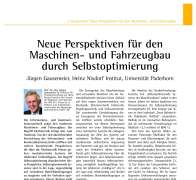
New Perspectives for Mechanical Engineering and Vehicle Construction by the Use of Self-optimization

New Perspectives for Mechanical Engineering and Vehicle Construction by the Use of Self-optimization

Jürgen Gausemeier
The information and communication technology distinguish the modern mechanical and automotive engineering. This is described by the term mechatronics. The development progress of information and communication technologies open up further fascinating perspectives: mechatronic systems with inherent partial intelligence. The term Self-optimization characterizes this perspective. Self-optimizing systems are able to react on changing environmental conditions and to optimize their behaviour autonomously. This contribution presents the paradigm of Self-optimization. The potential of Self-optimization is explained by two examples from the system RailCab.
Industrie Management | Volume 25 | 2009 | Edition 3 | Pages 33-36
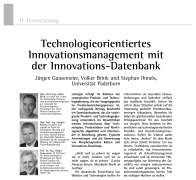
Technology-related Innovation Management with Innovation-Database

Technology-related Innovation Management with Innovation-Database

Jürgen Gausemeier, Volker Brink, Stephan Ihmels
Product innovations are mainly based on a future-oriented alignment of technology push and market pull. The alignment of both aspects with regard to conformity to the corporate strategy is carried out in the context of the strategic product and technology planning, which is the initial point within the product design process. The integral element of this paper is a data base-system which allows performing the tasks of strategic product and technology planning. In particular, information about technologies, product ideas and market segments are represented and related with each other. Typical applications are the design of morphologic boxes an innovation roadmaps.
Industrie Management | Volume 25 | 2009 | Edition 1 | Pages 40-44
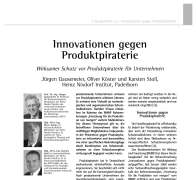
Innovations against counterfeiting

Innovations against counterfeiting

Effective protection against counterfeiting for producing companies
Jürgen Gausemeier, Oliver Köster, Karsten Stoll
Capital goods industry is imperilled by counterfeiting more than ever. Legal services are the preferred measure of companies facing this challenge. This article shows further possibilities how producing companies can protect themselves effectively against counterfeiting. There are many technological and organisational measures already available. Furthermore, innovative measures are being developed at the very moment. Considering this background it is necessary to inform affected companies about the manifold possibilities of preventing counterfeiting. Moreover it is essential to depict how a specific threat can be faced by combining stand alone measures to customised safety concepts.
Industrie Management | Volume 24 | 2008 | Edition 6 | Pages 51-54
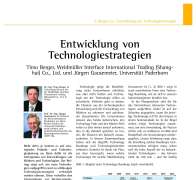
Development of Technology Strategies

Development of Technology Strategies

Timo Berger, Jürgen Gausemeier
Strategic product planning and strategic technology planning is more important than ever. This planning is based upon the anticipation of market and technology developments. The article shows how new technologies are taken up and how they can be combined to coherent technology strategies. These help the companies to further develop the product range and to position themselves advantageously in the competition of tomorrow. A consistent example from the automotive lighting engineering underlines the high feasibility of the methodology.
Industrie Management | Volume 24 | 2008 | Edition 3 | Pages 31-36
Module Strategies for Mechatronics

Module Strategies for Mechatronics

Daniel Steffen, Jürgen Gausemeier
Today, most modern mechanical engineering products are strongly driven by information technology. Therefore, the degree of complexity increases, which can reduced by a consistent modularization of the product. This contribution describes which challenges arise especially for the modularization of mechatronic systems, how the product structuring can be conducted and how the product development process is affected.
Industrie Management | Volume 23 | 2007 | Edition 6 | Pages 9-12
1 2