Training in Industry 4.0 with AI Tutoring Systems |
State of technology

| Journal | Industry 4.0 Science |
| Issue | Volume 40, 2024, Edition 5, Pages 50-57 |
| Open Access | https://doi.org/10.30844/I4SE.24.5.50 |
| Bibliography | Share | Cite | Download |
Abstract
Keywords
Article
The commercialization of generative artificial intelligence (generative AI) through systems such as OpenAI’s ChatGPT has introduced a new generation of AI for use in all areas of life, but also in industry [1, 2]. Generative AI not only allows existing information to be processed, but also new information to be generated either automatically or with the help of prompts in a humanized way. This technological leap opens up new possibilities in Industry 4.0, including tutoring systems [3, 4].
Artificial Intelligence Tutoring Systems (AITS) or Intelligent Tutoring Systems (ITS) describes software that consists of a total of four main components, known as models. Each of these models represents a specific part of the AITS, for example the domain (also known as knowledge or expert) model contains the subject knowledge that is to be taught. The learner (also known as student) model records how successfully the learner works with the AITS and whether the learner really understands the content to be learned. The tutor (also called pedagogical) model represents the virtual teacher of the AITS, which for example addresses and reacts to problems or questions with the help of feedback and learning content.
The learner interacts with the software through the interface (the fourth model), which can be in a variety of multimedia formats [5, 6]. Typical and widespread types of AITS are chatbots [7, 8, 9, 10], virtual agents [10, 11] or social robots [6, 10], which all make use of artificial intelligence.
Due to the increasing advancement and market maturity of tools such as various AITS, but also the use of IoT systems, the term Education 4.0 is also used in reference to the further development of digital learning, corresponding to Industry 4.0 [12, 13]. If Education 4.0 is viewed as a supply chain in terms of continuing education, it is recognized that basic knowledge is taught in school education and specialized knowledge is taught in academic education or training, then consolidated in the workplace in Industry 4.0 and constantly expanded in the sense of lifelong learning [14].
When talking about Education 4.0 involving the use of AITS in Industry 4.0, learning basically involves the creation and fostering of competencies of employees in Industry 4.0 [15, 16]. Competencies can be differentiated into:
- Technical or domain competencies: equipment operation, process understanding, understanding of technology
- Methodical or action competencies: creativity, problem solving, decision-making, analytical skills, research skills
- Social competencies: communication, teamwork, networking, leadership skills, knowledge transfer
- Personal competencies: autonomous work, sense of responsibility, organizational skills, flexibility, motivation
Related to this is the acquisition and transfer of knowledge. A distinction may be drawn here between explicit knowledge (documented knowledge) and tacit knowledge (employee experience) [17]. There are a number of roles within an organization that require different skills to a varying degree.
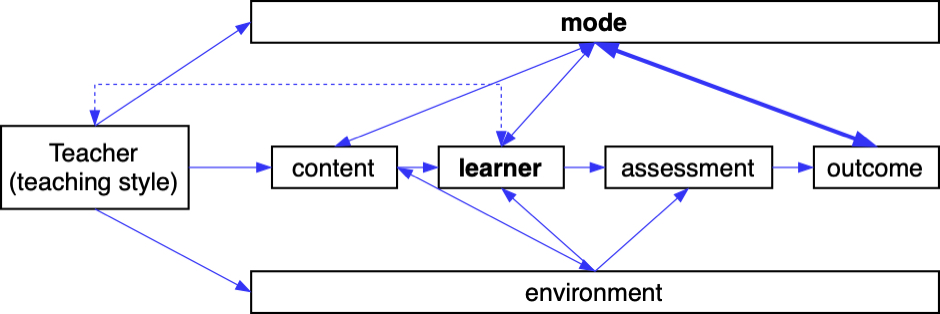
Digital teaching and learning in general can be put into a classification like the one from [18] (Fig. 1). AI influences all of these elements in the model.
Categorization of Artificial Intelligence Tutoring Systems
AITS in Industry 4.0 can be differentiated using various perspectives. On one hand, AITS can be distinguished in terms of the addressed learning approaches [19]. On the other hand, a classification in application, especially regarding work and company organization, might be beneficial [14, 20]. In addition, there are various underlying AI techniques in AITS itself, as well as in conjunction with other technologies that find their use within Industry 4.0 [5, 12, 13, 19]. These differentiations can be combined in a taxonomy to create a framework that can categorize AITS.
Learning approaches
One of the most important tasks of AITS is conveying learning content or supporting both teachers and learners in this process. Various learning approaches or methods can be used in education and training. It is therefore useful to categorize these learning approaches so that both the student and the teacher understand how learning should take place.
Here it is crucial to understand that learning approaches do not have to remain on their own but can be partially combined with other learning approaches. There is a variety of classic learning approaches that can be pursued, some being used particularly frequently, and others being used less frequently [21, 22].
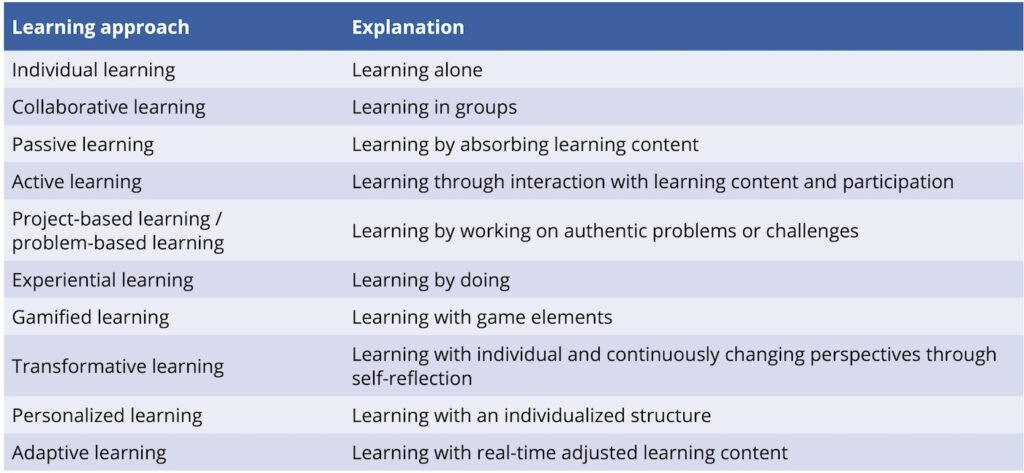
The most common learning approaches, particularly in connection with AITS are shown in Figure 2. Firstly, a distinction can be made as to whether the learner learns individually, i.e., alone, or collaboratively in a group with other individuals. A further distinction can be made as to whether the learner learns passively by merely absorbing the learning content or follows the active learning approach, in which the learner participates and actively interacts with the content, e.g., by asking questions. With the project-based or problem-based learning approach, learners are challenged with real or at least authentic problems to solve them and to deal with the solution [22].
Similar to this is the approach of experiential learning, which can also be described as “learning by doing”, where practical skills are fostered [23]. Through gamified learning, learning content can be conveyed in a playful way with the help of game design and gamification in order to increase the motivation, interest or commitment of the learner [24, 22]. Transformative learning describes individual learning with a continuously changing overall perspective of the learner on learning content, which is linked to lifelong learning through accumulating experience and self-reflection [21, 25].
AITS can pursue all these learning approaches in different ways with the help of their respective design. All these learning approaches often require learners to be guided by a teacher, the tutor. However, in many learning scenarios, a tutor cannot respond to the individual needs of each learner. Learning content is often standardized. However, AITS can close the gap of exactly that problem, so that a large number of learners can benefit simultaneously from both the learning approaches of personalized learning and adaptive learning [23, 12, 19, 26].
The AITS adapts to the learner and creates its own AI model (Learner’s Model), which continues to refine itself and therefore improves as it is progressively used [20]. With personalized learning, individual needs, preferences, and abilities can be addressed. This leads to a more effective development of skills and acquisition of knowledge. Learners can dedicate themselves to new content at their own pace or focus particularly carefully on areas that need improvement.
The learning process is thus individually structured [12, 23, 27]. This is closely linked to adaptive learning, in which the AITS, including its learning materials, adapts to the learner’s learning progress. The level of difficulty is dynamically controlled, and the learner is given real-time feedback based on their performance. In this way, the AITS can provide the right level of difficulty and support and increase the effectiveness of the overall learning process [23, 12, 28]. Therefore, the goal of an AITS is to allow the learner a strong personalization and interactivity in the learning process [26].
It should also be emphasized that AITS meets every learner with none or the same social and emotional bias, which can be seen as both an advantage and, under certain circumstances, a disadvantage, as human factors of a human tutor disappear [19].
Advantages of AI usage in AITS
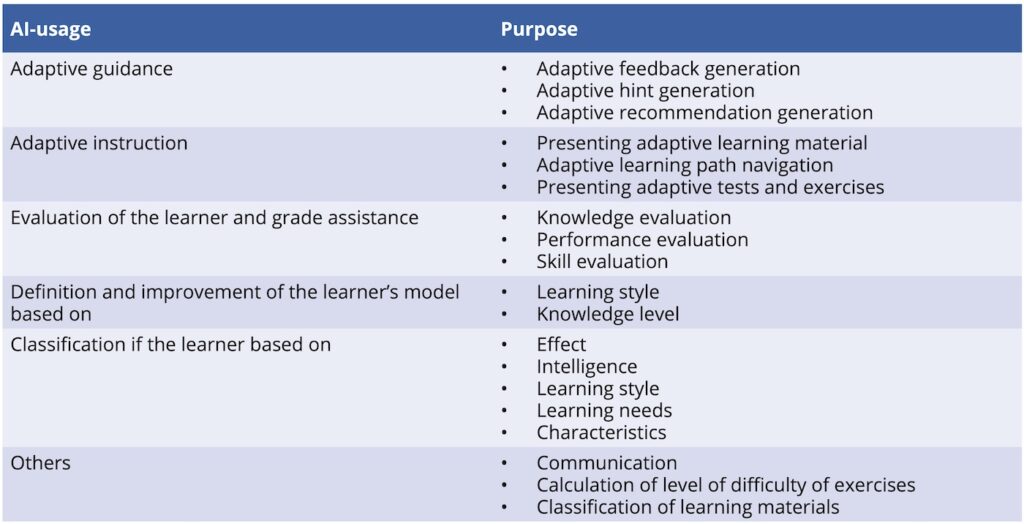
In addition to classifying which learning approaches can be addressed by AITS, it should also be asked where the learner, and the teacher, can benefit from AI using AITS. AITS can help to provide every learner with a personalized and adaptive learning environment. However, a major benefit is that AITS can help in the assessment of both learning content and the learner’s skills and knowledge [19].
Furthermore, AI can be used to classify the learners and create individual AI learner models to track the learning progress of individuals as well as entire groups. This also makes it easier to adapt learning content, both in terms of content and difficulty. Specific AI benefits and their purposes are listed in Figure 3 based on [20], who conducted a systematic review of AITS. With the help of this table, AITS can be classified according to which benefits they pursue and how they do so. An AITS can fulfill several purposes.
AI techniques
In addition to the classification of AITS into the addressed learning approaches and areas of AI usage, the differentiation of the underlying AI techniques is also crucial. This allows an even more in-depth determination of which AITS are used and how, and which capabilities can be used to address tasks of AITS and how well they can be fulfilled. It also helps, for example, to further develop an AITS.
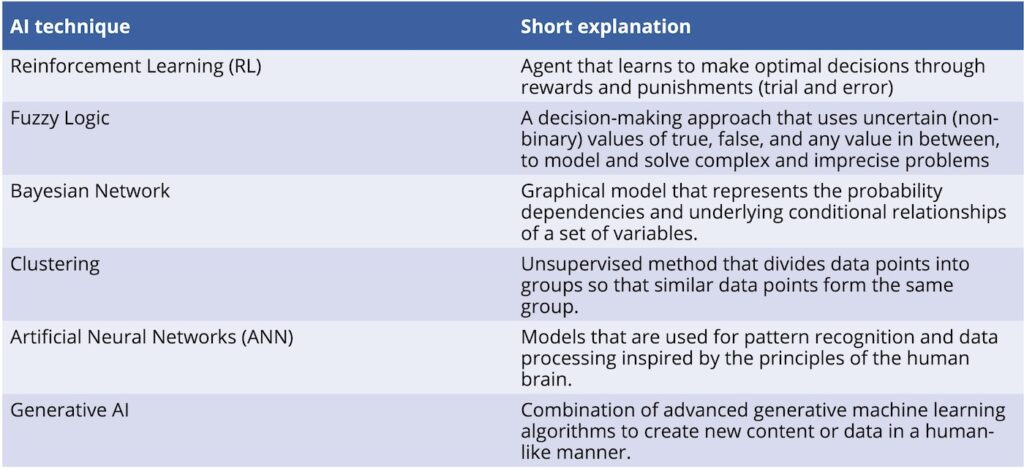
Furthermore, it can also be used to determine whether the AI of an AITS can be classified as weak or strong [29]. Figure 4 summarizes the most common AI techniques and how they work to build AITS, based on [5]. These include reinforcement learning, fuzzy logic, Bayesian networks, clustering and artificial neural networks. Moreover, these techniques have been complemented by the combination of several advanced techniques under generative AI [20, 30, 31]. An AITS can be built using one AI technique or can combine several techniques, depending on the desired complexity of the tasks.
Categorization
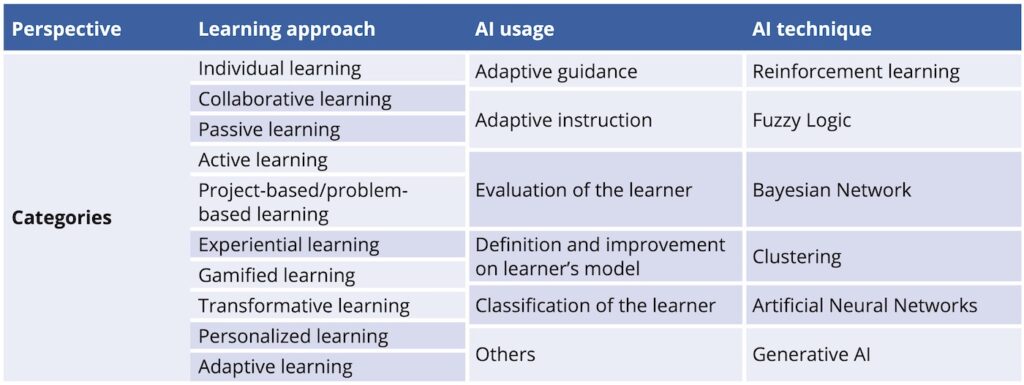
AITS can be viewed from different perspectives: the learning approach, the usage of AI and the technique of AI. Combining these three perspectives from Figures 2‒4, a taxonomy (Figure 5) can be established. This taxonomy allows AITS to be categorized from these perspectives. When applying the taxonomy, each AITS can be examined from each perspective, with each AITS addressing one or more categories for each perspective.
Conclusion and future research
The categorization can help to understand how an embedded AITS works or how it should be designed. In addition, it can be better understood how AITS can be more effectively integrated into other cross-sectional technologies of Industry 4.0, such as augmented reality, virtual reality, Internet of Things, assistance systems, robotics, additive manufacturing, simulation, big data, CPSs, wearables, among others, from the educational perspective of Education 4.0. AITS also support more autonomous, consistent or even automated learning in such an environment [13, 14, 32].
The disruptive character of generative AI can lead to even greater effectiveness in use, as it can be used to respond even more strongly and quickly to the learner [30, 31]. For practitioners of operational transformation, this categorization will help in the selection of existing AITS, in which the categories shown can be used to evaluate the available AITS and thus allow them to be better compared with each other. Here, the perspective of learning approaches is particularly advantageous. This allows a better understanding and classification of how a learner learns with the help of AITS in the first instance.
The categorization may not yet be complete and could be expanded to include further perspectives in the future. Furthermore, the individual categories are not necessarily exhaustive, as they only represent the most common categories in the context of AITS in Industry 4.0. Additional categories could emerge in the future. Moreover, the question could arise as to how both explicit and tacit knowledge can be transferred in terms of knowledge management with a wide variety of AITS, including with the help of new types of AITS using generative AI, for example.
AITS that are based on generative AI still need to be developed and, above all, become mature enough for the market, in which the adaptivity and personalization of the systems can be used to a much greater extent. This also raises the question of how robust the underlying data constructs need to be. Lastly, the tutor perspective should be discussed in more detail, to what extent the tutor becomes replaceable and must adapt to the AITS, and how this is dealt with ideally, especially regarding gaining acceptance within organizations.
Bibliography
[1] Javaid, M.; Haleem, A.; Singh, R. P.: A study on ChatGPT for Industry 4.0: Background, potentials, challenges, and eventualities. In: Journal of Economy and Technology 1 (2023), pp. 127-143. DOI: https://doi.org/10.1016/j.ject.2023.08.001.[2] Rane, N.: ChatGPT and Similar Generative Artificial Intelligence (AI) for Smart Industry: Role, Challenges and Opportunities for Industry 4.0, Industry 5.0 and Society 5.0. In: SSRN Electronic Journal (2023). DOI: https://doi.org/10.2139/ssrn.4603234.
[3] Kohnke, L.; Moorhouse, B. L.; Zou, D.: ChatGPT for Language Teaching and Learning. RELC Journal 54 (2023) 2, pp. 537-550. DOI: https://doi.org/10.1177/00336882231162868.
[4] Wang, X.; Anwer, N.; Dai, Y.; Liu, A.: ChatGPT for design, manufacturing, and education. In: Procedia CIRP 119 (2023), pp. 7-14. DOI: https://doi.org/10.1016/j.procir.2023.04.001.
[5] AlShaikh, F.; Hewahi, N.: AI and Machine Learning Techniques in the Development of Intelligent Tutoring-System: A Review. 2021 International Conference on Innovation and Intelligence for Informatics, Computing, and Technologies (3ICT), pp. 403-410. DOI: https://doi.org/10.1109/3ICT53449.2021.9582029.
[6] Schiff, D.: Out of the laboratory and into the classroom: The future of artificial intelligence in education. In: AI & SOCIETY 36 (2021) 1, pp. 331-348. DOI: https://doi.org/10.1007/s00146-020-01033-8.
[7] Chen, L.; Chen, P.; Lin, Z.: Artificial Intelligence in Education: A Review. In: IEEE Access 8 (2020), 75264-75278. DOI: https://doi.org/10.1109/ACCESS.2020.2988510.
[8] Kim, J.; Merrill, K.; Xu, K.; Sellnow, D. D.: My Teacher Is a Machine: Understanding Students’ Perceptions of AI Teaching Assistants in Online Education. In: International Journal of Human–Computer Interaction 36 (2020) 20, pp. 1902–1911. DOI: https://doi.org/10.1080/10447318.2020.1801227.
[9] Kim, N.-Y.: A Study on the Use of Artificial Intelligence Chatbots for Improving English Grammar Skills. In: Journal of Digital Convergence 17 (2019) 8, pp. 37-46. DOI: https://doi.org/10.14400/JDC.2019.17.8.037.
[10] Li, M.; Suh, A.: Machinelike or Humanlike? A Literature Review of Anthropomorphism in AI-Enabled Technology. 2021 Hawaii International Conference on System Sciences. DOI: https://doi.org/10.24251/HICSS.2021.493.
[11] Zhang, K.; Aslan, A. B.: AI technologies for education: Recent research & future directions. In: Computers and Education: Artificial Intelligence 2 (2021), 100025. DOI: https://doi.org/10.1016/j.caeai.2021.100025.
[12] Ciolacu, M. I.; Svasta, P.: Education 4.0: AI Empowers Smart Blended Learning Process with Biofeedback. 2021 IEEE Global Engineering Education Conference (EDUCON), pp. 1443-1448. DOI: https://doi.org/10.1109/EDUCON46332.2021.9453959.
[13] Moraes, E. B.; Kipper, L. M.; Hackenhaar Kellermann, A. C.; Austria, L.; Leivas, P.; Moraes, J. A. R.; Witczak, M.: Integration of Industry 4.0 technologies with Education 4.0: Advantages for improvements in learning. In: Interactive Technology and Smart Education 20 (2023) 2, pp. 271-287. DOI: https://doi.org/10.1108/ITSE-11-2021-0201.
[14] Li, L.: Education supply chain in the era of Industry 4.0. In: Systems Research and Behavioral Science 37 (2020) 4, S. 579-592. DOI: https://doi.org/10.1002/sres.2702.
[15] Erol, S.; Jäger, A.; Hold, P.; Ott, K.; Sihn, W.: Tangible Industry 4.0: A Scenario-Based Approach to Learning for the Future of Production. In: Procedia CIRP 54 (2016), pp. 13-18. DOI: https://doi.org/10.1016/j.procir.2016.03.162.
[16] Mourtzis, D.: Development of Skills and Competences in Manufacturing Towards Education 4.0: A Teaching Factory Approach. In: Ni, J.; Majstorovic, V. D.; Djurdjanovic, D. (ed): Proceedings of 3rd International Conference on the Industry 4.0 Model for Advanced Manufacturing. Berlin 2018. DOI: https://doi.org/10.1007/978-3-319-89563-5_15.
[17] Gronau, N.; Teichmann, M.; Weber, E.: Serious Game-Based Haptic Modeling—An Application-Oriented Approach for Sequentially Developing New Business Models from Tacit Knowledge. In: Shishkov, B. (ed): Business Modeling and Software Design, Vol. 483. Basel 2023. DOI: https://doi.org/10.1007/978-3-031-36757-1_3.
[18] Gonnermann, J.; Brandenburger, B.; Vladova, G.; Gronau, N.: To What Extent Can Individualisation in Terms of Different Types of Mode Improve Learning Outcomes and Learner Satisfaction? A Pre-study. Hawaii International Conference on System Sciences 2023 (HICSS-56) (2023) 14. URL: https://aisel.aisnet.org/hicss-56/cl/teaching_and_learning_technologies/14.
[19] Hemachandran, K.; Verma, P.; Pareek, P.; Arora, N.; Rajesh Kumar, K. V.; Ahanger, T. A.; Pise, A. A.; Ratna, R.: Artificial Intelligence: A Universal Virtual Tool to Augment Tutoring in Higher Education. In: Computational Intelligence and Neuroscience (2022), pp. 1-8. DOI: https://doi.org/10.1155/2022/1410448.
[20] Mousavinasab, E.; Zarifsanaiey, N.; Niakan, R.; Kalhori, S.; Rakhshan, M.; Keikha, L.; Ghazi Saeedi, M.: Intelligent Tutoring-Systems: A systematic review of characteristics, applications, and evaluation methods. Interactive Learning Environments 29 (2021) 1, pp. 142-163. DOI: https://doi.org/10.1080/10494820.2018.1558257.
[21] Mindt, L.; Rieckmann, M.: Desarrollo de las competencias para el emprendimiento orientado a la sostenibilidad en la educación superior: Una revisión bibliográfica de los métodos de enseñanza y aprendizaje. Teoría de La Educación. In: Revista Interuniversitaria, 29 (2017) 1, pp. 129-159. DOI: https://doi.org/10.14201/teoredu291129159.
[22] Ng, D. T. K.; Lee, M.; Tan, R. J. Y.; Hu, X.; Downie, J. S.; Chu, S. K. W.: A review of AI teaching and learning from 2000 to 2020. In: Education and Information Technologies 28 (2023) 7, pp. 8445-8501. DOI: https://doi.org/10.1007/s10639-022-11491-w.
[23] Adel, A.: The Convergence of Intelligent Tutoring, Robotics, and IoT in Smart Education for the Transition from Industry 4.0 to 5.0. In: Smart Cities, 7 (2024) 1, pp. 325-369. DOI: https://doi.org/10.3390/smartcities7010014.
[24] Kapp, K. M.: The gamification of learning and instruction: Game-based methods and strategies for training and education. Pfeiffer 2012.
[25] Thomas, I.: Critical Thinking, Transformative Learning, Sustainable Education, and Problem-Based Learning in Universities. In: Journal of Transformative Education, 7 (2009) 3, pp. 245-264. DOI: https://doi.org/10.1177/1541344610385753.
[26] St-Hilaire, F.; Vu, D. D.; Frau, A.; Burns, N.; Faraji, F.; Potochny, J.; Robert, S.; Roussel, A.; Zheng, S.; Glazier, T.; Romano, J. V.; Belfer, R.; Shayan, M.; Smofsky, A.; Delarosbil, T.; Ahn, S.; Eden-Walker, S.; Sony, K.; Ching, A. O.; Kochmar, E.: A New Era: Intelligent Tutoring-Systems Will Transform Online Learning for Millions (2022) (arXiv:2203.03724). arXiv. URL: http://arxiv.org/abs/2203.03724.
[27] Palanivel, K.: Emerging Technologies to Smart Education. In: International Journal of Computer Trends and Technology 68 (2020) 2, pp. 5-16. DOI: https://doi.org/10.14445/22312803/IJCTT-V68I2P102.
[28] Zahabi, M.; Abdul Razak, A. M.: Adaptive virtual reality-based training: A systematic literature review and framework. In: Virtual Reality 24 (2020) 4, pp. 725-752. DOI: https://doi.org/10.1007/s10055-020-00434-w.
[29] Kuleshov, A.; Prokhorov, S.: Domain Dependence of Definitions Required to Standardize and Compare Performance Characteristics of Weak AI Systems. 2019 International Conference on Artificial Intelligence: Applications and Innovations (IC-AIAI), 62-623. DOI: https://doi.org/10.1109/IC-AIAI48757.2019.00020.
[30] Baidoo-Anu, D.; Ansah, L. O.: Education in the Era of Generative Artificial Intelligence (AI): Understanding the Potential Benefits of ChatGPT in Promoting Teaching and Learning (2023).
[31] Qadir, J.: Engineering Education in the Era of ChatGPT: Promise and Pitfalls of Generative AI for Education. 2023 IEEE Global Engineering Education Conference (EDUCON), pp. 1-9. DOI: https://doi.org/10.1109/EDUCON54358.2023.10125121.
[32] Mian, S. H.; Salah, B.; Ameen, W.; Moiduddin, K.; Alkhalefah, H.: Adapting Universities for Sustainability Education in Industry 4.0: Channel of Challenges and Opportunities. In: Sustainability 12 (2020) 15, 6100. DOI: https://doi.org/10.3390/su12156100.
Your downloads
Potentials: Services
You might also be interested in