Open-Source and Cost-Effective Digital Twin |
A case study with two weeks to succeed

| Journal | Industry 4.0 Science |
| Issue | Volume 41, Edition 3, Pages 62-68 |
| Open Access | https://doi.org/10.30844/I4SE.25.3.62 |
| Bibliography | Share | Cite | Download |
Abstract
Keywords
Article
Industry 4.0’s revolution in manufacturing has driven progress in technologies that blend physical and digital, including AI, IoT, and cloud computing [1]. Digital Twin (DT) technology [2] is central to this progress; it virtually replicates physical assets and processes, enabling real-time monitoring, simulation, and optimization. Despite its advantages, DT technology faces significant adoption challenges across various sectors. High implementation costs and technical and organizational issues often keep industries from reaping the full benefits of these solutions [3].
This study aims to bridge the gap between advanced technology and practical applications. It achieves this by creating an affordable, easy to implement, validated DT at Technology Readiness Level 5 (TRL 5) with open-source platforms and widely available commercial tools.
DT technology enhances real-time monitoring, predictive maintenance, and automation, benefiting Industry 4.0. Despite its widespread use in manufacturing, the automotive industry, and healthcare, the technology sees limited use in agriculture [4].
In Germany, key adoption barriers include strict data protection laws (77%), a shortage of skilled workers (64%), and financial constraints [5]. In agriculture, challenges extend to high costs, unclear return of investment, and limited technical support [6].
Despite these challenges, DTs can transform agricultural digitization by providing real-time virtual representations of assets and processes, supporting sustainable farming practices. Agriculture is a significant source of greenhouse gas emissions and energy consumption [7], but DTs enable tracking of carbon emissions, biodiversity, and soil health, promoting the adoption of more sustainable practices [8].
This study explores the design of an accessible and affordable DT in agriculture using Arduino-based IoT sensors and Microsoft tools such as Power BI. It aims to develop a functional digital twin, validated with TRL 5, within a short time frame of two weeks using open source and office suite tools. The following research questions guided this study:
- RQ1: Is it possible to build a validated TRL 5 digital twin on the short term using open-source and office suite tools?
- RQ2: How do affordable DTs facilitate real-time agricultural monitoring and predictive analysis?
- RQ3: How does this model contribute to Industry 5.0’s sustainability and human-centered goals?
A case study using Design Science Research (DSR) assesses the feasibility and impact of Technology Readiness Level 5 DT in agriculture, showing its potential to democratize advanced digital technologies and promote sustainable innovation.
Background: why digital twin?
A Digital Twin (DT) is a dynamic digital replica of a physical object, which enables real-time two-way data exchange for monitoring, control, and optimization. It integrates actual space, virtual space, and bidirectional data flow, allowing the digital system to simulate the physical system’s behavior under varying conditions [9]. Developed for aerospace, DTs have become integral to Industry 4.0, incorporating simulations, real-time analytics, and automation [10]. DTs offer the ability to prototype, virtual testing, and evaluation of new features or operational strategies without physical alterations [9].
The concept has evolved into the Digital Triplet (D3) [11], which includes human expertise and knowledge in decision-making in the DT framework, aligning with Industry 5.0’s focus on human-machine collaboration and sustainability [12]. Industry 5.0 prioritizes resilient, human-centric, and sustainable manufacturing.
DTs can significantly enhance energy efficiency and environmental responsibility [13]. Agriculture’s rising food needs, indicated by an expected global population of 9.8 billion by 2050 [14], demand innovative solutions. Smart farming, using digital twins, leads to sustainable food production and improved food security. But success hinges on dependable technology and smooth integration within current systems.
DT in smart agriculture enables precise monitoring of environmental variables, improving resource efficiency and crop yields. Yet most applications remain in prototype stages and many concepts remain theoretical [15]. Easy-to-use, reliable, and simple implementations are key to ensure adoption. The shift from Industry 4.0 to 5.0 emphasizes human-centered technologies; using familiar workplace tools can encourage adoption. Among those tools is Microsoft 365, with more than two million companies using it worldwide, and 62% of organizations relying heavily on Microsoft software [16][17].
While commercial tools offer ease of use and scalability, open-source technologies present an affordable, flexible alternative for DT development. Message Queuing Telemetry Transport (MQTT), a lightweight messaging protocol, efficiently transmits sensor data, making it ideal for environmental monitoring [18]. Arduino, an open-source hardware platform, simplifies IoT prototyping for smart agriculture with its user-friendly design.
Open-source tools offer customization and transparency, but they can be technically complex and have fragmented support. Conversely, commercial platforms such as Microsoft Azure IoT may lead to vendor lock-in because of proprietary formats, APIs, and extended licensing contracts, which raise switching costs and limit operational adaptability [19]. Self-hosted platforms offer more control over data and system behavior, avoiding subscription costs but requiring technical expertise and strong infrastructure management [20]. The decision between cloud and self-hosted platforms depends on an organization’s needs, digital maturity, and the trade-off between convenience, cost, and control.
Building a digital twin in two weeks: methodology and framework
This study employs a Design Science Research (DSR) methodology to develop and validate a scalable, low-cost DT model. DSR enhances knowledge through innovative artifacts and iterative cycles: problem identification, objective of a solution, design and development, and demonstration [21]. Design knowledge (DK) represents the relationship between problem and solution through artifacts, principles, and theories.
The Technology Readiness Levels (TRL) framework evaluates technology maturity from basic research (TRL 1) to full deployment (TRL 9) [22]. This study’s DT development falls under TRL 5, meaning validation in a real environment, integrating IoT sensors for real-time monitoring and data visualization, with a future scope in agriculture.
Case study
The case study reflects a real dilemma that companies face when implementing new technologies deciding between user-friendly commercial platforms and adaptable open-source tools. This study uses both open-source and commercial tools for flexible and user-friendly results. The study uses a testbed that simulates real-world precision farming conditions, featuring variable soil moisture, controlled temperatures, and energy monitoring. The objective was to assess the feasibility of an open-source DT for optimizing agricultural processes while ensuring sustainability and energy efficiency by integrating a system to assess the efficiency of irrigation and electrical consumption.
The study utilizes five key environmental and operational sensors:
- a temperature sensor for monitoring and assessing the climate’s effect on crops;
- a soil moisture sensor for measuring soil hydration to enable precision watering;
- a light intensity sensor for measuring sunlight exposure to analyze crop growth;
- an atmospheric pressure sensor for observing weather patterns and microclimate conditions;
- an electric current sensor for monitoring power consumption to improve energy efficiency.
The DT system architecture included four main layers: data acquisition, data transmission, data processing, and data visualization/automation. Figure 1 depicts the DT model’s architecture, data transmission workflow, and structure.

Sensors connect to Arduino MKR WiFi 1010 microcontrollers, transmitting data via MQTT in JSON format to Azure IoT Hub. Azure Stream Analytics processes the data, which is visualized through Power BI dashboards. Power Automate facilitates alerts and notifications in Microsoft Teams, ensuring anomaly detection and automated workflows. Moreover, the DT has to satisfy four key criteria: real-time visualization, forecasting, what-if scenario simulation, and notifications and/or bidirectional communication.
Implementation and findings
The study aimed to develop a TRL 5 DT within two weeks using open-source and commercial tools, prioritizing sustainability, ease of use, and human-centric design.
Experimental setup
The experiment was set up in a simulated agricultural environment within a laboratory. Two participants with different backgrounds, a computer engineer and a mechanical engineer, were considered for the development. The experiment was based on two phases.
Phase one focused primarily on hardware setup and data collection. The initial week involved setting up Arduino MKR WiFi 1010 microcontrollers and environmental sensors. To create a forecast, data was gathered every five minutes for seven days to build a historical dataset. Power BI received CSV file data to build predictive models and analyze trends. Thresholds were established for temperature, humidity, soil moisture, and energy use. Environmental conditions for the next seven days were forecast using Power BI’s Exponential Smoothing ETS time-series model.
During phase two, real-time sensor data was sent from an Arduino to Azure IoT Hub using MQTT. Incoming data was processed by Azure Stream Analytics, then sent to Power BI for visualization. What-if simulations were used to test the system’s predictive analysis of sudden environmental changes. When sensor readings surpassed predefined thresholds, Power Automate workflows sent a notification to Microsoft Teams. If an anomaly was detected, Power Automate sent a command to Azure IoT Hub, triggering a buzzer or LED to signal bidirectional communication. From the eighth day onwards, real time values were obtained within the model, which allowed for a comparison of the predicted values with the actual values of the following days.
Real-time analytics and automation in Power BI
The DT dashboard displayed real-time data, forecasting, what-if simulations, and alerts. Predictive analytics improved decision-making, with a 95% confidence interval ensuring reliable predictions. Thresholds for anomalies were established:
- Temperature: Below 5°C or above 28°C.
- Humidity: Below 10% or above 80%.
- Energy Consumption: Above 3.73 kWh.
- Soil Moisture: Below 190 (requires water) or above 260 (excess water).
Automated alerts and bidirectional communication were enabled through Power Automate, sending notifications and triggering physical responses like activating buzzers or lights. The dashboard in Figure 2 displays the real-time moisture level model and forecast at the top. In the bottom-left corner, a what-if scenario simulator sits beside the notification box. Press the trigger at the bottom right to activate notifications in Microsoft Teams via Power Automate.

Power Automate allowed real-time alerts and bidirectional communication between digital and physical systems. Automated alerts in Microsoft Teams sent notifications of critical changes, such as temperature anomalies. The system’s temperature sensors activated a buzzer and warning light, signaling a need for cooling. Power Automate used HTTP requests to communicate with Azure IoT Hub, which then communicated with an Arduino.Power Automate allowed real-time alerts and bidirectional communication between digital and physical systems. Automated alerts in Microsoft Teams sent notifications of critical changes, such as temperature anomalies. The system’s temperature sensors activated a buzzer and warning light, signaling a need for cooling. Power Automate used HTTP requests to communicate with Azure IoT Hub, which then communicated with an Arduino.
Validating real-time monitoring and automation
Controlled tests validated system functionality. Temperature sensors detected heat source changes, triggering alerts. A soil moisture validation test was performed by adding water to the soil. The system precisely measured and showed the higher moisture levels. Power Automate sent notifications successfully, averaging a response time of two seconds. This trigger was also activated when the data changes were simulated in the dashboard.
Key outcomes
The experiment successfully demonstrated that a TRL 5 Digital Twin can be developed in two weeks using open-source technologies and commercial tools, providing real-time monitoring, predictive analytics, anomaly detection, and alerting functionalities. The human-centered design ensured usability for non-experts.
However, certain limitations came to light. A subscription is necessary to access a fully functional version of Azure IoT Hub and Stream Cloud Analytics. Power Automate workflows requiring features like HTTP connection also necessitate Microsoft 365 Pro or Premium. Although they have limitations, cloud-based IoT platforms are still very practical and useful, mainly due to their user-friendliness, simple integration, scalability, and widespread familiarity.
Future research could consider exploring hybrid DT architecture that combines the strengths of self-hosted and cloud-based IoT platforms. This would allow organizations to retain data ownership and flexibility through local infrastructure, while leveraging the scalability and AI capabilities of commercial cloud services when needed. Investigating methods for secure, modular integration between platforms like Eclipse Ditto, Node-RED, and Azure IoT could address interoperability challenges and reduce vendor lock-in.
Assessing the accuracy, insights, and challenges of the model
The forecasting model’s accuracy was assessed using relative error analysis:

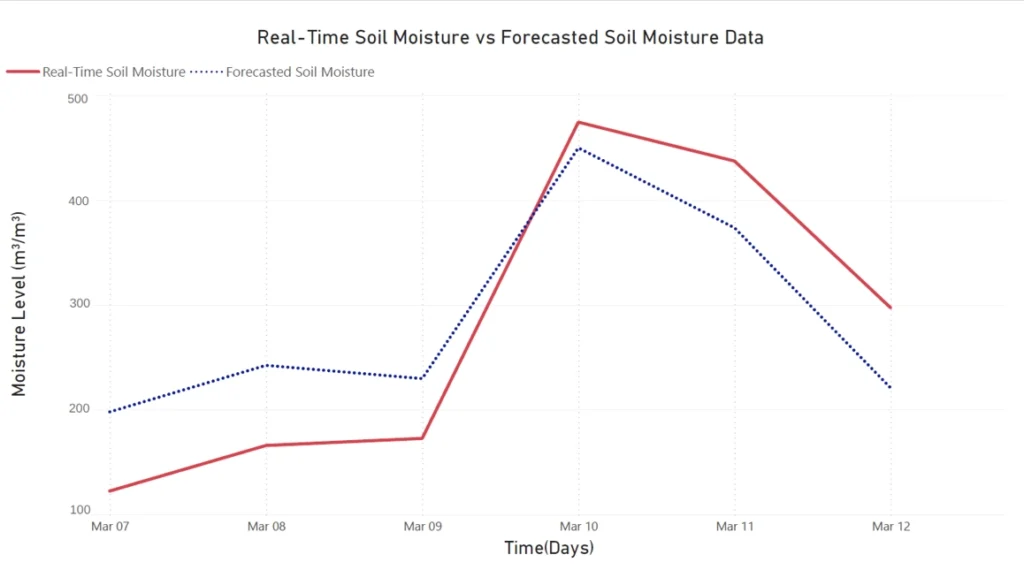
The average relative error was 7.76%, indicating moderate precision. The model followed actual data trends but had deviations that affected irrigation efficiency. The forecast line closely follows the actual data, indicating a reasonably accurate model, but enhancing accuracy could improve water usage. Whether this accuracy level is acceptable depends on the application and industry standards. Figure 3 presents a six-day time series depicting real-time and forecasted soil moisture.
Response time tests for notifications confirmed a two-second average, demonstrating the system’s effectiveness in real-time alerting. Integrating various platforms, particularly the unfamiliar Azure tool, presented some challenges. Improvements are needed in AI-driven automation, edge computing, and security. While not yet at an industrial scale, DT provides a solid foundation for further deployment.
From concept to reality: the impact of a two-week digital twin
The research addressed its questions by proving that a validated TRL 5 Digital Twin could be constructed within a short period using open-source and office suite tools (RQ1). By combining real-time monitoring, predictive analytics, and automation, the DT demonstrated its ability to support affordable real-time agricultural monitoring and predictive analysis (RQ2). Moreover, the model supports Industry 5.0 objectives by fostering sustainability and improving human-centric decision-making in smart farming (RQ3).
Although the model had a 7.76% average relative error, its predictions were reliable, and anomaly detection was achieved within two seconds. Challenges remain, especially with cloud service restrictions and automation limitations caused by subscription prerequisites. However, this DT model offers a promising, affordable, accessible, and sustainable solution for smart agriculture.
Further studies should strive to enhance the TRL through extensive testing in real operating environments and varied agricultural scenarios. Demonstrating the Digital Twin’s performance at higher readiness levels (for example, TRL 6–7) is critical for validating its robustness, reliability, and scalability for field deployment. This research can propel large-scale agricultural use, thus speeding up DT adoption on the way to achieving a two-week success rate!
Bibliography
[1] Attaran, S., Attaran, M., Celik, B. G.: Digital Twins and Industrial Internet of Things: Uncovering operational intelligence in industry 4.0. In: Decision Analytics Journal 10 (2024), p. 100398.[2] Attaran, M., Attaran, S., Celik, B. G.: The impact of digital twins on the evolution of intelligent manufacturing and Industry 4.0. In: Advances in Computational Intelligence 3 (2023) 3, p. 11.
[3] Pileggi, P., Bujari, A., Barrowclough, O., Haenisch, J., Woitsch, R.: Overcoming nine digital twin barriers for manufacturing SMEs. Change2Twin Project. 2021.
[4] Pylianidis, C., Osinga, S., Athanasiadis, I. N.: Introducing digital twins to agriculture. In: Computers and Electronics in Agriculture (2021) 184, p. 105942.
[5] Bitkom: What are the biggest obstacles in the development of digital products or services in your company? In: Statista (2023). URL: https://www.statista.com/statistics/1356352/obstacles-to-digital-development-of-companies-germany/m, accessed 04.03.2025.
[6] McKinsey & Company: Main global challenges for the adoption of agricultural technology in 2024, by region. In: Statista (2024). URL: https://www.statista.com/statistics/1549977/challenges-for-agricultural-technology-adoption-worldwide-by-region/, accessed 11.03.2025.
[7] Food and Agriculture Organization of the United Nations: World agriculture: towards 2030/2050. Interim report. Rome (2006).
[8] Fiala N.: The greenhouse hamburger. In: Sci Am (2009) 300, pp. 72–75.
[9] Grieves, M., Vickers, J.: Digital twin: Mitigating unpredictable, undesirable emergent behavior in complex systems. In: Transdisciplinary perspectives on complex systems: New findings and approaches (2017), pp. 85-113.
[10] Singh, M., Fuenmayor, E., Hinchy, E. P., Qiao, Y., Murray, N., & Devine, D.: Digital twin: Origin to future. In: Applied System Innovation 4 (2021) 2, p. 36.
[11] Umeda, Y., Hongo, Y., Goto, J., & Kondoh, S.: Digital triplet and its implementation on learning factory. In: IFAC-PapersOnLine 55 (2022) 2, pp. 1-6.
[12] Leng, J., Sha, W., Wang, B., Zheng, P., Zhuang, C., et al.: Industry 5.0: Prospect and retrospect. In: Journal of Manufacturing Systems (2022) 65, pp. 279-295.
[13] Cisneros Saldana, S., Kapoor, A., Acharya, S., & Markus, H.: Energy Efficiency Analysis in Industry 4.0 set up leveraging Industry 5.0 methods for Sustainable Manufacturing: Case Study. In: Procedia Computer Science (2025) 253, pp. 594-602.
[14] The State of Food and Agriculture 2017: Leveraging Food Systems for Inclusive Rural Transformation. 2017. URL: https://www.fao.org/3/i7658e/i7658e.pdf
[15] Monteiro, J., Barata, J., Veloso, M., Veloso, L., Nunes, J.: A scalable digital twin for vertical farming. In: Journal of Ambient Intelligence and Humanized Computing 14 (2023) 10, pp. 13981-13996.
[16] Enlyft: Number of companies using Office 365 worldwide as of February 2025, by leading country. URL:https://www.statista.com/statistics/983321/worldwide-office-365-user-numbers-by-country/, accessed 14.04.2025.
[17] Flexera Software: Types of services/software used by global organizations from leading tech vendors (Microsoft, Oracle, and IBM). URL: https://www.statista.com/statistics/1106115/types-software-used-by-companies/, accessed 14.04.2025.
[18] Al-Fuqaha, A., Guizani, M., Mohammadi, M., Aledhari, M., Ayyash, M.: Internet of things: A survey on enabling technologies, protocols, and applications. In: IEEE communications surveys & tutorials 17 (2015) 4, pp. 2347-2376.
[19] Opara-Martins, J., Sahandi, R., Tian, F.: Critical analysis of vendor lock-in and its impact on cloud computing migration: a business perspective. In: Journal of Cloud Computing 5 (2016) 1, p. 4.
[20] Minerva, R., Biru, A., Rotondi, D.: Towards a definition of the Internet of Things (IoT). In: IEEE Internet Initiative 1 (2015) 1, pp. 1-86.
[21] Peffers, K., Tuunanen, T., Rothenberger, M. A., Chatterjee, S.: A design science research methodology for information systems research. In: J Manag Inf Syst (2007) 24, pp. 45–77.
[22] Mankins, J. C.: Technology readiness levels. 1995.
Your downloads
Potentials: Energy Efficiency Profitability Resource Efficiency
Solutions: Production Control
You might also be interested in