Agility as Consequence or Prerequisite of Digitization?

JournalIndustrie 4.0 Management
Issue Volume 35, 2019, Edition 4, Pages 30-34
Open Accesshttps://doi.org/10.30844/I40M_19-4_S30-34
Bibliography Share Cite Download

Abstract

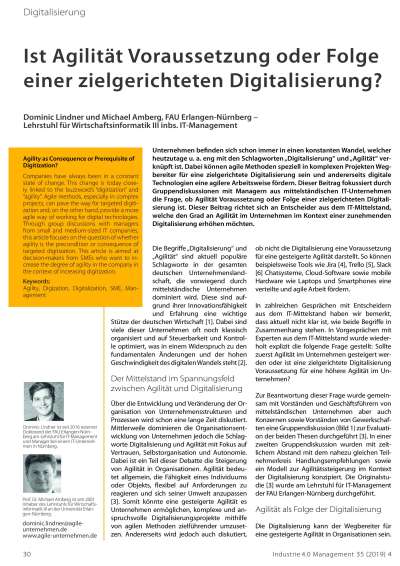
Companies have always been in a constant state of change. This change is today closely linked to the buzzword’s “digitization” and “agility”. Agile methods, especially in complex projects, can pave the way for targeted digitization and, on the other hand, provide a more agile way of working for digital technologies. Through group discussions with managers from small and medium-sized IT companies, this article focuses on the question of whether agility is the precondition or consequence of targeted digitization. This article is aimed at decision-makers from SMEs who want to increase the degree of agility in the company in the context of increasing digitization.

Keywords


Bibliography

[1] Ludwig, T. u. a.: Arbeiten im Mittelstand 4.0: KMU im Spannungsfeld des digitalen Wandels. In: HMD: Praxis der Wirtschaftsinformatik 53 (1), S. 71–86 (2016).
[2] Urbach, N.; Ahlemann, F.: Der Wissensarbeitsplatz der Zukunft: Trends, Herausforderungen und Implikationen für das strategische IT-Management. In: HMD: Praxis der Wirtschaftsinformatik 53 (1), S. 16–28 (2016).
[3] Lindner, D.; Leyh, C.: Organizations in Transformation: Agility as Consequence or Prerequisite of Digitization? In: BT: Business Information Systems. Cham (2018).
[4] URL: de.atlassian.com/software/jira, Abrufdatum 19.03.2019.
[5] URL: de.atlassian.com/software/jira, Abrufdatum 19.03.2019.
[6] URL: slack.com/intl/de-de, Abrufdatum 19.03.2019.
[7] Lindner, D.: KMU im digitalen Wandel: Ergebnisse empirischer Studien. Wiesbaden (2019).
[8] URL: agile-unternehmen.de/was-ist-scrum/, Abrufdatum 20.06.2019.
[9] URL: agile-unternehmen.de/was-ist-kanban/, Abrufdatum 20.06.2019.
[10] URL: agile-unternehmen.de/lean-startup-methode, Abrufdatum 20.06.2019.
[11] URL: agile-unternehmen.de/design-thinking-methode, Abrufdatum 20.06.2019.
[12] URL: agile-unternehmen.de/devops, Abrufdatum 20.06.2019.
[13] URL: ifm-bonn.org/defi nitionen, Abrufdatum 19.03.2019.

Your downloads


Potentials: Management

You might also be interested in

Serious Games as a Training Tool

Serious Games as a Training Tool

Game mechanics design to promote resilience
Annika Lange ORCID Icon, Thomas Knothe ORCID Icon
Unforeseen events are increasingly challenging manufacturing companies. Being resilient during crises is becoming a key competence. Serious games (SG) can help make resilience-building processes more transparent. This article derives specific requirements for SG from different phases of resilience and shows how these can be implemented in game mechanics in order to effectively support the training of resilience.
Industry 4.0 Science | Volume 42 | 2026 | Edition 2 | Pages 98-104
MAKI—A Digital Assistant for Practice-Based Learning

MAKI—A Digital Assistant for Practice-Based Learning

Why every factory is a learning factory
Olaf Resch ORCID Icon
With the help of digital assistants, academic teaching is possible in any factory. In order to achieve the best learning effects, however, the interests of all stakeholders must be taken into account. The factory wishes to deploy its employees quickly and productively, the learners desire a positive learning experience, and the educators want to illustrate abstract concepts in a meaningful and practical way. The only way to combine all of these perspectives is via a well-thought-out educational concept and highly functioning technology.
Industry 4.0 Science | Volume 42 | 2026 | Edition 2 | Pages 70-77
Serious Gaming and the Energy Transition

Serious Gaming and the Energy Transition

Collaborative knowledge generation and interactive understanding of complex interrelationships
Janine Gondolf ORCID Icon, Gert Mehlmann, Jörn Hartung, Bernd Schweinshaut, Anne Bauer
Conveying the complexity and multifaceted nature of the energy transition to a broad audience is a challenge. This article demonstrates how interactive serious games on a multitouch table can help make connections tangible and comprehensible. The games and the table were used in various conversational contexts. These are presented here in three case vignettes based on participant observation of the different applications, as well as situated and shared reflection. The vignettes demonstrate how interaction can trigger epistemic processes, enable shifts in perspective, and foster collective thinking, all of which are necessary for shaping the future of society as a whole.
Industry 4.0 Science | Volume 42 | 2026 | Edition 2 | Pages 62-69
Industrial Transformation via a Machining Learning Factory

Industrial Transformation via a Machining Learning Factory

A learning module to foster competencies for a sustainability-driven transformation
Oskay Ozen ORCID Icon, Victoria Breidling ORCID Icon, Stefan Seyfried ORCID Icon, Matthias Weigold
Sustainability-enhancing transformation processes are necessary in all sectors if we are to remain within planetary boundaries. This also applies to the industrial sector as a significant emitter of greenhouse gases. Employees need new competencies to master this complex task of industrial transformation. These range from CO2 equivalents accounting to the development and evaluation of transformation scenarios, including technical measures. The learning module developed here addresses these competency requirements and uses the example of the ETA factory to show how a competency-oriented learning module for industrial transformation can be structured. It essentially comprises four phases: data collection and CO2 equivalents accounting, cause analysis, development of measures and evaluation of measures.
Industry 4.0 Science | Volume 42 | Edition 2 | Pages 38-47 | DOI 10.30844/I4SE.26.2.38
From Brownfield to Industry 4.0

From Brownfield to Industry 4.0

Learning factories as training and testing environment for digital transformation
Jakob Weber, Sven Völker ORCID Icon
To succeed in their digital transformation, manufacturing companies need engineers with in-depth knowledge of key technologies and concepts, and a profound understanding of the transition from Industry 3.0 to Industry 4.0. This article describes the concept of a learning factory that is continuously subjected to a digital transformation, thereby creating an environment for the development of transformation competencies. The concept of digital transformation is based on digital worker assistance systems and multi-agent systems for production control. These enable the incremental integration of existing resources into the digitalized factory. The learning factory is not presented to students as a completed solution. Instead, it is continuously developed further as part of student projects. This way, it contributes directly to the qualification of personnel for the implementation of Industry 4.0.
Industry 4.0 Science | Volume 42 | 2026 | Edition 2 | Pages 88-96
AI Colleagues?

AI Colleagues?

Competence requirements and training for AI use in industry
Swetlana Franken ORCID Icon
Artificial intelligence is fundamentally changing tasks, roles, and skills in (industrial) companies. Increasingly, it acts as a colleague, preparing decisions, supporting processes, and interacting with people. This article highlights key competence requirements for AI use in industry, presents an integrated competence model, and outlines practical strategies for the transfer of skills. The aim is to prepare companies and employees for humane, competence-oriented AI implementation that combines technological efficiency with human creativity and judgment.
Industry 4.0 Science | Volume 42 | 2026 | Edition 2 | Pages 78-86