Foundation Models in Industrial Robotics |
Requirements for AI-supported assistance in production and logistics

| Journal | Industry 4.0 Science |
| Issue | Volume 42, 2026, Edition 5, Pages 16-23 |
| Open Access | 10.30844/I4SE.26.5.2 |
| Bibliography | Share | Cite | Download |
Abstract
Keywords
Article
Industrial robotics has been a key component in automating industrial production processes for decades. Its widespread adoption is due to its ability to implement highly repeatable and efficient process flows in standardized environments [1].
However, the required programming often demands considerable effort. This is particularly true for processes involving frequent product changes, small batch sizes or unstructured working environments. In such scenarios, established programming paradigms are increasingly reaching their limits. Implementation is often reserved for experienced specialists, which prolongs implementation times and limits access, particularly for smaller companies [2].
In parallel, foundation models have led to the development of AI systems that are increasingly relevant to industrial robotics. Foundation models are pre-trained on large datasets that, depending on their design, can process different modalities of information. These include, in particular, LLMs, which process textual input and are capable of interpreting natural-language instructions, structuring tasks and deriving action sequences [3].
Vision-language models (VLMs) link visual and linguistic information. They thus open up new possibilities for the context-aware processing of dynamic environmental and state information [6]. Vision-language-action models (VLAs) extend these capabilities by linking perception, linguistic description and resulting action.
These model classes are particularly relevant to robotics, as they efficiently combine planning, perception and execution [7]. However, these technological developments do not merely hold the promise of greater efficiency and flexibility. Rather, it is reasonable to assume that the wider use of such models will have a significant impact on existing work processes, individual job profiles and competence requirements [4].
Whilst the technical feasibility and application potential of foundation model-based approaches are increasingly being investigated, their implications for skilled workers remain under-researched. This article aims to derive implications for competence requirements based on developments in foundation model-based robot programming for switch cabinet assembly. On this basis, a competence framework is presented that provides a structured summary of the identified tasks and the competence requirements necessary to perform them.
A practical example of LLM-based robot programming
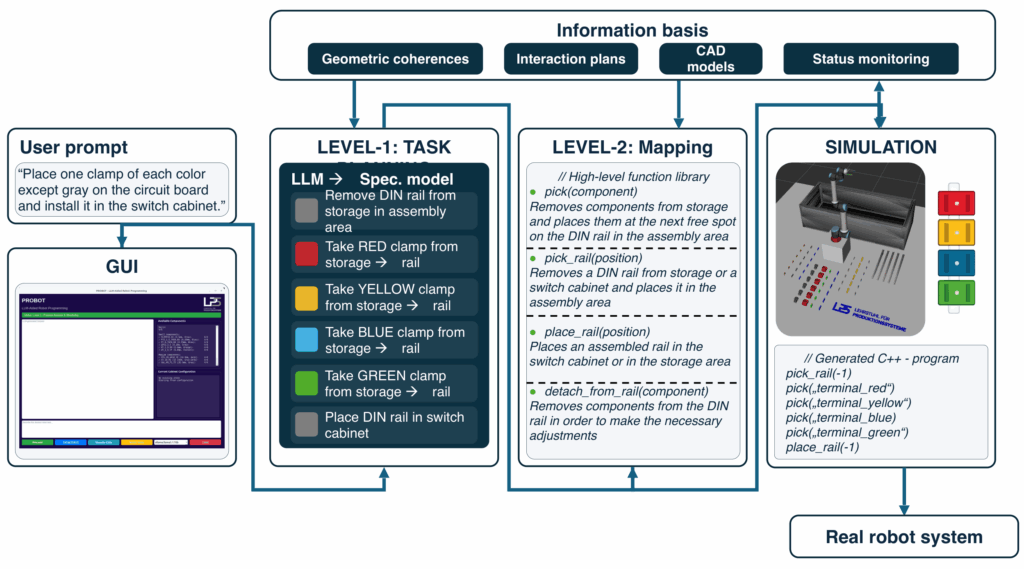
A previous article used switch cabinet assembly with modular clamps as an example of how natural-language work instructions are converted in a two-step process into structured process steps and then into executable C++ code. The technical implementation is based on an architecture consisting of an LLM layer, standardized data storage, and a simulation and execution layer [5].
A key feature of this approach is the high level of abstraction in the programming process. The model-based system does not generate low-level motion instructions but instead relies on a fixed set of predefined high-level functions. These include functions for handling modular clamps and DIN rails. Path planning, collision detection, state management, and scene updating are handled by the underlying software layers. This shifts program generation and system interaction to a semantic level, where tasks are described in the form of understandable process logic and subsequently automatically converted into technically executable programs.
An illustrative test case from this work is the installation of multiple DIN rails in a switch cabinet based on a user instruction. Figure 1 illustrates the overall process. Depending on the model used, successful program generation was achieved in up to 57 out of 60 test runs, corresponding to a success rate of 95% [5].
Methodological Approach
The changes in tasks and competence requirements described below were not derived from a separate empirical study but exploratively from the development, integration, and evaluation of the technical system described. Methodologically, this is a qualitative case study based on observations made during the implementation period.
The derivation took place in three steps:
- Recurring tasks, difficulties, and the need for intervention were documented across the three project phases.
- These observations were then classified into recurring task categories—goal formulation and prompting, result validation, data provision and integration, and model selection.
- These categories were abstracted into four overarching competence dimensions and assigned to existing organizational role profiles.
Due to the case-by-case nature of the study, the results cannot be statistically generalized and should be understood as conceptual.
Competence requirements for robot programming
During the development and testing of the solution, both the technical feasibility and the potential of a foundation model-based approach were demonstrated. Changes in job profiles and competence requirements were not the focus of the initial study but can be inferred from accompanying observations. Relevant aspects were identified particularly in the areas of goal formulation, validation, and system integration.
The starting point for all observations is the shift in the level of abstraction in the programming process. Users can program the robot system without familiarizing themselves in detail with proprietary programming languages and system-specific program structures (Fig. 2). This offers significant potential for shortening commissioning times and increasing flexibility in the programming process. At the same time, it lowers the barrier to entry for individuals without in-depth programming knowledge.
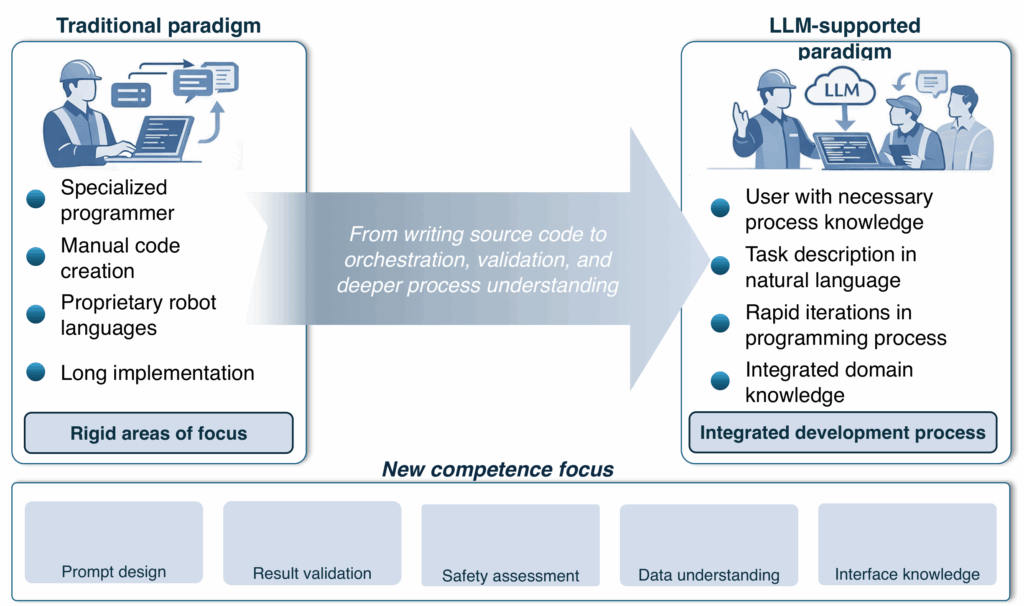
However, this shift is not accompanied by a general reduction in system complexity. Rather, requirements and workloads are redistributed within the overarching programming process. The quality of the results depends largely on the precision, structure, and contextualization of the input. Ambiguities or errors in prompts do not have merely isolated effects. Rather, they can propagate throughout the entire subsequent process and become difficult to trace after numerous processing steps.
Consequently, the design of system prompts and prompt engineering methods are gaining in importance. In particular, structured, context-rich inputs and few-shot examples can significantly improve model performance. At the same time, a single user input is often insufficient. In many cases, iterative refinement is required, in which the model is repeatedly alerted to errors and the task description is gradually refined.
Before transferring the results to real-world systems, the model-generated solutions are always manually evaluated in the simulation environment. This allows for the identification of errors in path planning, implausible process sequences, or collisions before execution on the physical system. The systematic verification of the generated programs currently accounts for a significant portion of the total effort.
Furthermore, model-generated solutions are more difficult to validate than those developed in-house. Since programming is not carried out actively, there is no step-by-step consideration of structure, design, and anomalies. The potential time savings in the overall process are thus largely negated by additional verification and correction work.
Relevant core activities were also identified in the context of system development and integration. The provision of suitable environmental and process information is crucial, since this cannot be fully captured by user prompts, particularly when there is high variant diversity. For the reliable use of foundation model-based systems, existing engineering data and dynamic perception information must therefore be integrated. This requires the availability of suitable communication interfaces, the use of compatible data standards, and the preparation of data in a processable form. As a result, not every application area is suitable for model-based robot programming.
The effective use of foundation model-based methods depends largely on whether these conditions are met and the process requirements favor model-based generation. The business value of such a solution is considered low in areas where programs can be used unchanged for long periods, for example.
Another key activity is the selection and adaptation of the models. The specific strengths, weaknesses, and specializations of the different models must be taken into account on a case-by-case basis. In some cases, fine-tuning may be necessary or at least beneficial, particularly when company- or process-specific data is available. This is precisely where potential lies for foundation model-based approaches, as the performance of the models can be significantly enhanced by incorporating domain-specific information.
Furthermore, questions arise regarding technical implementation, namely whether to use local or server-based execution and whether to use open or proprietary models. This involves fundamental decisions regarding information flows, data protection, and integrability.
Overall, the observations suggest that foundation models do not result in an unconditional reduction in workload. If systems, data sources, and verification mechanisms do not interact in a structured manner, it is more likely that the total workload will be merely shifted.
In line with this, the skills required for setting up, using, and maintaining foundation model-based robot programming are also shifting. In addition to traditional programming knowledge, skills in prompt design, result validation, safety assessment, data comprehension, and working with interfaces and integrated software landscapes are becoming particularly important. We have structured the resulting competence requirements into four overarching dimensions, which are summarized in Figure 3.
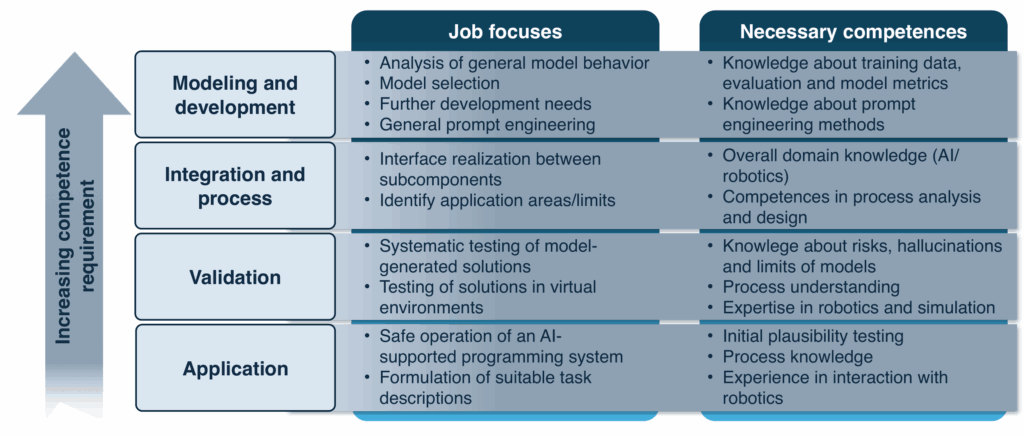
At the application level, the focus is on the use of model-based programming systems. This involves translating implicit experiential and process knowledge into explicit, structured, and model-compatible descriptions. Equally important is the ability to break down complex processes into meaningful subtasks. This builds on the existing roles of specialists in production, robot programming, and application-oriented automation. These individuals already possess the necessary understanding of the processes and of robot kinematics and behavior.
The validation level involves the systematic verification of model-generated solutions prior to their deployment in the physical world. Due to the non-deterministic and context-dependent nature of foundation models, simulation environments, digital twins, and virtual testing methods are increasingly important. The ability to detect malfunctions and validate the generated solutions through simulation is essential. These tasks may fall within the scope of robot programming, commissioning, and quality assurance roles, where simulation testing, fault diagnosis, and safety assessment expertise is already present.
The higher-level integration and process level focuses on embedding model-based programming approaches into existing technical and organizational structures. The central task is to design interfaces between system components and identify areas of application in production and automation processes. This includes connecting data sources, control systems, engineering tools, simulation environments, and user interfaces so that foundation models can be utilized efficiently. At the same time, it requires close coordination with operational domains like production planning, IT, and quality assurance. This level is well-suited to automation and digital engineering professionals, who work at the intersection of technical system integration, process planning, and software integration.
Finally, at the modeling and development level, the focus is on understanding, selecting, adapting, and further developing the models. The central task is to select application-specific models and identify optimization opportunities. This requires expertise in machine learning, data preparation and provision, and the integration of external knowledge sources, e.g. via retrieval-augmented generation (RAG). These tasks correspond to the competence profiles of data scientists and AI specialists. In an industrial context, however, they must be supplemented by an understanding of robotic programming logic, motion sequences, and safety-related constraints.
Overall, the competence requirements described here should be understood less as an indication of entirely new job profiles and more as further developments of existing role profiles. Production and robot programming specialists will likely be more involved in the operational use of model-based systems in the future. Also commissioning and quality assurance are expected to shift toward digital validation. Automation engineers are key players in the technical and organizational integration of such approaches, whereas data scientists and AI specialists perform foundational work at the modeling and development levels.
The proposed framework differs from a large number of existing models in one key respect. Established AI competence models such as AICOMP are typically generic and education-oriented [8]. They describe general skills in work with AI without being tailored to a specific industry or field of activity. This paper operationalizes these general competences for the specific use case of foundation model-based industrial robot programming.
Changing competence requirements due to foundation models
The example presented here suggests that foundation models not only technically expand industrial robot programming but also shift the focus of programming work. As the focus shifts from low-level programming to semantic task description, model-based generation, and simulation-based validation, the required professional skills also change. The competence framework presented here structures these along the dimensions of application, validation, integration, process design, model understanding, and further development.
The insights also led to the hypothesis that using foundation models makes the robot programming process more efficient and accessible only if suitable high-level function libraries, structured engineering data, and simulation-based testing methods are available. If these or comparable peripheral components are missing, the workload simply shifts toward testing, verification, fault diagnosis, and data preparation.
The extent to which the described changes result in operational process change remains unclear. Reliable estimates require extensive empirical studies. Future research should therefore focus on examining changes in work processes, job profiles, and qualification requirements in industrial applications.
Bibliography
[1] Palčič, I.; Prester, J.: Effect of Usage of Industrial Robots on Quality, Labor Productivity, Exports and Environment. In: Sustainability 16 (2024), p. 8098. DOI: https://doi.org/10.3390/su16188098.[2] Pan, Z.; Polden, J. et al.: Recent progress on programming methods for industrial robots. In: Robotics and Computer-Integrated Manufacturing 28 (2012) 2, pp. 87-94. ISSN 0736-5845, DOI: https://doi.org/10.1016/j.rcim.2011.08.004.
[3] Firoozi, R.; Tucker, J. et al.: Foundation Models in Robotics: Applications, Challenges, and the Future. In: The International Journal of Robotics Research 44 (2025) 5, pp. 701-739. DOI: https://doi.org/10.1177/02783649241281508.
[4] Bachlechner, D.; Lächler, F. et al.: Foundation Models in Production and Logistics. Whitepaper 2025. DOI: 10.13140/RG.2.2.28055.07847.
[5] Syniawa D.; Droste L. et al.: Semi-Automated Programming of Industrial Robotic Systems Using Large Language Models and Standardized Data Model. In: MDPI Robotics (2026).
[6] Kim, S.; Yoon, J.: VLM-integrated 3D perception model for robust robotic grasping adapted to deformable sacks with arbitrary shapes. In: Robotics and Autonomous Systems 199 (2026) 105372. ISSN 0921-8890, DOI: https://doi.org/10.1016/j.robot.2026.105372.
[7] Brohan, A.; Brown, N. et al.: RT-2: Vision-Language-Action Models
Transfer Web Knowledge to Robotic Control. 2023, Google DeepMind, URL: https://robotics-transformer2.github.io
[8] Ehlers, U..; Lindner, M. et al.: Future Skills in a World Increasingly Shaped By AI. Ubiquity Proceedings 2023, DOI: https://doi.org/10.5334/uproc.91.
Your downloads
You might also be interested in