Digital Factory Planning for Startups |
A simulation-based production structure design

| Journal | Industry 4.0 Science |
| Issue | Volume 42, 2026, Edition 3, Pages 68-75 |
| Bibliography | Share | Cite | Download |
Abstract
Keywords
Article
Startups face unique challenges in factory planning. Unlike established companies, they tend to lack historical planning and process data, making it difficult to accurately determine capacity requirements. Furthermore, sales forecasts in young, dynamic markets are highly volatile, meaning that factory planning decisions must be made under conditions of high uncertainty. At the same time, startups usually operate with limited planning resources, facing barriers such as high acquisition costs for specialized software and insufficient know-how. Given the strong pressure to reduce time-to-market, planning errors in the physical environment can threaten the very existence of young companies.
Factory planning is a multi-stage process aimed at optimal design of industrial production systems as a whole. According to VDI Guideline 5200, the term factory planning refers to a methodically structured and goal-oriented process in which a factory is designed from the initial concept through to commissioning using appropriate tools and methods. A factory is defined as a location where value is created through the division of labor in the production of industrial goods, while incorporating various production factors. [1]
Digital factory planning also enables holistic and forward-looking planning of production systems and factories using digital tools. With the support of computer-aided tools, factory layouts, material flows, and production processes can be modeled and tested in a virtual environment. According to the literature, the essential tools and methods of digital factory planning can be divided into three categories.
The first category comprises basic support software such as Office programs, project management software, groupware systems and knowledge management solutions. These tools primarily provide organizational support for factory planning projects but offer a comparatively low degree of technical integration.
The second category includes specialized planning and simulation tools for layout planning, material flow simulation, ergonomics simulation, and robot simulation.
The third category consists of production-oriented development tools, such as Computer-Aided Manufacturing (CAM), Computer-Aided Quality Assurance (CAQ), Computer-Aided Planning (CAP), Computer-Aided Design (CAD), and the Finite Element Method (FEM). These tools belong to the field of product development and play only a minor role in this article, as digital factory planning for startups focuses primarily on the development of suitable material flow concepts and layout planning. [2]
Due to their data-driven nature, these digital tools are becoming increasingly relevant across a wide range of application areas. Unlike established companies, startups are often confronted with the initial planning of production structures, which may serve as a blueprint for future production sites.
In building and equipment planning, which is responsible for designing the structural layout of a production site, CAD models and 3D layout software can be used to visualize floor plans, spatial concepts, and machine layouts at an early stage. This allows layouts to be modified and evaluated before implementation in order to identify the most suitable alternative. A particular advantage of digital tools lies in the early integration of functional relationships. For example, material flows, production processes, and logistics concepts can be analyzed in terms of their interactions by linking simulation data.
Production planning aims to design production processes regarding quantity, schedule, and capacity aspects and ideally ensures a smooth production flow while efficiently utilizing the required production factors—time, personnel, machinery, and materials—on a long-term basis. By creating a digital factory model, production processes can be virtually represented within it. By simulating manufacturing processes, various production scenarios can be analyzed in terms of lead times, capacity utilization, and potential bottlenecks. In addition, the effects of machine failures and different shift models on production flow can be realistically represented within the simulation.
As part of digital factory planning, logistics planning is also supported by advanced digital tools that enable the holistic modeling and analysis of logistics processes . Of particular importance is the use of material flow simulations, which allow the realistic representation and optimization of internal transport routes, storage strategies, transfer points, and buffer zones.
Digital models allow for the comparison of different transport concepts, thereby enabling the early identification of potential bottlenecks, inefficient routing, and oversized buffers. [3] Digital factory planning aims to support planning and decision-making processes in the development of production facilities through digital methods and tools. The focus lies on a holistic and software-based view of factory structures, which offers advantages over traditional factory planning approaches and improves planning quality. By modeling various scenarios at an early stage, production potential can be identified sooner, errors avoided, and investments secured. [4]
This paper addresses the development of a methodological approach to digital factory planning in which VR simulation is applied to the layout planning of a factory hall for a young company in the solar industry. To achieve this, best-practice use cases from the international literature were first examined, and a generalized model was subsequently developed that can be specifically adapted for startups. The study is guided by the following research questions:
- How can digital factory planning contribute to the development and optimization of production processes in startups?
- To what extent can simulation software help identify critical bottlenecks or layout problems in the planned production system at an early stage?
- What advantages do startups gain from using simulations in digital factory planning compared to traditional planning methods?
Development of Digital Models for Startups
Best practices from international literature
As a basis for developing a methodological concept for implementing digital factory planning, international literature was first reviewed to identify existing case studies illustrating how young companies have successfully utilized digital tools and methods. The selected case studies are intended not only to illustrate the current state of implementation in real-world companies, but also to serve as inspiration for application within the present case study. In this way, practical insights regarding success factors, obstacles, and possible parallels to one’s own planning project can be derived.
Yildiz et al. propose a Digital Twin-based Virtual Factory model in which strategic management is supported through the use of virtual reality. One of the key advantages identified is the early visualization of the effects of design decisions across the entire value chain. This enables different departments to contribute more effectively to the design and optimization of production processes throughout the value chain [5].
Banduka et al. address facility layout problems, which are of great importance in manufacturing companies, as material costs account for 30–75% of product costs and 20–50% of total operating costs. Consequently, costs can be significantly reduced through effective material handling management and optimized factory layouts. Banduka et al. divide their factory planning approach into three phases:
The conceptual phase, in which a material flow-optimized factory layout is created using Schmigalla’s triangle method. This is followed by the transformation phase, during which the Schmigalla layout is transferred into simulation software to create a two- and three-dimensional digital model. In the optimization phase, the virtual layout can be optimized manually or automatically based on material flow intensity and transport distances [6].
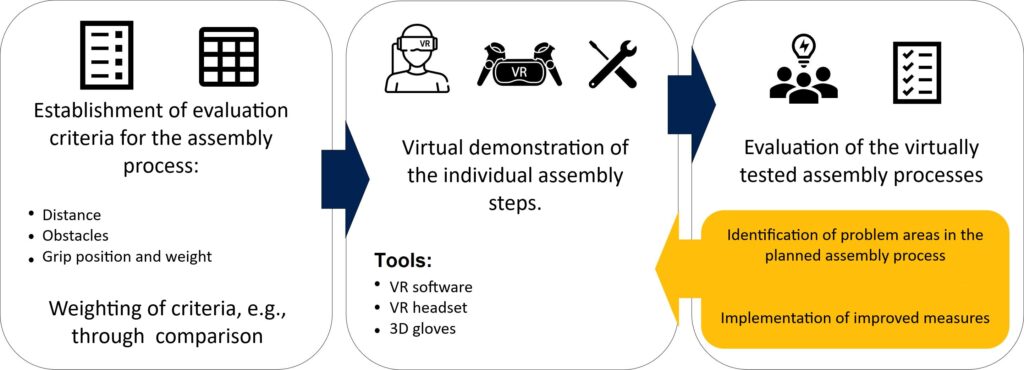
Another article by Winkes and Aurich describes a method for improving assembly planning processes through the systematic integration of VR. Errors occurring during assembly planning are often not detected until after implementation. Since modifications can become costly, digital tools such as VR are intended to support the early identification of planning errors before implementation takes place.
The core element of the proposed approach is a structured VR workshop. During this three-stage workshop, the planned assembly process is tested, evaluated, and optimized. In the first stage, evaluation criteria for the assembly process are defined and weighted using pairwise comparison methods. In the second stage, the assembly tasks are carried out within a virtual environment using VR hardware and software. Finally, the virtually executed assembly processes are evaluated, and improvement measures are derived and implemented based on the findings [7].
Flowchart of the digital factory planning process
Based on the traditional factory planning approach according to Grundig, the methodology was adapted for a young company in the solar industry and expanded through the use of digital tools. [8] The planning process can be divided into three areas and six planning phases. The applied digital factory planning process based on Grundig is shown in Figure 1.
The planning fundamentals phase includes target planning and preliminary planning. During target planning, the overarching requirements and framework conditions for the future factory are defined. These include short-, medium-, and long-term goals in the form of economic indicators, qualitative requirements, and future production volumes. Building upon these objectives, preliminary planning involves conducting potential analyses and demand assessments in order to develop an initial production program.
In the present case study, target planning and preliminary planning had already been completed by the startup, and the resulting data served as the basis for the subsequent planning phases.
The field of factory layout planning encompasses both preliminary and detailed planning, in which digital tools are used extensively. For this purpose, the two-part simulation software of the ema Software Suite (ema SWS) was employed, consisting of ema Plant Designer and ema Work Designer. In ema Plant Designer, factory and material flow planning were carried out primarily using tabular and graphical methods. ema Work Designer facilitated a more detailed workstation and process design through its 3D visualization capabilities.
The result of the rough planning was an ideal layout for the startup’s production facility. This layout was subsequently transformed into a realistic factory layout through manual adjustments and adaptation to specific constraints. The subsequent detailed planning focused on the precise design of the factory, including the precise arrangement of machines, workstations, and storage areas, as well as the design of material flows, means of transport, and supply infrastructure.
The final part of the planning process is project implementation. The implementation planning phase encompasses all preparatory activities required for the organizational, technical, and structural realization of the planning object, thereby ensuring the functional, timely, and smooth execution of the project solution. Project implementation is subsequently carried out by the participating startup and is guided by insights from the factory structure planning.
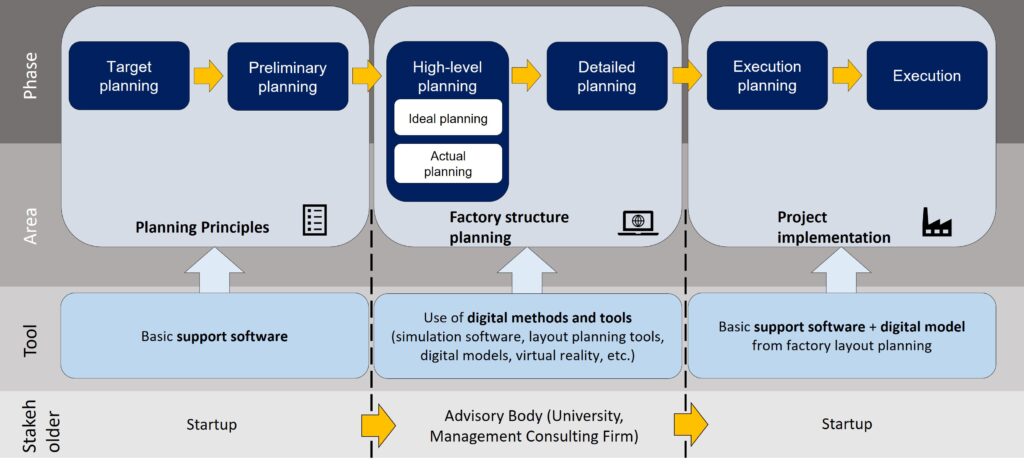
A distinctive feature of this approach is the collaboration between the startup and a university acting as an advisory body. This cooperative approach directly addresses key barriers faced by startups. The university provides the necessary infrastructure and expertise, thereby eliminating high licensing costs and complex training requirements for the young company. In this way, the frequently discussed imbalance between the costs and benefits of digital tools for small businesses can be mitigated. Furthermore, the collaboration enables mutual knowledge transfer, allowing the startup to benefit from experiences and lessons learned from previous research and industrial projects.
Integration of Immersive Technologies into the Factory Planning Process
A central component of the digital factory planning approach is the integration of immersive technologies into the process. The digitally created factory layout and process flows were visualized using virtual reality. . For this purpose, the VR application integrated into the ema Software Suite was utilized. As the hardware component, Meta Quest VR headsets were used.
The integration of VR into factory planning offers two key methodological benefits. On the one hand, the technology can be actively incorporated into the planning process (Fig. 2); on the other hand, it serves as an effective tool for communicating planning results to project stakeholders.
Within the iterative planning process, VR visualization enables users to virtually walk through the digital factory model during the early planning stages. The immersive environment allows planners and stakeholders to experience the future production environment in a highly realistic manner. As a result, distances, visibility conditions, movement spaces, and spatial constraints at individual workstations can be directly verified and adjusted where necessary.
Additional value is created through the use of VR for result communication and stakeholder presentations. As part of the iterative feedback process, the factory layouts developed within the simulation environment can be presented through virtual walkthroughs. This enables assemblers, operators, and management personnel within the startup to gain realistic insights into the future production facility and to provide early feedback on the planned production environment.
Insights from simulation-based planning
Building upon the scientific findings, the developed digital factory planning approach was implemented as a pilot project at a startup. For the startup , a robust factory layout was developed and made digitally navigable. Additionally, a specific material flow and logistics concept was developed, with selected process steps simulated as motion sequences. Beyond qualitative insights, ema Plant Designer also enabled a quantitative analysis regarding batch sizes, projected sales figures, and lead times. This further allowed for an economic evaluation in which labor costs, capital expenditures, and operating costs were analyzed. The unique feature of digital planning is that bottlenecks and planning errors can be identified and eliminated before the factory is built.
Strategic Importance of Digital Models for Sustainability Goals
This article has shown that digital factory planning can be a key tool for young companies to design production processes in a structured and efficient manner. With the aid of simulation, material flows, layout variants, and logistics concepts could be evaluated and improved before implementation. This reduced the risk of planning errors and provided a solid basis for decision-making regarding investments, space planning, and staffing requirements. Digital factory planning therefore contributes to the systematic, transparent, and flexible organization of production structures.
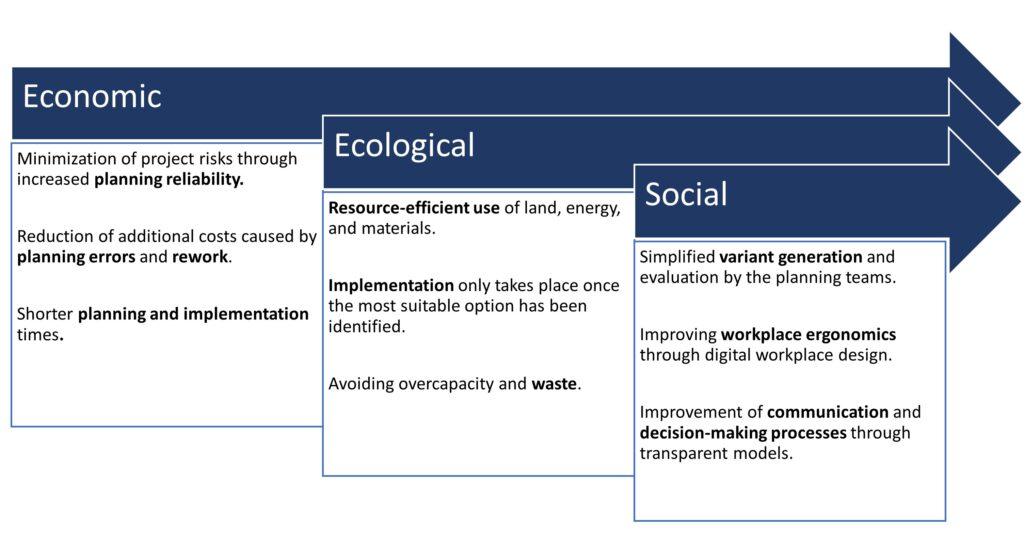
The contribution of digital models to a corporate sustainability goals can be broadly divided into three dimensions, as illustrated in Figure 3: economic, environmental, and social dimensions.
From an economic perspective, digital approaches improve planning certainty and thereby minimize project risks. At the same time, digital methods can shorten planning and implementation times, enabling faster realization of factory projects and an accelerated time-to-market. [9]
Digital factory planning also provides environmental benefits by enabling the resource-efficient use of space, energy, and materials through the virtual evaluation of layout and process alternatives. Consequently, the physical factory is only implemented once the most suitable solution has been identified, thereby conserving resources. In addition, digital planning helps prevent overcapacity, idle times, and material waste [10].
The social benefits of digital factory planning primarily relate to the improved integration of employees into the planning process. Because interim planning results can be generated and visualized quickly, feedback from internal stakeholders can already be incorporated during the early planning stages. Digital models enable transparent variant development and facilitate informed decision-making among all stakeholders involved. Furthermore, digital workplace design contributes to improved ergonomics through the use of ergonomic simulations and immersive technologies such as virtual reality [11].
By combining these economic, environmental, and social dimensions, digital factory planning can be characterized as a sustainable planning approach.
Overcoming hurdles: An approach for young companies
The literature shows that many small and medium-sized enterprises as well as startups are not yet actively utilizing the digital opportunities available. The main reasons cited for this are high software license costs, lack of expertise in using digital tools, and a perceived mismatch between effort and benefit. [12]
Unlike established companies, which can draw on historical planning data, standardized processes, and specialized departments, startups typically operate in a dynamic environment. Key obstacles include the lack of benchmarks, tight time-to-market requirements, and limited financial resources to absorb costly planning errors.
The proposed collaboration model addresses these challenges by enabling startups without dedicated planning departments to achieve a level of professionalism in factory planning comparable to that of established companies. Through cooperation with academic institutions, startups gain access to technical infrastructure, specialized expertise, and practical experience from previous projects. In addition, the early identification of planning errors helps safeguard investments while simultaneously reducing time-to-market through accelerated planning processes.
The approach described thus overcomes the key barriers identified and thereby contributes to the competitiveness of young companies.
Bibliography
[1] Verband Deutscher Ingenieure: VDI 5200 Blatt 1 – Fabrikplanung: Planungsvorgehen.[2] Bracht, U.; Geckler, D.; Wenzel, S.: Digitale Fabrik. Berlin, Heidelberg 2018.
[3] Burggräf, P.; Schuh, G. (Hrsg.): Fabrikplanung: Handbuch Produktion und Management 4. Berlin, Heidelberg 2021.
[4] Kruse, C.; Duisberg, M.; Burgert, F.; Kranz, M.; Latos, B.; et al.: Digitale Unterstützung für eine partizipative und simulationsbasierte Montageplanung in kleinen und mittleren Unternehmen. In: Nitsch, V.; Brandl, C.; Häußling, R.; Roth, P.; Gries, T.; Schmenk, B. (Hrsg.): Digitalisierung der Arbeitswelt im Mittelstand 2 – Ergebnisse und Best Practice des BMBF-Forschungsschwerpunkts „Zukunft der Arbeit: Mittelstand – innovativ und sozial“. Berlin, Heidelberg 2022, S. –70.
[5] Yildiz, E.; Moller, C.; Bilberg, A.: Demonstration and Evaluation of a Digital Twin-Based Virtual Factory. In: International Journal of Advanced Manufacturing Technology 114 (2021) 1–2, S. 185–203.
[6] Banduka, N.; Mladineo, M.; Eric, M.: Designing a layout using Schmigalla method combined with software tool Vistable. In: International Journal of Simulation Modelling 16 (2017) 3, S. 375–385.
[7] Winkes, P.; Aurich, J.: Method for an Enhanced Assembly Planning Process with Systematic Virtual Reality Inclusion. Präsentiert auf: CIRPE 2015 – Understanding the Life Cycle Implications of Manufacturing, University of Kaiserslautern 2015, Erkoyuncu, J. (Hrsg.), S. 152–157.
[8] Grundig, C.-G.: Fabrikplanung: Planungssystematik, Methoden, Anwendungen. 6., neu bearbeitete Auflage. München 2018.
[9] Burggräf, P.; Schuh, G. (Hrsg.): Fabrikplanung: Handbuch Produktion und Management 4. Berlin, Heidelberg 2021.
[10] Bracht, U.; Geckler, D.; Wenzel, S.: Digitale Fabrik. Berlin, Heidelberg 2018.
[11] Adler, S.; Masik, S.: Der digitale Zwilling für virtuelle Fabrikplanung und -betrieb.
In: Orsolits, H.; Lackner, M. (Hrsg.): Virtual Reality und Augmented Reality in der Digitalen Produktion. Wiesbaden 2020, S. 191–215.
[12] Goerzig, D.; Lucke, D.; Lenz, J.; Denner, et al.: Engineering Environment for Production System Planning in Small and Medium Enterprises. Präsentiert auf: 9th CIRP Conference on Intelligent Computation in Manufacturing Engineering – CIRP ICME ’14, University of Stuttgart 2015, Teti (Hrsg.), S. 111–114.
You might also be interested in