Autor: Ralf Elbert

Electric Trucks in Intermodal Terminal Pre- and Post-Carriage

Electric Trucks in Intermodal Terminal Pre- and Post-Carriage

Impact on terminal processes in combined road-rail freight transport
Ralf Elbert, Samira Ghaneian Sebdani ORCID Icon
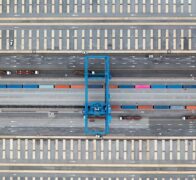
Electric trucks (e-trucks) play an important role in reducing CO₂ emissions especially on short distances in pre and post-carriage in combined road-rail freight transport (CT). Using the example of a CT terminal, this article highlights the logistical and energy challenges involved in using e-trucks to establish suitable charging infrastructures and ensuring a reliable power supply.
Industry 4.0 Science | Volume 41 | Edition 6 | Pages 70-77
Implementation of Additive Manufacturing

Implementation of Additive Manufacturing

An Analysis of Supply Chain Related Decision Factors of the Implementation Decision
Ralf Elbert, Anne Friedrich, Elisa Schuhmann
Additive manufacturing technologies, such as 3D printing, have reached a stage of performance for industrial application such as small series and spare parts. The adoption of additive manufacturing has so far mostly been investigated from the perspective of individual manufacturing firms. This paper focuses on the identification of overarching influence factors. In a category system, influence factors are analyzed from the perspectives of the supply and demand side, the supply chain actors and flows as well as sustainability, thus contributing to the adoption from a supply chain perspective.
Industrie 4.0 Management | Volume 36 | 2020 | Edition 4 | Pages 30-34
Pick-by-Vision for Manual Order Picking

Pick-by-Vision for Manual Order Picking

Requirements for Industrial Application
Ralf Elbert, Anne Friedrich, Eszter Knobloch
Smart glasses are recognized as a promising technology for supporting operational processes in the logistics sector. In particular, the application of Pick-by-Vision is capable of increasing the efficiency, quality and ergonomics of manual order picking. But first industrial pilots reveal problems concerning the implementation as well. To provide an overview a comprehensive requirement analysis is conducted and the results are presented.
Industrie 4.0 Management | Volume 33 | 2017 | Edition 6 | Pages 25-28
CEP Service Providers – Innovators of Urban Supply

CEP Service Providers - Innovators of Urban Supply

Innovationsfelder bei Kurier-, Express- und Paketdienstleistern im urbanen Kontext
Ralf Elbert, Armin Bohnhoff, Dominik Thiel, Daniel Reinhardt, Sebastian Will
Courier, express and parcel service providers (CEP service providers) have a crucial importance for the economy by handling flows of goods between businesses and private households. Challenges such as the increasing online sales, tighter delivery time requirements and growing competition along with the higher importance of environmental issues and political regulation result in an increased pressure to innovate in the CEP industry. Especially in urban areas various fields of innovation can be identified which can contribute to a more cost-efficient and environmentally friendly supply of companies and households in the city.
Industrie Management | Volume 30 | 2014 | Edition 4 | Pages 21-24
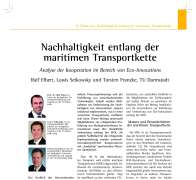
Sustainability Along Maritime Transport Chains

Sustainability Along Maritime Transport Chains

Analysis of Cooperation in Terms of Eco-Innovations
Ralf Elbert, Lowis Seikowsky, Torsten Franzke
The majority of international transport is processed via maritime transport chains, which contribute significantly to global emissions of CO2. As a result, companies attempt to reduce the pollution by optimizing processes and by introducing environmental friendly technologies. However, initiatives are rather pursued on an individual company level than in an inter-actor cooperation. This strategy is ineffective because the key for sustainable operations in a transport chain is the alignment of linking intersections. This paper examines opportunities for the successful implementation of Eco-Innovations along the maritime transport chain as well as its actual adaption. Boundary-spanning cooperation with “landside” actors has been identified as the largest lever for a successful implementation of Eco-Innovations.
Industrie Management | Volume 29 | 2013 | Edition 6 | Pages 53-56
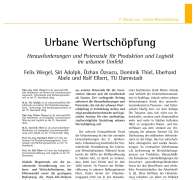
Urban Value Creation

Urban Value Creation

Challenges and potentials for production and logistics in urban areas
Felix Wiegel, Siri Adolph, Özhan Özsucu, Dominik Thiel, Eberhard Abele, Ralf Elbert
Global megatrends such as the increasing urbanization of living environments and economic areas, the climate change and the increased meaning of work-life-balance require new production and logistics concepts. An opportunity to cope with the linked challenges offers the concept of urban value creation. This kind of value creation reveals chances for the participating stakeholders when ecologically, economically and socially acceptable designed. This article addresses the challenges and potentials linked with urban value creation and shows production-related and logistical approaches to design a sustainable, city-compatible urban value creation.
Industrie Management | Volume 29 | 2013 | Edition 5 | Pages 15-18
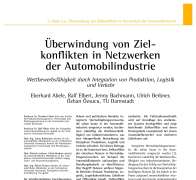
Overcoming Goals Between Stakeholders in Automotive Networks

Overcoming Goals Between Stakeholders in Automotive Networks

Wettbewerbsfähigkeit durch Integration von Produktion, Logistik und Verkehr
Eberhard Abele, Ralf Elbert, Jenny Bachmann, Ulrich Berbner, Özhan Özsucu
The concern of an interdisciplinary research project called Dynamo PLV from institutes of the TU Darmstadt and the European Business School is to combine the three topics production, logistics and traffic and merge them together. Goal of the project is to generate holistic approaches to resolve disciplinary boundaries. Integrated value adding networks which can already be located in the automotive industry will have strong effects on competitiveness of industrial locations in the future. This calls for an overlapping consideration of the systems production, logistics and traffic. Aim of this paper is to show and identify the differing interests and conflicts between the actors of a value adding network from the automotive industry. Conflicting goals between multi-layers like intra-company areas (logistics and procurement) or areas along the supply chain (supplier and OEM) or beyond the supply chain (companies and public authorities) prevent optimal resource use and reduce ...
Industrie Management | Volume 28 | 2012 | Edition 5 | Pages 29-32