
Building the Future Workforce Today |
Trendiation as a strategic framework for employee qualification and training
| Journal | Industry 4.0 Science |
| Issue | Volume 42, 2026, Edition 2, Pages 22-29 |
| Open Access | https://doi.org/10.30844/I4SE.26.2.22 |
| Bibliography | Share | Cite | Download |
Abstract
Keywords
Article
The rapid evolution of Industry 4.0 and the accelerating integration of artificial intelligence (AI) are fundamentally transforming how organizations learn, adapt, and innovate. AI influences not only automation but also cognitive work, personalization, and the design of learning experiences. In such environments, leadership increasingly involves strategic learning guidance—creating conditions for continuous learning and adaptation within complex socio-technical systems [1, 2].
Industry 4.0 intensifies skill shifts: digital literacy, socio-cognitive competence, and reflective judgment become as critical as technical expertise. The capacity to learn, unlearn, and relearn emerges as a strategic capability for individuals and organizations [3-7]. Yet many qualification systems remain compliance-driven and role-based and are organized around slow update cycles. When capability requirements shift rapidly and unevenly across functions, purely retrospective training-need assessments risk optimizing for skills of the past while underestimating emerging capability gaps.
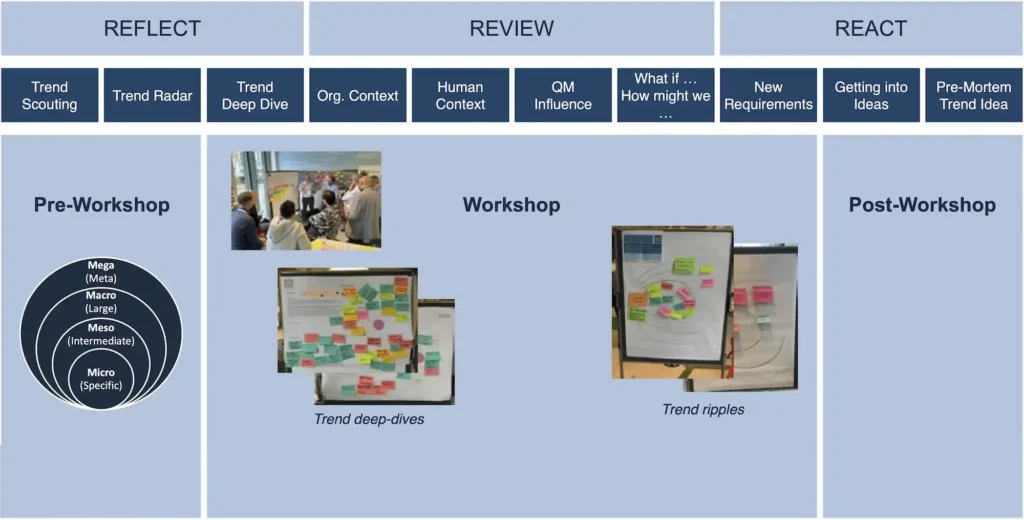
Trendiation addresses this challenge by linking analytical trend work with participatory translation into organizational practice. It integrates three phases—REFLECT, REVIEW, and REACT—to move from trend sensing to explicit, evaluable requirements for qualification and training [8]. Originally applied in strategic and quality management contexts, Trendiation is extended here to workforce development to support learning-system design under Industry 4.0 dynamics.
Aim and research questions
The aim of this paper is to examine how Trendiation can be operationalized to translate trends into actionable outputs for employee qualification and training in Industry 4.0 contexts. We address three research questions (RQ):
- RQ1: How can Trendiation be implemented in a workforce qualification and training context (i.e., which steps, methods, and artifacts support the different phases)?
- RQ2: What types of outputs does Trendiation generate when applied to trends relevant to learning and workforce development (e.g., learning requirements and systemic implications)?
- RQ3: How do participants assess the clarity and usefulness of the method and resulting outputs compared to common training-needs approaches?
Method: Research design, data, and trend sourcing
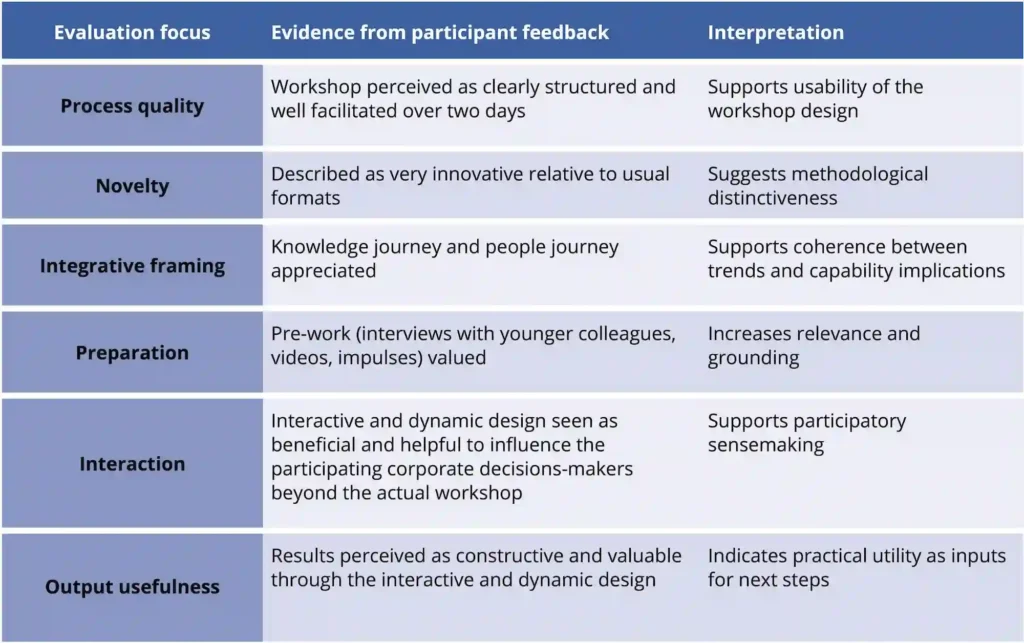
This study follows a workshop-based qualitative research design. Trendiation was deployed as a participatory intervention in one organizational setting. Data consist primarily of the documented artifact trail created before and during a two-day workshop: trend briefs, clusters, “How might we…?” questions, idea write-ups, requirement statements, assessment logs, and prioritization outputs. End-of-workshop participant feedback was collected as an embedded formative evaluation (Fig. 4).
Trends were identified through a structured horizon scan based on external trend compendia [9-11] and organized using the STAGE framework as a categorization and selection tool [12]. STAGE (Social, Technology, Adaptive competency, Governance, Environment) supported clustering and selection for competence development, with priority given to Technology and Adaptive competency trends. The curated set informed the workshop focus on Edutainment, Human-Centered Design, and Workforce Transformation.
The Trendiation method
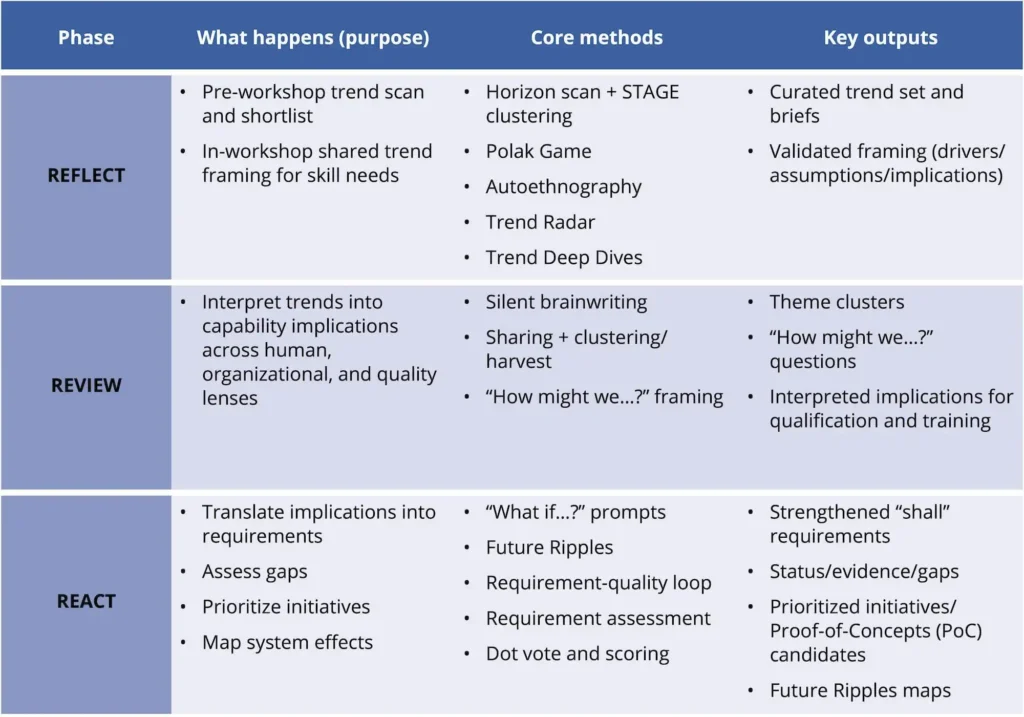
Trendiation combines systematic identification and interpretation of change signals with structured translation into future-oriented responses, addressing the recurring gap between abstract foresight and implementation [13-17]. It proceeds through three iterative phases (Fig. 2). Operationally, the workshop deployment followed a facilitation playbook specifying concrete techniques for each phase, including the Polak Game, autoethnography, Trend Radar, brainwriting and clustering, “What if…?” provocations, Future Ripples, dot voting, and portfolio scoring. The overall procedure and expected artifacts are summarized in Figure 2.
REFLECT…
…establishes a shared trend framing. The pre-workshop includes selection, clustering, prioritization, and preparation of standardized trend briefs [18, 19]. During the workshop, assumptions are surfaced through the Polak Game and complemented by structured autoethnographic reflection. Perspectives are consolidated through Trend Radar mapping and Trend Deep Dives based on the briefs. Outputs consist of a jointly validated framing of drivers, assumptions, and plausible implications for each trend.
REVIEW…
…translates shared framing into capability-relevant implications. Participants first generate inputs individually through silent brainwriting and then consolidate them via facilitated sharing, clustering, and harvesting across human, organizational, and quality lenses. “How might we…?” framing supports the articulation of structured problem statements and interpreted implications that guide translation work [20].
REACT…
…converts interpreted implications into explicit requirements and priorities. Translation begins through “What if…?” prompts and consequence mapping using Future Ripples representing three horizons. This approach is based on McKinsey’s three horizon model [21] and allows for the derivation of requirement statements across human, organizational, and quality dimensions.
Requirements were refined through a requirement-quality loop: initial statements were strengthened into outcome-oriented formulations (e.g., shifting from “must” language toward “shall” statements) and benchmarked against outcome-driven corporate requirements to clarify measurable obligations. Each requirement was then assessed during the workshop (fulfillment status, evidence, gaps), and candidate initiatives were prioritized using structured logic based on Complexity, Contribution, and Impact (Fig. 2).
Deployment on three key trends and results
Trendiation was applied to three trends relevant to learning and workforce development in Industry 4.0: Edutainment, Human-Centered Design, and Workforce Transformation. Results for each trend are reported in Figure 3, providing traceability from trend framing to requirements, assessed gaps, and prioritized initiatives.
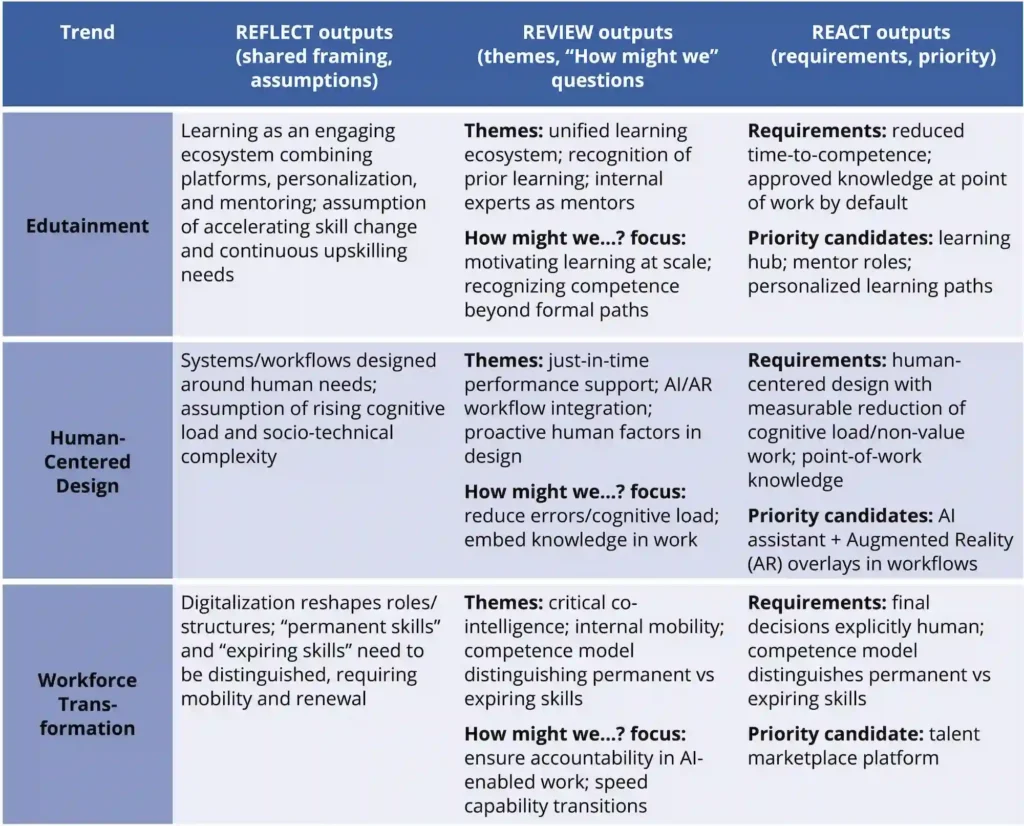
Across all trends, the workshop converged on cross-cutting requirements, emphasizing faster capability development (e.g., reduced time-to-competence), point-of-work access to approved knowledge, measurable human-centered design (reducing cognitive load and non-value work), and explicit human accountability in AI-enabled work contexts. The requirement assessments repeatedly showed that, while enabling ideas were strong, measurable obligations often required refinement through the requirement-quality loop.
Edutainment
Outputs emphasize an integrated learning ecosystem combining personalization, recognition of prior learning, and internal experts as mentors. These were translated into requirements targeting learning speed and point-of-work knowledge availability and linked to implementation candidates such as a consolidated learning hub and formalized mentoring roles.
Human-centered design
Outputs focus on embedding learning and guidance into workflows (e.g., AI- and augmented reality (AR)-supported performance support) and treating human factors as explicit design constraints in Industry 4.0 environments. Requirements were strengthened toward measurable effects (e.g., reduction of errors, effort, and cognitive load) and linked to pilotable solutions such as AI assistants trained on procedures and task-specific AR overlays.
Workforce transformation
Outputs emphasize critical co-intelligence (AI as assistant/challenger with explicit human accountability), internal mobility, and competence models distinguishing “permanent” from “expiring” skills. Requirements were refined to clarify accountability and renewal triggers, and implementation candidates included an AI-enabled talent marketplace concept for internal mobility and development-path matching. These outcomes align with the premise that learning on the job and cross-functional initiatives can be integral elements of training in learning organizations [5].
Evaluation
End-of-workshop participant feedback indicates high perceived process clarity and usefulness of the two-day format (Fig. 4). Participants described the approach as innovative and valued the pre-work activities (including interviews with younger colleagues and short videos) and the interactive, dynamic design. Outputs were perceived as a constructive foundation for follow-up qualification and training work.
Implications, discussion, and limitations
The findings suggest that Trendiation can operationalize foresight for workforce development by producing a traceable artifact chain from trend framing to strengthened requirements, assessed gaps, and prioritized initiatives. For organizations navigating Industry 4.0, the outputs support (i) competence-model and learning-architecture development through clearly defined requirements, (ii) governance clarification (gaps, boundary conditions, accountability—particularly for AI-enabled learning and decision support), and (iii) sequencing and resourcing decisions through prioritized initiatives.
Addressing the research questions: RQ1 is answered by the phase logic and artifact chain operationalized in Figure 1 and Figure 2; RQ2 by the phase-explicit outputs per trend in Figure 3; and RQ3 by the embedded formative evaluation summarized in Figure 4.
Limitations arise from single-case workshop deployment and reliance on qualitative artifacts and immediate participant feedback. Longer-term adoption and effects on training outcomes in Industry 4.0 contexts require follow-up assessment and additional cases.
This is an original article. The German translation can be accessed via DOI: 10.30844/I4SD.26.2.22
Bibliography
[1] Sterman, J. D.: Learning in and about complex systems. In: System Dynamics Review 10 (1994) 2–3, pp. 291–330.[2] Bevilacqua, S.; Masárová, J.; Perotti, F. A.; Ferraris, A.: Enhancing top managers’ leadership with artificial intelligence: Insights from a systematic literature review. Review of Managerial Science 19 (2025), pp. 2899–2935.
[3] Sharma, S.; Lenka, U.: Exploring linkages between unlearning and relearning in organizations. In: The Learning Organization: An International Journal 26 (2019) 5, pp. 500–517.
[4] Klammer, A.; Grisold, T.; Nguyen, N.; Hsu, S.: Organizational unlearning as a process: What we know, what we don’t know, what we should know. In: Management Review Quarterly 75 (2015) 3, pp. 2147–2171.
[5] Rupčić, N.: Learning-forgetting-unlearning-relearning – the learning organization’s learning dynamics. In: The Learning Organization: An International Journal 26 (2019) 5, pp. 542–548.
[6] Laloux, F.: Reinventing organizations – A guide to Creating Organizations Inspired by the Next Stage of Human Consciousness. Nelson Parker 2014.
[7] Basten, D.; Haamann, T: Approaches for Organizational Learning: A Literature Review. In: SAGE Open 8 (2018) 3.
[8] Fritz, J.; Busse, S.: Von Signalen zu Strategien mit Trendiation – Eine innovative Methodik zur Ableitung strategischer Anforderungen aus Trends. In: wt Werkstattstechnik online 115 (2025) 11/12.
[9] McKinsey & Company: Technology Trends Outlook 2025. URL: https://www.mckinsey.com/business-functions/mckinsey-digital/our-insights/the-top-trends-in-tech, accessed 14.10.2025.
[10] Roland Berger Institute: Trend Compendium 2050: Six Megatrends That Will Shape the World. URL: https://www.rolandberger.com/de/Insights/Global-Topics/Trend-Compendium/, accessed 10.09.2025.
[11] Sitra: Megatrends 2023: Five Trends Reshaping Our Future. URL: https://www.sitra.fi/en/publication/megatrends-2023/, accessed 12.09.2025.
[12] Fritz, J.; Dieckmann, I.: Erfolgsfaktor Trends: Strategisch reagieren und langfristig profitieren – Qualitätsmanagement als Schlüssel für Innovation. In: VDI-Z Integrierte Produktion 166 (2025) 1–2, pp. 70–74.
[13] Voros, J.: A generic foresight process framework. In: Foresight 5 (2003) 3, S. 10–21.
[14] Horton, A.: A simple guide to successful foresight. In: Foresight: The Journal of Futures Studies, Strategic Thinking and Policy 1 (1999) 1, pp. 5–9.
[15] Slaughter, R. A.: Probing beneath the surface: futures studies and the social sciences. In: Futures 21 (1989) 4, pp. 447-456.
[16] Mintzberg, H.: The Rise and Fall of Strategic Planning. In: Harvard Business Review 1-2 (1994).
[17] Puglisi, M.: The study of the futures: an overview of futures studies methodologies. In: Camarda, D.; Grassini, L. (eds.): Interdependency between agriculture and urbanization: Conflicts on sustainable use of soil and water, Options Méditerranéennes: Série A. Séminaires Méditerranéens. CIHEAM, 2001, pp. 439–463.
[18] Curry, A.; Hodgson, A.: Seeing in Multiple Horizons: Connecting Futures to Strategy. In: Journal of Futures Studies 17 (2012) 1, pp. 1–20.
[19] Groß, B.; Mandir, E.: Zukünfte gestalten: Spekulation, Kritik, Innovation. Mainz 2023.
[20] Interaction Design Foundation: What is How Might We? (HMW). URL: https://www.interaction-design.org/literature/topics/how-might-we, accessed 20.10.2025.
[21] Baghai, M.; Coley, S.; White, D.; Coley, S.: The Alchemy of Growth: Practical Insights for Building the Enduring Enterprise. Basic Books 2000.
Your downloads
Potentials: Management Training
You might also be interested in