Digital Twins for Production |
RAPIDZ — Resource analysis and process integration through digital twins

| Journal | Industry 4.0 Science |
| Issue | Volume 41, Edition 3, Pages 6-12 |
| Open Access | https://doi.org/10.30844/I4SE.25.3.6 |
| Bibliography | Share | Cite | Download |
Abstract
Keywords
Article
The current era of smart manufacturing is characterized by comprehensive digitalization and the integration of intelligent technologies into production operations, condition monitoring, and process control. In this context, digital twins (DTs) are gradually assuming a central role. They are mathematical models that virtually represent physical production systems and are continuously fed with real-time data from sensors and IoT devices. DTs enable transparency and in-depth analysis of system statuses, productivity, energy consumption, emissions, and overall equipment effectiveness (OEE) [1].
By continuously monitoring and simulating production processes, DTs offer valuable predictions of the impact of production decisions on throughput, product quality, energy and resource utilization, as well as downtimes and maintenance intervals. The integration of DTs into the production environment and the resulting data-driven process control and decision-making help identify inefficiencies and implement targeted improvement measures [2,3]. In times of increasing environmental awareness and stricter emissions regulations, DTs play a central role in collecting and analyzing energy data and emission trends [4]. When consistently implemented and utilized, DTs can provide direct, measurable value to companies.
Despite the diverse possibilities of DTs and their status as a central pillar of modern process optimization, they are still awaiting broad adoption. This is due to the difficulty in estimating the basic cost of creating a suitable twin of one’s own production [5] and the differing understanding and conflicting requirements from production management, energy and sustainability management or the maintenance department [6].
This is where the modeling framework “RAPIDZ – Resource Analysis and Process Integration through Digital Twins”, presented below, comes into play. This tool was developed at the Fraunhofer Institute for Industrial Mathematics ITWM based on the requirements and wishes of various partners across the manufacturing industry. Focusing on simple implementation and a modular structure, the aim was to overcome the aforementioned obstacles of DTs in the manufacturing industry.
Aiming for overall system effectiveness and resource optimization
The creation of a DT of production lines and auxiliary systems includes the mapping of all relevant physical and operational properties in the manufacturing process. This approach allows the simulation, analysis and optimization of processes before changes are implemented in the real world and is used in various use cases:
Real-time monitoring: The digital twin collects real-time data from machines and production lines. This information helps to monitor availability and identify potential problems at an early stage.
Forecasting: By simulating different scenarios, companies can identify potential bottlenecks and predict the impact of changes in production, improving decision-making and planning.
Optimizing performance: Using data analysis algorithms, RAPIDZ can optimize the performance of production lines. It helps to determine the ideal production speed, adjust processes and plan maintenance to increase overall equipment effectiveness.
Quality assurance: DTs enable continuous quality monitoring. By analyzing production data, companies can identify deviations at an early stage and adapt to improve product quality.
Sustainability and energy management: Based on current operating data and forecasts from the DT, energy demand, local generation and storage can be adjusted to the prevailing conditions, such as weather, electricity prices and ancillary contractual conditions. Emissions from plant operation and electricity consumption can be estimated, forecasted, monitored and recorded.
The modular digital twin of production lines
Even if each production line is unique in its type and implementation, they all have a basic structure in common. They are a chain of individual machines, possibly branched, with a clearly defined direction and unambiguous transitions. At the beginning of each branch is an input of raw materials and/or preliminary products, which are then taken up and further processed by the first machine.
All subsequent line components have one or more inputs of preliminary or intermediate products and usually an output (occasionally multiple outputs) for further processed products up to the last machine of the production line, which delivers the end product. It is irrelevant whether these are preliminary, intermediate or end products, or if they are measured as countable units, volumes or weight. RAPIDZ makes use of this structure to provide a flexible framework that can be quickly adapted to specific systems.
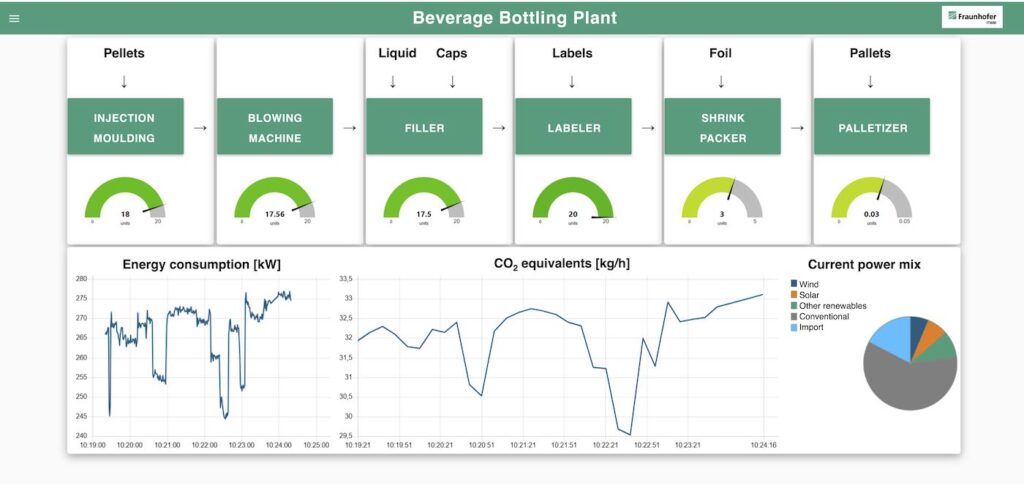
The dynamics of each component follow a recipe based on the operating point. The quantity of primary product required per intermediate product is known, as is the processing time and the duration of start-up, shutdown, or transitions between operating points. A bottler of beverages, for example, requires a bottle from the upstream conveyor belt, a liter of beverage, a screw cap and an operating point-dependent runtime to produce a single product.
Transport systems such as conveyor belts or stackers can be implemented in the same way. While they do not directly process the product, they determine transport times based on speed or cycle. Unlike direct production machines, auxiliary systems are not arranged in a fixed order but enclose one or more other machines. This can be a physical enclosure, as seen with clean rooms, or a purely logical one, like a power or compressed air supply.
Such auxiliary systems can also follow a standardized structure: They are individual components to which any number of machines can be connected, allowing for the exchange of information and status updates. An air conditioning system, for example, collects the waste heat and humidity emissions from all enclosed machines and—depending on its own performance—informs them of the resulting temperature and humidity in the room.
Digital twins—created quickly and efficiently
This simple and standardized structure offers two key advantages: First, the system information required for setup and parameterization is known to production management or can be easily recorded, eliminating the need for in-depth machine know-how on the part of the system manufacturer. Second, the DT of the overall system can be generated automatically with a structured declaration of system parameters. As a result, implementing the central dynamics and coupling all individual machines does not require complex modeling. This addresses one of the central problems in using DTs in production: The effort and time required to create them is now easy to estimate and significantly reduced.
This generic structure allows RAPIDZ to model all components using similar ordinary differential and transport equations. The time discretization can be adapted to the specific system and application. For example, a finer step size can be selected for pure simulation, while real-time requirements impose a maximum computing time, which limits the step size.
The DT presented thus far can already represent the processing steps of the production line in both stationary operating points and transition phases. This forms the foundation for using additional modules to answer user-specific questions related to production, energy management or maintenance, offering targeted decision support. Some application examples are presented below.
Model predictive control and production monitoring
When machines in a production line are interconnected, rather than decoupled, the question arises as to how to coordinate the operating points effectively. If a downstream machine malfunctions, you can simply continue until blockage from a growing backlog or adapt your own operating mode early on to maximize the advantages of the situation. These advantages may include more energy-efficient modes or those that are gentler on the machine or product. However, due to the high interdependency of systems in regular operation, determining the appropriate response of the overall system to local disruptions is often challenging.
Model-based control uses DTs to predict the effects of controller settings on complex, interacting systems and to evaluate the overall system’s performance based on a target function. Suitable optimization methods are employed to gradually improve controller settings and operating points. In model predictive control, for example, controller decisions and their future effects are simulated directly on the DT and the optimal setting is passed on to an assistance system or directly to the machines in a closed control loop [7].
While advances in mathematics and artificial intelligence continue to drive such processes, the challenge of quickly and efficiently creating the necessary, application-specific DT often goes unaddressed.
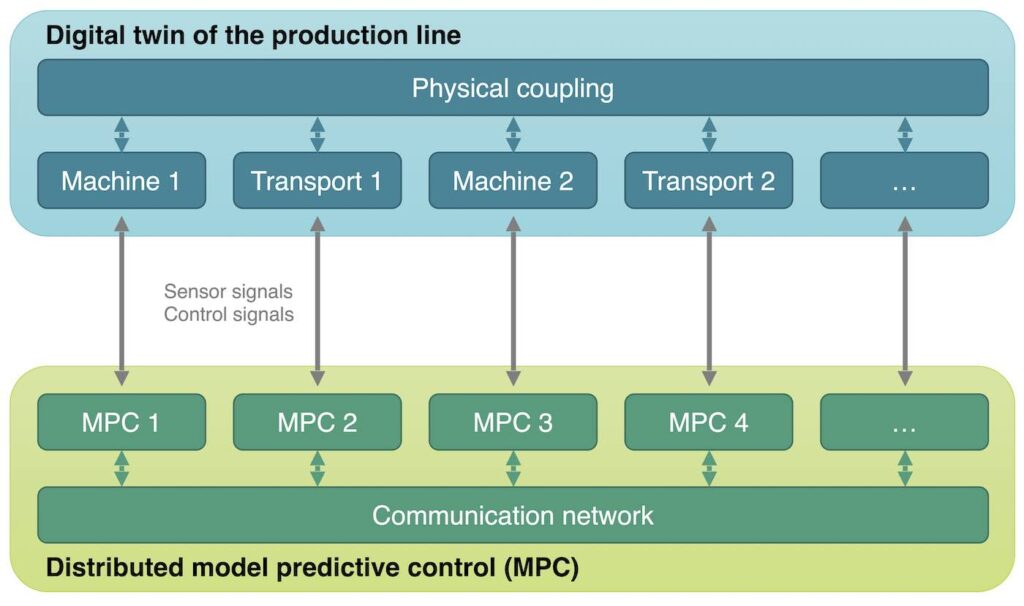
RAPIDZ, as a modeling and forecasting tool, solves this issue. Thanks to its modular structure, the resulting controllers can be distributed across individual machines while still achieving the overall optimization goals of the system. This leads to faster calculation of optimal operating modes.
The RAPIDZ modules allow for any number of target functionalities, for example the evaluation of what the “best” operating mode is. If, for example, scrap rates are known, they can be integrated into the DT. This enables the DT to simulate the quality of the intermediate or end products based on the operating point, which can then be factored into the overall system performance measure. These errors may result in defective B-grade products or direct rejections. By incorporating price information for raw materials, intermediate products or energy used for defective products, the resulting total costs can be specifically allocated to the defects at each production step.
Energy consumption, emissions and system availability
Another modular component in RAPIDZ is the mapping of energy supplies. The average energy consumption for the permissible operating modes is often already known or can be easily collected. However, the added value of this information is usually decoupled from production-oriented plant operation. High-load periods may be avoided during planning, but during actual operation, entire sections of a plant are often shut down only when the electricity demand reaches the contractual upper limit.
Here, too, RAPIDZ offers clear potential for improvement. By integrating additional information such as weather conditions, the current electricity mix and price or contractual limit values, the target functionalities can be expanded to include energy management and sustainability aspects. Possible data sources include the open API of the German Weather Service [8] for weather forecasts or SMARD, the free API for Germany-wide electricity market data from the Federal Network Agency, which provides electricity market data for Germany with 15-minute resolution [9].
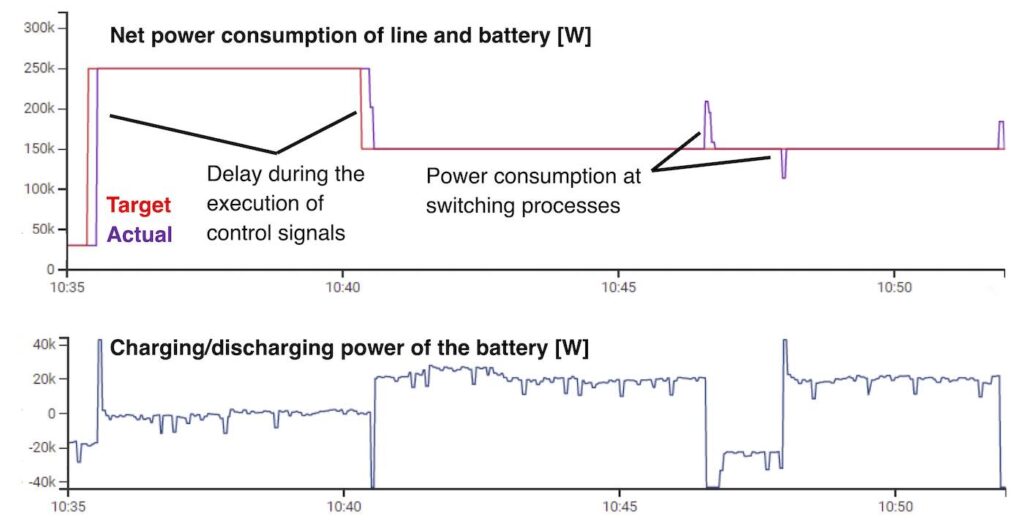
The same principle can also be applied to integrate emissions, such as waste heat, particulate matter or CO2, into the DT, thus fulfilling increasing sustainability requirements.
Implementation and outlook
To date, RAPIDZ has been implemented in a beverage bottling plant and in battery cell production. In both cases, the focus was on the combined optimization of production and energy management. The RAPIDZ model of the bottling plant operated with a time step of 3s and used model predictive control with a prediction horizon of 10 minutes. The control objective was fault-free operation and optimum production output while adhering to variable upper limits on electricity consumption set by the distribution grid operator (demand-side management).
In battery production, the aim was to coordinate volatile, electricity-intensive processes in such a way that power peaks were minimized (peak shaving) and the DC currents flowing back from the formation process were reused as directly as possible without having to be converted unnecessarily and with high losses into DC/AC. The processes considered in this case exhibited slower dynamics or longer cycle times, meaning that no critical real-time requirements arose.
Further projects in quality assurance and system availability are currently in preparation.
This article was written as part of the project “Re(Pro)³ – Resource-optimized production through inline process and product monitoring”, which is funded by the Ministry of Science and Health of the State of Rhineland-Palatinate (MWG).
Bibliography
[1] Tao, F.; Zhang, M.: Digital Twin Shop-Floor: A New Shop-Floor Paradigm Towards Smart Manufacturing. In: IEEE Access (2017). pp. 20418-20427.[2] Soori, M.; Arezoo, B.; Dastres, R.: Digital Twin for Smart Manufacturing, A Review. In: Sustainable Manufacturing and Service Economics (2023).
[3] Singh, M.; Fuenmayor, E.; Hinchy, E. P.; Qiao, Y.; Murray, N.; Devine, D.: Digital Twin: Origin to Future. In: Applied System Innovation, 4 (2021) 36.
[4] Zhang, C.; Ji, W.: Digital twin-driven carbon emission prediction and low-carbon control of intelligent manufacturing job-shop. In: Procedia CIRP 83 (2019), pp. 624-629.
[5] Lattanzi, L.; Raffaeli, R.; Peruzzini, M.; Pellicciari, M.: Digital twin for smart manufacturing: a review of concepts towards a practical industrial implementation. In: International Journal of Computer Integrated Manufacturing 34 (2021) 6, pp. 567-597.
[6] Lu, Y.; Liu, C.; Kevin, I.; Wang, K.; Huang, H.; Xu, X.: Digital Twin-driven smart manufacturing: Connotation, reference model, applications and research issues. In: Robotics and Computer-Integrated Manufacturing, 61 (2020), 101837.
[7] Bozzi, A.; Graffione, S.; Sacile, R.; Zero, E.: Dynamic MPC-Based Scheduling in a Smart Manufacturing System Problem. In: IEEE Access 11 (2023), pp. 141987-141996
[8] Deutscher Wetterdienst: API. URL: https://dwd.api.bund.dev/, accessed 03.04.2025.
[9] Deutscher Wetterdienst. URL: https://smard.api.bund.dev/, accessed 03.04.2025.
[10] Ferreira, C.; Gonçalves, G.: Remaining Useful Life prediction and challenges: A literature review on the use of Machine Learning Methods. In: Journal of Manufacturing Systems 63 (2022), pp. 550-562.
[11] Zonta, T.; da Costa, C. A.; da Rosa Righi, R.; de Lima, M.J.; da Trindade, E. S.; Li, G. P.: Predictive maintenance in the Industry 4.0: A systematic literature review. In: Computers & Industrial Engineering 150 (2020), 106889.
Your downloads
Solutions: Production Control Production Planning
You might also be interested in