Digital Twins for Production and Logistics Systems |
Challenges and focus areas in implementation and use

| Journal | Industry 4.0 Science |
| Issue | Volume 41, 2025, Edition 3, Pages 42-49 |
| Open Access | https://doi.org/10.30844/I4SE.25.3.42 |
| Bibliography | Share | Cite | Download |
Abstract
Keywords
Article
The ongoing digitalization of production and logistics requires the continuous development of existing digital methods and tools. One promising approach is the introduction of digital twins (DT), which is a digital representation of objects from the real world (e.g. resources, products or processes) in accordance with ISO/IEC 30173:2023-11 [1]. Using simulation and suitable data interfaces, a near-real-time representation of the current system behavior is created, which enables well-founded analyses, reliable forecasts and—with a suitable design—the ability to control interventions in reality [2, 3].
This concept creates new perspectives for the planning and operation of production and logistics systems, for example in the virtual commissioning (VC) of plants, the simulation-based improvement of production processes, in data-based process optimization or in the monitoring of complex material and goods flows [4]. Despite the high potential, however, companies repeatedly encounter technical, organizational and economic challenges when implementing and using DTs [4].
To obtain an overview of published use cases and challenges in the implementation and use of DTs, a systematic literature review is first carried out. The initial search returned 244 results, of which eight sources with comprehensive reviews were analyzed in detail [4–11]. To supplement the literature review, the results of an empirical survey are also included in the subsequent evaluation. During an event [12], 68 participants were asked about the possible uses of DT in production and logistics and the challenges involved in implementing and using DTs. Documentation of the research and the survey can be found in the repository of the University of Kassel [13].
Purpose of a digital twin
An initial analysis of the data sets [4–11, 13] shows 258 use cases of DTs, which can be grouped into eight clusters (Fig. 1). Each cluster represents a use case of the DT to support the planning and/or operation of production and logistics systems and is represented as a circle. The diameter of the circle represents the sum of the X-axis value (number of mentions in the literature) and the Y-axis value (number of mentions during the survey).
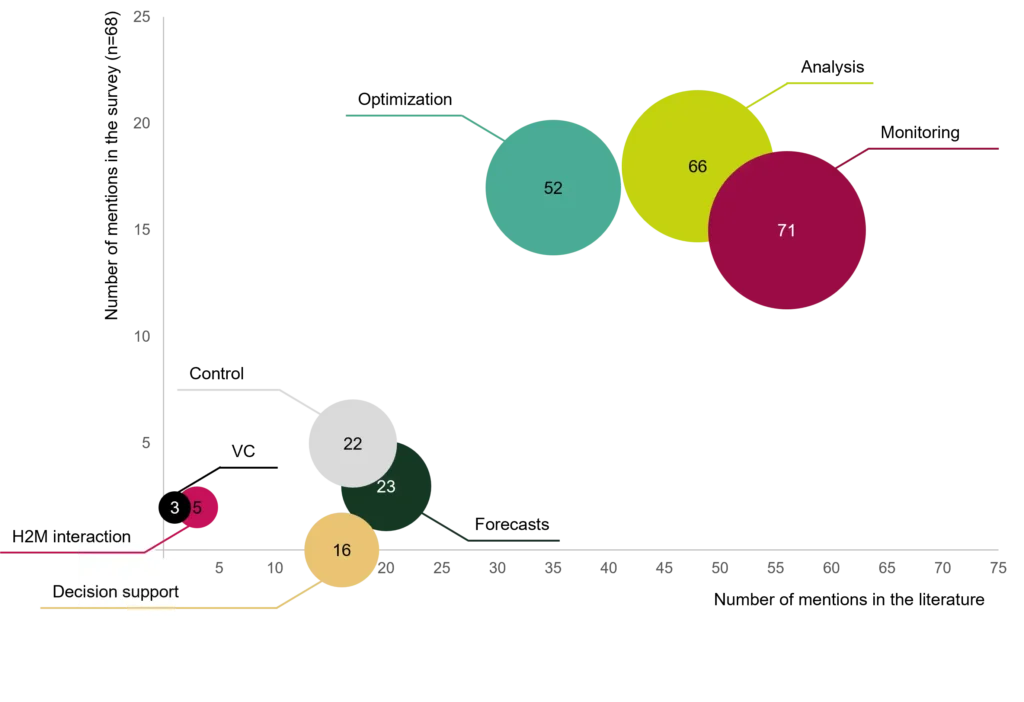
The most frequently cited use case relates to the continuous “monitoring” of the operating status of a production and logistics system or of the quality of the produced goods (71 mentions, ID 1–71 in [13]). The mapping of near-real-time system statuses creates increased transparency and traceability in production and logistics processes. The “analysis,” for example of production and logistics scenarios in the planning phase or of strategies for production planning and control in the operating phase of production and logistics systems, is also a well-documented area of application for the DT (66 mentions, ID 72–137 in [13]).
Closely related is the frequently mentioned use case “optimization” (52 mentions, ID 180–231 in [13]), which includes, for example, schedule and layout optimization for a production line, process optimization in warehouses or resource optimization in production logistics. The three areas mentioned, ”monitoring,” “analysis” and “optimization,” are already relevant in practice today, for example in improving the efficiency and performance of production and logistics systems and processes, and are likely to become even more relevant in the future.
With the appropriate underlying data, DTs can also be used for “forecasts” based on real-time data, for example for predicting failures, bottlenecks or anomalies to initiate proactive measures (23 mentions, ID 157–179 in [13]). However, DTs are also suitable for the operational “control” of production systems in real time (22 mentions, ID 232–253 in [13]), for example for production control or the control of an automated guided vehicle system.
Only a few use cases can be found in the area of human-machine interaction (“H2M interaction”) (5 mentions, ID 254–258 in [13]), although the DT can be used for expanded collaboration or for realistic training by simulating the working environment for assembly tasks. The “VC” represents the test operation of a planned system in a virtual environment and, according to the evaluation, has also only been used to a limited extent to date (3 mentions, ID 138–140 in [13]).
The effort required for implementing a DT varies depending on the intended use—a DT for monitoring requires far less implementation effort than a DT for real-time control in a production or logistics system. Nevertheless, the fundamental challenges are similar and are discussed below.
Challenges and focus areas
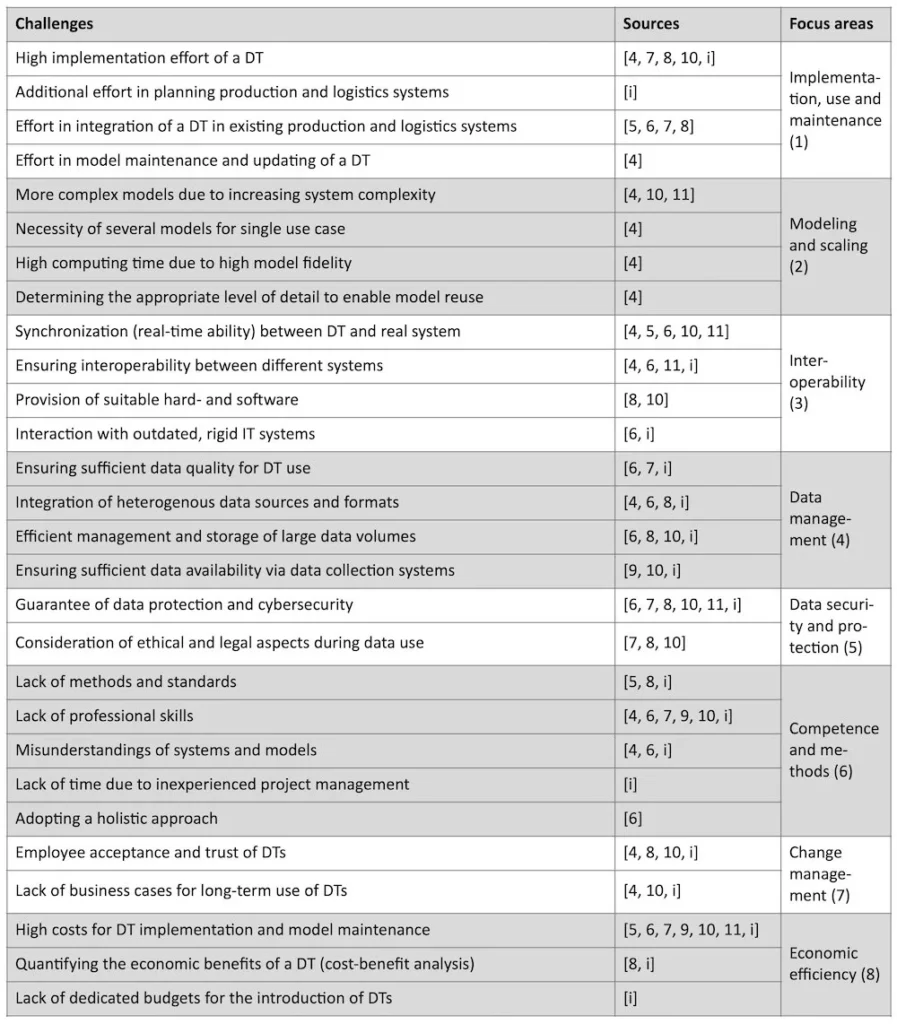
In the further analysis, the results of the literature review and the empirical survey provide insights into the challenges of implementing and using DTs for production and logistics systems (Fig. 2). In order to differentiate between the responses in the literature [4–11] and in the survey [13], answers from industry are marked with [i]. Eight focus areas can be derived based on the challenges.
Implementation, use and maintenance
When implementing and using a DT, a distinction must be made as to whether it is to be integrated during the planning phase of new production or logistics systems or only during the operating phase of an existing system. Reference architectures are already available for structured implementation (for example the Reference Architectural Model Industrie 4.0 (RAMI 4.0) [14] or the Digital twin framework for manufacturing [15]). However, both the modeling during implementation and the ongoing model maintenance and updating of the models during use represent considerable effort.
Standardized metamodels (Submodel Templates, Industrial Digital Twin Association e. V. (IDTA) [16]) will help to reduce initial costs in the future, but many of them are still in the development phase. Furthermore, the often-underestimated additional effort in the planning phase of production and logistics systems in industry is emphasized. All the aforementioned challenges are assigned to the first focus area “Implementation, use and maintenance.”
Modeling and scaling
Modeling challenges are only mentioned in the literature. The complexity and scalability of digital models (information models, CAD models, simulation models) is increasing due to growing system complexity and thus requires additional computing time.
Often, several models with differing levels of detail are necessary for a single application, especially when subsequent use is taken into account. Standardized models and uniform exchange formats (for example IDTA [16] and AASX Package [17]) help structure information and support the reuse of existing models. The requirements of digital models are collected under the second focus area “Modeling and scaling.”
Interoperability
Other challenges relate primarily to real-time synchronization between the DT and the real system, whereby a distinction can be made between the implementation of unidirectional, bidirectional and context-related connectivity [18]. This requires precise interface management and the use of suitable middleware.
The implementation of sufficient interoperability, which can be achieved using standards such as the Asset Administration Shell [19], is crucial for the seamless networking of different systems. RAMI 4.0 specifies the use of the administration shell as an interoperable link between digital and physical system components, with international standards such as the Open Platform Communications Unified Architecture [20] enabling a standardized communication infrastructure.
The literature also sees the provision of high-performance hardware and software for the simulation and analysis of the DT as a challenge, as the results must be determined in near-real time. Outdated, rigid IT systems make digitalization more difficult and hinder the introduction of modern technologies, e.g. Internet of Things [21]. Standardized interface and communication models (IDTA or projects such as Catena-X [22]) could be used more in the future. The technological aspects fall into the third focus area “Interoperability.”
Data management
Effective “Data management,” which is the fourth focus area, ensures the required data quality and enables the processing of large volumes of data. Ensuring data sovereignty in cloud-based and cross-company applications poses a risk [23], meaning that a clear governance structure and standardized access concepts are required.
The integration of heterogeneous data sources and formats and the selection of suitable data collection systems [24] to ensure a high level of data availability are equally challenging. The semantic description of technical characteristics (for example those given by the Common Data Dictionary [25]), standardized communication (Language for I4.0 Components, for example [26]) and loss-free exchange between systems (for example, Standard for the Exchange of Product Data [27]) are therefore becoming increasingly important.
Data security and protection
Data protection and cybersecurity aspects must also be taken into account. Projects such as Catena-X deal with solutions in comprehensive data ecosystems in which identity and authorization systems will increasingly ensure the secure management of access rights in the future [22].
The literature analyzed also emphasizes that ethical and legal aspects must be clarified (for example, the handling of personal data for performance evaluation or the clarification of liability in the event of malfunctions of the data center with subsequent damage). Appropriate measures at a technical level protect sensitive data, while training raises awareness of cybersecurity risks and reduces the likelihood of their occurrence. These aspects characterize the fifth focus area “Data security and protection.”
Competence and methods
Technical and organizational requirements are bundled in the sixth focus area “Competence and methods.” A lack of standardized methods, insufficient qualifications and misunderstandings of production and logistics systems can hinder the successful introduction of DTs.
In order to use a DT effectively, the literature emphasizes the need for a holistic approach to implementation in production and logistics systems, via standardized roadmaps, for example [28]. Interdisciplinary teams, further training and competent project management are crucial for successful implementation.
Change management
Problems with trust exist both at the organizational level and at the application level [29]. However, acceptance, trust and convincing business cases, for example for subsequent use, are essential for the long-term use of a DT.
Trust at application level can be built, for example, through joint model validation or transparency with regard to data protection compliance measures [29]. Targeted “Change management,” which is supported by the active involvement and training of staff, forms the seventh focus area.
Profitability
The eighth focus area, “Profitability,” addresses the costs associated with the implementation and long-term use of a DT, brought about by continuous model maintenance, for example, as well as uncertainties regarding the economic benefits. Cost-benefit analyses ensure the economic viability of DT introduction.
The use of established methods, such as total cost of ownership, is recommended for the economic evaluation of the DT [29]. In industry, the necessity of dedicated budgets is considered necessary for the successful project planning of a DT.
Interaction of the focus areas
For a holistic view, the focus areas described above are structured into superordinate dimensions (Fig. 3). The first two focus areas deal with the digital models for a DT and are summarized under the dimension “DT models.”
Technological requirements are addressed in focus areas three to five and can be found in the “IT infrastructure” dimension. Focus areas six to eight concern organizational and economic aspects and are assigned to the “DT application” dimension.
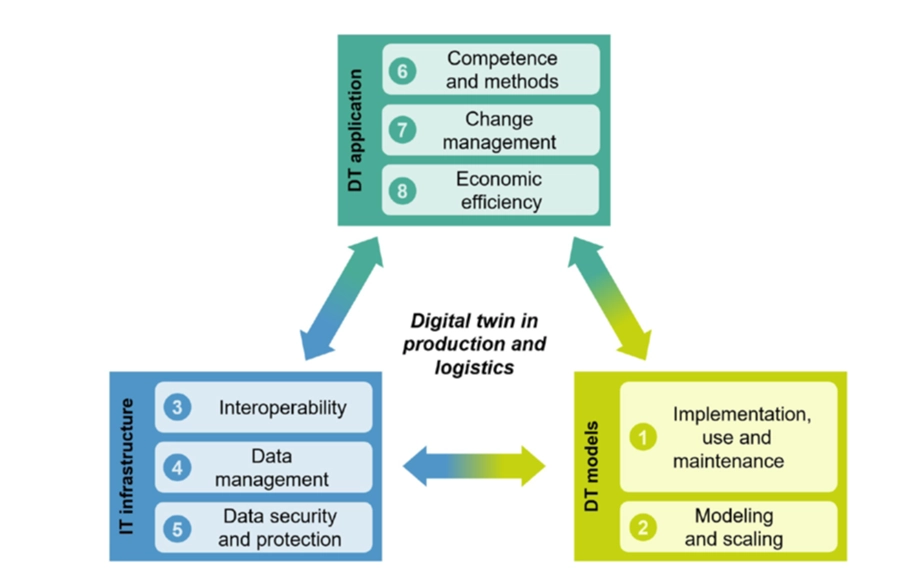
The three dimensions result in interdependencies that must be taken into account in a balanced manner to ensure the successful implementation and use of a DT. In the interplay of the three dimensions, it is crucial to build up further skills in addition to software and hardware knowledge for planning the implementation of a DT and for modeling and maintaining digital models.
Training not only helps to impart knowledge but also increases the acceptance and effectiveness of the DT. Budgets must be made available both for the development of the necessary know-how and for the technical equipment. An adequate IT infrastructure that enables the integration of digital twins into production and logistics systems forms the basis for the economical use and appropriate deployment of the DT.
For near-real-time mapping of logistics and production systems, high-performance hardware and software is required that enables automatic data collection and ensures seamless further processing of the data in the DT through practicable interfaces. Accordingly, business cases should be specifically tailored to the purpose of the DT and the available resources in the company. Standards such as RAMI 4.0 [14] and AAS [19], specific ISO standards on DTs [15], comprehensive overviews in the form of standardization roadmaps [28] and the results of the IDTA [16] already support the successful implementation, sustainable use and maintenance of DT for production and logistics systems.
Further potential
The applications listed above illustrate the potential of DTs for production and logistics systems. Thematic focus areas and overarching dimensions can be derived from the identified challenges. An adequate balance between the dimensions must be ensured for the successful implementation and sustainable use of DTs.
In the future, further research is required in the area of standards and methods in order to support companies in identifying suitable use cases, supporting efficient implementation and ensuring long-term use and maintenance. Especially in implementation, aspects such as detailing, connectivity, and the updating of models are relevant areas for further research.
Bibliography
[1] ISO/IEC 30173:2023-11: Digital twin – Concepts and terminology.[2] Kuhn, T.: Digitaler Zwilling. In: Informatik-Spektrum 40 (2017) 5, pp. 440–444.
[3] Boschert, S.; Rosen, R.: Digital Twin – The Simulation Aspect. In: Mechatronic Futures Cham (2016), pp. 59–74.
[4] Kattenstroth, F.; Disselkamp, J.-P.; Lick, J.; Dumitrescu, R.: Challenges in the implementation of simulation models for the digital factory twin – a systematic literature review. In: Procedia CIRP 128 (2024), pp. 441–447.
[5] Zhu, Y.; Cheng, J.; Liu, Z.; Cheng, C.; Zou, X.; et al.: Production logistics digital twins: Research profiling, application, challenges and opportunities. In: Robotics and Computer-Integrated Manufacturing 84 (2023), pp. 1–20.
[6] Zaidi, S.A.H.; Khan, S.A.; Chaabane, A.: Unlocking the potential of digital twins in supply chains: A systematic review. In: Supply Chain Analytics 7 (2024), pp. 1–24.
[7] Moshood, T.D.; Nawanir, G.; Sorooshian, S.; Okfalisa, O.: Digital Twins Driven Supply Chain Visibility within Logistics: A New Paradigm for Future Logistics. In: Applied System Innovation 29 (2021) 4, pp. 1–24.
[8] Lattanzi, L.; Raffaeli, R.; Peruzzini, M.; Pellicciari, M.: Digital twin for smart manufacturing: a review of concepts towards a practical industrial implementation. In: International Journal of Computer Integrated Manufacturing 34 (2021) 6, pp. 567-597.
[9] Małgorzata, G.: Digital twin technology – awareness, implementation problems and benefits. In: Engineering Management in Production and Services 14 (2022) 1, pp. 63–77.
[10] Melesse, T.Y.; Di Pasquale, V.; Riemma, S.: Digital Twin models in industrial operations: State-of-the-art and future research directions. In: IET Collaborative Intelligent Manufacturing 3 (2021), pp. 37–47.
[11] Guo, D.; Mantravadi, S.: The role of digital twins in lean supply chain management: review and research directions. In: International Journal of Production Research (2024), pp. 1–22.
[12] Wenzel, S.; Gliem, D.; Wittine, N.: Tagungsband. Wissenschaft trifft Wirtschaft: Digitaler Zwilling in Produktion und Logistik – Herausforderungen und Chancen. Kassel, 2024. URL: http://dx.doi.org/10.17170/kobra-2024112210706, accessed 23.04.2025.
[13] Wenzel, S.; Gliem, D.; Wittine, N.: Forschungsdatenpublikation. Wissenschaft trifft Wirtschaft: Digitaler Zwilling in Produktion und Logistik – Herausforderungen und Chancen. Kassel, 2024. URL: http://dx.doi.org/10.48662/daks-52.3, accessed 23.04.2025.
[14] DIN SPEC 91345:2016-04: Referenzarchitekturmodell Industrie 4.0 (RAMI4.0).
[15] ISO 23247-2:2021–10: Automation systems and integration – Digital twin framework for manufacturing – Part 2: Reference architecture.
[16] IDTA: Website of the Industrial Digital Twin Association e. V. (IDTA) – AAS Submodel Templates. URL: https://industrialdigitaltwin.org/content-hub/teilmodelle, accessed 23.04.2025.
[17] IDTA Number 01005-3-0:2023-04: Specification of the Asset Administration Shell. Part 5: Package File Format (AASX). Industrial Digital Twin Association e. V. (IDTA).
[18] Stark, R.; Damerau, T.: Digital Twin. In: CIRP Encyclopedia of Production Engineering. (2019), S. 1–8.
[19] IEC 63278-1:2023-12: Asset Administration Shell for industrial applications – Part 1: Asset Administration Shell structure.
[20] IEC TR 62541–1:2020: OPC Unified Architecture – Part 1: Overview and concepts.
[21] ISO/IEC TR 30172:2023: Internet of things (loT) – Digital twin – Use cases.
[22] Catena-X: Website of the Catena-X Automotive Network e. V. URL: https://catena-x.net/, accessed 23.04.2025.
[23] Kritzinger, W.; Karner, M.; Traar, G.; Henjes, J.; Sihn, W.: Digital Twin in manufacturing: A categorical literature review and classification. In: IFAC-PapersOnLine 51 (2019) 11, pp. 1016–1022.
[24] Gliem, D.; Vössing, D.; Wenzel, D.; Kusturica, W.; Laroque, C.: Final report on the project „dataject.log – Entwicklung eines semantischen Modells zur Beschreibung eines Digitalen Schattens der Logistikprozesse im Maschinen- und Anlagenbau zur Verwendung im Projektmanagement“. URL: https://kobra.uni-kassel.de/handle/123456789/15333, accessed 23.04.2025.
[25] IEC 61360-6:2016-10: Standard data element types with associated classification scheme for electrical components – Part 6: IEC Common Data Dictionary (IEC CDD) quality guidelines.
[26] VDI/VDE 2193-1:2020-04: Sprache für I4.0-Komponenten – Struktur von Nachrichten.
[27] ISO 10303-1:2024-01: Industrielle Automatisierungssysteme und Integration – Darstellung und Austausch von Produktdaten – Teil 1: Überblick und grundlegende Prinzipien.
[28] DIN, DKE: Deutsche Normungsroadmap Industrie 4.0, Version 5 (2023).
[29] Fuller, A.; Fan, Z.; Day, C.; Barlow, C.: Digital Twin: Enabling Technologies, Challenges and Open Research. In: IEEE Xplore (2020) 8, pp. 108951–108971.
Your downloads
Potentials: Innovation Strategy
Solutions: Logistics Logistics Technology
You might also be interested in