Logistik

Increasing Resilience in Logistics with IT

Increasing Resilience in Logistics with IT

Investigating supply chain risk management information systems
Alexander Baur, Jasmin Hauser, Dieter Uckelmann ORCID Icon
The blockage of the Suez Canal in 2021, caused by the accident involving the container ship Ever Given, clearly illustrates the need to design global supply chains in such a way that they can respond quickly to disruptions. In a volatile, uncertain, complex, and ambiguous (VUCA) environment, conventional logistics processes that focus on efficiency, and supply chain management methods in particular, are increasingly reaching their limits. Resilience, achieved through a combination of robustness and agility, is essential to ensure responsiveness. This article analyzes how risk management information systems (RMIS) can increase resilience. The analysis covers data availability, data transparency, modeling and simulation of risk scenarios, and the development of appropriate emergency action plans. Despite existing challenges in designing IT infrastructure, the measures mentioned have the potential to increase resilience in logistics.
Industry 4.0 Science | Volume 41 | Edition 4 | Pages 36-42
Technologies for Assisting Manual Order Picking

Technologies for Assisting Manual Order Picking

From conventional pick-by systems to AI-driven manual picking assistance
Md Khalid Siddiqui ORCID Icon, Jonathan Kressel ORCID Icon, Jürgen Grinninger
Manual picking remains common due to the high initial cost of support systems. This paper reviews existing technologies, presents an exploratory vision-based prototype, and examines existing literature that explores how combining object detection with language systems could enhance manual workflows. The findings suggest a promising, low-cost direction for worker support in logistics.
Industry 4.0 Science | Volume 41 | Edition 4 | Pages 6-19 | DOI 10.30844/I4SE.25.4.6
Digital Twins for Production and Logistics Systems

Digital Twins for Production and Logistics Systems

Challenges and focus areas in implementation and use
Deike Gliem ORCID Icon, Nicolas Wittine ORCID Icon, Sigrid Wenzel ORCID Icon
For a successful implementation as well as sustainable use and maintenance of digital twins for production and logistics systems, it is necessary to identify relevant use cases and master the associated challenges. This paper analyzes scientific literature on common applications and challenges in the implementation of digital twins for the planning and operation of production and logistics systems. To confirm the practical relevance of the results, the results of an empirical survey have also been included. The findings are used to derive key focus areas for the successful implementation and long-term use of digital twins in production and logistics.
Industry 4.0 Science | Volume 41 | 2025 | Edition 3 | Pages 42-49 | DOI 10.30844/I4SE.25.3.42
Intelligent Load Carrier Management

Intelligent Load Carrier Management

AI-supported monitoring and reduction of losses in logistics
Dominik Augenstein, Lea Basler
Load carriers are essential for transporting manufactured parts in manufacturing companies. Despite their ‘simplicity’, they are usually expensive to purchase as they are manufactured expressly to fit purpose. While tracking methods such as GPS tracking can be used to prevent the loss of load carriers, this is associated with monitoring costs and presents challenges with regard to data protection as soon as the work performance of intralogistics employees is monitored. Assigning load carriers to designated clusters and monitoring these clusters provides an effective solution—without drawing conclusions about employee performance. Furthermore, artificial intelligence can optimize this approach whilst also deterring the theft of load carriers.
Industry 4.0 Science | Volume 41 | 2025 | Edition 2 | Pages 78-84
Warehouse Inventory Detection with Airship Drones

Warehouse Inventory Detection with Airship Drones

(Semi-)autonomous aircraft for inventory and quality inspection of pallets in block storage facilities
Dmitrij Boger, Michael Freitag ORCID Icon, Britta Hilt, Michael Lütjen ORCID Icon, Benjamin Staar ORCID Icon
The complex dynamics of block warehouses pose major challenges to the manual stocktaking process. Frequent relocation of pallets, crates or pallet cages without fixed storage locations leads to a time-consuming and error-prone inventory process, wherein goods often have to be searched for and damages due to improper storage can occur. The use of (semi-)autonomous drones offers a promising solution to enable automated stocktaking, especially if these are appropriately equipped for optical goods detection.
Industry 4.0 Science | Volume 40 | 2024 | Edition 2 | Pages 56-63
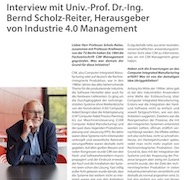
“Data Generated by Cyber-Physical Systems Will Play a Decisive Role”

"Data Generated by Cyber-Physical Systems Will Play a Decisive Role"

Interview with Prof. Bernd Scholz-Reiter, former editor of Industrie 4.0 Management
Bernd Scholz-Reiter ORCID Icon, Bernd Scholz-Reiter ORCID Icon
Professor Bernd Scholz-Reiter studied industrial engineering at the Technical University of Berlin. After several positions in Germany and abroad, he accepted the call to the University of Bremen in 2000, where he initially held the professorship of Planning and Control of Production Systems in the Department of Production Engineering. From 2002 to 2012, he also headed the Bremen Institute for Production and Logistics (BIBA). From 2012 to 2022, Bernd Scholz-Reiter was rector of the University of Bremen.
Industrie 4.0 Management | Volume 38 | Edition 6 | Pages 6-8
Work 4.0 – Logistics Working World of Tomorrow

Work 4.0 – Logistics Working World of Tomorrow

Effects and consequences of digitalization on the logistical working world
Tobias Reichert, Marc Lorscheider
In the course of digitalization, more and more digital technologies are being used in various areas of logistics. The occupational field is changing and problem-solving and abstracting skills as well as competencies in dealing with IT systems and data are increasingly required. Based on a literature review, this article provides an overview of the current situation in the logistics working world. Effects of digitalization as well as requirements and future competencies in the working world 4.0 are highlighted. Finally, a guideline for the management level is derived in order to promote the acquisition of competencies. (Only in German)
Industrie 4.0 Management | Volume 38 | 2022 | Edition 5 | Pages 30-34
Robotic Process Automation (RPA) in Logistics − Implementation Model and Success Factors

Robotic Process Automation (RPA) in Logistics − Implementation Model and Success Factors

Vorgehensmodell und Erfolgsfaktoren für die Implementierung
Carsten Feldmann, Jan Krakau, Victor Kaupe
RPA refers to bots that automate repetitive, rulebased tasks in a business process. This paper describes general areas of application for RPA in logistics as well as two practical logistics examples. In addition, a procedure model for the implementation of RPA in logistics is presented. The paper answers the following questions: What are suitable use cases for RPA in logistics? What criteria support the selection of suitable processes? And how should an implementation guide be designed to systematically support an implementation project taking into account critical success factors?
Industrie 4.0 Management | Volume 38 | 2022 | Edition 3 | Pages 35-40
Measures and Incentives to Reduce CO2-Emissions

Measures and Incentives to Reduce CO2-Emissions

How Small Carriers and Their Shippers Can Work Towards More Climate-Friendly Road Freight Transport
Moritz Petersen, Ramón van Almsick
Accelerating climate change drives companies to reduce their greenhouse gas emissions. Road freight transport accounts for around 6 % of global CO2 emissions. However, high growth rates, the dependence on fossil fuels, and the high fragmentation of the market make the decarbonization of road freight transport challenging. Based on survey results, this paper elaborates how small road carriers, together with their clients, can contribute to achieving global climate targets by implementing appropriate measures and incentives.
Industrie 4.0 Management | Volume 38 | 2022 | Edition 1 | Pages 41-44 | DOI 10.30844/I40M_22-1_41-44
A Recommendation for the Implementation of Innovations

A Recommendation for the Implementation of Innovations

A study on the specific requirements of logistics service provider
Dennis Abel, Hendrik Meyer, Torsten Rudolph
Due to the high requirements of customers, logistics service providers are getting under pressure to improve their processes more efficiently and economically. In this context, the advancing automation and digitalization in all industrial sectors are producing a multitude of innovative solutions which will help solving the problems mentioned before [1]. The resulting sociotechnical systems created this way are often not in the focus due to the new technology. In this study, a project procedure will be presented as a recommendation which will help to introduce an innovation − in this case especially for an automatic guided vehicle− in consideration of the aspects of socio-technical systems.
Industrie 4.0 Management | Volume 37 | 2021 | Edition 3 | Pages 49-52
1 2 7