
Digitalization of Logistics Processes on Construction Sites |
Concept for the creation and use of a digital shadow for construction site logistics in mechanical and plant engineering

| Journal | Industry 4.0 Science |
| Issue | Volume 39, 2023, Edition 1, Pages 53-58 |
| Open Access | https://doi.org/10.30844/I4SE.23.1.53 |
| Bibliography | Share | Cite | Download |
Abstract
Keywords
Article
The mechanical and plant engineering sector is primarily comprised of medium-sized companies characterized by a classic project-based business style [1]. Targeted project management for the on-time commissioning of customized products is facilitated by transparent project progress, which requires a valid planning database with near-real-time status reports.
However, continuous collection of project-relevant data on logistics processes rarely takes place on construction sites today [2], even though detailed planning of logistics processes, along with assembly planning, determines a company’s success [3, 4]. Instead, there is little to no status feedback during project execution [2]. Consequently, missing, analog or manually accumulated feedback leads to non-transparent project progression and results in additional costs due to delayed reaction times [5].
One of the challenges of mechanical and plant engineering is planning the use of equipment, as the exact whereabouts of certain items are often unknown due to transportation to and use on various construction sites. Unclear availability, lack of appropriate planning or even theft may complicate the project process because required equipment is either missing or can no longer be found at its original location.
The collection of relevant data on this equipment, such as its exact location, status, planned service life, and maintenance intervals, creates the necessary transparency on the construction site in the form of a logistical digital shadow. In the context of this paper, and following [6], a digital shadow is understood as a sufficiently accurate representation of the reality of processes in manufacturing and logistics in order to develop a real-time evaluation basis of all relevant data. Thus, by means of the digital shadow, real processes are transferred into the virtual world allowing, for example, the tracking of equipment during its route to and usage on the construction site. Digital twins as a digital representation of real processes and systems [7], e.g. using simulation models, are not addressed within the scope of this paper.
The basis for the development of a digital shadow of logistics processes is the definition and formal description of the logistics processes themselves, including their relevant Information and Communication processes (hereafter I&C processes) and the information to be exchanged, providing the structure for a semantic information model. The data model is instantiated as a database in which the logistics data recorded at the construction site is stored and related to one another. This is necessary so that different areas, such as project management, can access the logistics data via the database and process it for further use according to their specific needs.
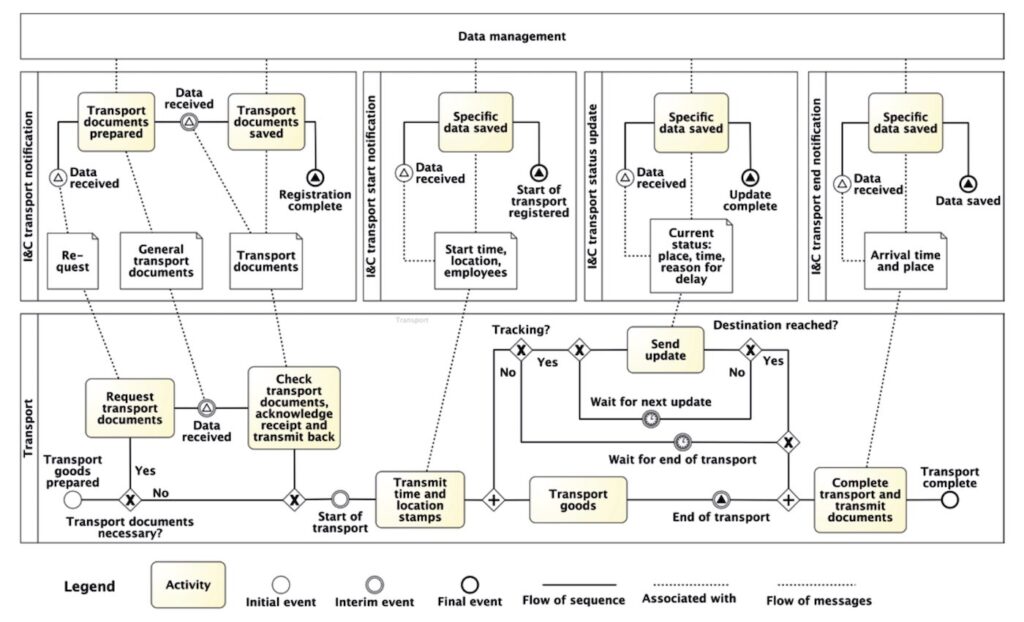
Information and communication processes within a logistics process
For the construction of a digital shadow of logistical processes on the construction site, the procurement and supply logistics, the construction site of the customer, the construction site and production logistics, and finally the disposal and return logistics are considered [9, 10]. Materials and equipment are typically transported to the construction site and made available at a delivery area. In addition to the assembly or installation site, construction site and/or intermediate storage facilities are available as required. At the construction site, the actual product is assembled and commissioned with the aid of the equipment. In the final step, any waste produced is disposed of, and reusable materials and equipment are returned to their regular location.
The identification and collection of information relevant for the digital shadow are based on a classification of all logistics processes to be performed as reference processes, taking into account evaluated elaborations from [10] and [11]. According to [12], logistics processes describe spatial, temporal, type or quantity transformations or a transformation of the service level required of an object. Logistics reference processes describe operations such as transportation, handling, storage, or commissioning.
In order to determine the information flows and the data to be exchanged and to model them as accurately as possible, the logistics reference processes was extended to include I&C processes employed for data collection. This data was checked for completeness and evaluated via relevant literature analyses and semi-structured expert interviews conducted with companies involved with the research project.
Figure 1 shows an example of a “Transport” reference process, complete with the I&C processes required for data collection and described using Business Process Model and Notation (BPMN). The second row describes the physical transport process and, thus, the logistical activities during execution. The row above is divided into four “pools”, which encompass I&C transport notification, I&C transport start notification, I&C transport status update, and I&C transport end notification. These pools model the I&C and data collection processes that accompany the actual transport process.
The transport process displayed in Figure 1 begins after loading has been completed. Transport notification is optional; in this case, transport documents are indeed requested, checked, acknowledged, and transmitted. Notification of the occurrence of a transport is optional because the reference process is designed to accurately represent all transport processes to and on the construction site. Therefore, start time and location of a transport are logged and saved persistently at the beginning of the transport. Tracking [13] can also occur alongside the actual transport process.
Current status updates about the transport process (such as location, time, or possible reasons for delays) are stored at regular intervals. At the end of the transport, an end-of-transport notification is sent, which includes the completion of the transport as well as the time and place of arrival. In relation to the above use case, the introduction of such a defined I&C process ensures that all information necessary for tracking equipment transport is always collected on a process-related basis; project planning can retrieve the exact location of equipment in transit at any time and take it into account during planning activities.
To make all process-related information available, it is stored in a semantic model that is instantiated as a database. To develop this database, an ontological approach is taken [14], allowing for an organized representation of the domain-specific terminologies and their semantic relationships. This results in the ontology incorporating all information about the modeled logistics reference processes, linking them and relating them to each other. The ontology operates on the principle of general validity, aiming to represent as much information from the logistics systems as possible.
Since there is a close relationship between the scope and content of the data to be collected and the technologies to be used for data collection, a systematic classification of the technologies available on the market in the form of a technology catalog is necessary. The ontology supplements the performance parameters and restrictions of these technologies, meaning that use of this ontology supports end users in selecting technologies best suited to their requirements and specific processes. Data collection should – if possible – be fully automated.
However, manual or at least partially automated data collection is still enabled for certain uses and processes. In order to achieve a high level of acceptance for the use of technology, the effort required for data collection by employees on the construction site should be minimized. For the use case under consideration in this article, GPS (Global Positioning System) sensors that record movement or personnel data may be implemented to track equipment transport. Alternatively, RFID (Radio Frequency Identification) chips can be used for tracking, and the data can be read out at departure and at arrival on the construction site.
Cloud-based software solutions are often employed to technically implement this, as they enable real-time tracking of assets like trucks and scaffolding at large construction sites, and can provide a cross-regional data-based communication structure, forming the basis for management decisions.
Concept for implementing and using a digital shadow
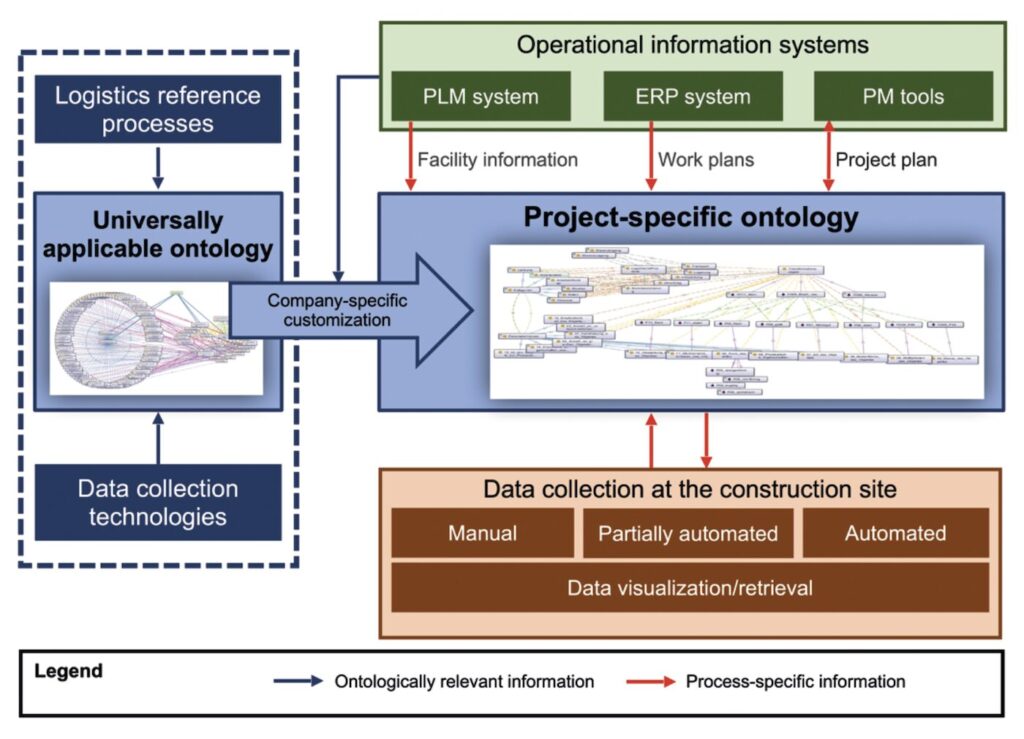
All components for the implementation and use of a digital shadow are summarized in Figure 2. To apply the ontology in practice, it must first be customized to reflect company- and project-specific requirements. Each project and each company introduces its own unique features that cannot be adequately represented within a universally applicable ontology. For example, when transporting goods across national borders to construction sites, additional information on customs regulations may be necessary. The information needed for company-specific customization is derived, whenever possible, from existing operational information systems. These systems include PLM (Product Lifecycle Management) or ERP (Enterprise Resource Planning) systems, along with all other PM (Project Management) tools and applications.
Building a project-specific ontology is crucial because this ontology serves as the central connection point between the tools used in project management and the data collected on the construction site. The arrows represent the exchange of data both between the physical processes on the construction site and the ontology, and between the ontology and the operational information systems.
On the construction site, data is collected manually, or collection is (partially) automated using various technologies (e.g., scanners, cameras, or tracking system) and made available to the ontology via WLAN (Wireless Local Area Network) or other mobile communications network. Simultaneously, project-relevant information can be retrieved from the ontology at the construction site.
The ontology updates the operational information systems based on the information received from the construction site and, in return, delivers instructions created based on this information. For example, modifications to assembly plans and resource allocations for employees or tools are communicated back to the construction site.
In the example discussed in this article, GPS positions and associated time stamps for equipment are automatically recorded and stored in the project-specific ontology. Consequently, there is always an up-to-date digital shadow of the equipment in question. The project management retrieves the equipment information from the ontology and schedules usage based on this.
Summary and outlook
The concept presented in this article for the creation and use of a digital shadow demonstrates how logistical process information can be recorded on the construction site in a timely manner and incorporated into project management. By ensuring adequate data collection on the construction site with the help of defined I&C processes and the networking of the information obtained in an ontology, a digital shadow of the logistical processes is created. An unresolved challenge lies in the selection of suitable technologies for data collection on the construction site in order to carry out the most convenient and consistent collection of relevant data.
Further research is currently underway to address the development of a method for evaluating technologies for data collection at multiple points of the logistics processes, and the prototypical implementation of a semantic model for describing a digital shadow of the logistics processes in the form of an ontology using a demonstrator. This further research will be evaluated at different companies.
The results presented in this paper originated in a joint research project of the University of Kassel and the University of Applied Sciences Zwickau. The IGF (Industrielle Gemeinschaftsforschung) Operation (21755) of the research association BVL (Bundesvereinigung Logistik e.V.) was funded via AiF (Arbeitsgemeinschaft industrieller Forschungsvereinigungen “Otto von Guericke” e.V.) within the framework of the program for the promotion of joint industrial research by the BMWK (Bundesministerium für Wirtschaft und Klima) based on a decision by the German Parliament.
Bibliography
[1] Heidmann, R.: Windenergie und Logistik. Losgröße 1: Logistikmanagement im Maschinen- und Anlagenbau mit geringen Losgrößen. Berlin 2015.[2] Helmus, M.: RFID in der Baulogistik. Forschungsbericht zum Projekt „Integriertes Wertschöpfungsmodell mit RFID in der Bau- und Immobilienwirtschaft“. Wiesbaden 2009.
[3] Schuh, G.; Hering, N.; Brunner, A.: Einführung in das Logistikmanagement. In: Schuh, G.; Stich, V. (ed): Logistikmanagement. Handbuch Produktion und Management 6, 2nd edition. Berlin 2013, pp. 1-33.
[4] Arnold, D.; Isermann, H.; Kuhn, A.; Tempelmeier, H.; Furmans, K.: Handbuch Logistik, 3rd edition. Berlin 2008.
[5] Wenzel, S.; Stolipin, J.; Weber, J.; König, M.: Digitale Planung der Baustellenlogistik im Großanlagenbau Ontologie zur Nutzung digitaler Modelle für die Logistikplanung auf der Baustelle. In: Industrie 4.0 Management 3 (2019) 6, pp. 55-59.
[6] Bauernhansl, T.; Krüger, J.; Reinhart, G.; Schuh, G.: WGP-Standpunkt Industrie 4.0. Darmstadt 2016.
[7] Glatt, M.; Kölsch, P.; Krenkel, N.; Langlotz, P.; Siedler, C.; Yi, L.; Aurich, J.: Rahmenwerk zur Einordnung Digitaler Zwillinge in Produktionssystemen. In: Zeitschrift für wirtschaftlichen Fabrikbetrieb 115 (2020), pp. 429-433.
[8] Schach, R.; Schubert, N.: Logistik im Bauwesen. Dresden 2009.
[9] Krauß, S.: Die Baulogistik in der schlüsselfertigen Ausführung. 2005.
[10] Gliem, D.; Jessen, U.; Stolipin, J.; Wenzel, S.; Kusturica, W.; Laroque, C.: Schlussbericht zum Projekt SimCast – Simulationsgestützte Prognose der Dauer von Logistikprozessen. Kassel 2019.
[11] Stolipin, J.; Jessen, U.; Wenzel, S.; Weber, J.; König, M.: Schlussbericht zum Projekt BIMLog – Projekt zur digitalen Planung und Steuerung der Baustellenlogistik im Großanlagenbau. Kassel 2020.
[12] Schönherr, M.: Wertorientiertes Logistikmanagement. Modell zur Bewertung logistischer Maßnahmen aus Sicht des Unternehmens. Wiesbaden 2016.
[13] Hausladen, I.: IT-gestützte Logistik: Systeme – Prozesse – Anwendungen. Wiesbaden 2016.
[14] Busse, J.; Humm, B.; Lubbert, C.; Moelter, F.; Reibold, A.; Rewald, M.; Schlüter, V.; Seiler, B.; Tegtmeier, E.; Zeh, T.: Was bedeutet eigentlich Ontologie? In: Informatik-Spektrum 37 (2014), pp. 286-297.
Your downloads
Solutions: Logistics Logistics Technology
You might also be interested in