Digital Solutions for SMEs’ Circularity Transition |
Examples from the textile industry

| Journal | Industry 4.0 Science |
| Issue | Volume 40, 2024, Edition 5, Pages 26-33 |
| Open Access | https://doi.org/10.30844/I4SE.24.5.26 |
| Bibliography | Share | Cite | Download |
Abstract
Keywords
Article
Transforming industries from linear to circular systems is an important goal for the European Union’s future economy, making circular economy one of the main pillars of the European Green Deal. With the Green Deal, the European Union (EU) plans to reduce European greenhouse gas emissions by at least 55% by 2030, compared to 1990 levels. Europe is to become the first climate-neutral continent by 2050 [1].
The Circular Economy Action Plan [2] is a basic building block for achieving these goals, as it’s been shown that the transition to a circular economy in the EU will lead to a reduction in greenhouse gas emissions of up to ten percent and contribute to increasing the competitiveness of firms. On policy level, the goals have been translated, among others, to the textile sector, resulting in the EU strategy for sustainable and circular textiles [3]. This industry traditionally has very fragmented value creation systems and supply chains, and in Germany as well as all over Europe the textile industry is characterized by a particularly high share of SMEs.
Not only EU and national regulations, as well as stakeholder initiatives, put high pressure on the textile industry to develop towards a more sustainable, circular economy. Additional pressure results from a severing scarcity of resources, and at the same time increasing market demand for circular products due to higher customer awareness with regard to sustainability. Faced with this situation, firms and SMEs in particular, need low-threshold access to information and training in order to meet future requirements and to make use of new market opportunities and business models [4].
Hence, to enable textile SMEs to operate successfully in circular economy systems, support is needed [5]: first, for the strategic positioning and participation of firms in new, circular, value creating industrial structures, and second, for the corresponding transformation of internal processes, competences, etc. Digital solutions have great potential to implement such support.
This paper presents examples of current circular economy approaches—a general one encompassing all industries (including the textile and clothing industry) as well as a specific one for the textile and clothing industry—that are supported with digital methods and that are particularly suitable for SMEs. The main intention of this paper is to encourage SMEs more generally to develop towards circular economy and to use existing digital methods that are publicly available from applied research.
The paper first outlines general needs and strategies regarding SME transformation towards circular economy. It then describes existing support to implement circular economy principles in SMEs, followed by an example focused on the textile and clothing industry in which both the inter-organizational value creation perspective and the internal firm perspective are addressed. Finally, it discusses benefits and challenges and points to further research needs.
Need for circular economy (CE) in the textile industry
The EU‘s Circular Economy Action Plan addresses various product value chains, which are the main drivers of greenhouse gas emissions. The European Parliament (2023) estimates that with eight to ten percent of global CO2 emissions, the textile industry is one of these drivers due to its extensive supply chains and energy-intensive production methods. Given the aim of the EU Green Deal to reduce greenhouse gas emissions by 55% by 2030, compared to 1990, industries with high CO2 emissions are in the focus of transition plans towards these goals.
For the textile industry, this has been specified in the EU Strategy for sustainable and circular textiles. It aims at reducing the industry’s environmental impact while at the same time increasing its competitiveness. Initiatives for proceeding towards these goals address different stakeholders in the complex overall system and include firm-centric approaches such as e.g. incentivizing circular business models as well as consumer-centric ideas such as the right to repair [3].
Strategies for CE
In addition to change of customer behavior, a holistic transformation of linear industries such as the textile industry into circular value creation also requires a coordinated industrial turnaround [4]. From a single firm’s perspective, it’s mandatory to first develop its own position within the industry’s transition.
A systematic approach to this end can be based on the R-strategies framework. Although the number of distinct R-strategies varies throughout different publications (see the overview table in [6]), generally this framework enables a comprehensive view of opportunities and requirements in the context of CE strategies.
The widely used R-strategies framework of the UNEP [7] describes nine distinct strategies. It is based on Refuse (R1), Reduce (R2), Reuse (R3), Repair (R4), Refurbish (R5), Remanufacture (6), Repurpose (R7) and Recycle (R8), plus the principle of Reduce by Design (R9). The first three strategies are seen as user-centric, whereas Repair, Refurbish and Remanufacture aim at user-business-interactions. Repurpose and Recycle focus on business-to-business contexts. In addition, Reduce by Design is seen as a key guiding principle for sustainable production.
While R-strategies describe generic principles that are relevant to any industry, their application has to take into account the respective industry’s specifics that either enable or hinder their implementation. Moreover, from a single firm’s perspective, additional limiting or facilitating conditions may arise.
A study of the Dutch textile industry [8], identifies cultural, market, and technical barriers beyond regulatory barriers to CE, both on industry and on firm level. Industry-wide barriers include, for example, limited willingness to cooperate in the value chain and limited volumes of circular value streams. Firm-level barriers include lack of knowledge and ability as well as hesitant organizational culture.
Need for SME support in the textile CE transition
To some extent, selected CE approaches such as on-demand production, the production of small batch sizes in close proximity (short runs), and individualization, all aiming at reduction of overproduction and waste, are already finding their way into firms in the textile and clothing industry. This contributes to the demand of placing the “…CE concept in a new context away from voluntary corporate sustainability strategy towards a collective societal implementation effort” [9].
However, the full range of R-strategies has not yet been addressed. Especially those strategies that do not only rely on a single firm’s activities but need a comprehensive re-design of inter-organizational value creating structures are challenging to address in an industry in which these structures traditionally are highly fragmented and involve numerous SME actors.
In order to develop new closed-loop strategies and successful new business models, textile firms must first understand their own current and future practices and capabilities with regard to textile cycles and the related R-strategies. In order to implement new CE strategies, textile firms in many cases must then enter into new collaborations with partners in order to e.g. increase resource efficiency, recycle textile waste, reduce overproduction, offer repair services, or find partners that apply “reduce by design” principles.
Textile firms, and SMEs in particular, need support for both the development step and the implementation step of CE approaches. In the development step, SMEs need information, e.g. about established and well-founded guidelines and directives, and can benefit from benchmarks and lighthouse examples not only from their own industry, but also from other industries.
In addition, they need information and advice on how to support the broad range of CE approaches with digital tools. [10] show what contribution digitalization, especially in the textile industry, can offer to support sustainable development. During implementation, SMEs need access to potential partners. The range of partners spans from service partners, e.g. for implementing digital tools within a firm, to production partners to complete the complex inter-organizational value-creating structures the specific CE approach builds on.
SME support for digitalization toward CEs
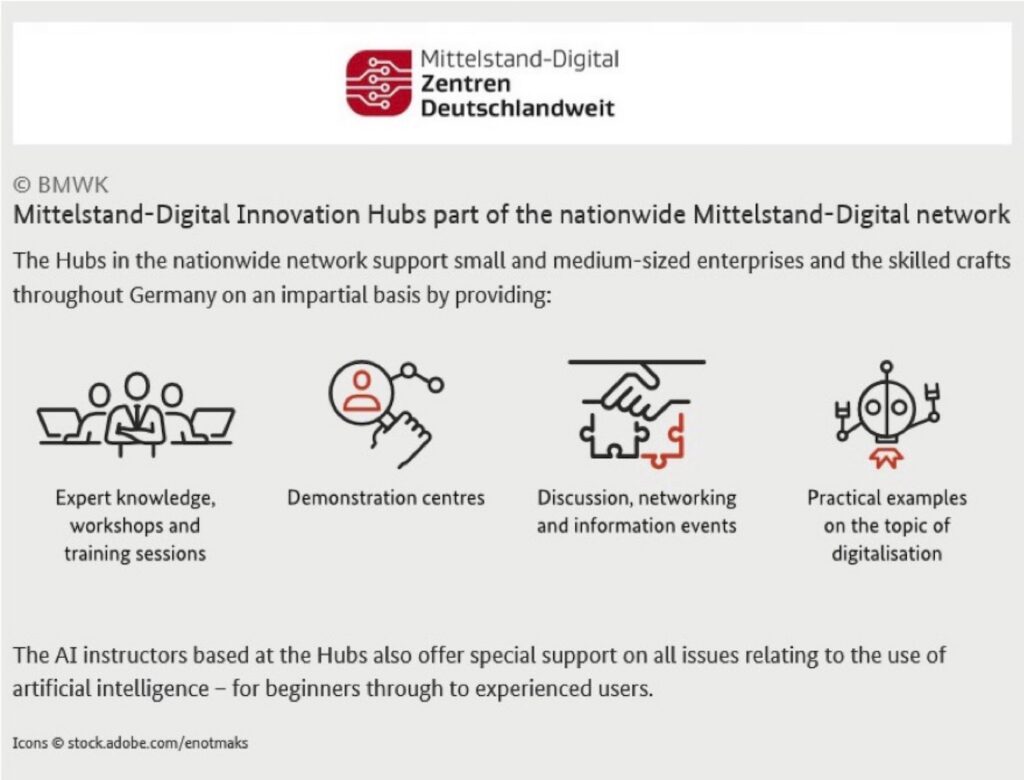
In a cross-industry approach, the Mittelstand Digital Zentren (MDZs) in Germany, which are funded by the German Federal Ministry for Economic Affairs and Climate Action, offer SMEs of all industries comprehensive support for their individual digital transformation [11]. The MDZs act as Innovation Hubs that offer three categories of support activities: raising awareness, training, and implementation. The centers are located throughout Germany. They each have their own specific topical focus, but they are networked with each other so that SMEs seeking advice can be directed to the appropriate center depending on their needs.
Among these MDZs, the center that focuses on digitalization as a driver for CE is named “Smarte Kreisläufe” (Smart Cycles). Here SMEs are provided with cross-industry support for all questions relating to digitization and to digitalization as well as work design topics and artificial intelligence [12]. This includes a variety of services for implementing CE approaches, supporting digital engineering and production, applying artificial intelligence methods, but also for enabling new work approaches and supporting change management. Besides demonstrators and implementation projects there a various practice-oriented and free information events, lab tours and workshops as well as industry dialogues.
Some of the demonstrators and completed projects presented on this center’s website are related to the textile and clothing industry. Examples include smart home lamps from recyclable paper yarn, or providing learning materials for digital twinning of materials [12].
The support offered by the MDZ Smart Cycles is highly appreciated by SMEs. In the first 15 months more than 8000 industry representatives (3300 coming from SMEs) from 4300 firms (2350 being an SME) have been involved in the center’s 570 total activities. While the services of the MDZ can help firms to develop and implement their individual digital approaches towards CE on firm level, the inter-organizational perspective especially relevant to the textile industry is typically not addressed. Hence, an additional industry-specific approach is required.
A digital platform solution to support textile CE
The needs described above call for a solution to overcome both industry-specific and firm-specific barriers to implementing CE in the textile industry. Accordingly, the basic idea of the solution described below is to qualify firms in the textile industry and to support their cooperation with the help of a cloud-based platform. The solution developed in the DBU-funded project TCready4CE uses digital services in order to support textile and clothing firms in building up their CE-oriented competences and to initialize new CE-oriented collaborations [13].
The main goal of the project was to enable firms in the textile and clothing industry with the help of a digital service on a cloud-based cooperation platform to qualify for the circular (textile) economy. Thus, not only firm-specific support is provided, but also effective new collaborations for circular (repairable, reusable, biodegradable or recyclable) textiles can be easily initiated and streamlined, supporting the supply chain stakeholders with corresponding, intuitively usable digital tools. This closes a gap in the transition of firms in the textile and clothing industry towards circular economy with a solution that aims at overcoming barriers on both levels, industry-wide barriers and firm-specific barriers, at the same time.
The starting point for a firm is related to assessing and improving its readiness for circular economy. For this purpose, digital services for self-diagnosis and for enabling firms for the circular economy were developed. These services include three main tools: At first, a tool for self-diagnosis, a Self-Assessment Tool (SAT); secondly, a scoring and benchmarking system and thirdly a training module with seven courses for self-directed learning. These services enable a textile or clothing firm to analyze and develop itself individually in relation to its capacity and state of knowledge.
The diagnostic tool and the training courses are made available as digital services on the digital cooperation platform for fashion production “Sqetch.co”. Due to the large number of textile firms in the established Sqetch network, the new services can have a wide reach and develop a leverage effect via the existing platform. The platform itself can become an important actor in the textile circular economy with a broad impact in this way.
As a pilot area, the focus has been put on the matching of suitable partners for the production of clothing and for the procurement of textile materials and accessories. Accordingly, potential addressees of the services include clothing manufacturers who want to convert their linear production to closed-loop production; fashion brands and retailers who support their suppliers in qualifying for the circular economy; and suppliers of circular materials and components, as well as circular economy service providers (such as recyclers and logistics firms).
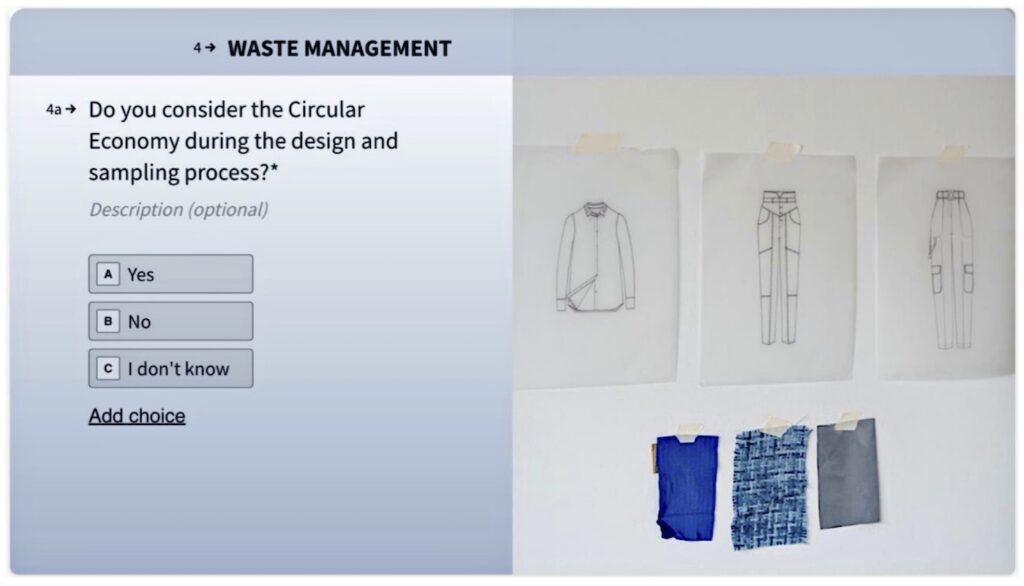
Via the established Sqetch platform, firms can access the digital services, the SAT (including the scoring system) and the training module: using the SAT, a firm can diagnose its capability regarding circularity. Areas such as CE knowledge, use of renewable resources, waste generation and use, as well as generation and communication of sustainability data and certificates are examined. The questionnaire developed and tested in the project consists of 71 questions, of which Figure 2 shows one example.
Depending on the specific results of the self-assessment and scoring, a training program is proposed giving clear and structured measures and actions that could be taken by the SME. This is a tailored selection from the seven training courses that have been developed. Theses seven training courses cover sourcing, new product development, production and distribution aspects. In particular, there is an introductory course plus six topical courses on Design for Circularity (Fig. 3), Manufacture for Circularity, Packaging and Logistics, Recycling, Internal and External Communication and Data Sharing, as well as Regulations, Laws and Certificates for CE.
The SAT and the training module were tested and validated with pilot brands and manufacturers. A group of 5 reference users was selected based on their competency and focus area within the value creation system. The group consisted of three SMEs, one textile association that’s extremely familiar with the needs of their SMEs and one large worldwide leading company that’s a business partner of SMEs, to get broad feedback and re-design the tool for as many users as possible.
The reference users tested both the SAT and the training courses and were asked to complete a detailed feedback questionnaire. Their feedback was then analyzed and used to re-iterate and create the final versions of the SAT and the training courses.
Since the go-live of the digital services in fall 2023, 49 firms have used this solution and accessed at least one of the courses. Such firm-level qualification can then spur platform-supported forming of new value creating structures to realize CE.

Industry-specific solutions required
Support for SMEs is needed to master the transition towards CE. Apart from cross-industry support for firm-level solutions, as provided in MDZs, industry-specific solutions are needed that address industry-level and firm-level solutions in a joint approach that supports not only new business models, but also the corresponding new value creation structures.
There are numerous tools existing that offer circularity assessment, but they all have shortcomings with regard to the needs outlined in this paper. Shortcomings include them being on a baseline level [14], working mainly with the tracking of CO2 or pollution [15, 16], only proving a concept for a specific ecosystem with a small number of cases [17], or not addressing the industry-specific needs of textile and clothing SMEs.
This paper highlighted two different approaches being developed with public funding, aiming at encouraging SMEs, not only from the textile and clothing industry, to specify their individual transition paths towards circularity and to combine and use existing support for digitalization to this end.
This paper uses results of the projects “Mittelstand-Digital Zentrum Smarte Kreisläufe”, which is funded by the Bundesministerium für Wirtschaft und Klimaschutz (BMWK) as part of Mittelstand-Digital and “Kreislauffähige Textil- und Bekleidungsunternehmen Entwicklung und Pilotierung eines Services zur Qualifikation von Unternehmen der Textilwirtschaft für die Kreislaufproduktion von Textilien und Bekleidung”, which was funded by the Deutsche Bundesstiftung Umwelt (DBU) under the file number 37821/01.
Bibliography
[1] European Commission: The European Green Deal – Striving to be the first climate-neutral continent. URL: https://commission.europa.eu/strategy-and-policy/priorities-2019-2024/european-green-deal_en, Accessed 05.02.2024.[2] European Commission: Circular economy action plan. URL: https://environment.ec.europa.eu/strategy/circular-economy-action-plan_en, Accessed 05.02.2024.
[3] European Commission: EU strategy for sustainable and circular textiles – To create a greener, more competitive textiles sector. URL: https://environment.ec.europa.eu/strategy/textiles-strategy_en, Accessed 05.02.2024.
[4] Prieto‐Sandoval, V.; Jaca, C.; Santos, J.; Baumgartner, R. J.; Ormazabal, M.: Key strategies, resources, and capabilities for implementing circular economy in industrial small and medium enterprises. In: Corporate Social Responsibility Environmental Management 26 (2019) 6, pp. 1473‒1484. DOI: 10.1002/csr.1761.
[5] Sharma, N.K.; Govindan, K.; Lai, K.K.; Chen, W.K.; Kumar, V.: The transition from linear economy to circular economy for sustainability among SMEs: A study on prospects, impediments, and prerequisites. In: Business Strategy and the Environment 30 (2021) 4, pp. 1803‒1822. DOI: 10.1002/bse.2717.
[6] Reike, D.; Vermeulen, W.; Witjes, S.: The circular economy: New or Refurbished as CE 3.0? — Exploring Controversies in the Conceptualization of the Circular Economy through a Focus on History and Resource Value Retention Options. In: Resources, Conservation and Recycling 135 (2018), pp. 246‒264. DOI: 10.1016/j.resconrec.2017.08.027.
[7] United Nations Environment Programme: Circularity. URL: https://www.unep.org/circularity, Accessed 05.02.2024.
[8] Hartley, K.; Roosendaal, J.; Kirchherr, J.: Barriers to the circular economy: The case of the Dutch technical and interior textiles industries. In: Journal of Industrial Ecology 26 (2022) 2, pp. 477‒490. DOI: 10.1111/jiec.13196.
[9] Reike, D.; Hekkert, M.P.; Negro, S.O.: Understanding circular economy transitions: The case of circular textiles. In: Business Strategy and the Environment 32 (2023) 3, pp. 1032‒1058. DOI: 10.1002/bse.3114.
[10] Weiß, M.; Winkler, M.; Seibold, J.; Grau, G.: What Contribution to Sustainability Can Digitalization Deliver? An Approach to Assessing Digitalization in Textile Production in Terms of Environmental and Economic Sustainability. In: Industry 4.0 Management 39 (2023) 2, pp. 25‒28.
[11] Mittelstand-Digital: What is Mittelstand-Digital? URL: https://www.mittelstand-digital.de/MD/Navigation/DE/Service/EnglischeSeite/englische-seite.html, Accessed 05.02.2024.
[12] Mittelstand-Digital: Mittelstand-Digital Zentrum Smarte Kreisläufe. URL: https://www.mittelstand-digital.de/MD/Redaktion/DE/Karte/Kompetenzzentren-Projekte/mittelstand-digital-zentrum-smarte-kreislaufe.html, Accessed 05.02.2024.
[13] TCReady4CE: Kreislauffähige Textil- und Bekleidungsunternehmen Entwicklung und Pilotierung eines Services zur Qualifikation von Unternehmen der Textilwirtschaft für die Kreislaufproduktion von Textilien und Bekleidung. URL: https://www.dbu.de/projektdatenbank/37821-01/, Accessed 05.02.2024.
[14] Ganbatte (2024), Circularity Assessment. URL: https://cat.ganbatte.world/, Accessed 06.14.2024.
[15] European Union [2024], #CEstakeholderEU: European Circular Economy Stakeholder Platform. URL: https://circulareconomy.europa.eu/platform/en/measuring-circular-economy, Accessed 06.14.2024.
[16] CTI Tool (2024) How to start with and understand your circularity assessment with CTI Tool. URL: https://ctitool.com/start-and-understand-your-circularity-assessment-step-by-step/, Accessed 06.14.2024.
[17] Tokazhanov, G.; Galiyev, O.; Lukyanenko, A.; Nauyryzbay, A.; Ismagulov, R.; Durdyev, S.; Turkyilmaz, A.; Karaca, F. (2022). Circularity assessment tool development for construction projects in emerging economies. Journal of Cleaner Production, pp. 362, 132293.
Your downloads
Potentials: Energy Efficiency Innovation Management Resource Efficiency
You might also be interested in