
Digital Platform Frameworks for Manufacturing Companies |
A review

| Journal | Industry 4.0 Science |
| Issue | Volume 40, 2024, Edition 2, Pages 8-15 |
| Open Access | https://doi.org/10.30844/I4SE.24.2.8 |
| Bibliography | Share | Cite | Download |
Abstract
Keywords
Article
Architectural and Governance Foundations of IIoT Digital Platforms
The integration of digital platforms into Industrial Internet of Things (IIoT) environments has amplified both structural and operational complexity within industrial systems. Acting as multi-layered coordination infrastructures, these platforms interlink heterogeneous cyber-physical assets, data pipelines, and organizational processes across distributed value networks. Their continuous evolution driven by accelerated technological innovation, market volatility, and regulatory adaptation positions them as adaptive socio-technical systems whose behavior is emergent rather than fully predictable, and whose management demands systematic architectural and governance insight [1].

Digital platforms have proliferated across diverse industrial domains including energy, chemical, transportation, and trade sectors serving as key enablers for the development of smart products and data-driven services within the IIoT landscape [2]. Current research increasingly emphasizes advanced software architecture paradigms that underpin such platforms. Figure 1 illustrates a representative architectural concept encompassing functional components, web services, service-oriented architectures, and in-memory databases, with a particular focus on the application, transport, and processing layers [3].
The application layer delivers domain-specific functionalities within Industrial Internet of Things (IIoT) environments, whereas the processing layer orchestrates data storage, analytics, and transmission, supported by the underlying transport layer.
The perception and business layers, while constitutive elements of comprehensive IIoT architectures, remain beyond the analytical scope of this article. The perception layer comprises sensor systems that transduce physical signals into digital data streams, whereas the business layer governs mechanisms of value appropriation, platform governance, and data privacy management [3].
Despite the rapid diffusion of digital platforms across industrial ecosystems, the criteria by which such platforms are evaluated and compared remain insufficiently systematized. Existing frameworks seldom reconcile technical capabilities with strategic alignment, leaving a persistent gap in evidence-based platform assessment [4]. Resolving this deficiency requires a rigorous analytical perspective that integrates technical attributes architecture, scalability, and interoperability with business-driven objectives and industrial applications [5].
In response, this research implements a systematic literature review of IIoT digital platform frameworks, concentrating on manufacturing enterprises where platformization constitutes a major vector of transformation. Earlier studies have articulated seminal frameworks for digital platforms and ecosystems, identifying their conceptual evolution and empirical tendencies [6]. Building on these contributions, the current paper outlines the prevailing comparative approaches and posits a central research question to guide the ensuing inquiry. “What are the current frameworks with criteria in the field of digital platform solutions in the context of the Industrial Internet of Things for manufacturing companies?”
To answer this research question, a systematic literature review approach and methodological tools were used. These are described in the following section. The results of the systematic literature review are then explained in the section entitled “summary of framework for industrial digital platforms”. This section synthesizes the current comparative frameworks and evaluation criteria for digital platforms within the Industrial Internet of Things (IIoT) domain, specifically focusing on manufacturing enterprises.
Research Design and Methodology
Prior to conducting this systematic literature review, a structured review approach tailored to the information systems domain was adopted to ensure comprehensive coverage of contemporary concepts for comparing digital platforms within the Industrial Internet of Things (IIoT). Following the review phases illustrated in Figure 2 [7], the subsequent section outlines how these stages were applied to the present article. In the initial phase, the research problem was defined, delimited, and specified, culminating in the formulation of the guiding research question. The second phase involved a systematic literature search and the evaluation of sources with respect to relevance, quality, and methodological rigor. In the final phase, the synthesized results were analyzed and presented, with particular emphasis on current frameworks for digital platform comparison in the IIoT context for manufacturing enterprises.

The categories used to characterize the reviews in this article were selected and are presented in Figure 3.
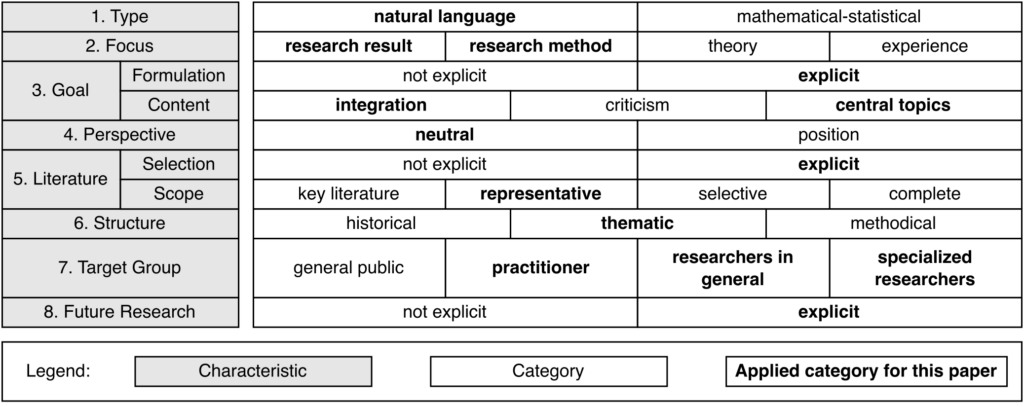
The categories applied to delimit the results of this systematic literature review are outlined below. Under the category “type”, the term “natural language” is selected, which provides verbal explanations and argumentation to enable an analysis of the selected literature. Regarding the methodology of the systematic literature review, the main focus is on the investigation of research findings (empirical results) and methods to answer the research question of the review. To ensure neutrality and transparency, an impartial author perspective is maintained, and the rationale for literature selection is made explicit. The scope of the review is confined to representative publications that focus exclusively on contemporary frameworks in the domain of digital platforms.
A thematic structure was adopted to enable the comparative analysis of studies addressing similar evaluation concepts, thereby ensuring broad comparability across research contexts. The results are intended to inform both practitioners and scholars while fostering scientific discourse within the respective research domains. Finally, the “Future Research” category explicitly identifies unresolved issues and outlines potential directions for the continued advancement of digital platform development.
Following the delineation of review characteristics, the search terms were defined and are presented in Figure 4.
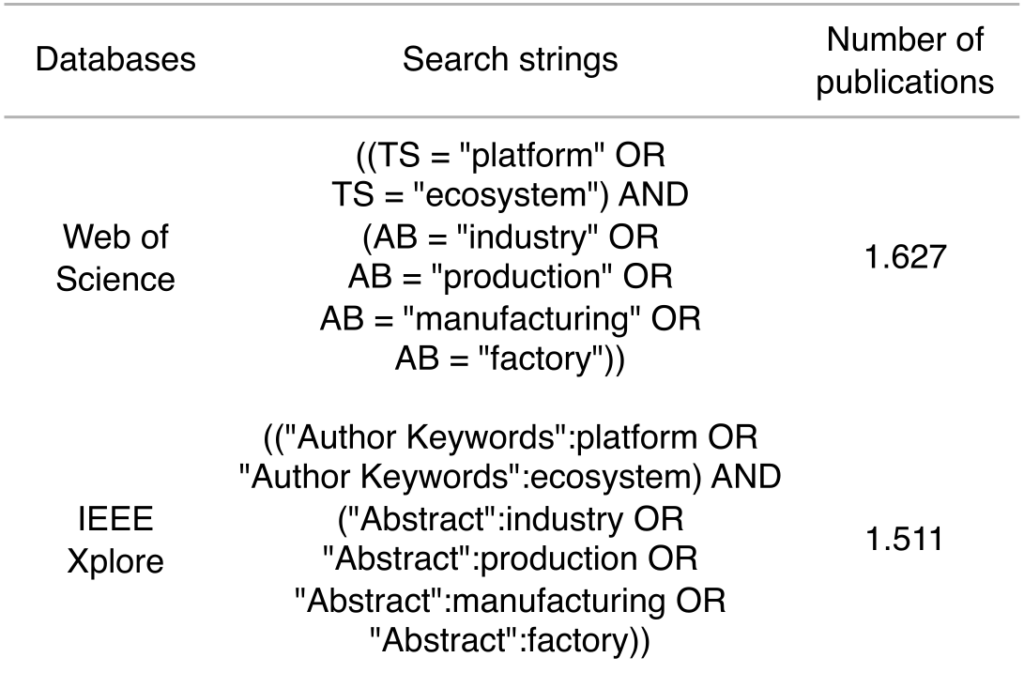
The categories employed to characterize the present systematic literature review are detailed below. The primary keywords used in the search strategy were “platform” and “ecosystem”, complemented by the general terms “Industry 4.0”, “production”, and “manufacturing.” The literature search was conducted using the Web of Science database, focusing on the topic field (TS), which encompasses the Title, Abstract, Author Keywords, and Keywords Plus sections for the main keywords.
For the general keywords, the search was restricted to the Abstract (AB) field. Applying these search parameters yielded 1,627 publications in Web of Science. In addition, IEEE Xplore was queried using the same terms within Author Keywords and Abstracts, resulting in the identification of 1,511 publications.
The following section delineates the information flow across the successive phases of the systematic literature review, as depicted in Figure 5. The review deliberately restricts its scope to English-language publications published after 2014 to capture the most recent advancements in digital platform research within the Industrial Internet of Things (IIoT) domain for manufacturing enterprises. To uphold methodological integrity, only peer-reviewed studies explicitly examining contemporary developments in IIoT digital platforms were retained.
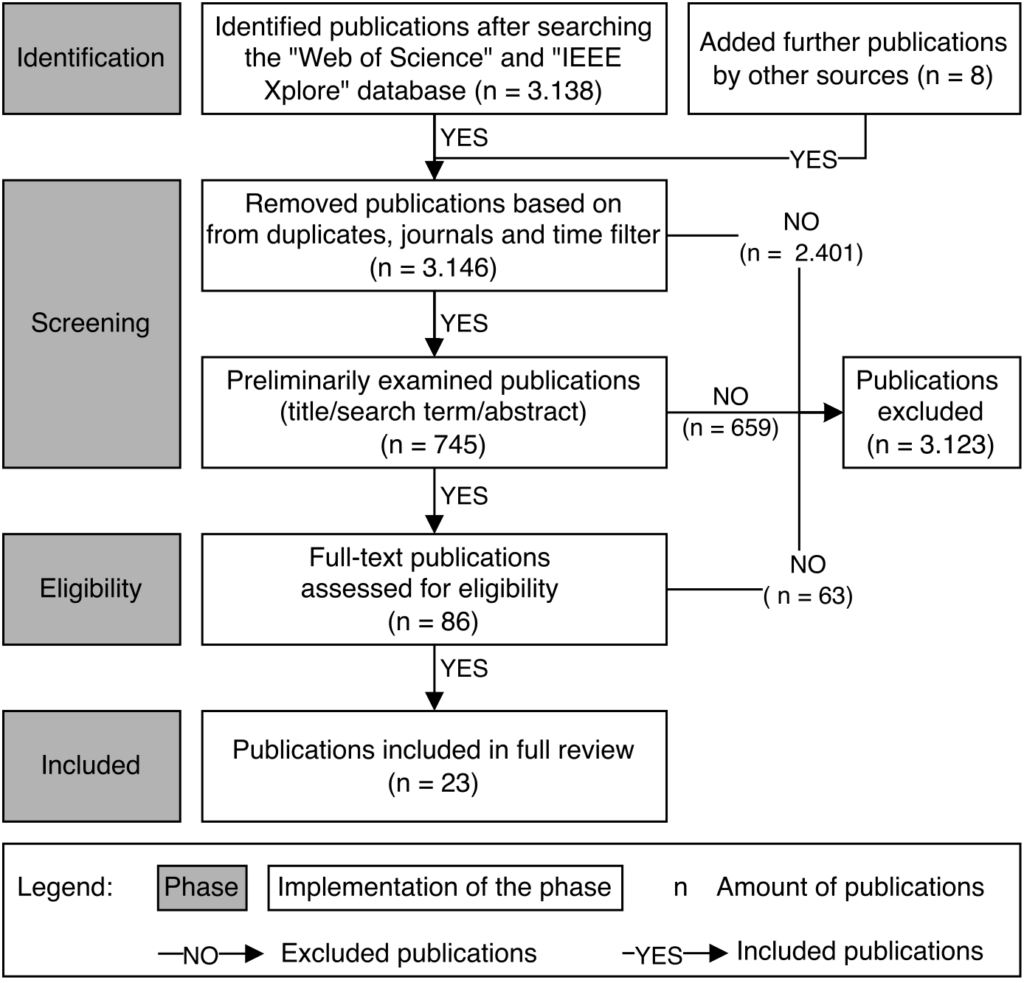
Research limited to technical, medical, biological, or physical domains was excluded to maintain coherence with the article’s focus on information systems and industrial engineering.
The broad representation of the final corpus across established, high-impact journals reinforces the scholarly validity of the analysis, encompassing venues such as IEEE Xplore, the International Journal of Advanced Manufacturing Technology, the International Journal of Production Research, the International Journal of Computer Integrated Manufacturing, and Computers & Industrial Engineering.
Comparative analysis of conceptual frameworks for industrial digital platforms
Prior systematic reviews by Ulla et al. [8] and Li et al. [9] have interrogated the methodological diversity and conceptual fragmentation within digital platform comparison research, underscoring the lack of harmonized evaluation criteria. Building upon these foundations, the present paper constructs a conceptual lens for analyzing contemporary frameworks in digital platform scholarship. The ensuing section offers a detailed examination of 23 relevant studies identified via the systematic review.
Specifically, Ulla et al. [8] refine earlier work by proposing 21 validated assessment factors derived through the Delphi method. Their comparative analysis of five dominant IoT platforms Amazon Web Services, Microsoft Azure, Google Cloud, IBM Watson, and Oracle demonstrates how these criteria enable evidence-based evaluation and facilitate strategic platform selection across heterogeneous industrial applications.
The identified key factors include stability, scalability, pricing model, security, time-to-market, data analytics, data ownership, protocol support, system performance, interoperability, redundancy, disaster recovery, interface quality, application environment, hybrid cloud support, platform migration, prior experience, bandwidth, and edge intelligence. This systematic comparison enables organizations and researchers to align their specific requirements with corresponding platform features, thereby facilitating a more transparent and efficient evaluation process [8].
The study by Li et al. [9] presents an evaluation framework for digital platforms. The evaluation framework assesses the use of the digital platform in three areas: Foundation, Key Capability, and Value and Benefits. The evaluation indicators for the key capability of the platform include cloud-based resource management, industrial big data management and mining, microservice deployment and invocation, and industrial application development. These indicators assess the platform’s capabilities and maturity across multiple critical functional dimensions.
Likewise, indicators related to the platform’s value and utility evaluate the scope, impact, and openness of its applications and ecosystem. This includes examining the platform’s user base, profitability, capacity for innovation, and the degree of data transparency and sharing. The investigation underscores the significance of coordinated governmental assessment initiatives in evaluating the developmental trajectory of the information society across industries and regions, promoting empirically guided policy action and systemic institutional adaptation.
The proposed assessment framework also enables platform stakeholders to undertake continuous self-evaluation, promoting iterative improvement cycles and adaptive capability development within digital ecosystems [9]. Siqin et al. [21] examine the operational paradigms of digital platforms in the context of Industry 4.0, exposing systemic constraints that hinder responsiveness and integration. To transcend these organizational and technological obstacles, Siqin et al. [21] propose the “3As” framework Awareness, Agility, and Adaptability as a unifying operational doctrine that embeds digital intelligence, responsiveness, and adaptability into industrial workflows, equipping firms to sustain continuous performance improvement amid dynamic market and production conditions.
Wankhede et al. [13] execute a comparative study of leading industrial cloud platforms Amazon Web Services IoT, Google Cloud Platform, and Microsoft Azure assessing technical dimensions such as pricing configurations, database and storage capabilities, AI and machine-learning integration, deployment processes, networking efficiency, and security protocols. The findings yield a structured decision framework for aligning platform adoption with organizational and operational imperatives. Correspondingly, Salami and Yari [14] conduct an evaluative analysis of IoT platforms ThingSpeak, Xively, and AWS IoT based on key parameters including data-management performance, monitoring efficiency, processing velocity, and latency, thereby informing evidence-based Platform-as-a-Service (PaaS) selection.
Hoffmann et al. [15] address ambiguities in workload allocation and platform choice for industrial IoT integration by proposing an Internet-of-Production reference framework. Assessing 212 digital platforms, they design a customized architecture that supports intra-organizational optimization through tailored deployment strategies.
Farshidi et al. [16] introduce a multi-criteria decision model for blockchain-platform selection to aid software-producing organizations in balancing functionality, adaptability, and interoperability. Its validation through three industrial case studies demonstrates the model’s practical utility. Huo et al. [17] present a systematic survey of blockchain integration in the IIoT, synthesizing motivations, technological prerequisites, and emergent research directions that promote innovation and operational efficiency in manufacturing contexts.
Rojahn and Gronau [18] introduce a structured analytical framework for the identification and categorization of measurable indicators of platform openness, offering a reproducible methodology to evaluate transparency and interoperability throughout the platform lifecycle. In parallel, Ismail et al. [19] address the lack of standardized performance benchmarks for digital platforms by designing and empirically validating an evaluation framework for open-source solutions, testing scalability and stability under intensive sensor-data loads on ThingsBoard and SiteWhere.
Moeuf et al. [20] examine Industry 4.0 implementation patterns in SMEs and find that most firms deploy isolated cloud and IoT applications without embedding them into end-to-end process automation, data integration pipelines, or real-time decision-support architectures thereby failing to generate measurable productivity or interoperability gains.
Siqin et al. [21] dissect the alignment between industrial platform architectures and organizational adaptation logics, demonstrating that insufficient abstraction between control, data, and coordination layers leads to rigidity in workflow orchestration and limits rapid technological integration. In response, they formulate the “3As” framework Awareness, Agility, and Adaptability as a systemic blueprint for integrating predictive insight, operational agility, and contextual fit into industrial platform management.
Finally, Ray et al. [22] provide a comprehensive critique of digital platform architectures to redress the longstanding theoretical vacuum surrounding architectural integration in platform studies. Their investigation delineates the functional and technological interdependencies that define ecosystem evolution, isolates systemic impediments to modularity and interoperability, and formulates a research trajectory toward establishing architectural robustness and cohesion.
Challenges in digital platform frameworks
This article deepens theoretical rigor and enhances methodological applicability in the study of IIoT platform evaluation, responding to an enduring shortfall in industrial systems research. The rising technological multiplicity and organizational intricacy of digital systems call for harmonized evaluation frameworks that align structural configuration, performance efficiency, and strategic orientation.
Although the article’s methodological design upholds analytical rigor and procedural transparency, its dependence on Web of Science and IEEE Xplore as central data repositories introduces inherent constraints. Expanding the literature base through additional repositories, including Google Scholar and the ACM Digital Library, could broaden coverage and mitigate selection bias. Likewise, enhancing the search taxonomy with further Industry 4.0–related descriptors would enable greater granularity and contextual sensitivity in future research.
In practical terms, this article refines both theoretical insight and managerial capability by delineating analytical dimensions that enable systematic evaluation, comparative benchmarking, and governance of digital platform architectures.Still, the conceptual integration principle warrants empirical testing and technical validation to verify its real-world applicability. Future investigations should therefore undertake longitudinal and performance-based evaluations of IIoT platforms, emphasizing maturity progression, cross-system interoperability, and scaling efficiency under production conditions. These efforts could substantially improve the operational resilience and strategic leverage of IIoT platforms within manufacturing ecosystems.
Bibliography
[1] Henfridsson, O. et al. 2014 “Managing Technological Change in the Digital Age: The Role of Architectural Frames,” in Journal of Information Technology (29:1), pp. 27–43. doi: 10.1057/jit.2013.30[2] Andreev, S. et al. 2012 “Internet of Things, Smart Spaces, and Next Generation Networking,” in Lecture Notes in Computer Science (7469). doi: 10.1007/978-3-642-32686-8
[3] Sethi, P. and Sarangi, S. R. 2017 “Internet of Things: Architectures, Protocols, and Applications,” in Journal of Electrical and Computer Engineering 2017, p. 1-25. doi: 10.1155/2017/9324035
[4] Guth, J., Breitenbucher, U., Falkenthal, M., Leymann, F., and Reinfurt, L. 2017. “Comparison of IoT platform architectures: A field study based on a reference architecture,” in Proc. Cloudification Internet Things (CIoT), pp. 1–6. doi: 10.1109/CIOT.2016.7872918
[5] Schuh, G., Hoffmann, J., Gruber, M., and Zeller, V. 2017. “Managing IT complexity in the manufacturing industry—An agenda for action,” in Journal on Systemics, Cybernetics and Informatics (15:2), pp. 61– 65.
[6] Rojahn M., and Gronau, N. 2023. “Digital Platform Concepts for manufacturing Companies – A Review,” in 10th International Conference on Future Internet of Things and Cloud (FiCloud), pp. 149-158, doi: 10.1109/FiCloud58648.2023.00030.
[7] Fettke, P. 2006 “State-of-the-Art des State-of-the-Art: Eine Untersuchung der Forschungsmethode “Review” innerhalb der Wirtschaftsinformatik,” in WIRTSCHAFTSINFORMATIK (48:4), p. 257.
[8] Ullah, M., et al. 2020. “Twenty-one key factors to choose an iot platform: Theoretical framework and its applications,” in IEEE Internet of Things Journal (7:10), pp. 10111-10119. doi: 10.1109/JIOT.2020.3000056
[9] Li, J., et al. 2020. “Study on the reference architecture and assessment framework of industrial internet platform,” in IEEE Access 8, pp. 164950- 164971. doi: 10.1109/ACCESS.2020.3021719
[10] Benitez, G. B. et al. 2020 “Industry 4.0 innovation ecosystems: An evolutionary perspective on value cocreation,” in International Journal of Production Economics 228 (107735).
[11] Weking, J., et al. 2020. “Leveraging industry 4.0–A business model pattern framework,” in International Journal of Production Economics (225), pp. 107588. doi: 10.1016/j.ijpe.2019.107588
[12] Rajput, S., and Singh, S. P. 2018. “Identifying Industry 4.0 IoT enablers by integrated PCA-ISM-DEMATEL approach,” in Management Decision (57:8), pp. 1784-1817. doi: 10.1108/MD-04-2018-0378
[13] Wankhede, P., Talati, M., and Chinchamalatpure, R. 2020. “Comparative study of cloud platforms- microsoft azure, google cloud platform and amazon EC2,” in Journal Research Engineering Application Science (5:2), pp. 60-64. doi: 10.46565/jreas.2020.v05i02.004
[14] Salami, A. and Yari, A. 2018 “A framework for comparing quantitative and qualitative criteria of IoT platforms,” in 4th International Conference on Web Research (ICWR). IEEE.
[15] Hoffmann, J. B., et al. 2018. “IoT platforms for the Internet of production,” in IEEE Internet of Things Journal (6:3), pp. 4098-4105. doi: 10.1109/JIOT.2018.2875594
[16] Farshidi, S., et al. 2020. “Decision support for blockchain platform selection: Three industry case studies,” in IEEE transactions on Engineering management (67:4), pp. 1109-1128. doi: 10.1109/TEM.2019.2956897
[17] Huo, R., et al. 2022. “A comprehensive survey on blockchain in industrial internet of things: Motivations, research progresses, and future challenges,” in IEEE Communications Surveys & Tutorials (24:1), pp. 88-122. doi: 10.1109/COMST.2022.3141490
[18] Rojahn, M., and Gronau, N. 2024. “Openness Indicators for the Evaluation of Digital Platforms between the Launch and Maturity Phase,” in Proceedings of the 57th Hawaii International Conference on System Sciences, pp. 4516–4525.
[19] Ismail, A. A., Hamza, H. S., and Kotb, A. M. 2018. “Performance evaluation of open source IoT platforms,” in IEEE global conference on internet of things (GCIoT). IEEE.
[20] Moeuf, A., et al. 2018. “The industrial management of SMEs in the era of Industry 4.0.,” in International journal of production research (56:3), pp. 1118-1136. doi: 10.1080/00207543.2017.1372647
[21] Siqin, T., et al. 2022. “Platform operations in the industry 4.0 era: recent advances and the 3As framework,” in IEEE Transactions on Engineering Management. doi: 10.1109/TEM.2021.3138745
[22] Ray, P. P. 2018 “A survey on Internet of Things architectures,” in Journal of King Saud University-Computer and Information Sciences (30:3), pp. 291-319. doi: 10.1016/j.jksuci.2016.10.003
Your downloads
You might also be interested in