Wertschöpfung

Transforming Under Pressure

Transforming Under Pressure

An analysis of coping strategies along the value chain in agriculture
Niklas Obermann ORCID Icon, Saskia Hohagen ORCID Icon, Uta Wilkens ORCID Icon
The transformation in production offers the chance to redesign existing value chains. Cooperation between various ecological, social and governmental stakeholders is seen as particularly key to sustainable development. However, little research has been conducted into how companies can best manage the resulting interdependencies. Agriculture is used as an example to examine how businesses can activate resources along the value chain.
Industry 4.0 Science | Volume 40 | 2024 | Edition 5 | Pages 99-106 | DOI 10.30844/I4SE.24.5.99
Federated Service Engineering

Federated Service Engineering

A development methodology for the realization of mobility applications in the Gaia-X decentralized data ecosystem
Christoph Heinbach, Michael Pahl, Oliver Thomas
The decentralized data ecosystem Gaia-X, which is currently under development, supports the future viability of the digital data economy in Europe. But how can relevant use cases be realized in Gaia-X from a service-oriented perspective? To answer this question, this article presents a methodology that describes a structured and interdisciplinary approach to service development in the ongoing Gaia-X 4 ROMS consortium research project [1]. In this project, federated services are realized in five processing steps on the basis of use cases. IT experts, software developers and industry users can leverage the model to efficiently coordinate the joint realization of use cases with Gaia-X and the goal of sovereign data exchange.
Industry 4.0 Science | Volume 40 | 2024 | Edition 2 | Pages 40-47
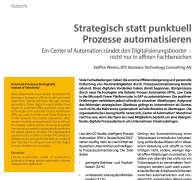
Automate Processes Strategically Instead of Selectively

Automate Processes Strategically Instead of Selectively

How and why a Center of Automation ignites the digitization booster—not only in related fields
Steffen Weiers
Many departments have already recognized the enormous increase in efficiency and personnel relief from routine activities through process automation. These digital thought leaders have begun to automate office processes using new technologies such as Robotic Process Automation (RPA), low code in the Microsoft Power Platform or in SAP. However, the positive experiences often remain in individual departments. Due to the lack of a strategic superstructure, companies as a whole have not yet succeeded in systematically transferring the added values to all areas. The organizational solution for this is called a "Center of Automation". Sometimes it is enough for the team to consist of two members to bring an overarching, digital process mindset into a company. (Only in German)
Industrie 4.0 Management | Volume 39 | 2023 | Edition 1 | Pages 58-62
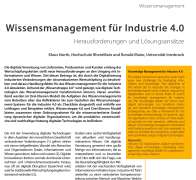
Knowledge Management for Industry 4.0

Knowledge Management for Industry 4.0

Herausforderungen und Lösungsansätze
Klaus North, Ronald Maier
The digital interactions along the value chain pose new challenges for managing information and knowledge. The objectives of this article are to describe the changes in knowledge-based value creation induced by digitalisation and to derive fields of action for knowledge management for Industry 4.0. The “knowledge ladder 4.0” shows how digital technologies can transform strategic and operative knowledge management. Subsequently, we offer a framework for the knowledge-oriented design of dynamic digital organisations that consists of three layers of activities for the operation, reflection and design of knowledge management illustrated with leading questions and case examples in order to promote the productive, responsible and sustainable usage of digital technologies.
Industrie 4.0 Management | Volume 35 | 2019 | Edition 2 | Pages 7-12
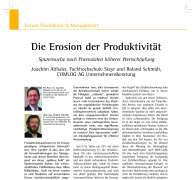
Productivity Erosion – The Quest for Greater Value

Productivity Erosion - The Quest for Greater Value

Spurensuche nach Potenzialen höherer Wertschöpfung
Joachim Althaler, Roland Schmidt
Increased productivity is a fundamental paradigm of successful business. No wonder management efforts are focused primarily on this “golden calf” of the market economy. There are enough scientific publications dealing with this topic to fill libraries. Never before have we seen so many students educated in the field of Economics at university level. Despite knowing a great deal about tools, methods and procedures, at the place where value is created we continue to think about the same questions and the same productivity deficits: Why is it that companies continue to lose the ability to maintain lean, productive processes in spite of having access to all instruments in the field of Economics? Why do many companies permit the growth of unproductive performance even though they have just introduced controlling instruments to prevent this from happening? Why is it so difficult to achieve significant, sustainable productivity growth even though companies often have access to a broad ...
Industrie Management | Volume 29 | 2013 | Edition 3 | Pages 52-55
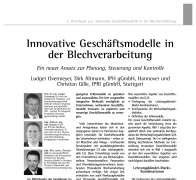
Innovative Business Models for the Sheet Metal Forming Industry

Innovative Business Models for the Sheet Metal Forming Industry

Ein neuer Ansatz zur Planung, Steuerung und Kontrolle
Ludger Overmeyer, Dirk Altmann, Christian Gille
The creation and configuration of innovative business models within the sheet metal forming industry focuses on the development of saleable product-service-combinations. It is necessary to integrate these product-service-combinations in adequate value chain configurations. To charge the output of the product-service-combinations appropriate revenue models must be selected and configured. This article shows an integrative methodology for redesigning existing and creating new business models.
Industrie Management | Volume 24 | 2008 | Edition 5 | Pages 9-12
Germany as Industrial Location – Even in Germany Money Can Be Earned!

Germany as Industrial Location - Even in Germany Money Can Be Earned!

Auch in Deutschland lässt sich Geld verdienen!
Horst Wildemann
Although the relocation trend has slightly decreased during the last five years, nowadays more companies plan to shift abroad in the near future. In particular small- and medium-sized companies plan the relocation of parts of their value chain. The disadvantage of the German location can only be compensated by a combination of cost optimization and an increase of productivity. A systematic procedure and the application of sophisticated evaluation tools support the company in its process of decision making. Considering the type of business, guidelines for competitive value chain management can be developed.
Industrie Management | Volume 22 | 2006 | Edition 1 | Pages 15-18