Transforming Under Pressure |
An analysis of coping strategies along the value chain in agriculture

| Journal | Industry 4.0 Science |
| Issue | Volume 40, 2024, Edition 5, Pages 99-106 |
| Open Access | https://doi.org/10.30844/I4SE.24.5.99 |
| Bibliography | Share | Cite | Download |
Abstract
Keywords
Article
Sustainability goals foster pressure to change
The organizational transformation of manufacturing firms is taking place in a field of tension with expectations and regulations at the social and market level and is characterized by new options for the design of value chains [1-4]. Moving towards a sustainable value chain, collaboration between stakeholders is emphasized as one of the key drivers [5]. It remains underexplored how firms can overcome the challenges arising from the interdependencies during transformation [6]. This contribution, using the example of agriculture, examines how farms manage the challenges of transformation and activate resources along the value chain to cope with the multi-faceted demands.
The agricultural sector is currently facing several challenges at the same time. Climatic conditions are changing, making agricultural production more difficult in many cases and in some cases even completely paralyzing it (e.g. looking back at the heavy rainfall in summer 2023) [7]. In addition, new legal framework conditions such as the European Green Deal, are constantly causing pressure to change [8]. Not forgetting the changing demands of consumers to which the stakeholders in the value chain, including farm managers, must respond [9].
With over 250,000 farms and almost one million employees, agriculture still plays a role in the German economy [10]. Agriculture is both socially important, as it ensures the food supply, and economically important, and closely interlinked with other sectors of the economy, such as the manufacture of agricultural machinery [8, 11]. A successful transformation of farms can only take place if all stakeholders along the value chain work together [6, 8].
It is particularly useful to examine the significance of environmental, social and governmental stakeholders, as these are playing an increasingly important role for businesses in various sectors in order to position themselves successfully on the market [3-5]. This is why agriculture is a good example for exploring the multi-faceted transformation that is currently taking place [12].
The study proceeds as follows: First, the characteristics of farms are categorized from a business perspective and the multi-stakeholder constellation of agricultural value creation is discussed. Then, based on a quantitative and qualitative study, the significance of the internal and external challenges for farms and their related protagonists is elaborated. From the results, implications are derived for farms and manufacturing firms.
Stakeholder management as a strategy for transformation in agriculture
The agricultural value chain is complex and requires the interplay of various stakeholders to ensure that food ultimately reaches households and thus consumers in the desired quality. Farms are undoubtedly the main hub to produce food [8, 9, 13]. In Germany, most agricultural work is still carried out by farm managers and their family members [10]. The agricultural sector is therefore representative of the German economy, in which almost nine out of ten farms are family businesses [14].
Agriculture is a very seasonal business that is particularly dependent on climate conditions. As a result, a lot of work is carried out by contractors who are employed by farms, particularly at harvest time, in order to cope with the high workload during these periods. Thus, the average number of employees per farm is comparatively low at 3.6 [10]. Due to the small size of farms, farm managers are responsible for a wide range of tasks, not only at a strategic but also at an operational level. They have to combine expertise in the fields of agriculture, business and stakeholder management and, increasingly, digitalization in order to successfully position their business on the market and in the value chain [8, 15].
Efforts to move towards sustainable agriculture are having an impact on all three areas of expertise [7]. In fact, farm managers need to build up and continuously develop a profound understanding of the regulatory framework conditions under which agricultural value creation can currently take place, what potential for digital technologies exists on their farms, and how they can tap into this potential [8].
As a result, the value creation process is in a state of flux. The efforts towards a more sustainable production are essential under the current conditions to ensure long-term competitiveness, regardless of whether farms or manufacturing companies in general are considered [6-7].
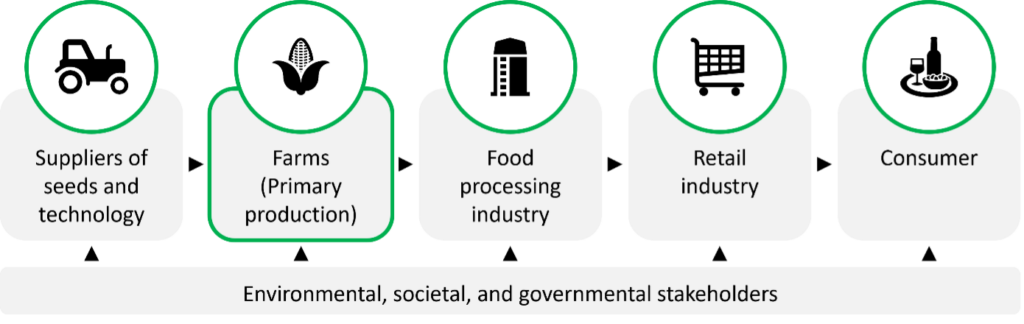
The transformation process puts farm managers in a situation in which they not only have to keep an eye on their own business, but also consider that the actions of one stakeholder have an impact on other stakeholders in the value chain. Agricultural value creation begins with stakeholders responsible for the supply of seeds and technology, which contribute as input factors to in-field operations on farms.
The subsequent steps of transportation, food processing and storage, packaging and handling (food processing industry) as well as distribution and retail (retail industry) then help to ensure that the food produced reaches consumers. Accordingly, farms are part of a B2B network [9, 13].
In addition to the related stakeholders of the value chain, considerations regarding the requirements and framework conditions placed on agriculture by environmental, social and governmental stakeholders must also be taken into account. It is particularly important to note the pressure that consumers exert on farms. Although they are not in direct contact from a value chain perspective (apart from farm stores or other forms of direct sales), it is the changing consumer demand that presents farms with the challenge of creating sustainable agricultural value in an economically viable way (Figure 1) [8-9, 16].
As already mentioned, the transformation goes beyond the farm as the main stakeholder, and extends to the entire value chain, which also changes the constellation of stakeholders [8, 13, 17]. In fact, there is reason to believe that the interdependent relationships along the value chain are evolving. Based on stakeholder theory [18] it can be argued that farms can contribute to sustainable value creation by an active management of stakeholders. To do so, farms must become aware of the fact that they are influenced by other stakeholders but can also exert an influence on them. In this regard, it is critical to first understand the main challenges farm managers are facing in the course of transformation and to identify the stakeholders that exert a particular influence on them.
In combination with an understanding of the extent to which farms can influence these stakeholders, implications can be derived as to how farms can activate resources along value chains in order to meet the transformation challenges.
Analysis based on survey and interview study
A quantitative and qualitative study was conducted to gain an understanding of how farms can manage the challenges of transformation and how they can activate resources along the value chain. Both studies were carried out as part of the project “Experimentierfeld Agro-Nordwest” funded by the BMEL.
The quantitative study aimed to gain an insight into the current challenges farms are facing and their assessed their ability to overcome them. Other aspects such as the understanding of the digital transformation and society’s view of agriculture were also considered. All items were measured with a 7-point Likert scale ranging from strongly disagree to strongly agree.
Overall, 123 farm managers from Germany took part in the online survey between September 2020 and February 2021. The sample is predominantly made up of male farm managers (87.0%). The majority of respondents had a high school diploma (47.2%) and a university degree (63.4%). The farm of most respondents is conventional agriculture (91.0%) on a full-time basis (80.3%). Small, medium-sized and larger farms are represented in the sample, either engaged in crop production (46.7%), animal husbandry (8.2%) or mixed farms (45.1%).
In addition, a qualitative interview study supplemented by an image-laying technique was conducted to substantiate a stakeholder analysis in the agricultural value network. In total, 15 expert interviews with interviewees from research, agricultural services, finance, chambers, farms and associations from the German agricultural sector were conducted right before the Covid-19 pandemic between February and March 2020. The aim was to understand the interdependencies and farmers’ scope of action within the agricultural value network. The data was evaluated based on a qualitative content analysis and the findings were summarized in a stakeholder map categorizing the influence of agent along the supply chain and farmers’ possibility to influence them in a strategic relevant manner [18].
Enhancing coping capabilities along the supply chain through stakeholder management
One of the main findings of the quantitative study (for more details see [19]) was that farms are exposed to a wide range of external pressures. Political requirements (5.74 M, 1.56 SD), economic pressure (5.42 M, 1.76 SD), the demands of society (5.11 M, 1.54 SD) and consumer preferences (4.36 M, 1.72 SD) are estimated as highly demanding triggers of change. In contrast, the effects of generational change in the farm (3.89 M, 2.20 SD), digitalization (3.90 M, 1.73 SD) or the food industry (3.97 M, 1.99 SD) are perceived as less decisive.
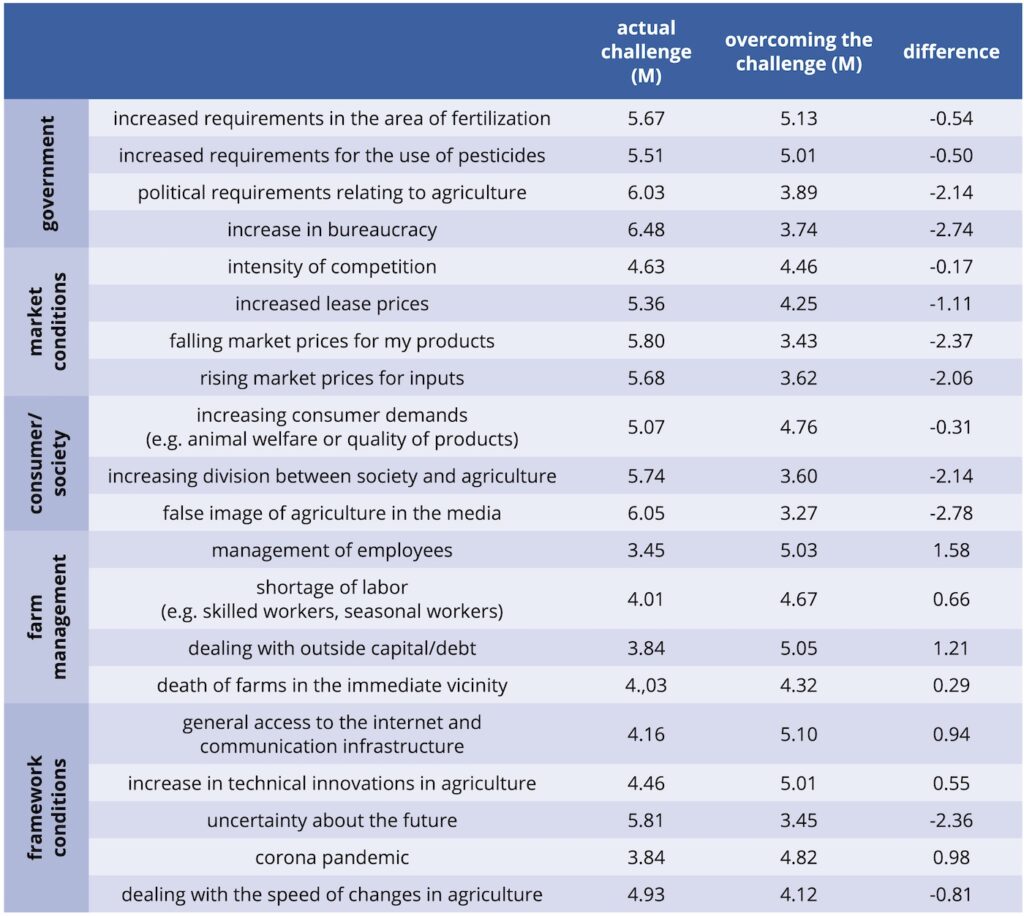
In terms of perceived coping capabilities, the results show that external challenges are perceived as less manageable, especially with respect to government and market conditions, but also with respect to society and consumers. These include challenges such as increasing bureaucracy, falling market prices for products, but also what farmers perceive as a “false image” of agriculture in society. In contrast, internal farm challenges are considered as manageable. These comprise the shortage of labor, technical innovations/digitalization or employee management (Figure 2). Obviously, there is a discrepancy between the assessed severity of the challenges and the assessment of the related coping ability. Merely, the increasing demands of consumers represent a smaller discrepancy.
The stakeholder analysis (for more details see [20]) reveals considerable differences between stakeholders’ influence on farms and their ability to be influenced by farms (Figure 3). Stakeholders who are firmly integrated into the agricultural value chain through manufacturers, the food industry, the retail trade and consumers have a high level of influence on farms and can only be influenced to a limited extent themselves (quadrant 4). Therefore, stakeholders who are not directly involved in the value chain, such as insurance companies or machine rings, can be assigned to other quadrants.
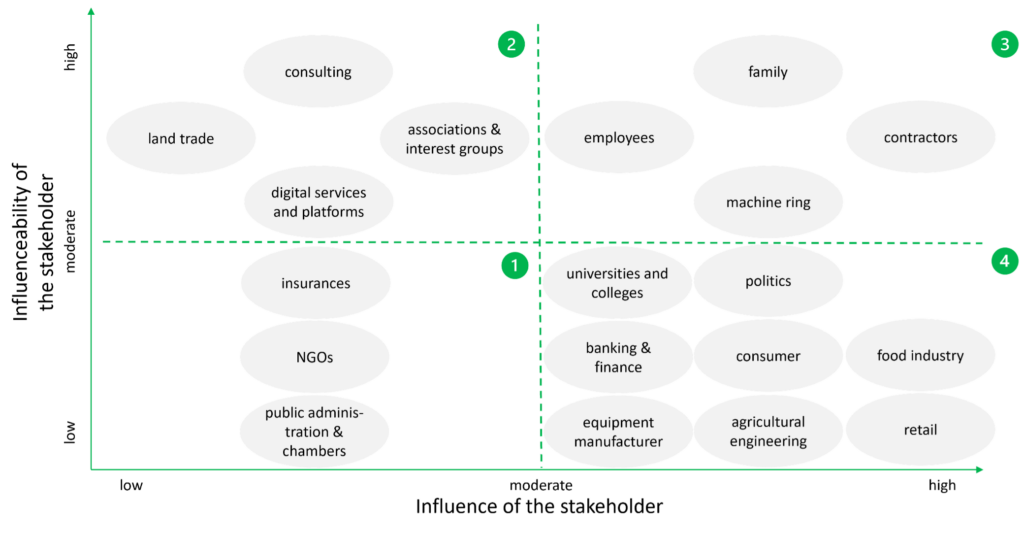
The combination of the challenges of transformation and the results of the stakeholder analysis shows that the pressure for change comes primarily from government and societal stakeholders. These include stakeholders from politics, public administrations, chambers or consumers, who, according to the experts, influence farms to varying degrees, with the greatest influence coming from politics and consumers. At the same time, these are stakeholders on whom farms can only have a small influence. Stakeholders who focus on internal farm aspects, such as the family or employees, are stakeholders that can be strongly influenced by the farms (see quadrant 3). It therefore seems not surprising that these stakeholders are associated with challenges that farms can handle well.
The main stakeholders in the value chain are mainly assigned to quadrant four and are associated with challenges that farms consider less manageable. Although these stakeholders have a high influence on farms but farms cannot influence them, the experts define two factors to deal with them: (1) promoting the relationship between the stakeholders through digitalization and (2) merging several agricultural companies in the interaction with stakeholders. For effective value creation, the various stakeholders must work together successfully.
Fostering the multi-stakeholder constellation
By linking the findings, it becomes obvious why some challenges for farms are considered manageable and others are not. The stakeholder analysis reveals which transformation challenges farms can address with the help of a stakeholder management. Promoting (1) relationship management through digitalization and (2) merging farms are key starting points for meeting external challenges in particular.
- Promoting relationship management using digital technologies can mainly help in the downstream sector. The food industry, retail and consumers face a variety of challenges (e.g. increasing consumer demands, society’s false image of agriculture, falling market prices for products) [9, 16]. Possible practical measures can range from public digital farm days, farm vacations and (digital) farm stores to the use of social media to bring agriculture closer to society. Although farms are primarily in direct contact with the food industry and retailers (B2B) and less with the end consumer [8-9, 16], farms can use digital technologies to update the image that consumers have of agriculture. In this way, consumers can regain trust in agricultural products. However, the effect of these considerations will only be fully realized if stakeholders from the food industry and retailers also make their contribution. This could be achieved by actively promoting the (regional) origin of food.
- One way to meet the challenges (e.g. rising market prices of inputs, intensity of competition) triggered by upstream stakeholders, which are associated with the manufacturing of equipment or agricultural engineering, would be the strategic merger of farms. Cooperation between several farms or between farms and contractors can facilitate the exchange of operational resources and open new deployment options. By doing so, these stakeholders can somewhat absorb the influence of the manufacturers that supply seeds and technologies on farms. At the same time, it can be more beneficial for such a manufacturer to enter into a partnership with an association of farms than with an individual farm.
The solutions to overcome challenges through cooperation with stakeholders could also be helpful for manufacturing SMEs.
- With a view to promoting relationship management in the downstream sector, digitalization can be seen as a bridge in overcoming challenges. Digital technologies can be used to strengthen B2B relationships but also enable more sustainable production [5], thus better meeting the demands of society.
- At the same time, strategic cooperation with other organizations in the upstream area can also be helpful, for example, to use resources more sustainably. Particular attention is paid not only to external resources, but above all to internal (human) resources. Especially with a view to the current skilled labor situation, organizations need to increase their employer attractiveness. Strategic cooperation can, for example, be used to implement projects such as a canteen or other incentives for employees that could prove difficult to implement for a single organization.
The example of agriculture clearly shows that the targeted activation of resources along the value chain and cooperation with stakeholders can make a decisive contribution to more sustainable production.
The joint transformation
The study shows that in increasingly networked economic relationships, the interaction between the stakeholders involved in a value chain is becoming more and more important to meet the challenges of the current times. In using the example of agricultural value creation, it becomes clear that a successful transformation is essentially based on the stakeholders involved having a deep understanding of the underlying processes and their significance for the value chain.
It is furthermore based on the corresponding framework conditions being jointly designed with the participation of a wide range of stakeholders. This insight also provides added value for other manufacturing SMEs by highlighting that it is only through the cooperation of the stakeholders involved that social reservations can be overcome and the prerequisites for successfully overcoming challenges in an increasingly complex environment can be created.
Finally, however, it should be emphasized that this study is also accompanied by limitations. One limitation is that although the qualitative study was conducted before the Covid-19 pandemic, the quantitative study took place during the pandemic, which could have potentially impacted the results of the study. In addition, the quantitative study only looked at the perspective of farms and did not include the perspective of other agricultural stakeholders. This could be the potential for a continuation of the study.
This article was produced as part of the “Experimentierfeld Agro-Nordwest”, which is funded by the Federal Office for Agriculture and Food under the reference 28DE103B22.
Bibliography
[1] Zambon, I.; Cecchini, M.; Egidi, G.; Saporito, M. G.; Colantoni, A.: Revolution 4.0: Industry vs. agriculture in a future development for SMEs. In: Processes (2019) 7, p. 36.[2] Parviainen, P.; Tihinen, M.; Kääriäinen, J.; Teppola, S.: Tackling the digitalization challenge: how to benefit from digitalization in practice. In: International journal of information systems and project management (2017) 5, pp. 63-77.
[3] Van Veldhoven, Z.; Vanthienen, J.; Digital transformation as an interaction-driven perspective between business, society, and technology. In: Electronic markets (2022) 32, pp. 629-644.
[4] Sartal, A.; Bellas, R.; Mejías, A. M.; García-Collado, A.: The sustainable manufacturing concept, evolution and opportunities within Industry 4.0: A literature review. In: Advances in Mechanical Engineering (2020) 12.
[5] Luthra, S.; Kumar, A.; Zavadskas, E. K.; Mangla, S. K.; Garza-Reyes, J. A.: Industry 4.0 as an enabler of sustainability diffusion in supply chain: an analysis of influential strength of drivers in an emerging economy. In: International Journal of Production Research (2020) 58, pp. 1505-1521.
[6] Negri, M.; Cagno, E.; Colicchia, C.; Sarkis, J.: Integrating sustainability and resilience in the supply chain: A systematic literature review and a research agenda. In: Business Strategy and the environment (2021) 30, pp. 2858-2886.
[7] Hrustek, L.: Sustainability driven by agriculture through digital transformation. In: Sustainability (2020) 12, 8596.
[8] Araújo, S. O.; Peres, R. S.; Barata, J.; Lidon, F.; Ramalho, J. C.: Characterising the agriculture 4.0 landscape—emerging trends, challenges and opportunities. In: Agronomy (2021) 11, 667.
[9] Abbasi, R.; Martinez, P.; Ahmad, R.: The digitization of agricultural industry–a systematic literature review on agriculture 4.0. In: Smart Agricultural Technology (2022) 2, 100042.
[10] Bundesministerium für Ernährung und Landwirtschaft: Agrarpolitischer Bericht der Bundesregierung 2023. URL: https://www.bmel.de/SharedDocs/Downloads/DE/Broschueren/agrarbericht-2023.pdf?__blob=publicationFile&v=9, retrieved on 17.06.2024.
[11] Dayıoğlu, M. A.; Turker, U.: Digital transformation for sustainable future-agriculture 4.0: a review. In: Journal of Agricultural Sciences (2021) 27, pp. 373-399.
[12] Porter, M. E.; Heppelmann, J. E.: How smart, connected products are transforming competition. Harvard business review (2014) 92, pp. 64-88.
[13] Routroy, S.; Behera, A.: Agriculture supply chain: A systematic review of literature and implications for future research. In: Journal of Agribusiness in Developing and Emerging Economies (2017) 7, pp. 275-302.
[14] Stiftung Familienunternehmen: Die volkswirtschaftliche Bedeutung der Familienunternehmen, 6th Edition. : ZEW Leibniz-Zentrum für Europäische Wirtschaftsforschung Mannheim and Institut für Mittelstandsforschung Mannheim. URL: https://www.familienunternehmen.de/media/pages/publikationen/die-volkswirtschaftliche-bedeutung-der-familienunternehmen-2023/5e5732bdbf-1700133949/die-volkswirtschaftliche-bedeutung-der-familienunternehmen_2023.pdf, accessed 17.06.2024.
[15] Annosi, M. C.; Brunetta, F.; Monti, A.; Nati, F.: Is the trend your friend? An analysis of technology 4.0 investment decisions in agricultural SMEs. In: Computers in industry (2019) 109, pp. 59-71.
[16] Meerburg, B. G.; Korevaar, H.; Haubenhofer, D. K.; Blom-Zandstra, M.; Van Keulen, H.: The changing role of agriculture in Dutch society. In: The Journal of Agricultural Science (2009) 147, pp. 511-521.
[17] Henriette, E.; Feki, M.; Boughzala, I.: The shape of digital transformation: A systematic literature review. In: MCIS 2015 Proceedings (2015) 10.
[18] Freeman, R. E.: Strategic Management: A Stakeholder Approach. Boston 1984.
[19] Hohagen, S.; Zaghow, L.; Wilkens, U.: Aktueller Einblick in die Arbeitswelt der Landwirtschaft – Ergebnisse einer Untersuchung unter Landwirtinnen und Landwirten (2022). URL: https://www.apf.ruhr-uni-bochum.de/wp-content/uploads/2022/06/ergebnisreport_landwirtebefragung_final.pdf, accessed 17.06.2024.
[20] Zaghow, L.; Hohagen, S.; Wilkens, U.: Stakeholder-Analyse im landwirtschaftlichen Wertschöpfungsgefüge – Bestandsaufnahme und Gestaltungsempfehlungen (2023). URL: https://www.apf.ruhr-uni-bochum.de/wp-content/uploads/2023/01/Ergebnisreport-Stakeholderanalyse_final.pdf, accessed 17.06.2024.
Your downloads
Potentials: Management
You might also be interested in