Supply Chain Management

Strategic Power Factors in Buyer Supplier Relationships

Strategic Power Factors in Buyer Supplier Relationships

Josef Oehmen, Paul Schönsleben, Max von Bredow, Philipp Gruber, Gunther Reinhart
The increasing globalization gives western companies great new opportunities. Especially China gained increasing importance as a sourcing market in the last years. Despite these opportunities, a retreat of many companies from China could be witnessed recently. Among other factors, this is due to the fact that western companies cannot exert enough influence on the performance and price of their suppliers. This article presents tools and processes to successfully face this challenge and improve the own position of power as a customer.
Industrie Management | Volume 25 | 2009 | Edition 4 | Pages 29-33
Effective Management of Business Related Services

Effective Management of Business Related Services

Using the InCoCo-S reference model
Oliver Schneider, Paul Schönsleben, Bert Lorenz
In recent years machine and plant manufacturers transformed to providers of complex after-sales services. After that transformation, many companies have problems in managing their activities effectively and efficiently. There is a lack of transparency on the not longer material driven processes. Bosch Packaging Services AG, as a provider of extensive after-sales services for the packaging machines sold by Bosch, realized the needed transparency through the development of two software tools on the basis of the InCoCo-S Reference Model, a process reference model for industrial services. Now Bosch Packaging Services is in the position to offer sustainable service contracts with adequate prices and realistic performance levels.
Industrie Management | Volume 24 | 2008 | Edition 2 | Pages 71-74
Identification of Potentialities Regarding the Value Chain Showcased for Source

Identification of Potentialities Regarding the Value Chain Showcased for Source

Peter Nyhuis ORCID Icon, Felix S. Wriggers, Tim D. Busse, Gottfried Wilhelm
To excel global players have to satisfy a multitude of requirements nowadays. Contradicting targets have to be resolved by value chain design on a regular basis, taking into consideration the complex setting of necessary decisions. This article explains how to identify and evaluate measures showcasing the source process.
Industrie Management | Volume 24 | 2008 | Edition 2 | Pages 47-49
Asymmetry in Interests with Suppliers from Germany and China

Asymmetry in Interests with Suppliers from Germany and China

Josef Oehmen, Paul Schönsleben, Max von Bredow, Gunther Reinhart
The increasing competitive pressure leads to a reduction of the depth of value creation and therefore to a rising importance of suppliers. Additionally, globalization is the cause for a tighter international network in production. Asymmetries in interests can obstruct a cooperation between companies and may endanger the commercial success. The article describes asymmetries in interests in the cooperation with local as well as Chinese suppliers.
Industrie Management | Volume 24 | 2008 | Edition 1 | Pages 31-34
Risiko-Controlling / Risk Controlling

Risiko-Controlling / Risk Controlling

Dieter Specht, Christian Mieke
Firms are acting more and more in networks, especially in industrial supply chains. Planning and controlling activities are realized in that supply chains e.g. for optimization of inventories. Apart from such advantages there are special risks in supply chains. In that case it is necessary to detect, to estimate and to regulate risks. Processes of control, alignment and regulation are not defined and established so far.
Industrie Management | Volume 23 | 2007 | Edition 6 | Pages 17-20
Available to Promise: On the way to Resilient Supply Chains

Available to Promise: On the way to Resilient Supply Chains

Auf dem Weg zu belastbaren Lieferterminen
Wolf-Rüdiger Bretzke
„Available to Promise“ can be regarded as the core concept of Supply Chain Management. It has become an integer part of modern software tools like SAP/APO and is being implemented in a growing number of companies. The author works out the potentialities and possible limitations of this concept and explains what remains to be done in order to make this risk management approach complete.
Industrie Management | Volume 23 | 2007 | Edition 5 | Pages 79-81
The impact of Supply Chain Management on the Self-Financing Power of Companies

The impact of Supply Chain Management on the Self-Financing Power of Companies

Erik Hofmann, Philip Wessely
Against the background of Basel II it gets more and more important for a company to strengthen its self-financing power to ensure liquidity. You can do this by rising sales, reducing operating expenses or shortening working capital. These levers are positively influenced by Supply Chain Management (SCM). For this reason we pick two concepts of SCM to analyse their impact on the self-financing power.
Industrie Management | Volume 23 | 2007 | Edition 5 | Pages 43-46
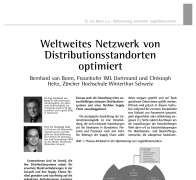
Optimization of a Worldwide Distribution Network

Optimization of a Worldwide Distribution Network

Bernhard van Bonn, Christoph Heitz
The ability of reacting to expected changes in markets in a robust manner and the design of flexible supply chains as reaction to ongoing changes and challenges helps gaining advantages for companies with these capabilities. To achieve this, the early involvement of internal and external expertise is as important as the principal underlying correct method. In this contribution the design of a robust distribution system and a flexible supply chain was as much crucial as the choice of the optimal locations in the USA and Europe.
Industrie Management | Volume 23 | 2007 | Edition 5 | Pages 71-74
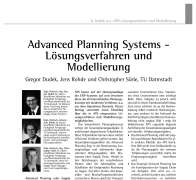
Advanced Planning Systems Solution Methods and Modelling

Advanced Planning Systems Solution Methods and Modelling

Modellierung
Gregor Dudek, Jens Rohde, Christopher Sürie
Advanced Planning or Supply Chain Planning constitutes a sub-task of Supply Chain Management. It focuses on planning of operational processes, and hence has its primary area of application in manufacturing and distribution of physical products. Advanced Planning Systems (APS) build upon databases of ERP systems. They enhance the latter by a concept of hierarchical planning which makes use of modern methods as developed in Operations Research and related fields. This article gives an overview of solution methods implemented in APS and modelling capabilities.
Industrie Management | Volume 22 | 2006 | Edition 6 | Pages 49-52
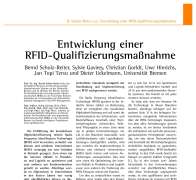
Development of a RFID Training Method

Development of a RFID Training Method

Bernd Scholz-Reiter ORCID Icon, Sylvie Gavirey, Christian Gorldt, Uwe Hinrichs, Jan Topi Tervo, Dieter Uckelmann ORCID Icon
The implementation of object-identification without contact by Radio Frequency Identification technology (RFID) is in the meantime taken into consideration by many small and medium sized enterprises (SMEs) to enhance on the one hand their internal workflows in production and logistics and on the other hand to satisfy customer demands. However, in the last years only little or superficial knowledge of this technology has been acquired. Hence, qualified and certified training for dealing with RFID is highly necessary. Process security shall thus be guaranteed internally and uniform standards within the supply chain regarding the implementation and application of RFID, can be substantiated.
Industrie Management | Volume 22 | 2006 | Edition 5 | Pages 9-11
1 4 5 6