Autor: Dieter Specht

Integrated Innovation and Maintenance Planning

Integrated Innovation and Maintenance Planning

Christian Mieke, Dieter Specht
Process innovation became more and more important for producing enterprises. Under these circumstances effective planning procedures for implementation of innovations are indispensable. The article shows possibilities of acting in this management field. The approach is atuned also for the needs and conditions of SMEs.
Industrie Management | Volume 26 | 2010 | Edition 1 | Pages 37-40
Application of MES for Generating Data

Application of MES for Generating Data

A study involving tact-oriented production systems
Dieter Specht, Renata Gruß, Thomas Schulz
Structures with historical background in industrial enterprises are often affected by a high degree of non-transparency and complexity. Reasons for this can be seen in heterogeneous processes and IT-environment. The adjustment of a tact-oriented project management system shows a possibility to achieve competitive advantages in the long-term. Other improvement potentials concerning the production process can be claimed by the application of a process-comprehensive Manufacturing Execution System (MES). Therefore an optimized adjustment of production should occur in two steps. On the one hand there has to be a tact-oriented restructuring of the production on the process level. On the other hand a MES solution, implemented on the system level, can operate as a support tool for the production.
Industrie Management | Volume 25 | 2009 | Edition 5 | Pages 51-56
Risiko-Controlling / Risk Controlling

Risiko-Controlling / Risk Controlling

Dieter Specht, Christian Mieke
Firms are acting more and more in networks, especially in industrial supply chains. Planning and controlling activities are realized in that supply chains e.g. for optimization of inventories. Apart from such advantages there are special risks in supply chains. In that case it is necessary to detect, to estimate and to regulate risks. Processes of control, alignment and regulation are not defined and established so far.
Industrie Management | Volume 23 | 2007 | Edition 6 | Pages 17-20
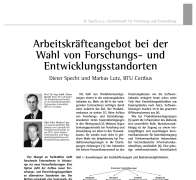
The Impact of Qualitative and Quantitative Labor Supply

The Impact of Qualitative and Quantitative Labor Supply

On the selection of sites for research and development
Dieter Specht, Markus Lutz
Experts predict a lack of skilled employees for research and development in Western Europe within the next decades. Companies, which belong to the high tech sector, look for alternative sites to establish their research and development activities. The most important criteria for this selection are the level of education and the skills of their employees. The article develops a systematic process to support the decision making.
Industrie Management | Volume 23 | 2007 | Edition 1 | Pages 27-30
Revenue Management’s Inventory Control Models for the Industry

Revenue Management’s Inventory Control Models for the Industry

Dieter Specht, Christian M.F. Gruß
20 years have gone by since the first complex Revenue Management System DINAMO (Dynamic Allocation and Maintenance Optimizer) has been applied for an integrated price and capacity control. From then on Revenue Management has established itself as a planning- or rather as a decision-instrument for acceptance/rejection problems mainly within the service industry. Airlines, car rentals and hotels particularly use this instrument. Until today only a few authors have discussed the possibility to assign Revenue Management also to the industry [1 - 4].
Industrie Management | Volume 21 | 2005 | Edition 5 | Pages 57-60
The Organisation-Oriented Analysis of Weak Spots as a Support System for Innovations in Structures and Processes

The Organisation-Oriented Analysis of Weak Spots as a Support System for Innovations in Structures and Processes

Dieter Specht, Christian Mieke, Markus Lutz
A wide definition of weak spots does not only allow analysing the possibilities for technical or technological improvements and innovations, but it is the basis for innovations in the companies’ organization. If a weak spot exists due to disrespect of the normative organizational structure, the management has to enforce the acceptance of the given structure. If there is a weak spot due to any mistake in the organizational structure itself, the analysis of weak spots in the organizational system provides a basis for process optimizations.
Industrie Management | Volume 21 | 2005 | Edition 3 | Pages 33-35
Strategic Flexibility by Technology Control

Strategic Flexibility by Technology Control

Dieter Specht, Stefan Behrens, Christian Mieke
An effective technology control system is helpful for preserving potentials of flexibility. The product technology portfolio is a suitable technique for reviewing effective and efficient applications of technologies. The results are basis for decisions in technology management of firms.
Industrie Management | Volume 20 | 2004 | Edition 2 | Pages 51-54
Methods of Technological Forecasting

Methods of Technological Forecasting

Scenario Technique in Comparison to Roadmapping
Dieter Specht, Christian Mieke, Stefan Behrens
Technologies have influence upon competitive ability of enterprises in global and increasing competition. Espe-cially enterprises of so called high tech branches suffer from shorter product life cycles but longer periods of development. Enterprises in developed branches are threatened by technologies that may substitute the existing ones. In these circumstances an effective knowledge management and systematic technological forecasting with methodic support strengthen the competitive ability of the enterprise. Scenario technique and roadmapping are methods that register technological trends and reproduce the knowledge about technological development. In this article the suitability of the methods is assessed and both are integrated. The combination of scenario technique and roadmapping can use the advantages of both methods.
Industrie Management | Volume 19 | 2003 | Edition 3 | Pages 71-74