Supply Chain Management

Adaptive Network Production by Collaborative Demand and Capacity Management

Adaptive Network Production by Collaborative Demand and Capacity Management

A Decentralized and Collaborative Approach for Inter-organizational Networks
Tobias Hegmanns
The article deals with the topic of demand and capacity management in inter-organizational production networks. It addresses the question how firms can coordinate build-up as well as reduction of the capacities of their production resources. For this purpose a decentralized negotiation-based coordination mechanism is presented. By this production networks are enabled to synchronize their capacities without the help of a central coordinator. The coordinating effect of the proposed decentralized planning approach was proven also in comparison to existing centralized network planning methods.
Industrie Management | Volume 27 | 2011 | Edition 3 | Pages 25-28
A New Approach for Handling Perturbations in Supply Chains

A New Approach for Handling Perturbations in Supply Chains

Bernd Scholz-Reiter ORCID Icon, Thomas Makuschewitz, Antonio G. Novaes, Enzo M. Frazzon
Dynamic production and logistics systems along supply chains have to operate smoothly with each other in order to satisfy customer demand in time. This task becomes even more challenging in the presence of perturbations affecting the systems. In order to address this challenge, information concerning capabilities and employment level should be appropriately exchanged between production and transportation systems. Nevertheless different stakeholders perform the planning and control of the individual systems, making locally bounded decisions. In this article we present a new approach for the alignment of production and transportation processes that enables an advanced handling of perturbations on the operational level. To this end we introduce a trigger that indicates when a re-planning of existing schedules becomes necessary. We also present a collaborative planning approach that allows for an advanced management of perturbations and a dynamic vehicle routing concept for the on time ...
Industrie Management | Volume 27 | 2011 | Edition 2 | Pages 19-22
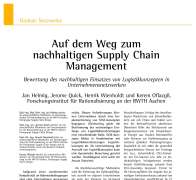
Sustainable Supply Chain Management

Sustainable Supply Chain Management

Assessment of the Sustainable Application of Logistic Concepts in Corporate Networks
Jan Helmig, Jerome Quick, Henrik Wienholdt, Kerem Oflazgil
Since the turn of the millennium companies are confronted with a tightly interwoven network consisting of changed framework conditions. Thus, for many companies it is necessary to form a network, together with a simultaneous securing of liquidity. Additionally, it is important to consider ecological values. The selection of adequate concepts in the supply chain management in combination with the right extent in logistic services poses a major challenge. However the dynamic assessment and selection of logistic concepts is quite possible. This article presents such an approach.
Industrie Management | Volume 26 | 2010 | Edition 5 | Pages 58-60
Planning Method for Cross-Company Process Management

Planning Method for Cross-Company Process Management

Bernd Scholz-Reiter ORCID Icon, Christian Meinecke, Carmen Ruthenbeck
Several logistics service providers are involved in the handling process at the seaport terminal in Bremerhaven, Germany. This process includes the arrival of the vehicles by vessel from the automotive manufacturer followed by the storage and the technical treatment ending with the transport to the automotive retailer. A cross-company approach of the complete process is necessary in order to improve the qua-lity of services and to enhance the utilization of the terminal as a holistic system. A control centre is used in order to generate information transparency. This is the basis for the development of cross-company planning and scheduling method. The simulation study was used to investigate the effectiveness of the developed method towards process and economic performance indicators of the supply chain.
Industrie Management | Volume 26 | 2010 | Edition 5 | Pages 39-42
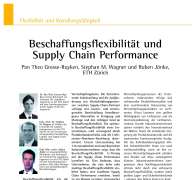
Sourcing Flexibility and Supply Chain Performance

Sourcing Flexibility and Supply Chain Performance

Pan Theo Grosse-Ruyken, Stephan M. Wagner, Ruben Jönke
Sourcing flexibility, i.e., the capability of a company’s procurement processes to respond rapidly to changing supply requirements is one of the building blocks of supply chain agility. In today’s decentralized supply chains, companies increasingly depend on their suppliers for value creation. Hence, understanding the causes and consequences of sourcing flexibility is critical. Based on a survey of 336 companies from Europe and the U.S., we show that sourcing flexibility is curvilinearly (U-shaped) related to supply chain performance. Companies with either low or high levels of sourcing flexibility exhibit high supply chain performance, whereas medium levels of sourcing flexibility reduce a company’s supply chain performance by up to 30%. That is, the “stuck in the middle” phenomenon, which is frequently observed in areas of strategy and organization, is evident in procurement decisions as well.
Industrie Management | Volume 26 | 2010 | Edition 3 | Pages 38-42
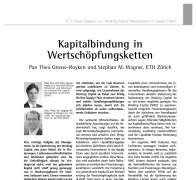
Working Capital Management in Supply Chains

Working Capital Management in Supply Chains

Pan Theo Grosse-Ruyken, Stephan M. Wagner
An optimized working capital aims to activate tied capital, capital which is frozen in account receivables and payables as well as in inventories. Often the ability to deliver anytime is a top priority for firms so that the tied capital is not optimized which increases the potential of bankruptcy in economic recessions. The potential to release tied capital can only be mastered by a tight company-wide collaboration, including the finance purchasing, production, sales and accounting department. Furthermore a holistic approach taking the whole supply chain into consideration must be realized to achieve a superior working capital performance. We show how firms can benefit from an optimal working capital in order to turn their supply chains into gold veins.
Industrie Management | Volume 25 | 2009 | Edition 6 | Pages 45-48
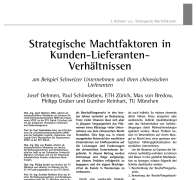
Strategic Power Factors in Buyer Supplier Relationships

Strategic Power Factors in Buyer Supplier Relationships

Josef Oehmen, Paul Schönsleben, Max von Bredow, Philipp Gruber, Gunther Reinhart
The increasing globalization gives western companies great new opportunities. Especially China gained increasing importance as a sourcing market in the last years. Despite these opportunities, a retreat of many companies from China could be witnessed recently. Among other factors, this is due to the fact that western companies cannot exert enough influence on the performance and price of their suppliers. This article presents tools and processes to successfully face this challenge and improve the own position of power as a customer.
Industrie Management | Volume 25 | 2009 | Edition 4 | Pages 29-33
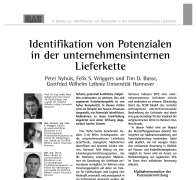
Identification of Potentialities Regarding the Value Chain Showcased for Source

Identification of Potentialities Regarding the Value Chain Showcased for Source

Peter Nyhuis ORCID Icon, Felix S. Wriggers, Tim D. Busse, Gottfried Wilhelm
To excel global players have to satisfy a multitude of requirements nowadays. Contradicting targets have to be resolved by value chain design on a regular basis, taking into consideration the complex setting of necessary decisions. This article explains how to identify and evaluate measures showcasing the source process.
Industrie Management | Volume 24 | 2008 | Edition 2 | Pages 47-49
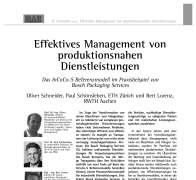
Effective Management of Business Related Services

Effective Management of Business Related Services

Using the InCoCo-S reference model
Oliver Schneider, Paul Schönsleben, Bert Lorenz
In recent years machine and plant manufacturers transformed to providers of complex after-sales services. After that transformation, many companies have problems in managing their activities effectively and efficiently. There is a lack of transparency on the not longer material driven processes. Bosch Packaging Services AG, as a provider of extensive after-sales services for the packaging machines sold by Bosch, realized the needed transparency through the development of two software tools on the basis of the InCoCo-S Reference Model, a process reference model for industrial services. Now Bosch Packaging Services is in the position to offer sustainable service contracts with adequate prices and realistic performance levels.
Industrie Management | Volume 24 | 2008 | Edition 2 | Pages 71-74
Asymmetry in Interests with Suppliers from Germany and China

Asymmetry in Interests with Suppliers from Germany and China

Josef Oehmen, Paul Schönsleben, Max von Bredow, Gunther Reinhart
The increasing competitive pressure leads to a reduction of the depth of value creation and therefore to a rising importance of suppliers. Additionally, globalization is the cause for a tighter international network in production. Asymmetries in interests can obstruct a cooperation between companies and may endanger the commercial success. The article describes asymmetries in interests in the cooperation with local as well as Chinese suppliers.
Industrie Management | Volume 24 | 2008 | Edition 1 | Pages 31-34
1 3 4 5 6