Autor: Ruben Jönke

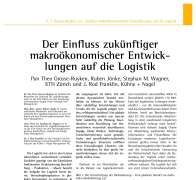
The Influence of Future Macroeconomic Developments on Logistics

The Influence of Future Macroeconomic Developments on Logistics

Pan Theo Grosse-Ruyken, Ruben Jönke, Stephan M. Wagner, J. Rod Franklin
Logistics has changed extensively in recent decades. Initially characterized by the classical functional structuring procurement - production - distribution, the task of logistics in our days is to integrate value chains into global networks. In future, logistics challenges will proceed even faster. Logisticians from science and practice estimate that the next 10 years will bring as many changes as the past 50 years. To keep pace with this dynamic change the knowledge about future developments and trends that will shape the logistics of tomorrow is key to success. From our perspective, four global core developments will significantly influence the planning, coordination and proceeding of product flows in the future: supply chain risk, technology, environment and geopolitical orientation and change of social structures. These developments open up opportunities for logistics but include also major challenges.
Industrie Management | Volume 27 | 2011 | Edition 2 | Pages 27-32
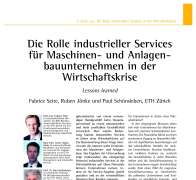
The Role of Industrial Services in Manufacturing

The Role of Industrial Services in Manufacturing

Lessons learned from the economic crisis
Fabrice Seite, Ruben Jönke, Paul Schönsleben
For many companies from the investment goods industry industrial services have evolved from a necessary prerequisite for selling a core product to a very important source of turnover and profit. But what role do industrial services play for the providing company during an economical crisis? To answer this question, the authors conducted interviews with six Swiss companies from machining and plant industry. The results of the research especially highlight the unique economic potential of industrial services. Companies may use the highlighted potential by adapting their service offering according to their customer’s economic situation.
Industrie Management | Volume 26 | 2010 | Edition 6 | Pages 57-61
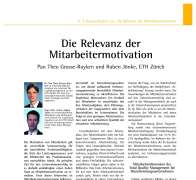
The Relevance of Employee Motivation

The Relevance of Employee Motivation

Pan Theo Grosse-Ruyken, Ruben Jönke
The motivation of employees is an essential requirement for operational efficiency, the quality of the production process and the effectiveness of the work force. Therefore the primary objective for a company’s success should be the achievement of a high degree of employment motivation and satis-faction. Nevertheless, a high motivation of employees is not a matter of course. Therefore, we empirically investigate the status quo of employee orientation and motivation of the workforce aiming to identify potential improvements with regard to a better employee orientation. The results are surprising: The majority of employees are dissatisfied with the work tasks, the leadership of the supervisors or the working atmosphere in the company. The consequence: Lower works force motivation and a poor quality of employee performance, even though in the service industries employees are key for delivering quality and results.
Industrie Management | Volume 26 | 2010 | Edition 4 | Pages 74-77
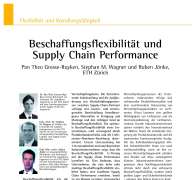
Sourcing Flexibility and Supply Chain Performance

Sourcing Flexibility and Supply Chain Performance

Pan Theo Grosse-Ruyken, Stephan M. Wagner, Ruben Jönke
Sourcing flexibility, i.e., the capability of a company’s procurement processes to respond rapidly to changing supply requirements is one of the building blocks of supply chain agility. In today’s decentralized supply chains, companies increasingly depend on their suppliers for value creation. Hence, understanding the causes and consequences of sourcing flexibility is critical. Based on a survey of 336 companies from Europe and the U.S., we show that sourcing flexibility is curvilinearly (U-shaped) related to supply chain performance. Companies with either low or high levels of sourcing flexibility exhibit high supply chain performance, whereas medium levels of sourcing flexibility reduce a company’s supply chain performance by up to 30%. That is, the “stuck in the middle” phenomenon, which is frequently observed in areas of strategy and organization, is evident in procurement decisions as well.
Industrie Management | Volume 26 | 2010 | Edition 3 | Pages 38-42
Implications of Online Trading on Tire Producers’ Sales Potentials

Implications of Online Trading on Tire Producers’ Sales Potentials

Stephan M. Wagner, Pan Theo Grosse-Ruyken, Ruben Jönke
In the tire replacement business, customers increasingly recognize and use e-Commerce as a sales and distribution channel. A survey of the ETH Zurich indicates that up to now tire producers hardly operate online platforms - even though the future growth potential of online distribution is substantial. The tire producers should react quickly and with a thought-through approach to the challenges of online trading in order to take advantage of this distribution channel. An intensive cooperation with local tire assemblers is decisive for making the online distribution channel work, because customers still require a professional tire fitting.
Industrie Management | Volume 25 | 2009 | Edition 4 | Pages 49-52