Digitalisierung

Additive Manufacturing 4.0 Learning Factory

Additive Manufacturing 4.0 Learning Factory

Digitalization for batch size 1
Fabian Riß, Nicolas Rolinck, Stefan Böhm ORCID Icon, Alessandro Morath
In the course of digitalization, collaboration between humans and machines is inevitable. This should be considered as early as possible in further training. There’s a major obstacle to this in mechanical engineering: the lack of access to the knowledge needed for success. This can have a negative impact on the acceptance of digitalized processes. A teaching and learning platform teaching digitalization on real machines does important work here.
Industry 4.0 Science | Volume 40 | 2024 | Edition 4 | Pages 57-62
Shaping Digital Change in Companies

Shaping Digital Change in Companies

Using the living lab approach and the backcasting method to develop a vision
Annalena Präger, David Koch ORCID Icon, Julia Brandt, Sebastian Schmid
Alongside sustainability, sustainability management is also gaining in importance. At the same time, digitalization continues to advance, embedded in a complex interplay of economic, ecological and social challenges. A sustainability platform that not only records relevant company data, but also ensures the necessary security, can unleash synergies between transformative trends to foster sustainable and efficient corporate development.
Industry 4.0 Science | Volume 40 | 2024 | Edition 3 | Pages 61-66
GAIA-X Maturity Model 

GAIA-X Maturity Model 

Assessing the future viability of cross-company 
data exchange
Maximilian Weiden, Jokim Janßen
In order to cope with growing customer requirements and the associated increase in complexity, companies are opening up their value chains, reducing their vertical integration and increasingly entering into collaborations. Cross-company data exchange along the supply chain is thus becoming a key component for competitiveness and the realization of customer-specific solutions. For this reason, the European Union has launched the GAIA-X project, which aims to create the next generation of data infrastructure for Europe and its companies. The GAIA-X maturity model offers an approach for classifying companies into different development stages and provides concrete requirements for further development along a predefined development path towards becoming a fully-fledged participant in the federated GAIA-X data infrastructure.
Industry 4.0 Science | Volume 40 | 2024 | Edition 3 | Pages 14-20
Federated Service Engineering

Federated Service Engineering

A development methodology for the realization of mobility applications in the Gaia-X decentralized data ecosystem
Christoph Heinbach, Michael Pahl, Oliver Thomas
The decentralized data ecosystem Gaia-X, which is currently under development, supports the future viability of the digital data economy in Europe. But how can relevant use cases be realized in Gaia-X from a service-oriented perspective? To answer this question, this article presents a methodology that describes a structured and interdisciplinary approach to service development in the ongoing Gaia-X 4 ROMS consortium research project [1]. In this project, federated services are realized in five processing steps on the basis of use cases. IT experts, software developers and industry users can leverage the model to efficiently coordinate the joint realization of use cases with Gaia-X and the goal of sovereign data exchange.
Industry 4.0 Science | Volume 40 | 2024 | Edition 2 | Pages 40-47
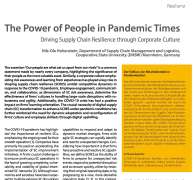
The Power of People in Pandemic Times

The Power of People in Pandemic Times

Driving Supply Chain Resilience through Corporate Culture
Nils-Ole Hohenstein
The assertion “Our people are what set us apart from our rivals” is a common statement made by nearly every company, highlighting the significance of their people as the most valuable asset. Similarly, a corporate culture emphasizing risk awareness and learning from experiences has played a key role in shaping supply chain resilience (SCRES) amidst competitive dynamics in response to the COVID-19 pandemic. Employee engagement, communication, and collaboration, as dimensions of SC risk awareness, determine the effectiveness of firms’ cultures in handling large-scale disruptions with robustness and agility. Additionally, the COVID-19 crisis has had a positive impact on firms’ learning orientation. The crucial necessity of digital supply chain (SC) transformation to enhance SCRES under pandemic conditions has further reinforced the need for dynamic adaptation and reconfiguration of firms’ culture and employee skillsets through digital upskilling.
Industrie 4.0 Management | Volume 39 | 2023 | Edition 4 | Pages 25-30 | DOI 10.30844/IM_23-4_25-30
Pragmatism for Resilient Logistics Networks

Pragmatism for Resilient Logistics Networks

Pragmatism on the road to resilient logistics networks
Michael Schröder
As a result of disruptions in the supply chain, enhancing resilience has become imperative. Upon reevaluating risks associated with the supply side, it is necessary to shift our perspective on inventory management. Drawing from proven and practical solutions, we should focus on implementing swift measures to bolster stock levels and transition from single sourcing to multiple sourcing. Furthermore, embracing digitization will significantly enhance the efficiency of the supply chain as well as the identification of faults. (Only in German)
Industrie 4.0 Management | Volume 39 | 2023 | Edition 4 | Pages 63-66
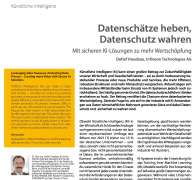
Leveraging Data Treasures, Protecting Data Privacy

Leveraging Data Treasures, Protecting Data Privacy

Adding value with secure AI solutions
Detlef Houdeau
Artificial Intelligence (AI) can make a major contribution to the future viability of our economy and society—whether by improving existing processes or new products and services that promise greater efficiency, more robust structures and more climate protection. At present, however, SMEs in particular are still reluctant to use AI systems. The frequently cited reason is that data protection hurdles appear to be too high. This article discusses the opportunities of data-based value creation. The central question is how AI applications in industry can generate economic added value from data while maintaining data protection and security.
Industrie 4.0 Management | Volume 39 | 2023 | Edition 3 | Pages 24-27
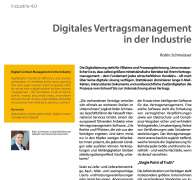
Digital Contract Management in the Industry

Digital Contract Management in the Industry

Robin Schmeisser
Digitalisation stands for efficiency and process optimisation. It is therefore all the more surprising that even larger medium-sized companies often do not yet have a digital solution for their contract management - the foundation of all economic activity. Instead, long email chains, inconsistent documents and unclear responsibilities dominate the processes from drafting to signing a contract.
Industrie 4.0 Management | Volume 39 | 2023 | Edition 3 | Pages 56-57
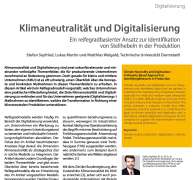
Climate Neutrality and Digitization

Climate Neutrality and Digitization

A maturity-based approach to identifying measures in production
Stefan Seyfried ORCID Icon, Lukas Martin, Matthias Weigold
Climate neutrality and digitisation are two future-relevant and interlinked topics that are gaining in importance for manufacturing companies. However, especially for small and medium-sized enterprises (SMEs), it is often difficult to get an overview of the concepts and practical measures in these fields. This article presents a maturity model that offers companies practical assistance in combining the goals of climate neutrality and digitisation and in identifying suitable (digitisation) measures for the company to support the transformation towards climate-neutral production. (Only in German)
Industrie 4.0 Management | Volume 39 | 2023 | Edition 2 | Pages 51-55
Potentials of Digital Technologies in Scope 3-Carbon Accounting

Potentials of Digital Technologies in Scope 3-Carbon Accounting

Hannah-Deborah Harbich, Johannes Schnelle ORCID Icon, Wolfgang Kersten ORCID Icon
Climate change is one of the biggest challenges facing companies. To be able to define strategies for decarbonizing their business activities, companies need to start accounting for their emissions. Calculating Scope 3 emissions is a complex, resource- intensive, and often imprecise process for companies. By using digital technologies, Scope 3 carbon accounting can become more transparent, efficient, and secure. This article highlights the potential of digital technologies in Scope 3 carbon accounting.
Industrie 4.0 Management | Volume 39 | 2023 | Edition 2 | Pages 29-32 | DOI 10.30844/IM_23-2_29-32
1 2 3 4 13