Shaping Digital Change in Companies |
Using the living lab approach and the backcasting method to develop a vision

| Journal | Industry 4.0 Science |
| Issue | Volume 40, 2024, Edition 3, Pages 61-66 |
| Bibliography | Share | Cite | Download |
Abstract
Keywords
Article
Corporate sustainability management is becoming increasingly important and sustainability aspects are becoming key factors in market competitiveness [1]. At the same time, digitalization continues to advance and taking part is also increasingly necessary for companies in order to meet the complex economic, environmental and social challenges they face [2, 3]. Digitalization offers a number of opportunities, particularly with regard to the collection, processing and interpretation of large amounts of sustainability data [4, 5].
This is where the EcoHub research project comes in, with the aim of improving the sustainability management in manufacturing companies by conceptualizing a service-oriented Hub – a kind of sustainability platform – that enables a comprehensive sustainability management system. In addition to collecting and analyzing company data connected to sustainability, the focus is also on aspects of data security and validity. The EcoHub project is funded by the German Federal Ministry of Education and Research and involves collaboration between the research institutes Fraunhofer IPA and the Wuppertal Institute, the company Conact as a partner for software development as well as numerous partners from the mechanical and plant engineering sectors and the food industry.
The EcoHub platform is being developed as an open research and innovation process in line with the living lab approach [6]. The approach involves users in the development process from the outset by implementing forms of co-creation and having users test innovations at regular intervals in practice in order to obtain important feedback and achieve further development together [7, 8, 9]. In the EcoHub project, this development process began with the creation of a vision that was shared by all participants despite the differences in their companies and objectives. This article describes the visioning process for the development of EcoHub and the relevance of a shared vision for the successful realization of innovations and change processes in companies.
Why a vision?
According to the definition by Rawolle and Kehr [10], visions can be understood as “positive, emotionally charged images of a desirable and at the same time achievable future for individuals, groups or organizations” [10, 11]. What is important here is the imagery of the vision and its distinctiveness. While corporate goals define concrete results, a strategy formulates the way to achieve the goals and a mission describes the core competence and business area of the company, a vision creates an image of the desired future of the company and sets the direction of the company’s development [10].
By visualizing shared ideas, corporate visions can unleash a “motivating force” [10] and innovations by triggering emotions and motivations. This creates access to unconscious motives and, as a result, generally has a positive influence on goal setting, performance and implementation, thus supporting decision-making in companies [10, 12, 13]. In addition, visions foster community and identity if they are developed and shared by all those involved. If visioning processes are designed in a participatory manner, they can fulfill further functions such as capacity building, empowerment and emancipation of stakeholders or the taking on of responsibility [13].
In sustainability management processes, visions can also create an important basis in the form of a shared understanding of sustainability [14]. This was also one of the goals set for vision development in the EcoHub project, which is why future visions and potential aspects of sustainability management in 2030 were first discussed. A special feature of the EcoHub project is the large number of very different applications and impact areas that it entails, which are being worked on in multidisciplinary teams. This is due to the fact that the practice partners come from a variety of industries (agriculture and food, paper, chemicals, metal processing and recycling) and therefore bring different problems and issues to the project.
For example, one practice partner is aiming to reduce energy and resource consumption in wire drawing production through optimized control of this metalworking process. Another wants to increase the recycled materials quota in their production by networking process monitoring and production planning. In these cases, the vision development helped to integrate the high level of diversity and the differing goals and wishes of all participants into a common vision and thus also laid the foundation for the development and recording of the empirical requirements for the EcoHub.
Vision development for the EcoHub
As a basis for vision development in the EcoHub project, five baseline studies were initially created on selected topics relevant to the course of the project. These cover the topics of stakeholder and sustainability management, processes in sustainability management, approaches and methods of sustainability management, approaches and technologies of data management in production and, finally, the topic of communication concepts and interaction design for digital solutions. As an analysis of the current situation and trends, these studies provide an overview of the content and requirements and thus form the basis for the creative phase of the visioning process.
Building on this, a two-hour vision workshop was held with the entire project consortium, in which 18 people took part. The aim of the vision workshop was to develop a vision for the EcoHub platform together with all stakeholders. The key functions identified from the analysis of the current situation and trends in the baseline studies were to be expanded to include further potential EcoHub services and ultimately to formulate a vision for the EcoHub that is shared by all members of the project consortium.
The methodological basis for the vision workshop was backcasting. This method is designed to develop visions for the future and also to model potential strategies and steps (or milestones) for achieving the vision, working backwards to the current status quo. Criteria for a sustainable and desirable future are first defined, which set the direction for the development and implementation of measures to achieve them [15, 16].
In contrast to pure forecasting, in which current trends are projected into the future, which often leads to path dependencies and is not necessarily useful for planning long-term and novel goals, backcasting proves to be the more profitable alternative [14, 16, 17]. In addition, the backcasting method is highly participatory, which means that it can be excellently embedded in the living lab approach, as it promotes social learning and can therefore contribute to social change in companies [15].
For sustainability-oriented backcasting, Broman and Robért developed the four-step, iteratively applied ABCD process as part of the “framework[s] for strategic sustainable development” [14].
The first step (A) is about raising participants’ awareness and creating a common understanding, learning the method and sustainability principles and developing a shared vision that is in line with the sustainability principles.
Next (B), the current status quo of the organization is analyzed and set in relation to the developed vision. The baseline analysis is particularly concerned with identifying how the company is currently contributing or not contributing to the vision and the sustainability principles and what the current challenges are.
In step C, the participants use creative methods, such as brainstorming, to find solutions to the identified challenges and opportunities to close the gap between the vision and the status quo.
The final step (D) deals with prioritizing the solutions found so that they can be combined into a strategic implementation plan [14, 18].
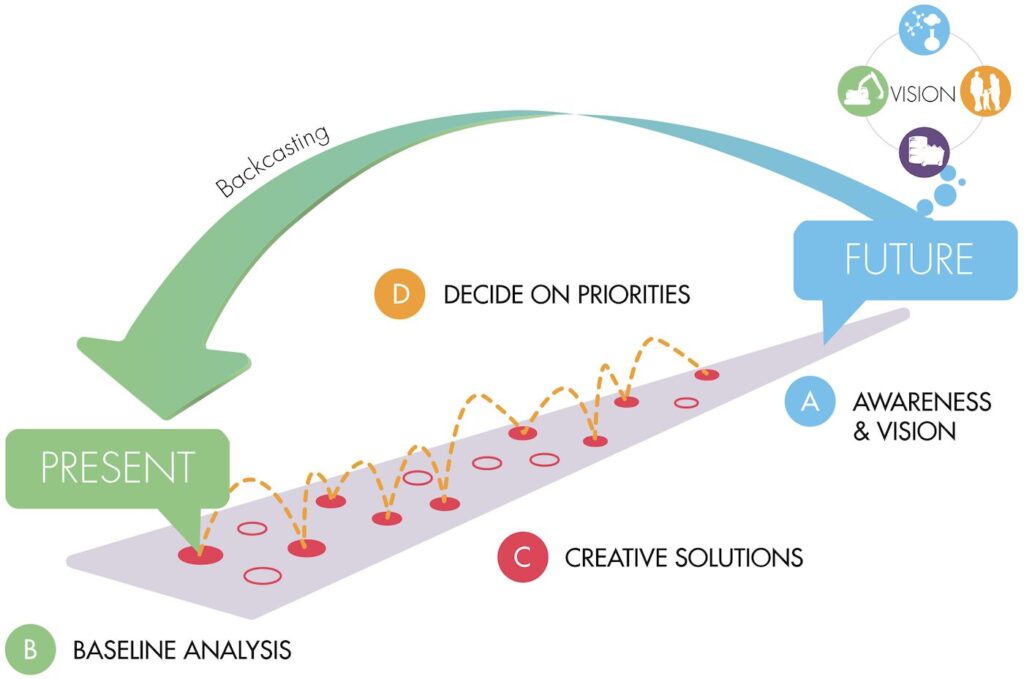
The vision workshop in the EcoHub project focused primarily on the first two steps (A and B), in which the participants dealt with the aspects of sustainability management that are relevant both now and in the future, as well as a vision for the EcoHub platform. The creative methods used were brainwriting and the formulation of vision statements, which were supported by discussions in small groups and the prioritization of aspects by allotting them points.
The result of the co-creative work phase was a list correspondingly prioritized aspects for future sustainability management and the EcoHub platform:
Aspects that will determine future sustainability management in 2030 emerged from the discussion, in particular the aspects of interfaces for connecting different data sources, digitalization and the circular economy. Aspects that determine the vision for the EcoHub are primarily the practical and user orientation as well as the ubiquity, structure and security of the data. The connection of different data sources was also considered particularly relevant with regard to the EcoHub platform.
Secondly, the joint vision was set out in a vision statement, which reads as follows: “The EcoHub is a user-friendly and secure platform for the systematic integration and provision of valid sustainability data for the company. The focus is on products and production processes. With its evaluation services, the EcoHub supports data-based sustainability management and promotes reliable decisions for sustainable corporate development” [19].
Identification of empirical requirements based on the vision
The visioning process not only served to develop the shared EcoHub vision, but also led to the identification of initial key requirements for the EcoHub, as described above. This would serve as the foundation for the empirical identification and operationalization of further requirements for an integrated data-based sustainability management system in the next phase. This phase was carried out in two steps: First, a questionnaire was used to collect basic requirements with the experts from the partner companies in a collaborative fashion. Follow-up workshops were then held with the company experts to clarify open questions and to work out details regarding data sources, data types, analysis capabilities and interfaces [20]. Figure 2 shows the procedure for determining the requirements.
The requirements identified can be divided into requirements for data acquisition and requirements for data processing. In both areas, however, the requirements vary significantly depending on the use case [20].

In terms of data collection, it can be stated that data relating to energy consumption and supply, logistics, carbon emissions, material flow, waste and production quality as well as process data and tool data must be collected, transmitted and stored. It is also important to provide a data interface that enables cross-company data exchange [20].
The requirements for data processing range from simple storage and provision of the collected data to the calculation of simple KPIs, and beyond that to the analysis of process data in order to optimize production planning and increase production efficiency as well as reduce energy and resource consumption [20].
The collected requirements were compiled in a general specification and then transferred into a functional specification, where they were prioritized and operationalized. The functional specification also contains the specific description of the development of a comprehensive and flexible data model as well as the definition of the database design and implementation and also addresses the requirements for data security and authorization concepts.
However, the data model is not rigid, but is designed as a flexible, expandable structure in which different data types can be integrated in order to adapt to changing requirements if necessary. It forms the core of the EcoHub and follows four key principles in particular:
- Modularity: Simple addition, deletion or updating of individual components.
- Entities and attributes: Mapping of basic information using entities, supplemented by additional attributes.
- Expandable key concepts: Flexible primary keys for uncomplicated integration of new data elements.
- Dynamic relationships: Dynamic adaptation of relationships between entities.
The entities and attributes can be divided into seven categories, which also serve as a structure for the data model: Company data, order data, data on assets and production, raw materials and materials, disposal, product data and universal data. In this way, both company data and sustainability data can be mapped and linked as comprehensively as possible.
Visions as a basis and compass for project work
The EcoHub project follows the innovative living lab approach and uses co-creative methods such as vision development in the form of backcasting. The results of the visioning process show that not only can a common understanding of sustainability be created through a vision, but also that a jointly developed idea of the desired end result, in this case an idea of the EcoHub platform, can be created and shared despite the widely differing use cases.
In addition, a vision can facilitate further project work by setting the direction and making relevant topics clear. In the EcoHub project, for example, the aspects from the vision workshop were included, validated and deepened in the questionnaires and follow-up workshops for formulating requirements. The aspects identified also play an important role in the development of the data model. With the help of the vision, the numerous requirements that emerged from the survey and the follow-up workshops can also be prioritized in the specifications.
The shared idea of a “secure platform”, as formulated in the vision statement, is therefore taken into account through the strong focus on data security. The desired “systematic integration” of sustainability data is also achieved through the development of entities, attributes and categories in the data model. The principles of modularity, expandability and dynamism of the EcoHub set out in the data model also enable a particularly high level of user-friendliness and future viability thanks to the flexibility this creates. These are also aspects reflected in the vision.
The example of the visioning work carried out in the EcoHub project clearly shows that visions, if they are developed co-creatively and shared by all participants, lay an important foundation for project work and can serve as a compass to guide the further course of the project. Looking ahead, EcoHub will also be evaluated on the basis of the vision by translating the prioritized aspects into evaluation criteria and tools. For example, UX tests will be carried out to assess the user-friendliness of the EcoHub platform, an aspect included in the vision statement.
The vision can therefore also provide important support at the end of the project and enable a retrospective view to be taken. The EcoHub platform will also be available to other companies once the project has been completed. The research results themselves are therefore available to the German economy as a whole, in order to leverage sustainability potential in companies.
This article was created as part of the project “Service-oriented hub for the utilization of sustainability information for manufacturing companies”, which is funded by the Federal Ministry of Education and Research as part of the “Social-ecological research” funding initiative under the reference number 02J20E528. Further information on the project, the research and the practice partners involved can be found at: www.wupperinst.org/p/wi/p/s/pd/2045.
Bibliography
[1] Löser, F.: Strategic information systems management for environmental sustainability: enhancing firm competitiveness with Green IS. Berlin 2015.[2] Baumgartner, R.J.; Ebner, D.: Corporate sustainability strategies: sustainability profiles and maturity levels. In: Sustainable Development 18 (2010) 2, pp. 76-89. DOI: 10.1002/sd.447.
[3] Miehe, R.; Waltersmann, L.; Sauer, A.; Bauernhansl, T.: Sustainable production and the role of digital twins-Basic reflections and perspectives. In: Journal of Advanced Manufacturing and Processing 3 (2021) 2, pp. 1-21. DOI: 10.1002/amp2.10078.
[4] Junker, H.; Farzad, T.: Towards Sustainability Information Systems In: Procedia Computer Science 64 (2015), pp. 1130-1139. DOI: 10.1016/j.procs.2015.08.587.
[5] Böhner, J.; Scholz, M.; Franke, J.; Sauer, A.: Integrating digitization technologies into resource efficiency driven industrial learning environments. In: Procedia Manufacturing 23 (2018), pp. 39-44. DOI: 10.1016/j.promfg.2018.03.158.
[6] Von Geibler, J.; Brandt, J.; Waltersmann, L.; Miehe, R.; Tesch, R.: Digitales Nachhaltigkeitsmanagement in Unternehmen. Ein serviceorientierter Ansatz zur Entwicklung einer Plattform für datengestütztes Nachhaltigkeitsdatenmanagement. In: Industry 4.0 Management 38 (2022) 1, pp. 45-47.
[7] Baedeker, C.et al: Interactive Design to Encourage Energy Efficiency in Offices: Developing and Testing a User-Centered Building Management System Based on a Living Lab Approach. In: Sustainability 12 (2020) 17, p. 6956. DOI: 10.3390/su12176956.
[8] Von Geibler, J.et al: Living Labs für nachhaltige Entwicklung: Potenziale einer Forschungsinfrastruktur zur Nutzerintegration in der Entwicklung von Produkten und Dienstleistungen. Wuppertal Special No. 47, Wuppertal 2013.
[9] Liedtke, C.; Baedeker, C.; Hasselkuß, M.; Rohn, H.; Grinewitschus, V.: User-integrated innovation in Sustainable LivingLabs: an experimental infrastructure for researching and developing sustainable product service systems. In: Journal of Cleaner Production 97 (2015), pp. 106-116. DOI: 10.1016/j.jclepro.2014.04.070.
[10] Rawolle, M.; Kehr, H.M.: Lust auf Zukunft Die motivierende Kraft von Unternehmensvisionen verstehen und nutzen. In: Organisationsentwicklung 4 (2012), pp. 12-17.
[11] Rawolle, M.: The motivating power of Visions: Exploring the Mechanisms. Erlangen-Nuremberg 2010. URL: open.fau.de/items/202e644c-61b8-440a-acf8-8c1f37d8cc13/full.
[12] Strasser, A.; Rawolle, M.; Kehr, H.M.: Wie Visionen wirken – Wissenschaftler untersuchen Motivation durch mentale Bilder. In: Wirtschaft Aktuell 2 (2011), pp. 9-13.
[13] Wiek, A.; Iwaniec, D.: Quality criteria for visions and visioning in sustainability science In: Sustainability Science9 (2014) 4, pp. 497-512. DOI: 10.1007/s11625-013-0208-6.
[14] Broman, G. I.; Robèrt, K.-H.: A framework for strategic sustainable development. In: Journal of Cleaner Production 140 (2017), pp. 17-31. DOI: 10.1016/j.jclepro.2015.10.121.
[15] Robinson, J.; Burch, S.; Talwar, S.; O’Shea, M.; Walsh, M.: Envisioning sustainability: Recent progress in the use of participatory backcasting approaches for sustainability research. In: Technological Forecasting and Social Change 78 (2011) 5, pp. 756-768. DOI: 10.1016/j.techfore.2010.12.006.
[16] Holmberg, J.; Robert, K.-H.: Backcasting – a framework for strategic planning. In: International Journal of Sustainable Development & World Ecology 7 (2000) 4, pp. 291-308. DOI: 10.1080/13504500009470049.
[17] Robèrt, K.-H.: Tools and concepts for sustainable development, how do they relate to a general framework for sustainable development, and to each other? In: Journal of Cleaner Production 8 (2000) 3, pp. 243-254. DOI: 10.1016/S0959-6526(00)00011-1.
[18] The Natural Step Germany: The ABCD process. URL: www.thenaturalstep.de/de/loesung/abcd-prozess/, Accessed: 09.01.2024.
[19] Präger, A.; Brandt, J.: Projekt EcoHub: Serviceorientierter Hub zur Verwertung von Nachhaltigkeitsinformation für produzierende Unternehmen. Documentation of the results of the vision workshop. Internal working document. Wuppertal 2022.
[20] Koch, D.; Waltersmann, L.; Sauer, A.: A Service-Oriented Sustainability Platform—Basic Considerations to Facilitate a Data-Based Sustainability Management System in Manufacturing Companies. In: Liewald, M.; Verl, A.; Bauernhansl, T; Möhring, H.-C. (Eds.): Production at the Leading Edge of Technology. WPG 2022 Lecture Notes in Production Engineering. Cham 2023. DOI: 10.1007/978-3-031-18318-8_78.
Your downloads
You might also be interested in