Internet of Things

Motion-Mining Compared to Traditional Lean Tools

Motion-Mining Compared to Traditional Lean Tools

Sensor-supported analysis of manual processes in manufacturing and logistics
Hendrik Appelhans, Christopher Borgmann, Carsten Feldmann
Motion-Mining® is a technology that uses motion sensors and pattern recognition to enable automated process mapping and analysis of manual work. This article evaluates the advantages and limitations of its use in manufacturing and logistics processes. To this end, Motion-Mining® is compared with traditional lean management tools used to analyze manual activities. Experiences derived from four use cases provide decision support for selecting the appropriate method for a specific use case.
Industry 4.0 Science | Volume 40 | Edition 2 | Pages 24-31
Effort and Benefits of IIoT Platforms

Effort and Benefits of IIoT Platforms

A systematic approach to identifying when to implement common use cases in SME
Rainer Eber, Steffen Schwarzer, Yannik Müller, Dennis Kollmann
SME often encounter risks and obstacles when implementing IIoT solutions, but these challenges can be mitigated with the use of an IIoT platform. To select the appropriate platform, a decision- making approach has been developed. By choosing the right use cases, companies can directly benefit from IIoT implementation and gain a competitive edge in the market. Our research indicates that at least three applications have a favorable balance between benefits and effort. Once successfully implemented, these applications can be expanded and scaled as the company becomes more digitally proficient.
Industrie 4.0 Management | Volume 39 | 2023 | Edition 5 | Pages 22-26
Bakery 4.0

Bakery 4.0

Development of an IoT framework for the automatic collection of machine, process data in medium-sized bakery operations
Abderrahim Ait Alla ORCID Icon, Frida Köning, Heiner Alsen, Joshua Coordes, Michael Freitag ORCID Icon
While the digital world has already made its way into many other production areas, the bakery industry has so far benefited little from these technological developments. This is because many baking processes are manually controlled and rely on expert knowledge. In addition, the process data from the machines is still not automatically captured via sensors. This paper describes a procedure for digitizing baking processes by developing an IoT framework consisting of an IoT device including measurement methods, an edge gateway, and a simulation-based solution for process optimization.
Industrie 4.0 Management | Volume 39 | 2023 | Edition 3 | Pages 36-40
WebAssembly for the Industrial Internet-of-Things

WebAssembly for the Industrial Internet-of-Things

Sichere, skalierbare Plattformen mit Bytecode-basierten Virtuellen Maschinen
Stefan Wallentowitz, Markus Friedrich
The industrial internet-of-things is built on heterogeneous hardware/software platforms, which vary in their architecture and performance. Virtualization is an important technology for building secure and portable applications on scalable IoT deployments. Bytecode based virtual machines are coming back into focus with WebAssembly, a technology that started in the web browser and now raises interest in other use cases. In this paper we discuss a vision of scalable WebAssembly deployments in the industrial internet-of-things.
Industrie 4.0 Management | Volume 39 | 2023 | Edition 3 | Pages 48-51 | DOI 10.30844/IM_23-3_48-51
Trends and Challenges in Factory Software

Trends and Challenges in Factory Software

Norbert Gronau ORCID Icon
Any networked information system that is used in the context of manufacturing and logistics in a factory can be referred to as factory software. This article describes six trends that will significantly influence the way software is used in factories in the near future. The trends are described in ascending order in terms of significance of impact.
Industry 4.0 Science | Volume 39 | 2023 | Edition 1 | Pages 114-119 | DOI 10.30844/I4SE.23.1.114
Information Exchange in the Maritime Supply Chain

Information Exchange in the Maritime Supply Chain

Johannes Schnelle ORCID Icon, Wolfgang Kersten ORCID Icon
Blockchain is seen as an enabler to increase the efficiency, transparency, and security of information exchange in supply chains. An important application area is maritime logistics, as blockchain facilitates the digitalization of documents and increases the efficiency of the processes. In this article, we elaborate on the example of temperature-controlled container transports the potential for adopting blockchain and the requirements to be considered from the technological and organizational environment.
Industrie 4.0 Management | Volume 38 | 2022 | Edition 6 | Pages 29-32 | DOI 10.30844/IM_22-6_29-32
Platform Economy Without a Platform

Platform Economy Without a Platform

How DAOs could make Industry 4.0 more efficient
Andreas Wagener
The application of blockchain and smart contracts also enables the building and operation of decentralized autonomous organizations (DAOs). While DAOs are already regularly in use in other areas – e. g. the financial sector − there has hardly been any application in an industrial environment, although, digitalisation and the upcoming of the "Internet of Things" have created a fruitful environment. This article looks at possible economic approaches to adaptation and explores potential business models that could result from the establishment of DAOs in Industry 4.0. (Only in German)
Industrie 4.0 Management | Volume 38 | 2022 | Edition 6 | Pages 51-53
Smart Connected Solutions

Smart Connected Solutions

Status quo, challenges and recommendations for industrial companies
Jonas Peter
As a result of dynamic markets, industrial companies often reach their limits to remain competitive. Smart connected solutions (SCS) comprise data-based and service-oriented offerings to stay successful. This paper provides practice-oriented insights into SCS maturity, challenges in building SCS business models and recommendations for action for industrial companies.
Industrie 4.0 Management | Volume 38 | 2022 | Edition 5 | Pages 57-60
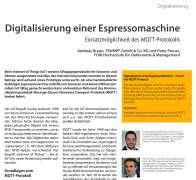
Digitalisation of an Espresso Machine

Digitalisation of an Espresso Machine

Use of the MQTT protocol
Andreas Braun, Peter Preuss
The article investigates whether a standard portafilter espresso machine can be made IoT-capable with the help of sensors and small microcontrollers and what added value the communication protocol Message Queue Telemetry Transport Protocol (MQTT) provides.
Industrie 4.0 Management | Volume 38 | 2022 | Edition 3 | Pages 53-56
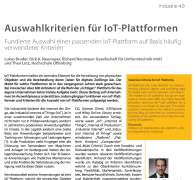
Selection Criteria for IoT Platforms

Selection Criteria for IoT Platforms

Fundierte Auswahl einer passenden IoT-Plattform auf Basis häufig verwendeter Kriterien
Lukas Bruder, Dirk A. Neumayer, Richard Neumayer, Theo Lutz ORCID Icon
IoT-Platforms are a key element for interconnecting physical objects and providing data for digital twins which represent such objects. The market for IoT platforms has grown massively in recent years. With now more than 600 providers, selecting the “right” platform for a company is no longer an easy task. This article supports companies in the selection process by providing an overview on common functionalities of IoT platforms and criteria for evaluating IoT platforms.
Industrie 4.0 Management | Volume 37 | 2021 | Edition 4 | Pages 55-58
1 2 3 7