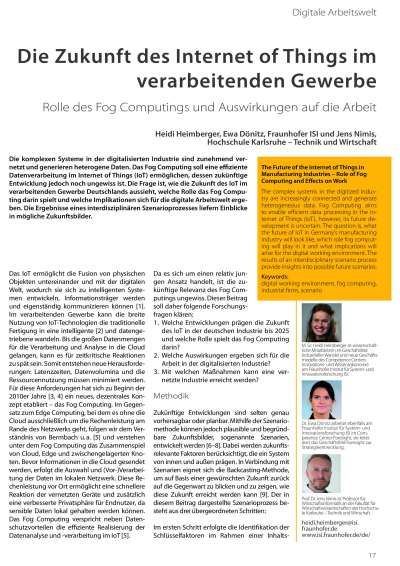
The Future of the Internet of Things in Manufacturing Industries

Role of Fog Computing and Effects on Work

JournalIndustrie 4.0 Management
Issue Volume 36, 2020, Edition 6, Pages 17-20
Share Cite Download

Abstract

The complex systems in the digitized industry are increasingly connected and generate heterogeneous data. Fog Computing aims to enable efficient data processing in the Internet of Things (IoT), however, its future development is uncertain. The question is, what the future of IoT in Germany’s manufacturing industry will look like, which role fog computing will play in it and what implications will arise for the digital working environment. The results of an interdisciplinary scenario process provide insights into possible future scenarios.

Keywords

Access limited

You are currently not logged in / not yet registered.

In order to download the desired file(s), you must be logged in and have an appropriate inclusive subscription. Alternatively, you can also obtain access by paying a one-off fee.

Subscription included Purchase
without 29,00 €
Digital 27,55 €
Expert 26,10 €
Professional 0,00 €

Download for one time 29,00 €

All prices include 7% VAT

After purchasing access rights, you will automatically be redirected back to this page.


You might also be interested in

AI Implementation in Industrial Quality Control

AI Implementation in Industrial Quality Control

A design science approach bridging technical and human factors
Erdi Ünal ORCID Icon, Kathrin Nauth ORCID Icon, Pavlos Rath-Manakidis, Jens Pöppelbuß ORCID Icon, Felix Hoenig, Christian Meske ORCID Icon
Artificial intelligence (AI) offers significant potential to enhance industrial quality control, yet successful implementation requires careful consideration of ethical and human factors. This article examines how automated surface inspection systems can be deployed to augment human capabilities while ensuring ethical integration into workflows. Through design science research, twelve stakeholders from six organizations across three continents are interviewed and twelve sociotechnical design requirements are derived. These are organized into pre-implementation and implementation/operation phases, addressing human agency, employee participation, and responsible knowledge management. Key findings include the critical importance of meaningful employee participation during pre-implementation, and maintaining human agency through experiential learning, building on existing expertise. This research contributes to ethical AI workplace implementation by providing guidelines that preserve human ...
Industry 4.0 Science | Volume 42 | 2026 | Edition 1 | Pages 120-127 | DOI 10.30844/I4SE.26.1.112
Guidelines for the Fair Use of Generative AI

Guidelines for the Fair Use of Generative AI

Practical examples from production management and social welfare
Anja Gerlmaier, Paul-Fiete Kramer ORCID Icon, Dirk Marrenbach ORCID Icon, René Wenzel ORCID Icon
With the rapid spread of assistive AI tools such as ChatGPT, Gemini, and Copilot, companies are being challenged to address the opportunities and challenges of artificial intelligence. Based on two practical examples, this article provides insight into how companies can use company-specific risk and potential analyses to develop guidelines for the fair and responsible use of AI.
Industry 4.0 Science | Volume 42 | 2026 | Edition 1 | Pages 22-28 | DOI 10.30844/I4SE.26.1.22
Enabling the Future of Manufacturing with Digital Twins

Enabling the Future of Manufacturing with Digital Twins

Opportunities and obstacles
Javad Ghofrani, Darian Lemke, Tassilo Söldner
Digital twins connect physical and digital systems, furthering efficiency, enabling predictive maintenance, and allowing the production of more customized products. Despite these advantages, challenges such as high costs, data synchronization, and security risks hinder widespread adoption. This article explores the potential of digital twins and examines key barriers to integration and implementation, also considering some industrial applications including additive manufacturing as a relevant use case.
Industry 4.0 Science | Volume 41 | Edition 3 | Pages 72-81
Open-Source and Cost-Effective Digital Twin

Open-Source and Cost-Effective Digital Twin

A case study with two weeks to succeed
Shantall Cisneros Saldana ORCID Icon, Sonali Pratap, Parth Punekar, Sampat Acharya, Heike Markus ORCID Icon
Digital Twin (DT) adoption remains a challenge due to high costs, complexity and lack of skills. This study proposes a cost-effective, TRL 5-validated DT model that can be built using open-source and office suite tools within just two weeks. Integrating real-time sensor data, predictive analytics, anomaly detection and notification, the model improves efficiency and sustainability in agriculture. Even with cloud service constraints, the system delivers a 7.76% average relative error and rapid, automated notifications. The findings show how open-source in combination with common commercial tools technologies can make advanced digital tools accessible to all, creating scalable, human-centered, and affordable solutions in line with Industry 5.0 principles.
Industry 4.0 Science | Volume 41 | Edition 3 | Pages 62-68 | DOI 10.30844/I4SE.25.3.62
Intelligent Load Carrier Management

Intelligent Load Carrier Management

AI-supported monitoring and reduction of losses in logistics
Dominik Augenstein, Lea Basler
Load carriers are essential for transporting manufactured parts in manufacturing companies. Despite their ‘simplicity’, they are usually expensive to purchase as they are manufactured expressly to fit purpose. While tracking methods such as GPS tracking can be used to prevent the loss of load carriers, this is associated with monitoring costs and presents challenges with regard to data protection as soon as the work performance of intralogistics employees is monitored. Assigning load carriers to designated clusters and monitoring these clusters provides an effective solution—without drawing conclusions about employee performance. Furthermore, artificial intelligence can optimize this approach whilst also deterring the theft of load carriers.
Industry 4.0 Science | Volume 41 | 2025 | Edition 2 | Pages 78-84
The “InTraLab” Learning Factory

The “InTraLab” Learning Factory

Gaining experience and knowledge in digitally transformed work environments
Norbert Gronau ORCID Icon, Malte Rolf Teichmann, Malte Teichmann
Learning factories offer a practical environment for simulating production processes in which learners can acquire skills through the direct application of new technologies. The Industrial Transformation Lab (InTraLab) models hybrid production processes by combining real-world demonstrators and virtual simulations. This enables learners to acquire the skills that are crucial for the digitally transformed world of work.
Industry 4.0 Science | Volume 41 | Edition 2 | Pages 46-51