Adaptability

Ten Commandments for a Successful Implementation of Digitalization Projects

Ten Commandments for a Successful Implementation of Digitalization Projects

Guidelines for Digital Transformation
Mikko Börkircher, Veit Hartmann, Tim Jeske
In many companies there is still a lack of clarity about the “right” way to implement digitalization projects. Therefore, the article describes guidelines for the successful implementation of digitalization projects. They are derived from the experience of various practical projects and include considerations of economic efficiency as well as resources and staff. Structured as “Ten Commandments for Digitalization Projects”, they are designed to support actors in the practical implementation of digitalization projects
Industrie 4.0 Management | Volume 36 | 2020 | Edition 6 | Pages 55-58
Daily.Scrum.Diverse – A Set of Rules for Agile Collaboration in a Diverse Team

Daily.Scrum.Diverse - A Set of Rules for Agile Collaboration in a Diverse Team

Vorgehensweise für agile Zusammenarbeit in einem diversen Team
Stephanie Bäuml, Uta Benner, Erdi Kan, Dawei Ni
This article is about agility, awareness and diversity in project management. In agile project management and especially in the working world 4.0, the importance of cooperation in diverse teams is emphasized again and again. Diversity does not only comprise crossing cultural, organizational and professional boundaries, but also integrating people who are sometimes excluded from communication in the working world. Deaf people belong to this group of people who are often disadvantaged regarding their job opportunities. Daily.Srum.Diverse offers a possibility to work together agilely in various teams and to bring together agility and diversity.
Industrie 4.0 Management | Volume 36 | 2020 | Edition 3 | Pages 53-56
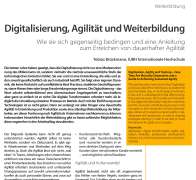
Digitization, Agility and Training

Digitization, Agility and Training

How They Are Mutually Dependent and a Guide to Achieving Sustained Agility
Tobias Brückmann
The past few years have shown that Digitization is not just a fad of the millennium, but rather the next inevitable step in technological evolution. It was and is a development that affects everything and everyone, both socially and industrially. But digital transformation requires more than just the conversion of individual processes in the company or the introduction of new technologies. Above all, it requires sustained agility in development and production, as well as ongoing employee training in order to be able to meet this demand for agility as a company.
Industrie 4.0 Management | Volume 36 | 2020 | Edition 3 | Pages 21-24
Respond to the Changing Work World with Resilience

Respond to the Changing Work World with Resilience

Operational Measures for Organizational Development
Anika Peschl, Sascha Stowasser
In times of digital transformation, it is important to counteract the associated challenges in the work world. This requires resilience and flexibility on the part of employees. Resilience has a positive effect on the health and performance of individuals. Therefore, organizations should support their employees in developing a positive attitude towards the unknown and increasing complexity, aspects that are often associated with new technologies. In this article, two exemplary corporate actions for organizational development aiming to strengthen the resilience of employees are explained.
Industrie 4.0 Management | Volume 36 | 2020 | Edition 3 | Pages 33-36
Human Work in Industrie 4.0

Human Work in Industrie 4.0

Actions to prepare enterprises for new requirements
Holger Kohl, Thomas Knothe ORCID Icon, Burkhard Schallock, Julia-Anne Scholz
Trends towards more customized products and shorter product life cycles are creating challenges, which companies are trying to meet with the use of Industrie 4.0 technologies. The digitalization and automation associated with this is causing employees in the manufacturing industry in particular to fear changes in work processes and requirements. This paper proposes four key socio-technical design measures to enable enterprises to cope with the new demands of human work in Industrie 4.0 - and thus to counteract fears. The focus is on increasing entrepreneurial agility and expanding employee skills.
Industrie 4.0 Management | Volume 35 | 2019 | Edition 6 | Pages 37-41
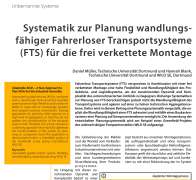
Digital Twins as Enabler for Changeable Production

Digital Twins as Enabler for Changeable Production

Realisierung einer durchgängig digitalisierten Industrie 4.0-Fertigung
Thomas Kuhn, Frank Schnicke
Today, manufacturing facilities are designed for mass-producing identical goods. Although they often have a certain flexibility, they are not fully changeable. Changes are associated with a high cost. Changeability allows producers to react more quickly to changing demand situations and to efficiently produce small quantities. The Digital Twin is a key concept for implementing the required changeability. In the reference project BaSys 4.0, funded by the German Federal Ministry of Education and Research (BMBF), we have developed a manufacturing concept that enables changeable production. Our open source middleware Eclipse BaSyx provides a reference implementation of the BaSys 4.0 concepts.
Industrie 4.0 Management | Volume 35 | 2019 | Edition 5 | Pages 13-16
Product Modularization Along the Supply Chain

Product Modularization Along the Supply Chain

How the Implementation Succeeds
Martin Brylowski, Henning Schöpper ORCID Icon, Marwin Krull
The advancing technological change, the globalization of markets as well as increasing customer requirements have led to a significant increase in complexity in manufacturing companies and their supply chains. Companies and entire value chains are countering this development with product modularization strategies. In this context, however, the investigation of the influences of product modularization on the supply chain receives little attention. This can lead to unused potentials and additional risks, such as the loss of core competencies. Therefore, this article deals with necessary processes and success factors that result from a joint consideration of product modularization along the supply chain. On the basis of a systematic analysis of scientific literature and guideline-supported expert interviews, a process model with different phases and steps was developed and currently necessary success factors were identified.
Industrie 4.0 Management | Volume 35 | 2019 | Edition 5 | Pages 50-54 | DOI 10.30844/I40M_19-5_S50-54
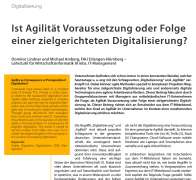
Agility as Consequence or Prerequisite of Digitization?

Agility as Consequence or Prerequisite of Digitization?

Dominic Lindner, Michael Amberg
Companies have always been in a constant state of change. This change is today closely linked to the buzzword’s “digitization” and “agility”. Agile methods, especially in complex projects, can pave the way for targeted digitization and, on the other hand, provide a more agile way of working for digital technologies. Through group discussions with managers from small and medium-sized IT companies, this article focuses on the question of whether agility is the precondition or consequence of targeted digitization. This article is aimed at decision-makers from SMEs who want to increase the degree of agility in the company in the context of increasing digitization.
Industrie 4.0 Management | Volume 35 | 2019 | Edition 4 | Pages 30-34 | DOI 10.30844/I40M_19-4_S30-34
Agile Working in Large Companies

Agile Working in Large Companies

On the Need to Unlearn
Marcel F. Volland
Many large companies are increasingly facing the pressure to meet rapidly changing customer needs and to respond quickly to new technologies. These companies often suffer from coercive bureaucracy, that is, rule rigidity. For this reason, a huge increase in alternative working practices such as agile working has been noticed lately. While it was firstly found in small business start-ups, more and more traditional companies as DAX-companies have tried to use agile working practices selectively in their development departments. However, can agile working be so simply transferred to development of traditional products?
Industrie 4.0 Management | Volume 35 | 2019 | Edition 2 | Pages 27-30 | DOI 10.30844/I40M_19-2_S27-30
The Digital Twin Theory – A New View on a Buzzword

The Digital Twin Theory - A New View on a Buzzword

Andreas Deuter, Florian Pethig
The digital twin is supposed to be a major tool for increasing productivity in the age of industrial digitalization. However, there are many heterogeneous definitions about the digital twin. This situation hardly supports the practical digital twin implementation. For this reason, the article introduces a new concept, called the Digital Twin Theory which is a theoretical framework containing several hypotheses about digital twins. The aim of the framework is a better understanding about the digital twin management in practice.
Industrie 4.0 Management | Volume 35 | 2019 | Edition 1 | Pages 27-30 | DOI 10.30844/I40M_19-1_S27-30
1 7 8 9 21