Digital Twins as Enabler for Changeable Production

Realisierung einer durchgängig digitalisierten Industrie 4.0-Fertigung

JournalIndustrie 4.0 Management
Issue Volume 35, 2019, Edition 5, Pages 13-16
Share Cite Download

Abstract

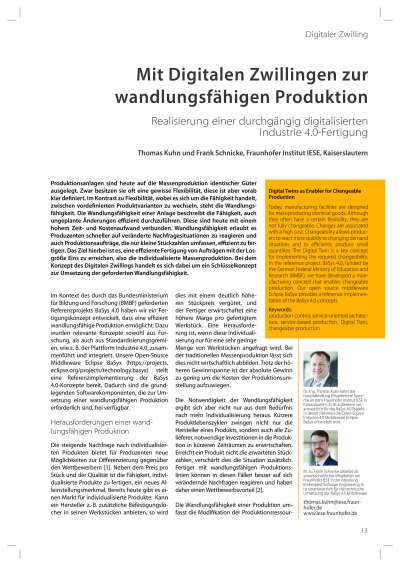
Today, manufacturing facilities are designed for mass-producing identical goods. Although they often have a certain flexibility, they are not fully changeable. Changes are associated with a high cost. Changeability allows producers to react more quickly to changing demand situations and to efficiently produce small quantities. The Digital Twin is a key concept for implementing the required changeability. In the reference project BaSys 4.0, funded by the German Federal Ministry of Education and Research (BMBF), we have developed a manufacturing concept that enables changeable production. Our open source middleware Eclipse BaSyx provides a reference implementation of the BaSys 4.0 concepts.

Keywords

Access limited

You are currently not logged in / not yet registered.

In order to download the desired file(s), you must be logged in and have an appropriate inclusive subscription. Alternatively, you can also obtain access by paying a one-off fee.

Subscription included Purchase
without 29,00 €
Digital 27,55 €
Expert 26,10 €
Professional 0,00 €

Download for one time 29,00 €

All prices include 7% VAT

After purchasing access rights, you will automatically be redirected back to this page.


Solutions: Production Control

You might also be interested in

Industry 4.0—Progress and Digitalization in Limbo

Industry 4.0—Progress and Digitalization in Limbo

Status of sustainable transformation and digitalization in production engineering
Christian Donhauser ORCID Icon, Daniel Riepl
Digitalization projects help users represent complex processes more simply and efficiently. However, there are many obstacles to implementation. Reluctance to implement these projects is palpable. This affects, among others, employers and employees, who may fall behind economically by waiting or avoiding change. These observations can be traced back to an overarching research question: What barriers and systemic challenges hinder sustainable transformation within the context of Industry 4.0, particularly when considering human labor in production engineering? What questions are the affected stakeholders asking? The primary goal of this long-term research project is to define these questions decisively and in detail in order to develop a conceptual foundation that integrates research, teaching, and technological development and thus combines the potential of digital technologies with the experiential and practical knowledge of production workers.
Industry 4.0 Science | Volume 42 | 2026 | Edition 3 | Pages 56-60
Digital Twin Technology and Architecture

Digital Twin Technology and Architecture

A synthesis of concept and practice
Arka Mukherjee ORCID Icon, Shibaji Chandra ORCID Icon
Digital twins are a key enabling technology of the fourth industrial revolution, integrating physical systems with their digital counterparts to create intelligent, data-driven environments. This conceptual/practice-oriented paper examines how to establish a modern architectural framework for digital twins leverages modern tech-stack like IoT, Data Fabric, AI/ML, seamless integration and enterprise grade security. The paper is grounded in an abundance of literature by leading vendors and analysts in space. It offers a comparative study of different vendors implementing the solution stack in the proposed architecture.
Industry 4.0 Science | Volume 42 | 2026 | Edition 3 | Pages 114-122
Developing Virtual Reality in Learning Contexts

Developing Virtual Reality in Learning Contexts

Navigating efficiency, content relevance and scalability
Stella Kanatouri ORCID Icon, Oliver Sosna ORCID Icon, Alexander Kulik, Sina C. Truckenbrodt ORCID Icon, Friederike Klan ORCID Icon, Christian Erfurth ORCID Icon
While virtual reality can facilitate hands-on learning, its development faces barriers, including high costs and time demands and scalability challenges. This article presents two case studies that illustrate strategies for overcoming such barriers when training the next generation of skilled workers in environmental technologies. By examining approaches for streamlining development and increasing content relevance and scalability, we highlight lessons learned for future practice. We conclude by envisioning a future in which educational institutions can flexibly and cost-effectively prototype virtual reality in learning contexts, ensuring alignment with curricular goals and learners’ needs.
Industry 4.0 Science | Volume 42 | Edition 3 | Pages 26-34 | DOI 10.30844/I4SE.26.3.3
Immersive Human Digital Twins for Industry 4.0

Immersive Human Digital Twins for Industry 4.0

Supporting adaptive human-centric production by integrating cognitive and physical states
Tajbeed A. Chowdhury ORCID Icon, Eric Wagner ORCID Icon, Paul Motzki ORCID Icon, Martina Lehser ORCID Icon
The rapid advancement of immersive technologies has created new opportunities to transform human-machine collaboration in industry. This paper presents an immersive platform with a digital twin that combines both physical and cognitive characteristics of human dynamics. By integrating multimodal sensing, human biomechanics, and cognitive state into digital twin technology, the proposed system enhances operational safety and ensures better ergonomics. The main argument is that human digital twins are not only desirable but essential for next-generation industrial systems. We discuss the limitations of existing human modeling approaches, outline the conceptual foundations of human digital twins, and demonstrate their industrial relevance across safety, productivity, ergonomics and sustainability.
Industry 4.0 Science | Volume 42 | 2026 | Edition 3 | Pages 6-13 | DOI 10.30844/I4SE.26.3.1
Digital Twins for Emission Reduction

Digital Twins for Emission Reduction

Ex-ante case study on a pump test bench in industrial production
Felix Bischoff, Ingela Tietze ORCID Icon, Peter Hertweck, Nina van Hasz
Digital twins are frequently referred to as a promising approach for reducing greenhouse gas (GHG) emissions in industrial production; however, robust empirical evidence of their benefits under real-world conditions is largely lacking. In this case study, the emission reduction potential of a digital twin—as a conceptually described target system—is quantified ex-ante via the example of a test bench for hydraulic pumps. To this end, the GHG emissions of the original test plan for the year 2025 are determined based on actual measured energy consumption of the tested pumps and time-resolved grid electricity emission intensities. This is followed by a rule-based rescheduling, in which energy-intensive test processes are shifted to time intervals with lower emissions. The rescheduling takes operational constraints into account so that processes and equipment remain unchanged. The savings potential is determined by comparing the GHG emissions of the reference and the optimized case.
Industry 4.0 Science | Volume 42 | 2026 | Edition 3 | Pages 16-24 | DOI 10.30844/I4SE.26.3.2
Serious Gaming and the Energy Transition

Serious Gaming and the Energy Transition

Collaborative knowledge generation and interactive understanding of complex interrelationships
Janine Gondolf ORCID Icon, Gert Mehlmann, Jörn Hartung, Bernd Schweinshaut, Anne Bauer
Conveying the complexity and multifaceted nature of the energy transition to a broad audience is a challenge. This article demonstrates how interactive serious games on a multitouch table can help make connections tangible and comprehensible. The games and the table were used in various conversational contexts. These are presented here in three case vignettes based on participant observation of the different applications, as well as situated and shared reflection. The vignettes demonstrate how interaction can trigger epistemic processes, enable shifts in perspective, and foster collective thinking, all of which are necessary for shaping the future of society as a whole.
Industry 4.0 Science | Volume 42 | 2026 | Edition 2 | Pages 62-69