Adaptability

Digital Transformation in International Conglomerates

Digital Transformation in International Conglomerates

Identification of Best Practice Solutions Using the Example of MANN+HUMMEL
Elena Haberstock, Peter Preuss
The article addresses the digital transformation in international corporations. Using the example of the MANN+HUMMEL group, it will be shown how the digital maturity level can be measured in a group with several production locations and how the transformation process can be simplified and accelerated by identifying and using group-wide best practice solutions.
Industrie 4.0 Management | Volume 38 | 2022 | Edition 1 | Pages 53-56
Industry 5.0

Industry 5.0

The European Commission on the trail of the next industrial revolution?
David Bendig, Kevin Lau, Julian Schulte, Stefan Endriß
Managers are still facing significant challenges in implementing Industry 4.0 technologies and many companies have not gone beyond their initial Industry 4.0 lighthouse project to date. In the midst of this ongoing transformation, the European Commission published a white paper in January 2021 dealing with the “Industry 5.0 concept”. This paper investigates the term “Industry 5.0” with regard to the contribution of the European Commission and illustrates the connection with current Industry 4.0 initiatives.
Industrie 4.0 Management | Volume 37 | 2021 | Edition 6 | Pages 20-22 | DOI 10.30844/I40M_21-6_S20-22
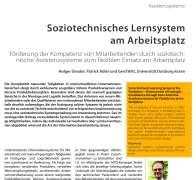
Socio-Technical Learning System at the Workplace

Socio-Technical Learning System at the Workplace

Enhancement of Employee Competence through Socio-Technical Assistance Systems for Flexible Use at the Workplace
Holger Dander ORCID Icon, Patrick Adler, Gerd Witt
The complexity of manual activities in different areas of a company is increasing due to smaller batch sizes, higher product variants and shorter product life cycles. The balanced provision of information ensures shorter training times, higher acceptance among employees and can be used directly at the workplace. For system implementation, organizational factors must also be considered in accordance of a socio-technical system design.
Industrie 4.0 Management | Volume 37 | 2021 | Edition 6 | Pages 47-51 | DOI 10.30844/I40M_21-6_S47-51
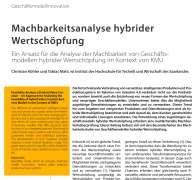
Feasibility Analysis of Hybrid Value Creation − An Approach for Analysing the Feasibility of Hybrid Value Creation Business Models in the Context of SMEs

Feasibility Analysis of Hybrid Value Creation − An Approach for Analysing the Feasibility of Hybrid Value Creation Business Models in the Context of SMEs

Ein Ansatz für die Analyse der Machbarkeit von Geschäfts-modellen hybrider Wertschöpfung im Kontext von KMU
Christian Köhler, Tobias Mahl
The diffusion of networked, intelligent products and production goods within the framework of Industry 4.0 is not only changing production, but is also causing the emergence of new forms of value creation and new types of business models that offer products and services in an integrated manner. This trend is called hybrid value creation and aims to offer customers holistic and individual solutions. The development of such business models requires a multi-criterial feasibility study. This paper deals with the specifics of the feasibility study of hybrid value creation business models.
Industrie 4.0 Management | Volume 37 | 2021 | Edition 5 | Pages 16-20 | DOI 10.30844/I40M_21-5_S16-20
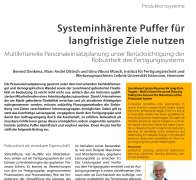
Use Inherent System Reserves for Long-Term Targets

Use Inherent System Reserves for Long-Term Targets

Multi-Criteria Personnel Planning Taking into Account the Robustness of the Production System
Berend Denkena, Marc-André Dittrich, Gina Vibora Münch
Companies sometimes miss opportunities to pursue long-term people-related targets despite short-term performance targets. There is a lack of a measurable variable that shows possibilities for the pursuit of person-related targets. This paper will therefore present an approach based on a simulation-based robustness analysis that makes it possible to integrate long-term targets into production planning. By identifying critical workplaces and determining the tolerable change in the planned personnel deployment, possibilities are shown for pursuing long-term people-related targets.
Industrie 4.0 Management | Volume 37 | 2021 | Edition 4 | Pages 59-62
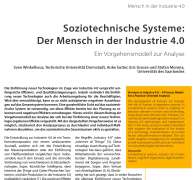
Humans in Industry 4.0

Humans in Industry 4.0

A process model for a practice-oriented analysis
Sven Winkelhaus, Anke Sutter, Eric Grosse ORCID Icon, Stefan Morana
The development of Industry 4.0 changes the role of humans in operations systems. In sociotechnical systems, there is ongoing interaction between humans and technology, impacting human life and work. However, human factors are broadly ignored in research on Industry 4.0 technologies and implementation. In this work, a process model is described that supports the evaluation of the impact of a technology implementation on human factors and performance indicators. This can avoid negative consequences for employees as well as phantom profits and can contribute to a successful digital transformation.
Industrie 4.0 Management | Volume 37 | 2021 | Edition 3 | Pages 45-48 | DOI 10.30844/I40M_21-3_S45-48
Self-Healing Systems – Towards Systems Resilience

Self-Healing Systems - Towards Systems Resilience

Ein Konzept zur Steigerung der Resilienz und Autonomie
Michael Hillebrand, Sebastian von Enzberg, Otthein Herzog
Applications such as mobile or industrial robotics gain increasing autonomous capabilities. Autonomous systems can adapt dynamically to user goals, perceive the environment and solve complex tasks without human intervention. During operation, unsafe system states may occur in a priori unknown scenarios, which can lead to an impairment or a safety risk. Self-healing is an inherent and necessary property of these systems. In this article, we present an architecture of self-healing systems. Using the example of an autonomous mobile robot, we present the results and possible application in a smart factory.
Industrie 4.0 Management | Volume 37 | 2021 | Edition 2 | Pages 12-16
Interactive Situation Picture for Crisis Management

Interactive Situation Picture for Crisis Management

A tool for process-oriented companies
Holger Kohl, Thomas Knothe ORCID Icon, Nicole Oertwig ORCID Icon, Patrick Gering, Julia-Anne Scholz
The SARS-CoV-2-crisis has brought many companies into existential distress. The sudden loss of suppliers and customers as well as short-term changes in regulations and relevant information sources pose challenges for companies. The linking and visualization of information from the corporate environment with internal capabilities remain an unsolved problem. This article shows how a situation picture can help companies to act in a goal-oriented manner.
Industrie 4.0 Management | Volume 37 | 2021 | Edition 1 | Pages 37-40
Crowdsourcing for Industrial Innovations − Solutions and Challenges for SMEs

Crowdsourcing for Industrial Innovations − Solutions and Challenges for SMEs

Christof Thim, André Ullrich ORCID Icon, Felix Eigelshoven, Norbert Gronau ORCID Icon, Ann-Carolin Ritter
Innovation activity in the industrial environment is shifting towards product-service systems as a result of digitalisation. Small and medium-sized enterprises have so far focused their development activities strongly on product development. The switch to “smart” products and the coupling to services often requires personnel and financial resources that SMEs cannot provide. Crowdsourcing is one way of opening up the innovation process to external actors and realising cost and speed advantages. However, the integration of crowdsourcing elements faces several challenges. This article shows both the potentials and the barriers of crowdsourcing in the industrial environment.
Industrie 4.0 Management | Volume 36 | 2020 | Edition 6 | Pages 9-13 | DOI 10.30844/I40M_20-6_S9-13
Competencies for Industrial Work 4.0.

Competencies for Industrial Work 4.0.

Requirements and Status Quo of the Competencies of Young Professionals in NRW
Swetlana Franken ORCID Icon
Industry 4.0 is work in progress in Germany, digital technologies such as IoT, KI, Cloud or Big Data Analytics are increasingly being introduced in companies. However, alongside technology, people and organisation are the central success factors of digital transformation. Further training, lifelong learning, agile organisation and corporate culture are becoming increasingly important in companies. Study results on the competence requirements for industrial work 4.0 show that in addition to IT and technical skills, openness, overview knowledge, interdisciplinary cooperation and agility are also required. Young professionals from NRW largely understand the importance of these competences, but show significant deficits in many of them, especially in digital competences, interdisciplinary cooperation and agility. It is necessary to promote these competences in a targeted manner during studies and further education.
Industrie 4.0 Management | Volume 36 | 2020 | Edition 6 | Pages 21-24
1 6 7 8 21