Logistics

Dynamic Routing for Logistics Companies

Dynamic Routing for Logistics Companies

Matthias Klumpp
Dynamic routing is a major research topic for logistics service providers and based on satellite navigation systems. The major challenge in operational business practice applications is the dynamic high-performance analysis of GPS data with individual depots and vehicles in logistics - and the acceptance and use by logistics employees in administration and truck driver roles. Therefore this contribution outlines a basic design of a software and process system for these application areas in order to evaluate the first estimates regarding the overall business value of GPS-based dynamic routing in logistics.
Industrie Management | Volume 31 | 2015 | Edition 2 | Pages 33-36
Lean Information Economy as Challenge of Modern Industry

Lean Information Economy as Challenge of Modern Industry

Einsatz der Lean-Philosophie zur Identifizierung wertschöpfender Informationen
Susanne Altendorfer-Kaiser, Johannes Kapeller, Georg Judmaier
The information economy is characterized by an excessive supply of data and information, which makes it difficult to establish an optimal information management. Therefore, this paper deals with the challenge of how an efficient information logistics can be established. An approach using the lean philosophy for identification and categorization of information is presented. The paper concludes with a practical use case example outlining the feasibilty of this approach.
Industrie Management | Volume 31 | 2015 | Edition 2 | Pages 19-22
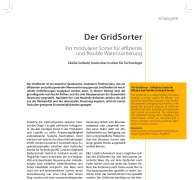
The GridSorter – A Modular Sorter for Efficient and Flexible Sorting of Goods

The GridSorter - A Modular Sorter for Efficient and Flexible Sorting of Goods

Ein modularer Sorter für effiziente und flexible Warensortierung
Zäzilia Seibold
The GridSorter is a decentralized controlled, modular conveyor system for efficient and space-saving sorting of goods. It can be flexibly adapted to changing requirements. In this article, the technical structure of GridSorter and the three main processes of its decentralized control are presented. The advantages and limitations arising from modularity and decentralized control are described and a short conclusion concerning potential application scenarios is drawn.
Industrie Management | Volume 31 | 2015 | Edition 1 | Pages 25-28
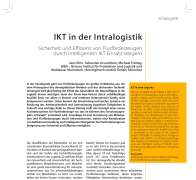
ICT in Intra-Logistics

ICT in Intra-Logistics

Sicherheit und Effizienz von Flurförderzeugen durch intelligenten IKT-Einsatz steigern
Jens Ehm, Sebastian Grundstein ORCID Icon, Michael Freitag ORCID Icon, Waldemar Marinitsch
The use of forklift trucks implies a high risk of accidents in intra-logistics. Due to the demographic change and the forthcoming skilled worker shortage, it becomes more and more important for logistics companies to preserve the health of their workers, since the loss of know-how can often not be compensated especially in small and medium-sized enterprises. Therefore, the development of new technologies, that raise safety and efficiency and that support cognitive ability in working environments, will become increasingly important in the future. This article presents the concept of an assistance system for forklift trucks that is developed in the scope of the research project “IntraSafe”. It is based on a linkage of workers and forklifts via infrared technology that enables a combination of collision avoidance and intelligent routing of forklift trucks for increasing safety and efficiency of logistics processes.
Industrie Management | Volume 31 | 2015 | Edition 1 | Pages 17-20
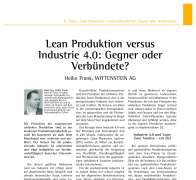
Lean Production vs. Industry 4.0: Opponents or Allies?

Lean Production vs. Industry 4.0: Opponents or Allies?

Heiko Frank
The principles of the so-called lean production are widely used and established in the modern production landscape. The benefits for the manufacturing industry are undisputed, and contribute significantly to the competitiveness of German companies. The current discussion regarding Industry 4.0 is mostly on an academic basis and examples are often theoretical. To date, practical illustrative examples are realized under laboratory conditions without an adequate proof of usability under real-world conditions. In principle, Cyber-Physical Systems have the potential to increase the effectiveness of established Lean Production principles.
Industrie Management | Volume 30 | 2014 | Edition 6 | Pages 17-20
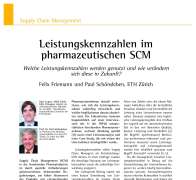
Key Performance Indicators within Pharmaceutical SCM

Key Performance Indicators within Pharmaceutical SCM

Welche Leistungskennzahlen werden genutzt und wie verändern sich diese in Zukunft?
Felix Friemann, Paul Schönsleben
Supply chain management (SCM) within the researching pharmaceutical industry is characterized by specific requirements: Especially regulations, a high value of the products with corresponding requirements on (anti counterfeit -) security and long cycle times characterize this industry. This article shows which key performance indicators supply chain managers at the biggest researching pharmaceutical companies use currently, how they change in the future and which implications can be derived from that. The findings mainly base on an interview series with 11 of the global TOP20 highest-grossing, researching pharmaceutical companies (ranking according to [1]) as well as a literature analysis and a single case study conducted at one of the companies.
Industrie Management | Volume 30 | 2014 | Edition 6 | Pages 30-34
Identification of Critical Supply Chain Processes

Identification of Critical Supply Chain Processes

Ein neuer Ansatz zur proaktiven Vermeidung kritischer Situationen in Versorgungsprozessen
Stefan Maurer, Gunther Reinhart, Severin Kreuels, Verena Rabenstein
External turbulences affecting producing industries are increasing because of rising natural and geopolitical changes. Due to this extended turbulences the vulnerability of today’s highly linked and complex supply chains of producing companies is rising. In terms of avoiding actual and future instabilities, critical processes need to be designed robust and flexible and to be monitored continuously. In order to initiate the necessary actions to guarantee the security of supply, critical processes have to be identified. For the evaluation of actual or future critical processes criticality gets introduced. So the influence of extended turbulences can be identified and possible instabilities can be detected and anticipated.
Industrie Management | Volume 30 | 2014 | Edition 5 | Pages 12-16
Combined Analysis of Physical Workload and Time for Order Picking Areas

Combined Analysis of Physical Workload and Time for Order Picking Areas

Erweiterung eines Systems vorbestimmter Zeiten zur Bewertung der Mitarbeiterbelastung in Kommissioniersupermärkten
Michael Kelterborn, Claudia Burghart, Ralf Kraul, Carsten Intra, Willibald A. Günthner
In the automotive industry, picking areas - so called supermarkets - are used to supply the production with material. By supplying the material in small quantities and with high frequency supermarkets are an important enabler of just in time production. A new method is presented, which allows a quantitative evaluation of order processing time and physical workload. Using the method, design alternatives as well as existing supermarkets can be assessed quantitatively at a favorable cost-benefit ratio.
Industrie Management | Volume 30 | 2014 | Edition 5 | Pages 41-44
CEP Service Providers – Innovators of Urban Supply

CEP Service Providers - Innovators of Urban Supply

Innovationsfelder bei Kurier-, Express- und Paketdienstleistern im urbanen Kontext
Ralf Elbert, Armin Bohnhoff, Dominik Thiel, Daniel Reinhardt, Sebastian Will
Courier, express and parcel service providers (CEP service providers) have a crucial importance for the economy by handling flows of goods between businesses and private households. Challenges such as the increasing online sales, tighter delivery time requirements and growing competition along with the higher importance of environmental issues and political regulation result in an increased pressure to innovate in the CEP industry. Especially in urban areas various fields of innovation can be identified which can contribute to a more cost-efficient and environmentally friendly supply of companies and households in the city.
Industrie Management | Volume 30 | 2014 | Edition 4 | Pages 21-24
Corporate Capability Management and SMEs?

Corporate Capability Management and SMEs?

Sigrid Wenzel ORCID Icon, Thomas Gutfeld, Dennis Abel, Melanie Dölle
New and unique tasks are regularly solved in interdisciplinary and sometimes cross-company teams. Thus, the necessary expertise can be combined for the collective success of projects. In this project-specific organizational form the advantages of collective intelligence can be used. Unfortunately, the acquired additional experience in project knowledge is often not systematically rooted in the company after the project expired. There are also specific challenges of SME projects. A project-based networking of expertise in terms of Corporate Capability Management often requires new approaches and tools. The idea for a simulation-based project management with integrated logistics could be forward-looking. It is based e.g. on the development and utilization of reference plans as well as project- and logistic-scenarios. Thereby, step by step experience and process improvements can be integrated.
Industrie Management | Volume 30 | 2014 | Edition 3 | Pages 7-10
1 8 9 10 19