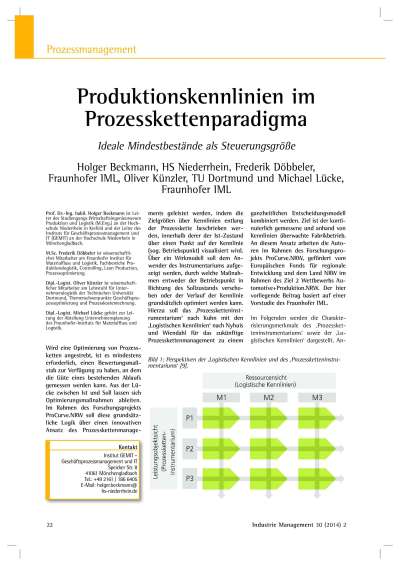
Combination of Production Characteristics Curves and the Process Chain Paradigm

Analysis of Different Perspectives

JournalIndustrie Management
Issue Volume 30, 2014, Edition 2, Pages 22-26
Share Cite Download

Abstract

Nowadays factories have to withhold an ever rising pressure to succeed. Customer demands become more demanding and goods have to be available within shorter lead times and lower prices. Flexibility, reliability and resilience are key factors for companies. Against this background, there is a need in companies for constant analysis of their business processes. This is an addition to a paper that was published in the last issue of this journal. The first part focused on the general possibility of the two methods “Dortmunder Process Chain Model” and production characteristics curves and how they could be used to analyse factories in different detail levels. In this second part the focus is set more on the perspectives that both models base on. On the one hand there is the order flow perspective of the “Dortmunder Process Chain Model” and on the other hand the resource perspective of the production characteristics curves that have to be aligned.

Keywords

Access limited

You are currently not logged in / not yet registered.

In order to download the desired file(s), you must be logged in and have an appropriate inclusive subscription. Alternatively, you can also obtain access by paying a one-off fee.

Subscription included Purchase
without 29,00 €
Digital 0,00 €
Expert 0,00 €
Professional 0,00 €

Download for one time 29,00 €

All prices include 7% VAT

After purchasing access rights, you will automatically be redirected back to this page.


Solutions: Logistics Process Management

You might also be interested in

Learning Factories for the Future of Manufacturing in Brazil

Learning Factories for the Future of Manufacturing in Brazil

Advancing manufacturing through technology and skills development
Manufacturing firms in developing countries face challenges in closing productivity gaps while adopting Industry 4.0 technologies. Learning factories are one helpful approach to countering these challenges. One such example is the learning factory Fábrica do Futuroin São Paulo, Brazil, which has engaged students, supported competence development, and collaborated with industry in applied research, functioning as a hub for advanced manufacturing initiatives.
Serious Gaming and the Energy Transition

Serious Gaming and the Energy Transition

Collaborative knowledge generation and interactive understanding of complex interrelationships
Janine Gondolf ORCID Icon, Gert Mehlmann, Jörn Hartung, Bernd Schweinshaut, Anne Bauer
Conveying the complexity and multifaceted nature of the energy transition to a broad audience is a challenge. This article demonstrates how interactive serious games on a multitouch table can help make connections tangible and comprehensible. The games and the table were used in various conversational contexts. These are presented here in three case vignettes based on participant observation of the different applications, as well as situated and shared reflection. The vignettes demonstrate how interaction can trigger epistemic processes, enable shifts in perspective, and foster collective thinking, all of which are necessary for shaping the future of society as a whole.
Industry 4.0 Science | Volume 42 | 2026 | Edition 2 | Pages 62-69
Industrial Transformation via a Machining Learning Factory

Industrial Transformation via a Machining Learning Factory

A learning module to foster competencies for a sustainability-driven transformation
Oskay Ozen ORCID Icon, Victoria Breidling ORCID Icon, Stefan Seyfried ORCID Icon, Matthias Weigold
Sustainability-enhancing transformation processes are necessary in all sectors if we are to remain within planetary boundaries. This also applies to the industrial sector as a significant emitter of greenhouse gases. Employees need new competencies to master this complex task of industrial transformation. These range from CO2 equivalents accounting to the development and evaluation of transformation scenarios, including technical measures. The learning module developed here addresses these competency requirements and uses the example of the ETA factory to show how a competency-oriented learning module for industrial transformation can be structured. It essentially comprises four phases: data collection and CO2 equivalents accounting, cause analysis, development of measures and evaluation of measures.
Industry 4.0 Science | Volume 42 | Edition 2 | Pages 38-47 | DOI 10.30844/I4SE.26.2.38
Experiencing Digital Twins in Production and Logistics

Experiencing Digital Twins in Production and Logistics

The fischertechnik® Learning Factory 4.0 as a development platform for possible expansion stages
Deike Gliem ORCID Icon, Sigrid Wenzel ORCID Icon, Jan Schickram, Tareq Albeesh
The fischertechnik® Learning Factory 4.0 has proven to be a suitable experimental environment for testing digital twins. Depending on the targeted maturity stage, the functions of a digital twin range from status monitoring and forecasting to the operational control of production and logistics systems. To systematically classify these functions, this article presents a maturity model that serves as a framework for the development of a digital twin. Building on this, selected use cases are implemented in a test and development environment based on a system architecture with multi-layered logic structure. These initial implementations serve to highlight application purposes, relevant methods, and typical challenges and potentials in the transfer to real factory environments.
Industry 4.0 Science | Volume 42 | Edition 2 | Pages 30-37 | DOI 10.30844/I4SE.26.2.30
Collaborative Robots in Production Environments

Collaborative Robots in Production Environments

Employee qualification and acceptance for human-machine interaction
Tobias Wienzek, Mathias Cuypers ORCID Icon
The introduction of new technologies poses a major challenge, especially for small and medium-sized enterprises (SMEs). At the same time, SMEs must rise to this challenge in order to keep pace technologically and economically. Employee acceptance is an important factor in ensuring that both the introduction and the long-term use of a technology are successful. At the same time, the introduction process also has a central influence on acceptance in the long term. This article uses the implementation of collaborative robotics as an example for examining such an introduction process, identifying the key factors that influence employee acceptance and the important role played by advanced employee training. It serves to highlight how the introduction process and employee training are seamlessly interlinked.
Industry 4.0 Science | Volume 42 | 2026 | Edition 2 | Pages 14-21 | DOI 10.30844/I4SE.26.2.14
XAI for Predicting and Nudging Worker Decision-Making

XAI for Predicting and Nudging Worker Decision-Making

Feasibility and perceived ethical issues
Jan-Phillip Herrmann ORCID Icon, Catharina Baier, Sven Tackenberg ORCID Icon, Verena Nitsch ORCID Icon
Explainable artificial intelligence (XAI)-based nudging, while ethically complex, may offer a favorable alternative to rigid, algorithmically generated schedules that simultaneously respects worker autonomy and improves overall scheduling performance on the shop floor. This paper presents a controlled laboratory study demonstrating the successful nudging of 28 industrial engineering students in a job shop simulation. The study shows that the observed concordance between students’ sequencing decisions and a predefined target sequence increases by 9% through nudging. This is done by using XAI to analyze students’ preferences and adjusting task deadlines and priorities in the simulation. The paper discusses the ethical issues of nudging, including potential manipulation, illusory autonomy, and reducing people to numbers. To mitigate these issues, it offers recommendations for implementing the XAI-based nudging approach in practice and highlights its strengths relative to rigid, ...
Industry 4.0 Science | Volume 42 | 2026 | Edition 1 | Pages 70-78