Logistics

Cloud-based Tool Management

Cloud-based Tool Management

Potenziale einer unternehmensübergreifenden Cloud-Lösung für ein digitales und automatisiertes Werkzeugmanagement
Marcus Röschinger, Dominik Stockenberger, Willibald A. Günthner
The networking between companies in a supply chain becomes tighter. This applies for manufacturing plants and the supply with manufacturing equipment as well. Hence, the complexity of the flow of information, in particular for tool management, increases. Currently the exchange of information is mostly paper-based and tool data is not available continuously along the supply chain. By using a digital and cloud-based tool management system, breaks in the flow of information along the supply chain for machining tools can be overcome. Herewith tool data can be called and updated ongoing and location-independent. Furthermore, after clearly identifying a tool, required tool data can automatically be transferred into the control system of the machine.
Industrie Management | Volume 30 | 2014 | Edition 3 | Pages 52-56
Combination of Production Characteristics Curves and the Process Chain Paradigm

Combination of Production Characteristics Curves and the Process Chain Paradigm

Analysis of Different Perspectives
Holger Beckmann, Frederik Döbbeler, Oliver Künzler, Michael Lücke
Nowadays factories have to withhold an ever rising pressure to succeed. Customer demands become more demanding and goods have to be available within shorter lead times and lower prices. Flexibility, reliability and resilience are key factors for companies. Against this background, there is a need in companies for constant analysis of their business processes. This is an addition to a paper that was published in the last issue of this journal. The first part focused on the general possibility of the two methods “Dortmunder Process Chain Model” and production characteristics curves and how they could be used to analyse factories in different detail levels. In this second part the focus is set more on the perspectives that both models base on. On the one hand there is the order flow perspective of the “Dortmunder Process Chain Model” and on the other hand the resource perspective of the production characteristics curves that have to be aligned.
Industrie Management | Volume 30 | 2014 | Edition 2 | Pages 22-26
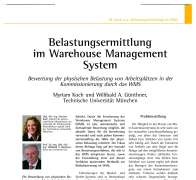
Automatic Assessment of Physical Workload in Order Picking Systems

Automatic Assessment of Physical Workload in Order Picking Systems

Bewertung der physischen Belastung von Arbeitsplätzen in der Kommissionierung durch das WMS
Myriam Koch, Willibald A. Günthner
In order picking, the workers lift, lower, push and pull variable loads. This manual handling is a common cause of musculoskeletal disorders. In order to assess the risk of musculoskeletal disorders, risk assessments in order picking are nowadays performed manually. This article presents an approach how to integrate two methods of risk assessment in warehouse management systems so the physical workload in order picking systems can be determined automatically.
Industrie Management | Volume 30 | 2014 | Edition 1 | Pages 47-50
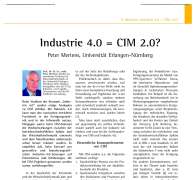
Industry 4.0 = CIM 2.0?

Industry 4.0 = CIM 2.0?

Peter Mertens
Regarding the concept „Industry 4.0“ some analogies to Computer Integrated Manufacturing (CIM) can be detected. Industry 4.0 is using technical progress in manufacturing as well as in IT while in the CIM frameworks the interdependencies between the business management and the engineering issues are analyzed more in-depth. When designing general or industry-specific Industry 4.0 solutions it is worthwhile to consider insights and experience collected with former CIM projects.
Industrie Management | Volume 30 | 2014 | Edition 1 | Pages 27-30
Combination of Production Characteristics Curves and the Process Chain Paradigm

Combination of Production Characteristics Curves and the Process Chain Paradigm

Holger Beckmann, Frederik Döbbeler, Oliver Künzler, Michael Lücke
Nowadays factories have to withhold an ever rising pressure to succeed. Customer demands become more demanding and goods have to be available within shorter lead times and lower prices. Flexibility, reliability and resilience are key factors for companies. Against this background, there is a need in companies for constant analysis of their business processes. The process perspective that was established in the industry since the 1980s will be addressed in the following by using the “Dortmunder Process Chain Model”. A permanent preparedness for change relies on being able to report about the plant’s status quo at all times. Therefore valuation methods and key figures are needed that represented by production characteristics curves in this paper. After an introduction to these two topics, the combination of both to one process based valuation method will be outlined. The intended methodology will represent a holistic decision model for plant controlling. This approach is being ...
Industrie Management | Volume 30 | 2014 | Edition 1 | Pages 22-26
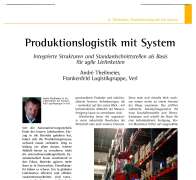
Systematic Logistics for Production

Systematic Logistics for Production

Integrierte Strukturen und Standardschnittstellen als Basis für agile Lieferketten
André Theilmeier
Automation technology moved into factories by the end of last century. Since then, production processes have changed dramatically worldwide. While companies first focused on optimizing interdepartmental collaboration, today the cross-company collaboration increasingly comes into focus. After all, in a globalized economy companies need to operate in networks. In order to cooperate efficiently and effectively in global supply chains, transparent structures and standards are indispensable. This applies first and foremost to the logistics.
Industrie Management | Volume 30 | 2014 | Edition 1 | Pages 59-62
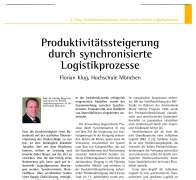
Enhanced Productivity through Synchronised Logistics Processes

Enhanced Productivity through Synchronised Logistics Processes

Florian Klug
That the pace of a rowing boat depends on time conformity of the strokes is common knowledge. Who gets out of step loses performance and does need longer to finish. What applies to a rowing team can be transferred to industrial logistics processes. Synchronised material flows between the different supply chain echelons enable an increase in throughput combined with stable processes. This paper is based on research results on the topic of „Synchronised Logistics Processes“, which have been performed at Munich University of Applied Sciences in the last couple of years. Based on already successfully applied traffic dynamics models, the crucial link between synchronisation, productivity and stability of material flows has been investigated thoroughly.
Industrie Management | Volume 30 | 2014 | Edition 1 | Pages 51-54
Detection of Critical Disruptions in Supply Chains

Detection of Critical Disruptions in Supply Chains

Jens Hartmann, Magdalena Metzger, Bernd Scholz-Reiter ORCID Icon
Nowadays, the production of many goods takes place in distributed facilities within supply chains. The production planning of single facilities is based on due dates for delivery of raw materials or intermediate products that were agreed with supply chain partners. Thus, for an efficient overall system it is of major importance that these due dates are fulfilled. However, production systems are usually subjected to disruptions that put the execution of a given schedule at risk. This paper presents a method for the signal-based detection of faults in production systems. In addition to the fault detection, a heuristic method is employed that mitigates the disruptions and leads to a reliable production.
Industrie Management | Volume 29 | 2013 | Edition 6 | Pages 26-30
Autonomously Controlled Route Planning for Rental Articles

Autonomously Controlled Route Planning for Rental Articles

Florian Harjes, Bernd Scholz-Reiter ORCID Icon
In general, rental articles circulate in closed logistic systems, where the order parameters determine the material flow. As the planning horizon often comprises several subsequent orders at different locations, the corresponding transport and route planning is a complex task. Additionally, dynamic effects, such as thefts, damages, rush orders as well as new orders or order changes complicate the proceeding. This paper introduces the concept of an autonomously controlled route planning for rental articles that bases on the Distributed Logistics Routing Protocol (DLRP). At this, an example from the field of event logistics illustrates the concept.
Industrie Management | Volume 29 | 2013 | Edition 6 | Pages 44-48
Capacity of Reaction of Logistic Networks

Capacity of Reaction of Logistic Networks

Herausforderungen und Chancen logistischer Systeme bei unvorhersehbar auftretenden Auslastungsschwankungen
Stephan Oelker, Ann-Kathrin Rohde
The complex and dynamic worldwide logistic systems are marked by the heavy dependence between the participants. Through this, local developments (especially in the economic sector) can entail unforeseeable consequences on the entire network. Furthermore, cyclical fluctuations occur at increasingly brief intervals. In times of an inconstant economic situation, the challenge arises to design processes with such flexibility or to construct the entire system in such a way, that unforeseeable market fluctuations can be reacted to in the best possible manner and that the system does not collapse. Only this can ensure the long term international competitiveness.
Industrie Management | Volume 29 | 2013 | Edition 4 | Pages 57-60
1 9 10 11 19