Autor: Willibald A. Günthner

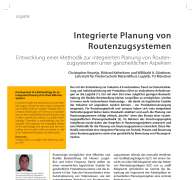
Development of a Methodology for an Integrated Planning of In-Plant Milk-Run Systems

Development of a Methodology for an Integrated Planning of In-Plant Milk-Run Systems

Entwicklung einer Methodik zur integrierten Planung von Routenzugsystemen unter ganzheitlichen Aspekten
Christopher Keuntje, Michael Kelterborn, Willibald A. Günthner
In order to meet the demands of a more flexible supply of small lot sizes, many companies use in-plant milk-run systems. Despite the increasing distribution of milk-runs, a standard has not been established yet and the planning is often carried out without a suitable methodology. Therefore, a methodology was developed that supports the integrated design of the technology, the process and the controlling of an in-plant milk-run system as well as an integrated evaluation of alternatives.
Industrie 4.0 Management | Volume 32 | 2016 | Edition 5 | Pages 32-36
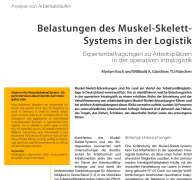
Strain on the Musculoskeletal System

Strain on the Musculoskeletal System

Expert Interviews about Operational Intralogistics Jobs
Myriam Koch, Willibald A. Günthner
Musculoskeletal disorders are responsible for about one quarter of all days of incapacity to work in Germany. In order to identify which types of strain lead to an increased risk of the emergence and aggravation of work-related musculoskeletal disorders in operational intra-logistics and to identify in which types of jobs this risk especially occurs, 30 people working in different companies were interviewed. It was discovered that almost all types of manual handling of loads (lifting, carrying, pulling and pushing), and both standing permanently as well as forced sitting are relevant.
Industrie 4.0 Management | Volume 32 | 2016 | Edition 3 | Pages 66-69
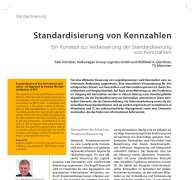
Standardization of Key Performance Indicators

Standardization of Key Performance Indicators

an Approach to Increase the Standardization of KPIs
Falk Schröder, Willibald A. Günthner
The importance of key performance indicators (KPIs) to efficiently control logistics processes is considerably rising. An essential requirement to successfully use KPIs is their comparability and consistency. In this article a review of the situation of KPIs’ standardization is used to derive nine fields of action for improving the standardization of KPIs. The first six fields are addressing the data collection, the data processing as well as the data preparation. Investments in IT and staff are vital to support these goals. On top of that the management’s support and a change in business culture that advocates the benefit of sharing information create the required setting for a standardized reporting.
Industrie 4.0 Management | Volume 32 | 2016 | Edition 2 | Pages 54-58
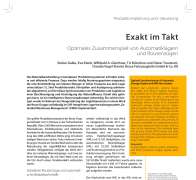
Optimal Synchronization of Automatic Storage System and Milk Run System

Optimal Synchronization of Automatic Storage System and Milk Run System

Optimales Zusammenspiel von Automatiklagern und Routenzügen
Stefan Galka, Eva Klenk, Willibald A. Günthner, Dieter Trautzsch, Claudia Vogel-Daniel
Modern lean production systems require fast, stable and efficient logistics processes to guarantee just-in-time deliveries of materials to production. For this, a new logistics concept for a plant of the Brose group was developed, which consists of an automatic small parts storage system and an in-plant milk run system. One major challenge was the synchronization of the storage system and the milk run systems in a way that both systems are operated with even utilization and that no obstructions occur between milk run trains. To this end, a timetable was implemented which determines departure times of each milk run train at the warehouse. The timetable takes into account breaks, shift changes and other relevant restrictions. The generation and monitoring of the schedules was implemented entirely in SAP EWM.
Industrie Management | Volume 31 | 2015 | Edition 2 | Pages 57-60
Combined Analysis of Physical Workload and Time for Order Picking Areas

Combined Analysis of Physical Workload and Time for Order Picking Areas

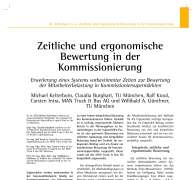
Erweiterung eines Systems vorbestimmter Zeiten zur Bewertung der Mitarbeiterbelastung in Kommissioniersupermärkten
Michael Kelterborn, Claudia Burghart, Ralf Kraul, Carsten Intra, Willibald A. Günthner
In the automotive industry, picking areas - so called supermarkets - are used to supply the production with material. By supplying the material in small quantities and with high frequency supermarkets are an important enabler of just in time production. A new method is presented, which allows a quantitative evaluation of order processing time and physical workload. Using the method, design alternatives as well as existing supermarkets can be assessed quantitatively at a favorable cost-benefit ratio.
Industrie Management | Volume 30 | 2014 | Edition 5 | Pages 41-44
Cloud-based Tool Management

Cloud-based Tool Management

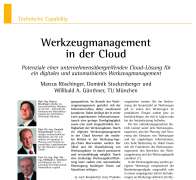
Potenziale einer unternehmensübergreifenden Cloud-Lösung für ein digitales und automatisiertes Werkzeugmanagement
Marcus Röschinger, Dominik Stockenberger, Willibald A. Günthner
The networking between companies in a supply chain becomes tighter. This applies for manufacturing plants and the supply with manufacturing equipment as well. Hence, the complexity of the flow of information, in particular for tool management, increases. Currently the exchange of information is mostly paper-based and tool data is not available continuously along the supply chain. By using a digital and cloud-based tool management system, breaks in the flow of information along the supply chain for machining tools can be overcome. Herewith tool data can be called and updated ongoing and location-independent. Furthermore, after clearly identifying a tool, required tool data can automatically be transferred into the control system of the machine.
Industrie Management | Volume 30 | 2014 | Edition 3 | Pages 52-56
Automatic Assessment of Physical Workload in Order Picking Systems

Automatic Assessment of Physical Workload in Order Picking Systems

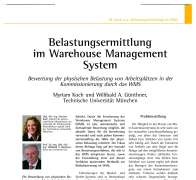
Bewertung der physischen Belastung von Arbeitsplätzen in der Kommissionierung durch das WMS
Myriam Koch, Willibald A. Günthner
In order picking, the workers lift, lower, push and pull variable loads. This manual handling is a common cause of musculoskeletal disorders. In order to assess the risk of musculoskeletal disorders, risk assessments in order picking are nowadays performed manually. This article presents an approach how to integrate two methods of risk assessment in warehouse management systems so the physical workload in order picking systems can be determined automatically.
Industrie Management | Volume 30 | 2014 | Edition 1 | Pages 47-50
Lean Supply Chain Management

Lean Supply Chain Management

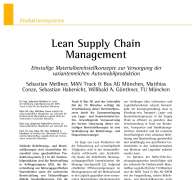
One-stage material provision concepts for automobile production
Sebastian Meißner, Matthias Conze, Sebastian Habenicht, Willibald A. Günthner
Lean material supply and provision concepts are crucial to an efficient production system. In the automobile production are common supply concepts: in-sequence material provision (JIS), vehicle specific sets and non-mixed provision. For the provision of sets containing different part clusters efficient picking processes are necessary. Picking is usually carried out in supermarkets close to the assembly line, which are replenished by warehouses. A scientific project of MAN Truck & Bus AG and the Technische Universität München aims at streamlining these processes and proposes to merge warehousing and picking stages. Prerequisite of a broad implementation of those one-stage material provision concepts is a change in the material supply and disposition strategy.
Industrie Management | Volume 28 | 2012 | Edition 6 | Pages 14-18
Preventive Anti-Counterfeiting in Mechanical Engineering

Preventive Anti-Counterfeiting in Mechanical Engineering

An approach using passive signed rfid-tags
Janina Durchholz, Dominik Stockenberger, Willibald A. Günthner
On the technical level there are different possibilities to fight counterfeiting and to prohibit the use of counterfeited parts in machinery and equipment. The aim should be to enable the machinery and equipment to recognize the exchange of wearing or the assembly of additional parts automatically and to check their originality independently. RFID offers not only the conditions to realize the suggested functions but also the possibility to check the authenti-city of products along the whole supply chain. Of course, the checking of parts along the supply chain avoids that co-pies or counterfeited goods break into the original value added chain.
Industrie Management | Volume 28 | 2012 | Edition 4 | Pages 11-14
Modularization and Dezentralization in Intralogistics

Modularization and Dezentralization in Intralogistics

From the Internet of Things to Cellular Conveyor Systems
Willibald A. Günthner, Peter Tenerowicz
Today’s systems of internal material flow must cope with high demands: an in-creasing variety and shorter innovation and product life cycles lead to difficulties in predicting order loads and structures. The order-based production is becoming increasingly important. Against this background, material handling systems have to be dynamically adjustable and thereby cause the lowest possible cost. Approaches of modularization and decentralization both in the field of control software and in the design of conveyor systems promise great potential in terms of flexibility, robustness and reusability. Technological developments in the areas of sensors, data processing and storage, communication, locating and identification support this trend and enable new, innovative solutions for transportation tasks in logistic systems - including swarm-like conveyor systems.
Industrie Management | Volume 27 | 2011 | Edition 1 | Pages 25-29
1 2