Typeset

Has the Time Come for an Energy Revolution in Intralogistics?

Has the Time Come for an Energy Revolution in Intralogistics?

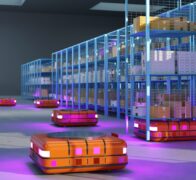
The current status of hydrogen fuel cell-powered MHE
Gustav Bösehans, Joseph W. Dörmann
Hydrogen fuel cells promise to be a sustainable alternative to fossil fuel or battery-electric material handling equipment (MHE) in various production or warehouse contexts. Short refuelling times, an absence of carbon emissions, and constant power input put fuel cell-powered MHE at an advantage in high-intensity work environments. However, various barriers to the adoption of fuel cells remain, including considerations surrounding cost and efficiency.
Industry 4.0 Science | Volume 41 | 2025 | Edition 6 | Pages 74-80
I4S 6/2025: Manufacturing in Space

I4S 6/2025: Manufacturing in Space

Infinite possibilities for industrial production?
Manufacturing is leaving Earth: what was once science fiction is becoming a strategic field for the future. Falling launch costs and new space industry players are enabling production and services under conditions that are impossible on Earth—from in-orbit maintenance to novel manufacturing processes in microgravity. This issue highlights opportunities, business models, and technological hurdles on the path to value chains in space.
Production Control in Space

Production Control in Space

An AI-supported approach for industry in orbit
Dominik Augenstein, Lara Jovic
Production in space, of semiconductors for example, offers many advantages for companies. At the same time, high transport costs mean that careful consideration must be given to the production materials being transported. The use of Kalman filters enables (real-time) control from Earth, making space production a cost-efficient option. Machine learning could make it a viable approach even for highly complex production systems.
Industry 4.0 Science | Volume 41 | 2025 | Edition 6 | Pages 22-29
Work Design for Learning and Competence Development

Work Design for Learning and Competence Development

Emerging ways of organizing and supporting learning in digitally transformed workplaces
Peter Dehnbostel
Learning and skill-enhancing work designs are essential for new work and organizational concepts such as “learning organizations” and “Industry 4.0.” Developing and applying criteria for promoting learning and skills development in digitally transformed work environments enables more effective and efficient work processes, makes work more people-centered, and the AI-based future of work more manageable. Digitalization is also introducing work-integrated learning formats such as online communities, learning platforms, and digital cognitive assistance systems that already meet many of these criteria. In the future, designing work environments that promote learning and skills development will become a central task of corporate training and personnel and organizational development.
Industry 4.0 Science | Volume 41 | 2025 | Edition 6 | Pages 58-64
Adaptive In-Orbit Servicing of Altered Satellite Components

Adaptive In-Orbit Servicing of Altered Satellite Components

Adaptive gripper placement on altered components for servicing in-orbit satellites
Justus Rein ORCID Icon, Christian Plesker ORCID Icon, Adrian Reuther ORCID Icon, Hanyu Liu ORCID Icon, Benjamin Schleich ORCID Icon
In-orbit servicing of satellites presents several challenges as the satellite hardware is exposed to external influences throughout its life cycle. These factors wear down the components and cause changes to their physical structure. In such cases, the limits of simple dis- and reassembly steps may be reached, as the gripping surfaces are no longer present or suitable. This paper proposes an approach of an adaptive grip position estimation in a CubeSat disassembly process. The relevant components are identified using CAD models and a 3D camera. The gripping positions are determined based on the geometry of the gripper and the point cloud of the component.
Industry 4.0 Science | Volume 41 | Edition 6 | Pages 10-21 | DOI 10.30844/I4SE.25.6.10
Quiz: Manufacturing in Space

Quiz: Manufacturing in Space

Test your knowledge!
Weightless production—just science fiction or already reality? Thanks to new space technologies, the first production processes are now emerging in space that enable materials and structures to be created that are virtually impossible to manufacture on Earth. From ultra-pure fibers to 3D printing of organs, weightlessness is opening up completely new perspectives for industries—and bringing space manufacturing closer to the present than many people think.
“Entrepreneurial courage is the key ingredient”

“Entrepreneurial courage is the key ingredient”

Interview with Prof. Jan Wörner, Director of the Frankfurt Institute for Advanced Studies (FIAS)
Production is leaving Earth. As access to space becomes increasingly affordable and reliable, the idea of manufacturing in space is evolving from science fiction to a real industrial strategy. In this interview, Jan Wörner, who has headed not only the German Aerospace Center (DLR) but also the European Space Agency (ESA) for many years, talks about strategic opportunities and regulatory challenges.
Potentials, Premises, Perspectives

Potentials, Premises, Perspectives

Using LLMs to reinterpret corporate knowledge management
Vanessa Kuks ORCID Icon, Pius Finkel ORCID Icon, Peter Wurster ORCID Icon
Demographic change is exacerbating the shortage of labor and skilled workers in the manufacturing industry, making knowledge management an increasingly important issue in many companies. Collecting and preserving tacit knowledge poses a particular challenge. This study examines the extent to which large language models (LLMs) can provide meaningful support in knowledge gathering through expert interviews. Three experts test and evaluate a personalized chatbot that has been developed using ChatGPT-5. The results of the interview are promising, but the summary shows room for improvement.
Industry 4.0 Science | Volume 41 | Edition 6 | Pages 48-56 | DOI 10.30844/I4SE.25.6.48
Explainable AI – XAI

Explainable AI – XAI

Making AI work in business and not just clever sounding
sponsored
European companies are investing heavily in AI. But many AI projects remain stuck in the pilot phase. The fault does not lie with the systems, but no one can explain their results. “The algorithm said so” is not a basis for costly decisions. Backwell Tech’s AI is both smart and transparent. This is how AI can give you a competitive advantage.
Electric Trucks in Intermodal Terminal Pre- and Post-Carriage

Electric Trucks in Intermodal Terminal Pre- and Post-Carriage

Impact on terminal processes in combined road-rail freight transport
Ralf Elbert, Samira Ghaneian Sebdani ORCID Icon
Electric trucks (e-trucks) play an important role in reducing CO₂ emissions especially on short distances in pre and post-carriage in combined road-rail freight transport (CT). Using the example of a CT terminal, this article highlights the logistical and energy challenges involved in using e-trucks to establish suitable charging infrastructures and ensuring a reliable power supply.
Industry 4.0 Science | Volume 41 | Edition 6 | Pages 70-77
1 3 4 5 44