Turning in Circles |
Exploiting the potential of circular economy in wind turbine operations

| Journal | Industry 4.0 Science |
| Issue | Volume 40, 2024, Edition 5, Pages 90-98 |
| Open Access | https://doi.org/10.30844/I4SE.24.5.90 |
| Bibliography | Share | Cite | Download |
Abstract
Keywords
Article
As 75% of EU greenhouse gas emissions come from energy use and production, the decarbonization of the energy sector is a crucial step towards a climate-neutral EU [1]. However, decarbonization is associated with high resource pressure, especially within the wind energy sector, as wind turbines have significantly higher material costs than other renewable energy sources (RES). At the same time, digital transformation presents a new opportunity to address these challenges. Innovative solutions are needed, combining digitalization and sustainable development, to meet this increasing resource demand and thus achieve the ambitious climate targets of the European Union [2].
The expansion of wind turbines (WTs) is accompanied by an increasing need for decommissioning, accelerated by the rapid technological progress within the wind energy sector [3, 4]. This unveils a pressing challenge tied to the End-of-Life (EoL) management of the WTs since the large structures of each WT contain more than 25.000 components and weigh several thousand tons [5, 6].
Yet, efficient EoL practices hold promise in meeting the increasing resource demands of RES, facilitating their further expansion. The wind energy sector alone is projected to recover 4.75 million tons annually by 2030, according to the European Environmental Agency [7]. However, realizing this potential necessitates overcoming numerous obstacles. Presently, the profitability and effectiveness of the EoL practices to close the circular economy gap are limited by various factors, including [8]:
- Limited stakeholder familiarity (e.g., policymakers, industry, wind farm owners) with EoL management options, their associated challenges, and opportunities
- Insufficient EoL data for Life Cycle Assessment (LCA) calculations
Therefore, the comprehensive consideration of effective strategies and assessment of the environmental impact of these becomes paramount in addressing this evolving challenge. This leads to the following research question: How can a sustainable decision-making framework for EoL treatment of onshore wind turbines be developed to effectively close the loop? The contribution of this article is, firstly, identifying current research gaps in the realms of EoL management strategies and environmental assessment concerning wind turbines. Secondly, the article synthesizes these results to propose a comprehensive digital decision-making framework for a sustainable-driven EoL selection for onshore wind turbines.
Data and methods
The research was performed via a desktop study exploiting the potential of circular economy in wind turbine operations as described in the research objectives. The data used within the comprehensive literature review is sourced from the Scopus database. Keywords such as: (“end of life” OR “end-of-life” OR “eol”) , (“circular economy” OR “CE”), (“concept” OR “strategy” OR “option” OR “method” OR “model”), (“wind” OR “wind turbine”), (“assessment” OR “evaluation” OR “selction”) were used, totaling in 264 papers focusing on (i) EoL practices and 94 papers on (ii) environmental impact assessment.
With the help of a three-stage screening process (title, abstract, full text) a total of 32 peer-reviewed journal articles, conference papers and reports were selected using the following selection criteria: (1) topics of interest (EoL management of wind turbines in Central Europe), (2) Relevance (published within the last (i) 10 or (ii) 25 years) and (3) Notability (referenced in high-quality articles or established sources).
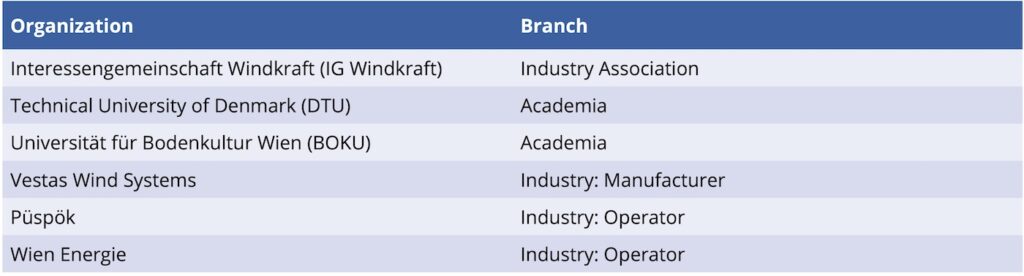
Additional insights were gained through expert interviews with key stakeholders of the wind energy sector along the value chain, as shown in Figure 1. The data used for the statistical analyses to gain some empirical insights into the composition of Austrian wind turbines was taken from an Austrian wind farm database (The Wind Power) [9].
Current research gaps
With the growing need for dismantling and renewal over the upcoming years, the EoL Management of wind turbines provides significant ecological and economical potential. Especially through the use of energy-efficient circular options such as reuse, remanufacturing and refurbishment a large amount of CO2 equivalents can be saved compared to the current state-of-the-practice of disposal (of concrete and fibre parts) and energetic recycling (metal parts) [8-10]. To facilitate achieving the objectives outlined in this study, this section offers an overview of the current state of knowledge in the two core disciplines of the research initiative and identifies current research gaps. Drawing upon the Scopus database, a comprehensive literature review is presented, addressing:
- Current EoL management practices for wind turbines
- Options for measuring the environmental impact of different EoL strategies
EoL management practices for wind turbines
As a wind farm is approaching the end of its service life, a decision must be made within the EoL management of the wind turbines as to whether operation should be extended by repowering, life-time extension (LTE) or decommissioning the project. This juncture offers a range of End-of-Life alternatives for consideration.
Traditionally, the EoL options are arranged in descending order based on the EU waste hierarchy of the European Waste Framework Directive (2008/98/EC) and the circular economy R-Framework derived from it, see for example [11-13]. However, in the wind industry, consistent adherence to EoL options with the R-framework of the circular economy (reuse, repair, refurbish, remanufacture, repurpose, recycle, recover) is currently absent, attributed to a lack of consensus in wind turbine research concerning the definition of EoL options see [8, 14-15].
There is a lack of structured analyses of potential EoL strategies for WTs in both political and scientific domains, see [8, 14-18]. Velenturf offers a notable exception, focusing on offshore turbines and providing a holistic view of circular economy strategies [18]. However, the results of this work are limited to a holistic view, focusing on the system level without considering individual components.
Examining End-of-Life (EoL) options for individual wind turbine components reveals two main trends. Firstly, rotor blade treatment receives significant attention in current research and policymaking, despite their relatively low weight contribution, see [19-25]. Secondly, recycling is emphasized in current research, despite it being one of the least preferred strategies of circular economy, see [10, 14, 25-27] , a trend supported by Eligüzel and Özceylan’s comprehensive review [16].
In summary, this points to the following research gap within current EoL management practices for wind turbines:
Absence of structured analyses of potential EoL options for individual wind turbine components beyond rotor blades, adhering to the circular economy framework and targeting high-value R-strategies beyond recycling.
Measuring the environmental impact of different EoL strategies
Quantifying the economic and environmental impacts of different End-of-Life options is critical to enable economically and environmentally sustainable decision-making, promote resource efficiency, and meet regulatory requirements for environmental assessment and management. Life cycle assessments (LCAs) are usually used to quantify these aspects [28-33].
However, the traditional LCA method has various limitations:
- Lack of application for the circular context [30, 33, 34].
- Time-consuming and cost-intensive implementation [28, 30, 31]
- Need for extensive data sets and input data [28, 31, 35]
Authors such as Kasner [14], Gennitsaris et al. [27], and Zhong et al. [36] use the LCA method to quantify the environmental impact of selected EoL scenarios of wind turbine components or materials used. [14] explores the environmental efficiency of a 2 MW Vestas V90/105 m wind farm, examining three EoL scenarios: decommissioning, LTE, and repowering. However, detailed distinctions, such as the variation of different decommissioning options (reuse, repurpose, recycle, etc.), are lacking. Gennitsaris et al. [27] assess the environmental impact of various End-of-Life management scenarios for decommissioning a Vestas V52 onshore wind turbine via LCA.
Considering the existing End-of-Life treatment technologies for the materials associated with wind turbine systems eleven scenarios were defined. However, the scenarios are not directly linked to the WT components but to their materials and only a limited number of EoL options are considered, neglecting EoL options like reuse. In the work by Zhong et al. [36], the consideration of EoL scenarios is further constrained, focusing solely on recycling. Furthermore, certain authors, including Ghosh et al. [37] and Fayyaz et al. [38], address the quantification of the environmental impact associated with specific End-of-Life (EoL) options for individual components, with a particular focus on rotor blades.
In conclusion, a significant research gap exists in the current research landscape pertaining to the quantification of environmental impact associated with diverse EoL strategies for WTs:
Approaches to quantifying the environmental impact associated with different EoL strategies for wind turbines are limited to a restricted selection of End-of-Life options, predominantly related exclusively to one type of wind turbine and refraining from further delving into the diverse multitude of components (>25.000) constituting wind turbines.
Empirical insights into the composition of Austrian wind turbines
In order to obtain empirical insights into the composition of wind turbines in terms of manufacturer distribution, wind turbine types, and sizing of the plants, statistical analyses were conducted illustrated by the example of Austria.
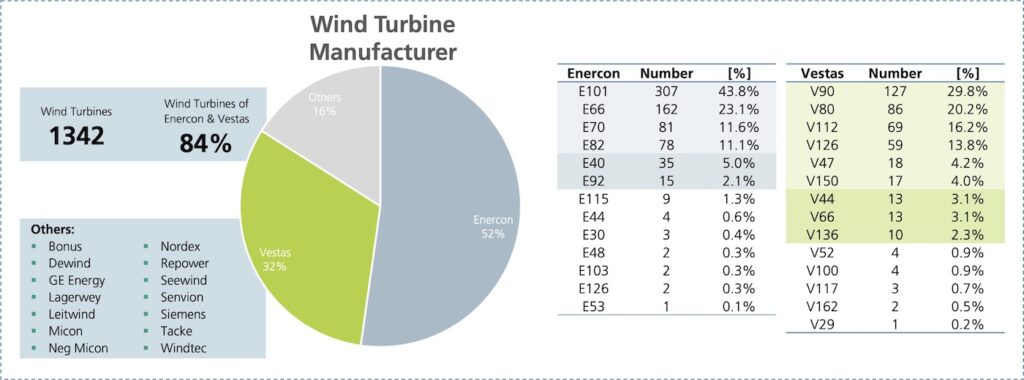
The database contains information on 1,342 out of 1,426 wind turbines commissioned in Austria by the end of 2023. Austria’s wind industry is primarily dominated by two manufacturers, Enercon and Vestas, which collectively represent 84% of the turbines. The remaining 16% consists of various manufacturers such as Nordex, Leitwind, GE Energy, Windtec, Siemens, among others. An in-depth examination of the turbine types reveals that Austria hosts only 13 different models of Enercon turbines and 14 different of Vestas. Notably, the Enercon E101 with 307 installations and the Vestas V90 with 127 installations emerge as the predominant turbine types (Figure 2).
Analyzing the turbine types commissioned annually alongside their dimensions unveils a consistent trend towards larger turbines. Over the years, the rotor diameter has notably increased, from around 30 meters in the mid-1990s, to turbines boasting diameters of up to 162 meters today.
In conclusion, the Austrian wind turbine landscape is characterized by a limited number of manufacturers and a small selection of turbine types. An examination of 15 distinct turbine models, including 6 from Enercon and 9 from Vestas, encompasses 76.4% (1,080 turbines) of all installations in Austria. In addition, the analyses of the WT composition shows that the dimensioning and thus the material consumption are strongly dependent on the rotor diameter, with a consistent upward trend driven by technological innovation and increasing turbine capacity [4, 27, 39].
Sustainable decision-making framework
Based on the extensive literature review, expert interviews and statistical analyses, a conceptual model is proposed in order to identify and choose the most sustainable option for End-of-Life treatment of wind turbines. The approach can be divided into three phases: (1) Product Description, (2) EoL Strategy Selection, and (3) Impact Assessment (Figure 3).

In the context of End-of-Life management of complex product structures, such as wind turbines, comprehensive decision-making requires a deep understanding of the complex design of the product, the properties of the components, the material composition, and their interrelationships. Therefore, the first phase of the decision-making framework focuses on the analysis and description of the wind turbine.
This phase begins with an analysis of the product’s construction types, primary components and material compositions to achieve a comprehensive depiction of the product structure. Ideally, Bills of Materials (BoM) and assembly drawings serve as input data [40]; otherwise LCA data published by the manufacturer can be used. Given the WTs unique complexity, an enhanced approach is adopted, utilizing a technology-supported regression analysis to address component variations, see [41]. The regression model offers the potential to predict the material consumption of current and future WTs, minimizing the need for analyzing various BoMs for each product variant.
Leveraging insights from the first phase regarding the components and their material composition, in phase two diverse End-of-Life alternatives for the product components need to be identified, e.g. through the systematic literature review (SLR) method. An iterative process analyzes domain-specific nomenclature to unveil additional EoL strategies, leading to standardization of procedural steps within each strategy [42]. The primary goal of this phase is to systematically identify circular economy opportunities throughout the product life cycle.
Finally, the results obtained from the two previous phases are integrated in the third branch to facilitate the streamlined quantification of environmental impacts associated with the individual EoL options of the product and its components. The starting point for this is the optimization of the data collection process of the LCA using digital technologies like artificial intelligence. Special attention should be paid to transitioning from modeling individual life cycles (classic LCA) to multiple life cycles (CE-LCA).
By employing this approach, the environmental impacts of various End-of-Life options can be quantified, providing decision-makers with the necessary data to make informed and sustainable choices regarding the End-of-Life management of wind turbines.
The pressing challenge of EoL management in the wind energy sector
Through comprehensive research, a sustainable decision-making framework for EoL treatment of wind turbines is proposed. This conceptual model makes an important contribution to streamline the complex decision-making process for EoL strategies in the wind energy sector. By combining circular economy approaches and digital technologies, a first step towards achieving a sustainable energy future can be made.
However, further research is needed, with a focus on ongoing collaboration with stakeholders across the wind energy spectrum, to ensure practical applicability and acceptance. Advancements in environmental impact assessment methodologies, especially tailored to the circular economy context, are essential for robust decision-making. Furthermore, as technology and industry practices evolve, continuous exploration of circular economy opportunities is crucial.
Bibliography
[1] European Commission: The European Green Deal – Communication from the Commission to the European Parliament, the European Council, the Council, the European Economic and Social Committee and the Committee of the Region. In: COM 640 Final. Brussels 2019.[2] European Commission: Proposal for a Regulation of the European Parliament and of the Council. Establishing the framework for Achieving Climate Neutrality and Amending Regulation (EU) 2018/1999 (European Climate Law). In: COM 80 Final. Brussels 2020.
[3] Breeze, P.: Wind Farms, Electrical Optimization, and Repowering. In: Wind Power Generation. (ed): Cambridge Academic Press. Cambridge 2016. pp. 59–65. DOI: 10.1016/B978-0-12-804038-6.00007-4.
[4] IG Windkraft: Beschleunigung der Windgeschwindigkeit 2023? Große Chancen für die Enerbaren im neuen Jahr. 2023.
[5] Graulich, K.; et al.: Emerging waste streams – Challenges and opportunities. Oeko-Institzt EV Freibg. URL: https://policycommons.net/artifacts/3363067/emerging-waste-streams/4161760/, accessed 02.01.2024.
[6] Mali, S.; Garrett, P.: Life Cycle Assessment of Electricity Production From an Onshore V150–4.2MW Wind Plant. Aarhus 2022.
[7] European Environmental Agency: Emerging waste streams: Opportunities and challenges of the clean-energy transition from a circular economy perspective. 2021. DOI: 10.1163/9789004322714_cclc_2021-0190-601.
[8] Woo, S. M.; Whale, J.: A mini-review of end-of-life management of wind turbines: Current practices and closing the circular economy gap. In: Waste Manag. Res. J. Sustain. Circ. Econ. 40 (2022) 12, pp. 1730–1744. DOI: 10.1177/0734242X221105434.
[9] The Wind Power: Austrian wind farms database. URL: https://www.thewindpower.net/country_en_13_austria.php, accessed: 23.04.2024.
[10] Andersen, N.; Eriksson, O.; Hillman, K.; Wallhagen, M.: Wind Turbines’ End-of-Life: Quantification and Characterisation of Future Waste Materials on a National Level. In: Energies 9 (2016). DOI: 10.3390/en9120999.
[11] European Commission: Circular economy action plan: For a cleaner and more competitive Europe. In: COM 98 Final. Brussels 2020. URL: https://eur-lex.europa.eu/resource.html?uri=cellar:9903b325-6388-11ea-b735-01aa75ed71a1.0017.02/DOC_1&format=PDF
[12] Potting, J.; Hekkert, M. P.; Worrell, E.; Hanemaaijer, A.: Circular Economy: Measuring innovation in the product chain. The Hague 2017.
[13] Zhang, C.; Hu, M.; Di Maio, F.; Sprecher, B.; Yang, X.; Tukker, A.: An overview of the waste hierarchy framework for analyzing the circularity in construction and demolition waste management in Europe. In: Sci. Total Environ 803 (2022), p. 149892. DOI: 10.1016/j.scitotenv.2021.149892.
[14] Kasner, R.: The environmental efficiency of materials used in the lifecycle of a wind farm. In: Sustain. Mater. Technol. 34 (2022), p. e00512. DOI: 10.1016/j.susmat.2022.e00512.
[15] De N. P. Leite, G.; Weschenfelder, F.; de Farias, J. G.; Kamal Ahmad, M.: Economic and sensitivity analysis on wind farm end-of-life strategies. In: Renew. Sustain. Energy Rev. 160 (2022), p. 112273. DOI: 10.1016/j.rser.2022.112273.
[16] Eligüzel, İ. M.; Özceylan, E.: A bibliometric, social network and clustering analysis for a comprehensive review on end-of-life wind turbines. In: J. Clean. Prod. 380 (2022), p. 135004. DOI: 10.1016/j.jclepro.2022.135004.
[17] Mendoza, J. M. F.; Gallego-Schmid, A.; Velenturf, A. P. M.; Jensen, P. D.; Ibarra, D.: Circular economy business models and technology management strategies in the wind industry: Sustainability potential, industrial challenges and opportunities. In: Renew. Sustain. Energy Rev. 163 (2022), p. 112523. DOI: 10.1016/j.rser.2022.112523.
[18] Velenturf, A. P. M.: A Framework and Baseline for the Integration of a Sustainable Circular Economy in Offshore Wind. In: Energies 14 (2021) 17. DOI: 10.3390/en14175540.
[19] American Clean Power: Decommissioned Wind Turbine Blade Management Strategies. ACP Wind Blade Working Group. URL: https://cleanpower.org/wp-content/uploads/2023/01/ACP_BladeRecycling_WhitePaper_230130.pdf
[20] Beauson, J.; Laurent, A.; Rudolph, D. P.; Jensen, J. Pagh: The complex end-of-life of wind turbine blades: A review of the European context. In: Renew. Sustain. Energy Rev. 155 (2022) p. 111847. DOI: 10.1016/j.rser.2021.111847.
[21] Cong, N.; Song, Y.; Zhang, M.; Wu, W.: Life cycle assessment of carbon reduction potential of EoL wind turbine blades disposal scenarios in China. In: Environ. Impact Assess. Rev. 100 (2023), p. 107072.DOI: 10.1016/j.eiar.2023.107072.
[22] Karavida, S.; Peponi, A.: Wind Turbine Blade Waste Circularity Coupled with Urban Regeneration: A Conceptual Framework. In: Energies 16 (2023) 3, p. 1464. DOI: 10.3390/en16031464.
[23] Majewski, P.; Florin, N.; Jit, J.; Stewart, R. A.: End-of-life policy considerations for wind turbine blades. In: Renew. Sustain. Energy Rev. 164 (2022), p. 112538. DOI: 10.1016/j.rser.2022.112538.
[24] Mishnaevsky, L.: Sustainable End-of-Life Management of Wind Turbine Blades: Overview of Current and Coming Solutions. In: Materials 14 (2021) 5. DOI: 10.3390/ma14051124.
[25] Zhang, W.; Yu, H.; Yin, B.; Akbar, A.; Liew, K. M.: Sustainable transformation of end-of-life wind turbine blades: Advancing clean energy solutions in civil engineering through recycling and upcycling. In: J. Clean. Prod. 426 (2023), p. 139184. DOI: 10.1016/j.jclepro.2023.139184.
[26] Cinar S.; Yildirim, M. B.: Reverse Logistic Network Design for End-of-Life Wind Turbines. In: Optimization and Dynamics with Their Applications: Essays in Honor of Ferenc Szidarovszky. Matsumoto, A. (ed.): Springer. Singapore 2017. pp. 225–256. DOI: 10.1007/978-981-10-4214-0_11.
[27] Gennitsaris, S.; Sagani, A.; Sofianopoulou, S.; Dedoussis, V.: Integrated LCA and DEA approach for circular economy-driven performance evaluation of wind turbine end-of-life treatment options. In: Appl. Energy 339 (2023), p. 120951. DOI: 10.1016/j.apenergy.2023.120951.
[28] Balanay, R.; Halog, A.: Tools for circular economy. In: Circ. Econ. Text. Appar. 2019. pp. 49–75. DOI: 10.1016/B978-0-08-102630-4.00003-0.
[29] Rigamonti, L.; Falbo, A.; Zampori, L.; Sala, S.: Supporting a transition towards sustainable circular economy: sensitivity analysis for the interpretation of LCA for the recovery of electric and electronic waste. In: Int. J. Life Cycle Assess. 22 (2017) 8, pp. 1278–1287. DOI: 10.1007/s11367-016-1231-5.
[30] Rigamonti L.; Mancini, E.: Life cycle assessment and circularity indicators. In: Int. J. Life Cycle Assess. 26 (2021) 10, pp. 1937–1942. DOI: 10.1007/s11367-021-01966-2.
[31] Samani, P.: Synergies and gaps between circularity assessment and Life Cycle Assessment (LCA). In: Sci. Total Environ. 903 (2023), p. 166611. DOI: 10.1016/j.scitotenv.2023.166611.
[32] Van Stijn, A.; Malabi Eberhardt, L. C.; Wouterszoon Jansen, B.; Meijer, A.: A Circular Economy Life Cycle Assessment (CE-LCA) model for building components. In: Resour. Conserv. Recycl. 174 (2021), p. 105683. DOI: 10.1016/j.resconrec.2021.105683.
[33] Vargas-Gonzalez, M. et. al.: Operational Life Cycle Impact Assessment weighting factors based on Planetary Boundaries: Applied to cosmetic products. In: Ecol. Indic. 107 (2019), p. 105498. DOI: 10.1016/j.ecolind.2019.105498.
[34] Peña, C. et. al.: Using life cycle assessment to achieve a circular economy. In: Int. J. Life Cycle Assess. 26 (2021) 2, p. 215–220. DOI: 10.1007/s11367-020-01856-z.
[35] European Environmental Agency: Life Cycle Assessment (LCA) – A guide to approaches, experiences and information sources. In: Environ. Issues Ser. 6 (1998). URL: d557efde1a1ab1006596c0acb40392bb
[36] Zhong, Z. W.; Song, B.; Loh, P. E.: LCAs of a polycrystalline photovoltaic module and a wind turbine. In: Renew. Energy 36 (2011) 8, pp. 2227–2237. DOI: 10.1016/j.renene.2011.01.021.
[37] Ghosh, T.; Hanes, R.; Key, A.; Walzberg, J.; Eberle, A.: The Circular Economy Life Cycle Assessment and Visualization Framework: A Multistate Case Study of Wind Blade Circularity in United States. In: Resour. Conserv. Recycl. 185 (2022), p. 106531. DOI: 10.1016/j.resconrec.2022.106531.
[38] Fayyaz, S.; Lund, K. W.; Khoshnevisan, B.; Madsen, E. S.; Birkved, M.: Sustainable end-of-life value chain scenarios for wind turbine blades. In: Journal of Physics: Conference Series (2023). DOI: 10.1088/1742-6596/2507/1/012007.
[39] Scherhaufer, S.; Part, F.; Beigl, P.: Das Sekundärressourcenpotenzial aus Windkraft- und Photovoltaikanlagen. The potential of secondary resources from wind power and photovoltaic plants. In: Österr. Wasser- Abfallwirtsch. (2020). DOI: 10.1007/s00506-020-00723-3.
[40] Lee, H. B.; Cho, N. W.; Hong, Y. S.: A hierarchical end-of-life decision model for determining the economic levels of remanufacturing and disassembly under environmental regulations. In: J. Clean. Prod. 18 (2010) 13, pp. 1276–1283. DOI: 10.1016/j.jclepro.2010.04.010.
[41] Volk, R.; Stallkamp, C.; Herbst, M.; Schultmann, F.: Regional rotor blade waste quantification in Germany until 2040. In: Resour. Conserv. Recycl. 172 (2021), p. 105667. DOI: 10.1016/j.resconrec.2021.105667.
[42] Feng, Y.; Gao, Y.; Tian, G.; Li, Z.; Hu, H.; Zheng, H.: Flexible Process Planning and End-of-Life Decision-Making for Product Recovery Optimization Based on Hybrid Disassembly. In: IEEE Trans. Autom. Sci. Eng. 16 (2019) 1, pp. 311–326. DOI: 10.1109/TASE.2018.2840348.
Your downloads
Potentials: Energy Efficiency Innovation
You might also be interested in