Strategic Product Planning Model |
Digital twins for circular products and production processes

| Journal | Industry 4.0 Science |
| Issue | Volume 41, Edition 3, Pages 24-31 |
| Open Access | https://doi.org/10.30844/I4SE.25.3.24 |
| Bibliography | Share | Cite | Download |
Abstract
Keywords
Article
Trends in Strategic Product Planning
Strategic Product Planning (SPP) ensures future-robust products and long-term corporate success. However, traditional SPP models are rooted in process frameworks developed in the 1980s, primarily for planning mechanical products. As a result, they often fail to address current technological, social and economic trends, such as sustainability, circular economy, digital business models and interdisciplinarity. Yet it is precisely these emerging trends that will drive the innovation of tomorrow.
For this reason, established approaches must be continuously reviewed and further developed. A key driver is the growing integration of mechanics, electronics and software in mechatronic and Cyber-Physical Systems (CPS). This shift demands greater interdisciplinarity and the ability to manage increased complexity in Strategic Product Planning.
Additionally, hybrid service bundles or Product-Service Systems—the combination of physical products with digital and service-based elements—are gaining increasing importance. It is furthermore essential to consider the entire product life cycle, starting from the early planning stages, to be able to proactively meet the challenges of these trends. Modern technologies such as digital twins make it possible to collect, analyze and continuously provide information throughout all stages of the product life cycle. This feedback enables the adaption of a dynamic and incremental product strategy, thus facilitating a quick reaction to changes in the product environment.
Necessary changes to SPP models
The trends described above represent a subset of the current factors influencing the strategic planning of technical systems and emphasize the need for further development of existing approaches. A comprehensive analysis of over 230 established models, including those by Brankamp [1], Eversheim [2], Brockhoff [3], Schuh [4], Cooper [5] and the “Planning and development of new products” guideline VDI 2220:1980 [6], revealed the following key areas where change is needed:
- Flexibility and agility: In increasingly volatile markets, strategic planning activities must be cyclical and adaptable.
- Information circularity: Data from all phases of the product life cycle must consistently feed back into the planning process. Digital twins serve as central tools for collecting and analyzing real time data to enable ongoing optimization.
- Sustainability and circular economy: To support circular products and production systems, all life cycle phases must be considered from the outset. This allows principles such as eco-design and material circularity to be embedded early in the product and production engineering.
SPP for successful product ideas
Strategic Product Planning serves as the critical link between corporate strategy and a specific engineering order [3]. Product portfolio planning is based on the company’s strategic direction and provides the framework for identifying promising new product ideas [7]. Specific innovation strategies are derived from the broader corporate strategy to uncover new areas of potential success [4]. These innovation strategies are implemented systematically and targeted.
Decisions should reflect a long-term perspective, and any conflicts with strategic guidelines must be avoided [4]. Within the context of product portfolio planning, corporate objectives, the business environment and innovation strategies are aligned to guide the implementation of development projects [8]. Based on this portfolio, the main objective of SPP is to generate product ideas and concepts that subsequently lead to concrete engineering orders [7].
The Product Engineering process (Figure 1) includes five phases: Strategic Product Planning, Product Engineering, realization, operation and service provision and decommissioning [9]. Based on corporate strategy and product portfolio planning, promising product ideas are developed within the SPP and formalized as engineering orders. During Product Engineering, solutions are designed to meet customer needs while adhering to defined specifications, the described scope of functions and budgeted costs.
The transition to realization begins with the series release or, in the case of intangible assets, with the preparation of operating models [10]. In the operation phase, the product is operated, routinely maintained, and supported through various services. At the end of its lifecycle, the product is evaluated to determine an appropriate utilization strategy depending on its condition [9].
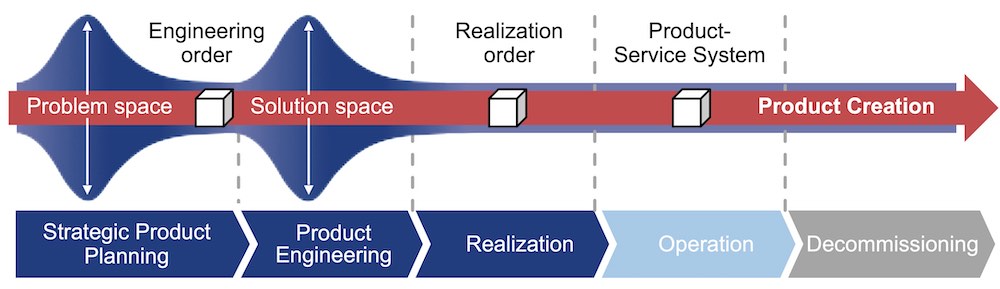
As a first approximation, the Product Engineering process is visualized consecutively in Figure 1. At the beginning of SPP, the initially unlimited problem space is successively narrowed down in the form of a search field and promising product ideas are identified and further engineered. During Product Engineering, relevant alternative solutions are identified and successively consolidated into a technically and economically viable approach.
Strategic Product Planning model
The SPP model presented below addresses the identified need for change and enhances established models. As shown in Figure 2, the model is shaped like a tapering funnel, symbolizing the gradual narrowing of alternative product ideas. This form represents the progressive refinement and concretization of the problem space, ultimately leading to a promising product idea captured in an engineering order. The five cyclically arranged activities are:
- Define goals
- Analyze future scenarios
- Develop ideas
- Develop concept
- Evaluate target achievement
These activities are carried out on an ongoing basis with varying focal points and interdependent content. In addition, information from product monitoring is continuously gathered, analyzed and made accessible. In product monitoring, experience and information from production, utilization and decommissioning are incorporated into Strategic Product Planning. This is based on Brankamp’s “Product monitoring in the Product Engineering phase” model [1].
The circular flow of information from downstream processes —e.g. via the digital product passport (DPP), a digital twin or extended product lifecycle management (PLM) capabilities — enables the engineering of circular products. This approach can minimize resource and energy consumption as well as waste and emissions while increasing the circularity of sustainable products [9]. The maturity of ideas, from initial conception to the engineering order, is assessed with five key control points.
![Figure 2: Strategic Product Planning model, enhancing [1-4, 9].](https://industry-science.com/wp-content/uploads/2025/06/Graessler_I4S-25-3_Figure-2.jpeg)
Key activities in sustainable product planning
Similar to the agile approach, a sequence of activities is repeatedly carried out throughout SPP. These activities are defined by three focal points: focus, creativity and systematics. In the model, this threefold structure is reflected by five cyclical activities. The focus phase includes setting goals and analyzing future scenarios. The objectives of SPP are derived from the innovation and product portfolio strategy [2], while potential future developments within the problem space are analyzed [4]. Scenario-technique is employed to develop possible images of the future, using networked thinking and the consideration of multiple futures [11]. As the engineering order evolves, the defined objectives are adjusted to reflect changing frameworks, and future scenarios are refined accordingly.
The creativity focus refers to the activity of developing ideas, which involves generating, evaluating and selecting ideas. At its core is the targeted search for future alternative ideas with a high probability for success, based on the previously identified future scenarios [2]. The ideas generated are pre-selected based on marketability, considering, for instance, the developed future images, and technical feasibility [1]. This early and ongoing evaluation helps reduce uncertainties and risks during implementation [4]. In the idea detailing phase, market information is gathered and integrated into concrete product concepts. Through continuous assessment of their relevance and potential, these identified ideas are systematically refined into targeted product solutions [4].
The systematic focus includes the activities of concept development and target achievement evaluation. Creatively generated ideas are systematically transformed into concrete, feasible concepts. As the product idea matures, for example, initial product requirements are gathered and preliminary business models and implementation strategies are explored [4]. Concept development follows the same pattern as idea development, with systematically developed concepts being continuously evaluated and incrementally refined.
As part of concept evaluation, these concepts are improved using completed and verified information from digital twins [2]. In addition, a continuous comparison is made between the defined objectives and the corresponding results. This comparison ensures the targeted implementation of the strategic planning project [4]. The information obtained is used to systematically control and coordinate the effort and design of the core activities.
Product monitoring complements the five cyclical activities through the continuous exchange of information during Product Engineering. Traditional product monitoring is defined in VDI 2220:1980 as a combined control and monitoring process for ensuring successful product performance [6]. For engineering successful Product-Service Systems, this definition is expanded to include feedback from the entire life cycle using digital twins [9]. Modeling information from networked Product-Service Systems is a prerequisite for engineering circular products and must therefore be considered in the early stages of strategic planning [12].
By representing the current status of systems across engineering, production, usage, inspection and decommissioning, the digital twin enables information circularity [9]. Based on product instances stored in the digital master of alternative product classes and the enriched with data from realization and operation in the digital shadow, individual digital twins can feed information back into the SPP [13].
The five control points of Strategic Product Planning
The SPP comprises five control points that are passed through as the product matures, ensuring its systematic engineering from the initial problem definition to an engineering order ready for implementation. To fulfill the requirements at each control points, specific artifacts of the SPP (see Fig. 3) must be submitted with sufficient detail. The control points correspond to the designation of the most important artifact in each section. Control questions are evaluated with each control point to assess whether the artifacts have reached an adequate level of detail. The questions enable the user to carry out the SPP in a structured and plannable manner [10].

Successful completion of the SPP requires full development of the defined artifacts. These artifacts are created as part of the continuous cycle of the five core activities. The first control point covers the defined problem space. This requires the definition of a target image, a clearly derived strategy and two or three alternative visions of the future. The aim of these future visions is to identify social trends as well as market and technology potential at an early stage and to incorporate them into Strategic Product Planning [11]. The visions form the basis for deriving specific innovation approaches and guiding the generation of ideas [4].
Together, these artifacts form the foundational orientation and action framework for promising product ideas. The defined problem space focuses innovation efforts on strategically relevant topics and generates relevant ideas [14]. The second control point involves the collection of ideas, which is developed based on statements and content of previously developed search fields, future scenarios and a formulated value proposition. Within the search fields, generic ideas are sought, considering parameters such as function, functional principles, materials, processes, trends and design [6]. This unstructured collection of ideas forms the basis for the third control point, the selection of ideas.
To achieve an initial selection, an overview of key stakeholders, a clear understanding of the company’s competence profile and an evaluation standard are required. Selected ideas are then further developed into product ideas. A product idea is considered mature when its technical and economic feasibility has been proven. Furthermore, additional artifacts such as a product life concept, personas and user stories must be present to ensure the implementation and marketability of the product idea.
To this end, initial information on the working principles and design structure is already included [15]. In essence, there are selected and validated product concepts whose technical and economic feasibility has been confirmed and which are transformed into the product and market engineering process [4]. The final maturity of the product idea is marked by the engineering order control point. Key artifacts, such as feasibility analysis, life cycle concept and business model, converge in the engineering order and form the basis for the subsequent Product Engineering [7].
Defining characteristics of core project activities
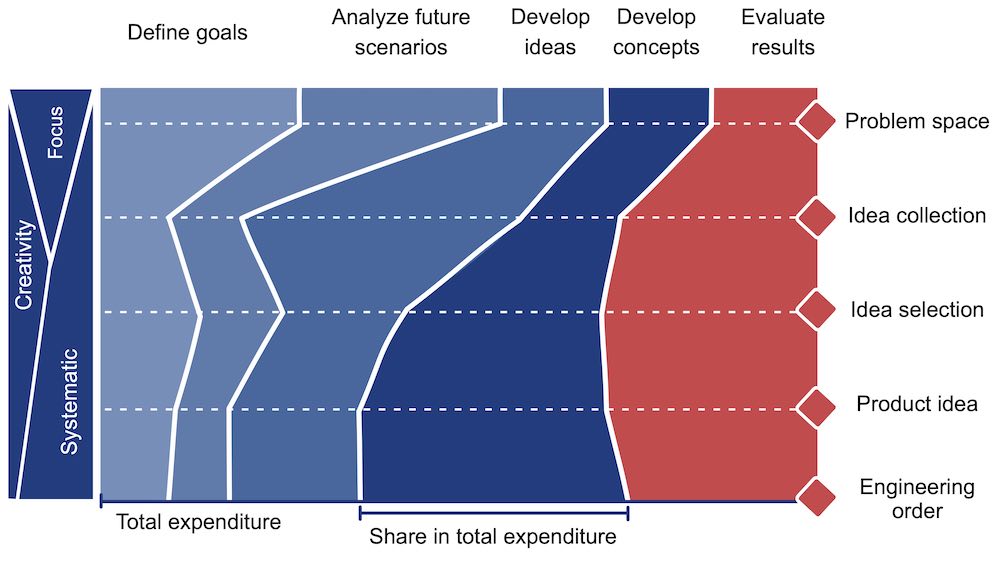
The SPP model is based on the principle that all activities remain important throughout the entire course of the SPP, although priorities shift eventually. As a result, both the focus of the content and the proportion of effort spent on the core activities vary. The characteristics of the core activities are project-specific, meaning they require tailored adaptation to individual cases. Based on the authors’ project and industry experience, exemplary characteristics were identified by retrospectively examining the project results (Figure 4).
The project results from the Decide4ECO and KLUG projects, funded by the Federal Ministry of Economic Affairs and Climate Action (BMWK) and the Federal Ministry of Education and Research (BMBF), were incorporated, along with insights from bilateral research projects in the fields of steel processing, special-purpose machine construction and quality assurance IT systems. At the beginning of the SPP, the core activities of goal identification and future analysis are prioritized to define the initial problem space, forming the foundation for further activities. Idea development relies on creative activities, which are particularly essential for generating and selecting ideas.
As the product idea matures, the emphasis on creative activities decreases, while systematic activities, such as concept development and evaluation of target achievement become increasingly important. The combination of continuous activities and control points enables a later entry into the SPP model, as usual, for example, in the facelift of a car.
Strategic Product Planning for project success
The model presented addresses the identified gaps in existing models and offers a clear, iterative structure that covers the entire Strategic Product Planning process from goal setting to handover to engineering. The five cyclical core activities set the framework for agile and flexible application of the model, enabling a later entry into the SPP. Product monitoring enables information circularity even throughout the SPP. Additionally, the early integration of the life cycle perspective fosters sustainability and facilitates circular economy. The model presented is generically designed to be applicable across industries. For company-specific implementation, individual methods and IT systems, such as PLM systems, can be used to support the creation of the identified artifacts.
This article was created as part of the “Decide4ECO” project, funded by the Federal Ministry for Economic Affairs and Climate Action under reference 13MX002G. We would also like to thank the project partners of the ”KLUG” project for the valuable dialogue.
The Strategic Product Planning model described here also serves as input for discussions in expert committee VDI/VDE 3.12 “Strategic planning and development of hybrid service bundles” to describe an SPP model for Product-Service Systems.
Bibliography
[1] Brankamp, K.: Planung und Entwicklung neuer Produkte De Gruyter 1971.[2] Eversheim, W.:Innovationsmanagement Für Technische Produkte. Systematische und Integrierte Produktentwicklung und Produktionsplanung . VDI Book Series. Berlin, Heidelberg: Springer Berlin / Heidelberg 2003.
[3] Brockhoff, K.: Forschung und Entwicklung. Planung und Kontrolle. Munich, Vienna, Berlin: Oldenbourg; De Gruyter 1999.
[4] Schuh, G.: Innovationsmanagement. Handbuch Produktion und Management 3, vol. 3. Berlin: Springer Vieweg 2012.
[5] Cooper, R. G.: The performance impact of product innovation strategies. European Journal of Marketing (1984).
[6] VDI-Gesellschaft Konstruktion und Entwicklung: VDI 2220. Produktplanung Ablauf, Begriffe und Organisation (1980).
[7] Bender, B. and Gericke, K. (edd..): Pahl/Beitz Konstruktionslehre. Methoden und Anwendung erfolgreicher Produktentwicklung. . Berlin, Heidelberg: Springer Berlin Heidelberg 2021.
[8] Seidenschwarz, W.: Portfoliomanagement. In: Lindemann, U. (ed.): Handbuch Produktentwicklung. Hanser. Munich: Hanser 2016, pp. 37-58.
[9] Gräßler, I. and Pottebaum, J.: Generic Product Lifecycle Model: A Holistic and Adaptable Approach for Multi-Disciplinary Product-Service Systems. Applied Sciences 11 (2021) 10, p. 4516.
[10] Verein Deutsch Ingenieure: VDI/VDE 2206. Entwicklung mechatronischer und cyber-physischer Systeme (2021).
[11] Gräßler, I., Thiele, H. and Scholle, P.: Methode zur Einflussanalyse in der SzenarioTechnik auf Basis gerichteter Graphen. Proceedings of the 30th Symposium Design for X. 2019, pp. 135-146.
[12] Corso, M., Martini, A., Paolucci, E. and …: Knowledge management in product innovation: an interpretative review. International journal of management reviews (2001).
[13] Stark, R., Anderl, R., Thoben, K.-D. and Wartzack, S.: WiGeP-Positionspapier. Zeitschrift für wirtschaftlichen Fabrikbetrieb (2020), pp. 47-50.
[14] Eversheim, W. and Schuh, G. (eds.): Betriebshütte Produktion und Management. 1996.
[15] Opitz, H., Grabwoski, H., Wiendahl, H.-P. and Schütze, R.: Entwicklung einer Methode zur Informationsgewinnung und -verarbeitung für die Planung und Entwicklung neuer Industrieprodukte (1974).
Your downloads
Solutions: Product Development
You might also be interested in