data sovereignty

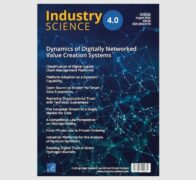
I4S 4/2026: Dynamics of Digitally Networked Value Creation Systems

I4S 4/2026: Dynamics of Digitally Networked Value Creation Systems

The whole is greater than the sum of its parts—exploring digital ecosystems together
Digital platforms and data spaces are transforming industrial value creation and creating new opportunities for cross-organizational collaboration. At the same time, new requirements are emerging regarding data sovereignty, security, and governance. This issue of Industry 4.0 Science provides insights into the DynaVer research program, in which 15 interdisciplinary projects are investigating the dynamics of digitally networked value creation systems.
Replacing Organizational Trust with Technical Guarantees

Replacing Organizational Trust with Technical Guarantees

Privacy-enhancing technologies for dynamic industrial value networks
Hajeong Jeon ORCID Icon, Johannes Lohmöller ORCID Icon, Klaus Wehrle ORCID Icon, Jan Pennekamp ORCID Icon
Long-term relationships are now insufficient to ensure trust in digitalized and dynamic industrial networks where sensitive data sharing is prevalent. While organizational trust mechanisms, such as contracts, remain significant, they are often slow and challenging to scale within evolving digital platforms. This article thus proposes privacy-enhancing technologies as a foundation for embedding technical and verifiable guarantees alongside organizational trust mechanisms. As a result, secure industrial collaboration can be achieved without the persistence of data silos.
Industry 4.0 Science | Volume 42 | 2026 | Edition 4 | Pages 72-80 | DOI 10.30844/I4SE.26.4.8
Open Source as Enabler for Smart Data Ecosystems

Open Source as Enabler for Smart Data Ecosystems

How collaboration shapes sovereignty and interoperability across industrial applications
Anna Maria Schleimer ORCID Icon, Julia Pampus ORCID Icon
From automotive supply chains to smart factories, data ecosystems promise seamless collaboration across company boundaries. But how can industries build the necessary infrastructure without creating new dependencies? This article explores how open-source software can serve as a foundation and impactful tool for sovereign, interoperable technologies and standards. Yet, open-source software is not a silver bullet; rather, it poses challenges for digital sovereignty in burgeoning data ecosystems.
Industry 4.0 Science | Volume 42 | 2026 | Edition 4 | Pages 6-13 | DOI 10.30844/I4SE.26.4.1
Open-Source Implementation of the Industrial Metaverse

Open-Source Implementation of the Industrial Metaverse

Case study and best practices
Henning Strauß ORCID Icon, Tim Johannsen
The digital transformation of small and medium-sized enterprises (SMEs) in the manufacturing sector is hampered by vendor lock-in, high cloud costs, and stringent data sovereignty requirements when implementing Industrial Metaverse solutions. Although the Industrial Metaverse is quickly becoming a key concept in Industry 5.0, SMEs are often at a disadvantage when using proprietary solutions. This paper demonstrates how Industrial Metaverse applications can be realized by combining proven communication standards with open web technologies, thereby reducing barriers. This makes immersive applications for training, maintenance, and monitoring feasible even in SMEs. Using an open-source-based prototype as a best-practice implementation, the paper illustrates how the Industrial Metaverse can be made technologically and economically accessible to SMEs.
Industry 4.0 Science | Volume 42 | Edition 3 | Pages 68-73