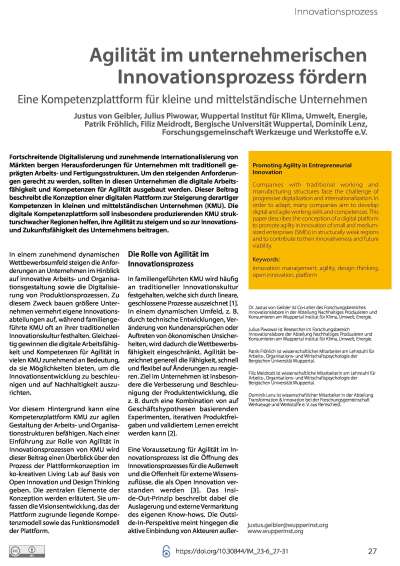
Promoting Agility in Entrepreneurial Innovation |
A competence platform for small and medium-sized enterprises

| Journal | Industrie 4.0 Management |
| Issue | Volume 39, 2023, Edition 6, Pages 27-31 |
| Open Access | https://doi.org/10.30844/IM_23-6_27-31 |
| Bibliography | Share | Cite | Download |
Abstract
Companies with traditional working and manufacturing structures face the challenge of progressive digitalization and internationalization. In order to adapt, many companies aim to develop digital and agile working skills and competences. This paper describes the conception of a digital platform to promote agility in innovation of small and mediumsized enterprises (SMEs) in structurally weak regions and to contribute to their innovativeness and future viability.
Keywords
Article
Bibliography
[1] Guertler, M. R.; Sick, N: Exploring the enabling effects of project management for SMEs in adopting open innovation – A framework for partner search and selection in open innovation projects. In: International Journal of Project Management 39 (2021) 2, S. 102-114.[2] Blank, S.: Why the Lean Start-Up Changes Everything. In: Harvard Business Review 91 (2013) 5, S. 63-72.
[3] Chesbrough, H.: Open Innovation: The New Imperative for Creating and Profiting from Technology. Boston 2003.
[4] Enkel, E.; Gassmann, O.: Neue Ideenquellen erschließen – Die Chancen von Open Innovation. In: Marketing Review St. Gallen 26 (2009) 2 , S. 6-11.
[5] Furr, N.; Dyer, J.: Choose the right innovation method at the right time. In: Harvard Business Review 12 (2014).
[6] Liedtke, C.; Welfens, M. J.; Rohn, H.; Nordmann, J.: LIVING LAB: user-driven innovation for sustainability. In: International Journal of Sustainability in Higher Education 13 (2012) 2, S. 106-118.
[7] Geibler, J. v.; Erdmann, L.; Liedtke, C.; Rohn, H.; Stabe, M.: Living Labs für nachhaltige Entwicklung: Potenziale einer Forschungsinfrastruktur zur Nutzerintegration in der Entwicklung von Produkten und Dienstleistungen. In: Wuppertal Institut (Hrsg): Wuppertal Spezial 47 (2013).
[8] Geibler, J. v.; Erdmann, L.; Dönitz, E.; Stadler, K.; Zern, R.: Roadmap Living Labs für eine Green Economy 2030. Kurzfassung. Wuppertal Institut und Fraunhofer-Institut für System- und Innovationsforschung. Wuppertal Karlsruhe 2018.
[9] Baedeker, C.; Piwowar, J.; Themann, P.; Grinewitschus, V.; Krisemendt, B. u. a.: Interactive Design to Encourage Energy Efficiency in Offices: Developing and Testing a User-Centered Building Management System Based on a Living Lab Approach. In: Sustainability 12 (2020) 17, 6956, S. 3f.
[10] Schuurman, D.; Leminen, S.: Living Labs Past Achievements, Current Developments, and Future Trajectories. In: Sustainability 13 (2021) 19, 10703, S. 4.
[11] Brown, T.: Change by Design: How Design Thinking Transforms Organizations and Inspires Innovation. New York 2009.
[12] Hasso-Plattner-Institut: Was ist Design Thinking? Die sechs Schritte im Design Thinking Innovationsprozess. URL: www.hpi.de/school-of-design-thinking/design-thinking/hintergrund/design-thinking-prozess.html, Abrufdatum 10.07.2023.
[13] Rawolle, M.; Kehr, H. M.: Lust auf Zukunft: Die motivierende Kraft von Unternehmensvisionen verstehen und nutzen. In: Organisationsentwicklung 4 (2012), S. 12-17.
[14] Broman, G. I.; Robèrt, K. H.: A framework for strategic sustainable development. In: Journal of Cleaner Production 140 (2017). S. 17–31. https://doi. org/10.1016/j.jclepro.2015.10.121.
[15] Curley, M.; Salmelin, B: The Evolution of Innovation. In: Open Innovation 2.0. Innovation, Technology, and Knowledge Management 2018.
[16] Piwowar, J.; Geibler, J. v.; Theben, L.: Organisationale Transformation: Steigerung der Innovationsfähigkeit und Nachhaltigkeitsorientierung mittels agiler, digitaler Arbeits- und Organisationsgestaltung. In: Wuppertal Institut (Hrsg): Arbeitsdokument im Arbeitspaket 2 (AS 2.1) des AgilOLab Projekt. Wuppertal 2022. URL: www.agilolab.de/wp-content/uploads/2023/06/Kurzstudie-Organisationale-Transformation.pdf, Abrufdatum 21.05.2023.
[17] Bass, B. M.: Two Decades of Research and Development in Transformational Leadership. In: European Journal of Work and Organizational Psychology 8 (1999) 1, S. 9-32. URL: doi.org/10.1080/135943299398410, Abrufdatum 17.07.2023.
[18] Zuraik, A.; Kelly, L.: The role of CEO transformational leadership and innovation climate in exploration and exploitation. In: European Journal of Innovation Management 22 (2019) 1, S. 84-104.
[19] Laloux, F.: Reinventing organizations: Ein Leitfaden zur Gestaltung sinnstiftender Formen der Zusammenarbeit. München 2015.
[20] Davies, M.: The Danish Design Ladder. URL: www.mrmattdavies.me/post/the-danish-design-ladder, Abrufdatum 17.07.2023.
[21] Pernice, K.; Gibbons, S.; Moran, K.; Whitenton, K.: The 6 Levels of UX Maturity. URL: www.nngroup.com/articles/ux-maturity-model/, Abrufdatum 10.07.2023.
[22] Piwowar, J.; Geibler, J. v.; Theben, L.: Ergebnisse des Visions-Workshops: Arbeitsdokument im Arbeitspaket 2 (AS 2.1) des AgilOLab Projekts. Wuppertal Institut. Wuppertal 2022. URL: www.agilolab.de/wp-content/uploads/2023/06/Ergebnisbericht_VisionsWorkshop.pdf, Abrufdatum 13.07.2023.
[23] Fröhlich, P.; Meidrodt, F.; Wasielewski, I.; Diestel, S.: Ergebnisse der Design-Thinking Workshops: Arbeitspapier im Arbeitspaket 1 (AS 1.3) des AgilOLab Projekts. Bergische Universität Wuppertal. Wuppertal 2022. URL: www.agilolab.de/wp-content/uploads/2023/04/DesignThinkingWorkshop-Ergebnisdokumentation.pdf, Abrufdatum 21.06.2023.
[24] Mayring, P.: Qualitative Inhaltsanalyse. In: Mey, G.; Mruck, K. (Hrsg): Handbuch Qualitative Forschung in der Psychologie. Wiesbaden 2020. URL: doi.org/10.1007/978-3-658-26887-9_52, Abrufdatum 17.07.2023.
[25] Mey, G.; Mruck, K.: Qualitative Interviews. In: Mey, G.; Mruck, K. (Hrsg): Handbuch Qualitative Forschung in der Psychologie. Wiesbaden 2020. URL: doi.org/10.1007/978-3-658-26887-9_33, Abrufdatum 17.07.2023.
[26] Vogl, S.: Gruppendiskussion. In: Handbuch Methoden der empirischen Sozialforschung (S. 581-586). Wiesbaden 2014. URL: doi.org/10.1007/978-3-531-18939-0_41, Abrufdatum 17.07.2023.
[27] Piwowar, J.; Geibler, J. v.; Theben, L.: Ergebnisse des Co-Creation-Workshops: Arbeitspapier im Arbeitspaket 2 (AS 2.3) des AgilOLab Projekts. Wuppertal Institut. Wuppertal 2022. URL: www.agilolab.de/wp-content/uploads/2023/06/Ergebnisbericht_CoCreationWorkshop.pdf, Abrufdatum 13.07.2023.
[28] Krieg, A.: Reifegradmodell für agile Unternehmensentwicklung (Agile Maturity Model). Bonn 2016.
[29] Mühlfelder, M.; Bullinger, S.; Klein, U.; Müller, M.: Reif für Agilität? Ist Ihre Organisation reif genug für die Anwendung agiler Projektmanagement Methoden. In: Organisationsentwicklung 37 (2018) 2, S. 78-85
[30] Wendler, R.: Development of the organizational agility maturity model. In: 2014 federated conference on computer science and information systems, S. 1197-1206.
[31] Hossain, M.; Leminen, S.; Westerlund, M.: A systematic review of living lab literature. Journal of Cleaner Production 213 (2019), 976-988.
[32] Geibler, J. v.; Erdmann, L.; Liedtke, C.; Rohn, H.; Stabe, M.; Berner, S.; Leismann, K.; Schnalzer K.; Kennedy, K.: Exploring the potential of a German Living Lab research infrastructure for the development of low resource products and services (2014). Resources 3:575-598.
Your downloads
Potentials: Business Models Innovation
You might also be interested in