


Digital Supply Chain Twin: The Pathway to Success |
A catalyst for increasing competitiveness

| Journal | Industry 4.0 Science |
| Issue | Volume 41, 2025, Edition 3, Pages 52-60 |
| Open Access | https://doi.org/10.30844/I4SE.25.3.52 |
| Bibliography | Share | Cite | Download |
Abstract
Keywords
Article
Supply chain networks are becoming increasingly complex and fragile due to geopolitical changes. Military conflicts and international sanctions have a direct impact on stability, hence resulting in a need to restructure networks and to simulate, plan, and evaluate routes and alternatives [1, 2].
Supply chain networks facilitate the exchange of goods and services across borders and continents. Due to international interdependencies, effective network management is essential for companies. The ability to manage risks in supply chains is of crucial importance in today‘s volatile and uncertain environment. Companies must continuously monitor their supply chains to protect it from risks, especially those arising from dependencies, natural disasters, geopolitical tensions, economic crises, and pandemics. Ongoing monitoring of inventory levels and logistical hubs enables timely responses to changing circumstances.
To minimize the overall risk and its associated impact, companies need to continuously analyze both their suppliers and their customers. However, most companies only have information on their direct suppliers and no transparency beyond that [3]. Supply chain managers need to develop new strategies to reduce or stabilize costs while ensuring availability and quality [4]. Furthermore, companies are required to ensure greater transparency and accountability across their supply chains to promote compliance with social and environmental standards as well as to support proactive risk management.
These obligations are legally anchored in the German Supply Chain Due Diligence Act (SCDDA) and the European Corporate Sustainability Due Diligence Directive (CSDDD) [5]. To enhance transparency, supply chain managers should leverage emerging technologies such as virtual reality, augmented reality, artificial intelligence, and business intelligence to minimize risks, strengthen resilience and efficiency in supply chain processes, and meet defined cost targets.
Digital twins are particularly suitable for enhancing transparency since they offer a new process-related option compared to conventional applications. The logistics service provider UPS, for example, uses digital twins to model real transport processes based on data, thus optimizing routing, vehicle utilization, and the use of resources. Simulation-based analyses of delivery vehicles and traffic flows were used to reduce average delivery times by 26% and to significantly lower fuel consumption as well as CO₂ emissions.
Digital twins provide a modern, user-optimized experience and offer advanced capabilities compared to traditional data evaluation methods used in spreadsheet-based enterprise resource planning (ERP) systems. While digital twins have primarily been developed for internal processes, their application to broader supply chain networks has largely been overlooked.
The Digital Supply Chain Twin (DSCT) offers an external perspective and facilitates an integrated and consistent overview of the value creation processes and stages. Companies can connect their IT systems to the Supply Chain Network Generator (SCNG) and, enriched by various data sources such as weather, environmental, or public financial/social data, receive a multi-faceted representation of the status quo of all (relevant) stakeholders of a value creation network in the DSCT. This provides a well-rounded foundation for further simulations as well as an opportunity for dynamic control and monitoring of key figures.
Digital twin — an overview
A digital twin is a virtual replica of physical objects, processes, or systems, and enables bidirectional data exchange between physical objects and the digital twin. It is possible to precisely replicate real objects and processes while monitoring them in real time using control signals [6, 7]. The digital twin reflects both the status and functionality of the real system and boosts decision-making processes by up to 90%. By simulating and evaluating internal processes, equipment, personnel, and the supply chain network, this technology offers managers the opportunity to increase efficiency and responsiveness.
The digital twin’s three primary elements are data capture, data modeling, and data application. The digital twin uses four technologies to capture and store data in real time, obtain information that provides valuable insights, and create a digital representation of a physical object. These technologies include the internet of things (IoT), artificial intelligence (AI), extended reality (XR) and the cloud (see Figure 2). The technologies used in the digital twin vary depending on the specific application.
The IoT describes a network of connected physical and virtual objects that communicate with each other and with people [8]. It serves as the central technology for all digital twin applications. Using sensors, the IoT collects and transmits data from real objects and enables the creation, analysis, and optimization of a digital representation. This representation is continuously refined using updated real-time data. According to forecasts, over 90% of all IoT platforms will have digital twin functionalities by 2027 [9]. Cloud computing describes the provision of services via the internet.
This technology offers an efficient way of storing and accessing data via the internet [8]. Cloud computing provides storage technology for digital twins. This way, large amounts of data can be stored virtually and accessed from any location. Cloud computing also helps to reduce the computing time of complex systems and overcome the challenges that arise with storing large amounts of data [10].
As a branch of computer science, artificial intelligence (AI) aims to imitate human intelligence to develop intelligent systems that mirror human behavior. The central research fields of AI include robotics, image and speech recognition as well as neural networks, machine learning, deep learning, and expert systems [11]. In the context of digital twins, AI analyzes processes, evaluates the collected data, and provides well-rounded findings to predict possible developments and calls for action to avoid potential problems [12].
Extended reality is a collective term for immersive technologies such as virtual reality (VR), augmented reality (AR), and mixed reality (MR). These technologies combine physical and virtual worlds and expand the human perception of reality [13]. XR enables the creation of digital images by allowing real and virtual objects to coexist and interact in real time. The use of XR technology in digital twins allows the virtual representation of real objects and creates an interactive environment for real-time interaction with digital content.
Towards a networked digital supply chain twin
The digital supply chain twin (DSCT) is a comprehensive digital model of the entire supply chain network. The DSCT simplifies planning, procurement, production, delivery, and customer service while increasing service levels and flexibility by up to 60 % and reducing cost by approximately 40 % [14]. The DSCT displays the complete end-to-end status across the entire supply chain and thus contributes to enhanced transparency. The physical supply chain objects data is synchronized with the DSCT and contains the actual transport, inventory, demand, and capacity data that is used for simulation, planning, and control [15]. In addition, the DSCT can be used for reports, e.g., for the ESRS or the SCDDA.
The DSCT also offers the user various map layers (levels) for monitoring, analysis, simulation, planning, and control. For example, the aspect of sustainability is mapped in a layer that supports companies in complying with sustainability from an ecological, economic, and social perspective – as required by the CSDDD and SCDDA. Additionally, potential risks as well as existing problems concerning labor law, environmental pollution, and human rights are identified, thereby ensuring legal protection and generating competitive advantages. As a result, producing a sustainable supply chain is not perceived as an obligation but rather as a strategic advantage.
In another layer, quality or logistics key figures, together with associated attributes and information, are displayed. This facilitates minimized procurement risks and ongoing optimization processes across the supply chain. Furthermore, natural disasters such as floods and earthquakes, as well as unforeseen incidents such as burning trucks and traffic jams, are visualized in real time, enabling companies to react immediately [16].
By integrating historical data in combination with real-time data and predictive analyses, the DSCT is able to simulate fluctuations in demand or disruptions in the supply chain. This enables companies to model potential disruptions at supplier sites or in transportation networks, facilitating the early identification of alternative sourcing or transport routes. In doing so, they can proactively prevent supply shortages and adjust their supply and distribution strategies over the medium term [17].
The modular structure of the SCNG and the DSCT enables the integration and visualization of additional data sources, with the aim of increasing transparency in the value chain and deriving proactive measures to reduce risk. Paired with a collaboration module, the use of VR glasses enables location-independent collaboration in a virtual environment. This approach replaces traditional on-site appointments, thereby shortening response times and reducing costs and resource consumption — among other things, by eliminating the need for business trips.
All information is available to employees virtually — attractively presented in a supply chain dashboard. The key advantage is the synchronized processing of real-time data, which serves as a basis for determining immediate actions and making joint decisions.
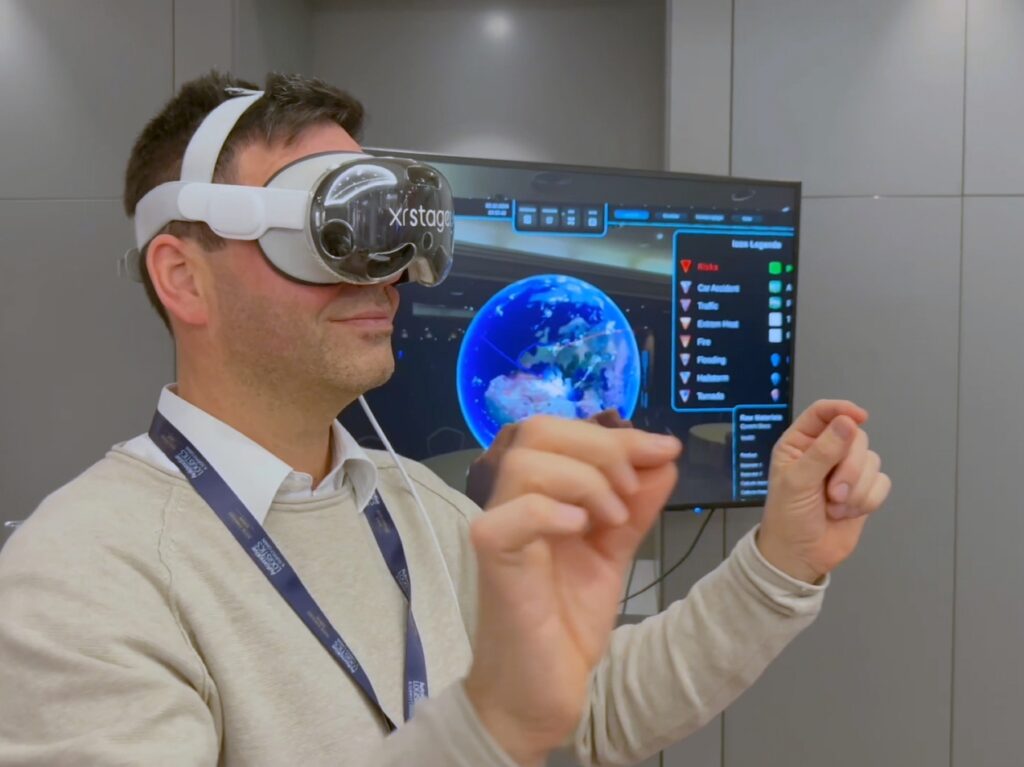
The VR environment thus promotes a solution for faster decision-making and simplifies communication along the supply chain, e.g., when identifying bottlenecks.
Figure 1 shows the use of Apple Vision Pro glasses for the DSCT, with control enabled through intuitive gestures without the need for an additional input device. For presentation purposes, the visualization in the glasses is mirrored on the screen in the background.
DSCT – Technology integration and business applications
The development and evaluation of the DSCT were conducted in an application-oriented manner using the design science methodology, ensuring that industry requirements and practical challenges served as key inputs for the development process [18]. Existing theoretical knowledge, combined with the practical experience of our development partner, Visoric GmbH from Munich, served as a foundation.
The architecture and technology of the DSCT are displayed in Figure 2. Our data platform (SCNG), portrayed in the middle, enables connections to company systems and real-time updates via interfaces. This in turn is connected to the DSCT via a MongoDB database.
Technically, the DSCT is an extension of our data platform – the Supply Chain Network Generator. The SCNG manages all data required to digitally map a supply chain network in a sandbox environment and enables the integration of additional data sources. The user interface is a web application that enables simple configuration and control. Automated simulations and business games can also be realized using the web application. The application uses the Meteor framework, which enables real-time communication between client and server by design. The data is stored semi-structured in a MongoDB database, which serves as an interface for connecting the DSCT.
The DSCT itself is based on the XR Stager framework for immersive applications — an in-house development by our technology partner. The twin retrieves the network information via the MongoDB C# driver. Using the “Change Streams” functionality, data updates are smoothly transferred to the twin in real time, and corresponding visualization processes are triggered based on the updates. In addition to the SCNG data, the DSCT accesses Mapbox and its own self-hosted routing server. Mapbox provides the available map styles in individual image tiles, which are then displayed on the virtual globe within the application. Depending on the type of route, i.e., road, train, and ship traffic, the routing server accesses suitable open-source software to provide the navigation data.
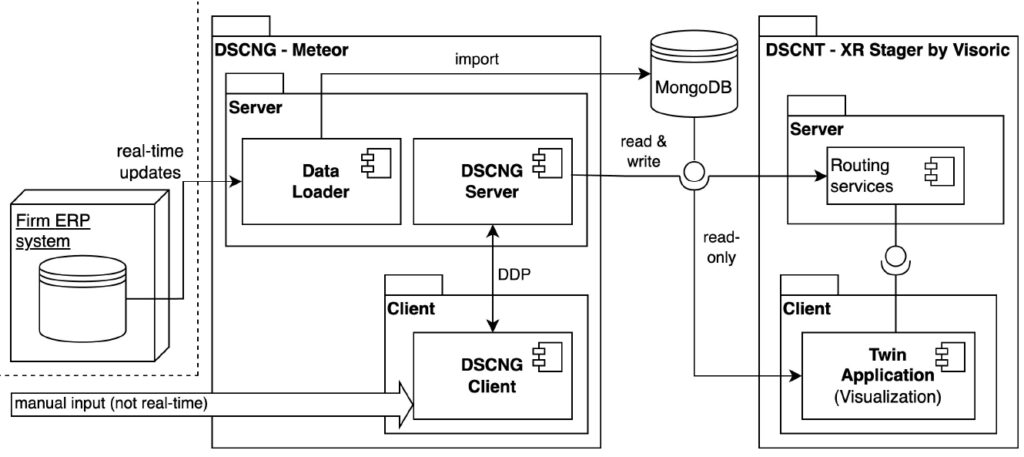
An API connection to the SCNG or a direct link to the DSCT is a feasible option for visualizing (real-time) data from, for example, ERP systems. However, given the wide variety of ERP systems available, such integration is complex, difficult to standardize, and typically requires one-time manual effort. The exact implementation will be determined in collaboration with interested companies. Alternatively, integration can be achieved through industry-specific data ecosystem platforms, such as Catena-X or Supply-On. It is also possible to configure the network manually via the SCNG to generate valuable insights through visualization.
Digital supply chain twin: added industry value
Digital twins and the DSCT are increasingly becoming standard components of the industrial metaverse. Within this virtual environment, the end-to-end supply chain network can be fully mapped and visualized. Transparency across all stages of the supply chain is improved through real-time information on product throughput times, logistics costs, delays and deliveries [19].
Figure 3 highlights the challenges, potential applications, and added value of digital twins and metaverse technologies in production and supply chain management. By leveraging digital twins, companies can realize the advantages of a more efficient, resilient, and forward-looking design for Industry 4.0 and 5.0.
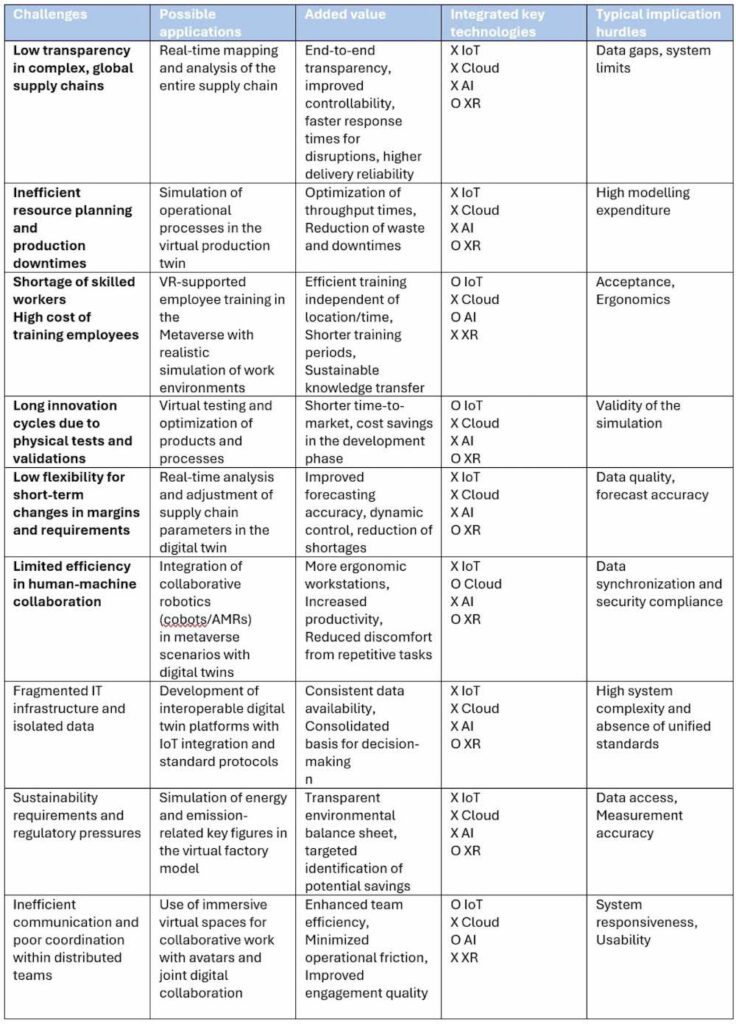
Digital twins use real-time data from IoT devices, which are combined with AI-driven analyses to create virtual representations of supply chain networks. This virtual mapping enhances transparency while predicting potential disruptions and supporting the simulation of preventive alternative scenarios [20]. To ensure resilience in supply chains, IoT and AI technologies play a crucial role when integrated with dynamic and adaptable digital twins [21].
The feedback loops between real-time data collection, AI processing, and digital twin simulations enable continuous improvement and facilitate accurate decision-making. Figure 3 illustrates the integration of IoT, AI, and digital twins in strengthening supply chain resilience. The illustration highlights the data flow, generation of actionable insights, and feedback mechanisms among these components, showcasing their combined impact on risk management and adaptive strategies.
In general, digital twins in supply chain management offer numerous advantages and opportunities to increase efficiency and flexibility while sustainably securing competitiveness through digitalization, automation, and the use of innovative technology. They also help counteract the acute shortage of skilled workers. By using the DSCT, companies can strengthen resilience, responsiveness, and transparency in supply chain management—economically, environmentally, and socially. Real-time data from various sources enables companies to proactively respond to disruptions, anticipate them in advance, and shift from reactive to proactive management – resulting in significant financial benefits.
The DSCT offers multiple advantages regarding simulation, planning, control, and monitoring of supply chain networks. It strengthens resilience and responsiveness, supports reporting, and enables the sustainable securing of competitive advantages for supply chain networks, whether based on a cloud or in-house solution.
This article was written as part of the “Zero Emission Networks” project within the Sustainable Supply Chain Network Cluster at the Smart Production and Logistics Technology Transfer Center (www.hnu.de/en) at Neu-Ulm University of Applied Sciences in Leipheim, funded by the Free State of Bavaria. The project was implemented in collaboration with the Munich-based company Visoric (www.visoric.com) and was co-financed by the European Union.
Bibliography
[1] Roscoe, S. et al: Redesigning global supply chains during compounding geopolitical disruptions: the role of supply chain logics. In: International Journal of Operations & Production Management, 42 (2022) 9, pp. 1407-1434.[2] Gong, Y.; Jiang, Y.; Jia, F.: Multiple multi-tier sustainable supply chain management: a social system theory perspective. In: International Journal of Production Research 61 (2023) 14, pp. 4684-4701.
[3] Dou, Y.; Zhu, Q.; Sarkis, J.: Green multi-tier supply chain management: An enabler investigation. In: Journal of Purchasing and Supply Management 24 (2018) 2, pp. 95-107.
[4] Kanike, U.K.; Factors disrupting supply chain management in manufacturing industries. In: Journal of Supply Chain Management Science 4 (2023) 2, pp. 1-24.
[5] McGrath, P. et al: Tools and technologies of transparency in sustainable global supply chains. In: California Management Review, 64 (2021) 1, pp. 67-89.
[6] Rajamurugu, N. and M. Karthik, Introduction, History, and Concept of Digital Twin. Digital Twin Technology: Fundamentals and Applications. New Jersey 2022.
[7] Kenett, R. S.; Bortman, J.: The digital twin in Industry 4.0: A wide-angle perspective. In: Quality and Reliability Engineering International 38 (2022) 3, pp. 1357-1366.
[8] Attaran, M.: The internet of things: Limitless opportunities for business and society. In: Journal of Strategic Innovation and Sustainability 12 (2017) 1, p. 11.
[9] Researchandmarkets. Digital Twins Market by Technology, Twinning Type, Cyber-to-Physical Solutions, Use Cases and Applications in Industry Verticals 2024 – 2029. 2024. Accessed 11.03.2025.
[10] Shu, Z. et al: Cloud-integrated cyber-physical systems for complex industrial applications. In: Mobile Networks and Applications 21 (2016), pp. 865-878.
[11] Hou, L. et al: Literature review of digital twins applications in construction workforce safety. In: Applied Sciences 11 (2020) 1, p. 339.
[12] Lv, Z. and S. Xie, Artificial intelligence in the digital twins: State of the art, challenges, and future research topics. In: Digital Twin 1 (2024) 1, p. 12.
[13] Upadhyay, B. et al: Barriers Toward the Implementation of Extended Reality (XR) Technologies to Support Education and Training in Workforce Development Programs. In: Proceedings of the Human Factors and Ergonomics Society Annual Meeting 68 (2024) 1, pp. 265-269. DOI: 10.1177/10711813241275080.
[14] Sandau, J. Digital supply chain management. 2018. URL: https://www.deloitte.com/de/de/issues/efficiency-resiliency/digital-supply-chain-management.html, accessed 07.01.2025.
[15] Ivanov, D.; Dolgui, A.: A digital supply chain twin for managing the disruption risks and resilience in the era of Industry 4.0. In: Production Planning & Control 32 (2021) 9, pp. 775-788.
[16] Kamble, S. S. et al: Digital twin for sustainable manufacturing supply chains: Current trends, future perspectives, and an implementation framework. In: Technological Forecasting and Social Change, 176 (2022), pp. 1-13. DOI: 10.1016/j.techfore.2021.121448.
[17] Bandara, L. V.; Buics, L.: Digital Twins in Sustainable Supply Chains: A Comprehensive Review of Current Applications and Enablers for Successful Adoption. In: Engineering Proceedings 79 (2024) 1, p. 64.
[18] March, S. T.; Smith, G. F.: Design and natural science research on information technology. In: Decision Support Systems 15 (1995) 4, pp. 251-266.
[19] Hofman, H.: 3 ways the metaverse will transform your supply chain. 2022. URL: https://www.maersk.com/insights/digitalisation/2022/11/29/how-the-metaverse-will-transform-supply-chain-management, accessed 10.01.2025
[20] Tsolakis, N. et al: Artificial intelligence and blockchain implementation in supply chains: a pathway to sustainability and data monetization? In: Annals of Operations Research 327 (2023) 1, pp. 157-210.
[21] Fisher, M. L.: What Is the Right Supply Chain for Your Product. In: Harvard Business Review March/April (1997), pp. 105-116.
Your downloads
