Resilience and Sustainability in the Supply Chain |
How SMEs can prepare for the changes to come

| Journal | Industry 4.0 Science |
| Issue | Volume 40, 2024, Edition 1, Pages 57-62 |
| Bibliography | Share | Cite | Download |
Abstract
Keywords
Article
Comprehensive transparency and increased cooperation in the supply chain are essential for achieving greater resilience and sustainability. Against this backdrop, the role of SMEs in the supply chain is becoming increasingly important. Based on the number of employees, the EU defines companies with fewer than 250 employees as SMEs [1]. These companies face unique challenges when implementing the new EU requirements. Limited knowledge of direct and indirect suppliers as well as limited financial and human resources are just some of the challenges that SMEs have to overcome in this context.
The events and resulting supply chain disruptions caused by the pandemic have made companies acutely aware of the vulnerability of their own value chains. Considering this, the desire to be better prepared for crises has taken on a new significance. “Resilience” – the ability to recognize disruptions as early as possible, react quickly, adapt, and recover effectively – has now been incorporated into the vocabulary not only for risk managers.
However, in order to adequately prepare for future disruptions and identify potential risks at an early stage, comprehensive transparency in the supply chain and detailed knowledge of both direct and indirect suppliers are required. Nevertheless, many companies still lack or only have limited visibility beyond their direct (Tier 1) suppliers [2]. But this will have to change: Regulatory requirements, such as the German Supply Chain Due Diligence Act (SCDDA), which obliges companies to uphold human rights in their supply chains and defines due diligence obligations, will increasingly enforce more transparency in the supply chain and enhanced data exchange in the coming years – even among SMEs. The new German Supply Chain Act will define requirements for responsible supply chain management practices for companies with at least 1,000 employees in Germany from January 1, 2024.
Similarly to the SCDDA, sustainability-related regulatory frameworks such as the Corporate Sustainability Reporting Directive (CSRD), the EU taxonomy or the EU’s Carbon Border Adjustment Mechanism (CBAM) for taxing “imported” CO2 emissions are already increasing the pressure on companies to record and exchange sustainability data within the entire supply chain. The growing importance of sustainability in general and of the recording and reporting of sustainability-relevant key figures, in particular, is increasingly felt in the German market. To bolster efforts to reduce greenhouse gas (GHG) emissions and strive for climate neutrality in products and companies, recording and reporting these emissions is a crucial basis for an accurate assessment.
Since GHG emissions from upstream and downstream activities in the value chain, known as Scope 3 emissions, account for an average of 84% of the total GHG emissions of individual companies [3] – 70% to 80% in the manufacturing sector [4] – it is far from sufficient for a company to only consider the emissions that arise within the company itself. This means that here too, the focus must shift to the supply chain, where SMEs play a decisive role. Although an average SME emits only a fraction of GHG emissions expelled by the average large company, due to the large number of small and medium-sized enterprises (SMEs), the collective contribution of SMEs to total corporate emissions in the EU is still over 60% [5].
These developments raise the question of how SMEs can meet this plethora of new requirements and simultaneously remain competitive in the market. The aim of this article is to provide an overview of the most important challenges that arise when implementing initiatives to increase resilience, particularly risk management approaches. Further, the article also deals with the challenges SMEs face when introducing sustainability measures and ultimately aims to prepare SMEs for said future developments by putting forward recommendations for action.
Research approach: Quantitative survey for status quo analysis
This article is based on an extensive literature analysis that was carried out to identify SME-specific challenges when attempting to create resilient and sustainable supply chains. As part of the joint project Mittelstand-Digital Zentrum Hamburg, the Institute of Business Logistics and General Management supports SMEs in their digital transformation, with the topics of resilience and sustainability currently representing important focal points.
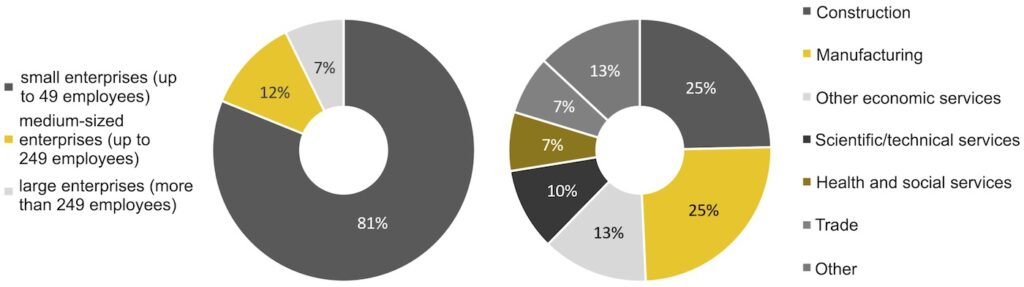
To identify challenges and derive recommendations for action, an empirical study in the form of a quantitative survey was conducted in addition to the literature analysis in order to identify the level of implementation and current challenges faced by SMEs in the Hamburg metropolitan region in the context of digitalization, resilience, and sustainability. The survey was conducted between September and December 2022 in the form of an online questionnaire and received 120 responses, of which 71 were partially completed and 49 were fully completed.
Figure 1 provides an overview of the sample, illustrating the size and sector affiliation of the companies surveyed. The approaches for solutions and recommendations for action derived from this survey are continuously being examined by experiences from the cooperation with SMEs in the project, where they form the basis for information, qualification, and support offerings.
New requirements clash with scarce resources
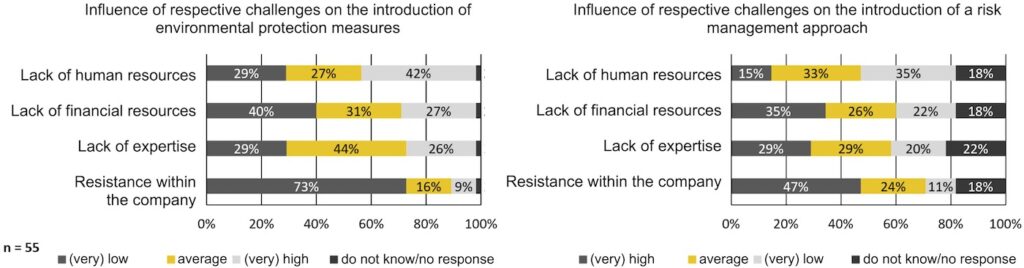
As part of the survey, the challenges faced by SMEs in implementing environmental protection measures and risk management approaches, as well as other digital transformation issues, were investigated. These challenges were previously identified as part of a literature analysis. The significance of the respective challenges was then assessed by the participants to determine their relevance for SMEs in the Hamburg metropolitan region.
With regard to the implementation of a risk management approach – one of the most important measures for increasing resilience and preparing for disruptions in the supply chain [6], the challenges identified in the literature and from survey respondents (Figure 2) are as follows [7, 8]: Due to the unique characteristics and structural features of SMEs, limited time, monetary and human resources are at the forefront of both the literature and the survey results. The constraints of day-to-day business are clearly at odds with the provision of sufficient resources, which would be necessary for the development of a forward-looking resilience strategy. This often results in a mindset of “taking things as they come” and “reacting in the short term” instead of taking early action with regard to potential risks [7]. Limited access to technological resources and qualified personnel exacerbate the problem. As a result, the necessary expertise is often not available within the company.
Five solutions for SMEs
When deriving SME-specific recommendations for action, it should be kept in mind that these SMEs are not a homogeneous group with the same characteristics across the board – significant differences arise, for example, due to company size or the sector to which companies belong [12]. The following recommendations for action are therefore solutions that address the challenges faced by SMEs, but their application must always take individual requirements and means into account.
Finding opportunities for cost savings
Dealing with topics such as resilience and sustainability should not be seen solely as a burden, but also as an opportunity. Data collected, for example, when identifying risks or CO2 hotspots within the company and its supply chain can be used to identify cost-saving potentials, which can justify the necessary effort twice over: By implementing an energy management system, SMEs can not only reduce their CO2 emissions, but also benefit from considerable savings [13].
Similarly, resource efficiency measures can lead to savings both in the release of GHG emissions in upstream stages of the value chain and in the cost of materials. Increasing transparency in the supply chain to identify risks or comply with the Supply Chain Due Diligence Act can reveal avenues for optimization in purchasing. The core of this strategy is to increase transparency and initially focus on those measures that also bring along financial benefits.
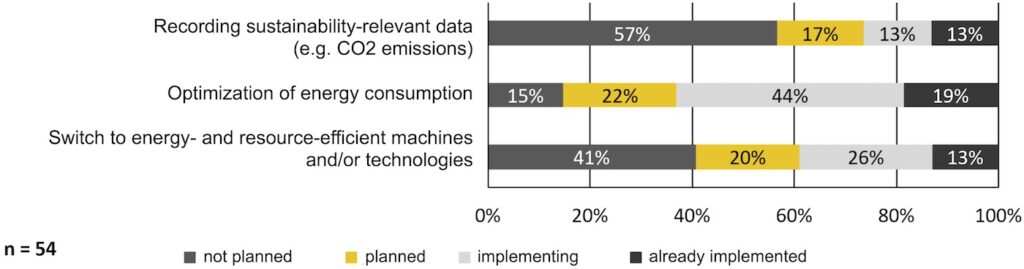
A look at the survey results (Figure 3) shows that many SMEs are naturally already pursuing this strategy and are focusing, for example, on optimizing energy consumption. Nevertheless, the increasing need to collect sustainability-relevant data has yet to be recognized by all such companies. There is a need to raise awareness here – also with regard to possible synergies and quantification of the successes achieved.
Using digitalization as a lever
Digitalization offers SMEs a wide range of opportunities to significantly reduce the effort required to collect and provide data by automating processes and thus making them more efficient. For example, managing sustainability indicators both in one’s own company and in the supply chain is a complicated task that can be considerably streamlined by making use of digitalization. Software solutions can automatically record data, which can then be made easily accessible not only for internal purposes but also for audits and reports to third parties.
The challenges facing SMEs should therefore be taken as an opportunity to focus on business processes and workflows within the company as well as on communication with customers and suppliers and, where possible and sensible, to digitize these. After all, this kind of investment not only benefits the issues of resilience and sustainability but also benefits the entire company through efficiency gains and by creating new opportunities.
Thinking holistically
To find effective solutions, the topics of resilience and sustainability should not be considered in isolation. Instead of creating parallel structures for resilience and sustainability projects, duplicate work can be avoided. Synergies, for example in the areas of personnel, data collection, IT systems, and even in the implementation of specific measures, can be utilized. Instead of making extensive changes for each new regulatory requirement, SMEs should develop robust internal systems that can react flexibly to different requirements. When looking at the supply chain, it makes sense to consider the requirements relating to resilience and sustainability at the same time and to set up structures, systems, and processes accordingly. Creating a joint roadmap that integrates both aspects can be helpful here.
Jointly overcoming challenges
Isolation is rarely the key to success. Instead of trying to solve every problem on their own, SMEs can gain valuable insights by using networks and collaborations. Many SMEs face the same challenges – close cooperation with other players can make them easier to overcome. By cooperating with competitors, customers, or suppliers, best practices can be exchanged, joint solutions can be found and knowledge shared. Industry associations, chambers of industry and commerce, and initiatives specifically geared towards SMEs, such as the publicly funded “Mittelstand-Digital Zentren” in Germany, offer platforms for exchange and knowledge transfer and can support the implementation of joint initiatives.
Carrying out an honest as-is analysis
In order to master the challenges, it is first necessary to take stock honestly. This applies not only to the topics of resilience and sustainability but also to digitalization as an important enabler. Tools such as maturity level analyses or (digitalization) check-ups can help to assess the status quo and develop an effective strategy based on this. A basic analysis can also serve to identify areas in which external expertise or additional resources are required. Taking stock also provides an opportunity for dialog with stakeholders and promotes a shared understanding of the steps to come.
Strengthening competiteveness by means of sustainability
The results of the study confirm the challenges already identified in the literature that companies face on the path to building resilient and sustainable supply chains. Once again, scarce human resources are particularly challenging for SMEs. The recommendations for action presented address precisely this issue and focus on the use of synergies. In this way, scarce resources can be used efficiently. The study also shows areas in which SMEs have an increased need for raised awareness and support in the implementation of sustainability measures or resilience strategies.
In view of the imminent extension of reporting obligations under CSRD, as well as emerging long-term trends such as the effects of climate change, resource scarcity, and geopolitical uncertainties, it is advisable for companies to address these issues comprehensively and at an early stage. Ultimately, the shift towards greater sustainability and the need for greater resilience should not be seen as a forced change, but as an opportunity to strengthen competitiveness. In terms of a “triple transformation” (sustainability, resilience, and digitalization) [14], companies have the opportunity now to position themselves for the future and make a positive contribution to society and the environment at the same time.
This article was created as part of the project “Mittelstand-Digital Zentrum Hamburg” (funding code 01MF21011D; project sponsor German Aerospace Center (DLR)). The project is part of the ” IKT-Anwendungen in der Wirtschaft” funding measure and is funded by the German Federal Ministry of Economics and Climate Protection (BMWK) as part of the ” Netzwerk Mittelstand-Digital” funding area on the basis of a resolution passed by the German Bundestag.
Bibliography
[1] Europäische Kommission: Benutzerleitfaden zur Definition von KMU. URL: doi:10.2873/182635.[2] Addicoat, A.; Flynn, R.; Kilpatrick, J.; Brown, J.; Mitchell, P.: Deloitte 2023 Global Chief Procurement Officer Survey. Orchestrators of Value. URL: www2.deloitte.com/content/dam/Deloitte/us/Documents/consulting/us-2023-global-chief-procurement-officer-survey.pdf, Abrufdatum 31.08.2023.
[3] Matthews, H. S.; Hendrickson, C. T.; Weber, C. L.: The importance of carbon footprint estimation boundaries. In: Environmental science & technology 42 (2008) 16, S. 5839-5842.
[4] Huang, Y. A.; Weber, C. L.; Matthews, H. S.: Categorization of Scope 3 emissions for streamlined enterprise carbon footprinting. In: Environmental science & technology 43 (2009) 22, S. 8509-8515.
[5] Gorgels, S.; Priem, M.; Blagoeva, T.; Martinelle, A.; Milanesi, G.: Annual report on European SMEs 2021/2022. SMEs and environmental sustainability: background document. Luxembourg 2022.
[6] Schröder, M.: Strukturierte Verbesserung des Supply Chain Risikomanagements. Wiesbaden 2019.
[7] Sullivan-Taylor, B.; Branicki, L.: Creating resilient SMEs: why one size might not fit all. In: International Journal of Production Research 49 (2011) 18, S. 5565-5579.
[8] Wagner, S. M.; Kemmerling, R.; Kersten, W.; Böger, M.: Supply Chain Risikomanagement: Besonderheiten und Herausforderungen für kleine und mittlere Unternehmen: Supply Chain Network Management 2010.
[9] Saeed, M.; Kersten, W.: Drivers of Sustainable Supply Chain Management: Identification and Classification. In: Sustainability 11 (2019) 4, S. 1137.
[10] Lee, S.-Y.; Klassen, R. D.: Drivers and Enablers That Foster Environmental Management Capabilities in Small- and Medium-Sized Suppliers in Supply Chains. In: Production and Operations Management 17 (2008) 6, S. 573-586.
[11] Alayón, C. L.; Säfsten, K.; Johansson, G.: Barriers and Enablers for the Adoption of Sustainable Manufacturing by Manufacturing SMEs. In: Sustainability 14 (2022) 4, S. 2364
[12] Conway, E.: Engaging small and medium-sized enterprises (SMEs) in the low carbon agenda. In: Energy, Sustainability and Society 5 (2014) 21.
[13] Chen, L.; Shen, B.; Wu, X.; Ding, X.: Development of a cost-effective energy and water management system for small and medium-sized manufacturers. In: Journal of Cleaner Production 135 (2017).
[14] Kersten, W.: Triple-Transformation von Logistik und SCM: digital, nachhaltig und resilient [Vortrag/Handout]. 30. Hamburger Logistik-Kolloquium im ZAL TechCenter Hamburg 30.06.2022.
Your downloads
Solutions: Logistics
You might also be interested in