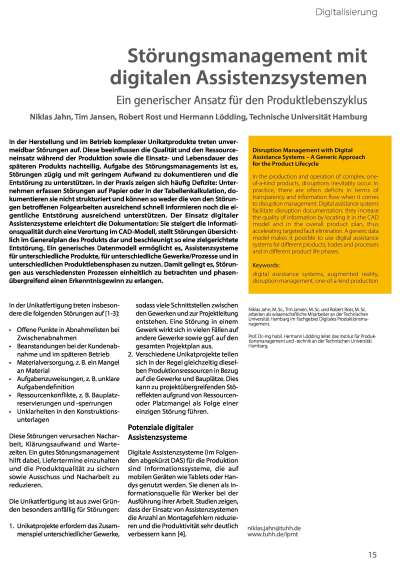
Disruption Management with Digital Assistance Systems

A generic approach for the product lifecycle

JournalIndustrie 4.0 Management
Issue Volume 39, 2023, Edition 2, Pages 15-19
Bibliography Share Cite Download

Abstract

In the production and operation of complex, one- of-a-kind products, disruptions inevitably occur. In practice, there are often deficits in terms of transparency and information flow when it comes to disruption management. Digital assistance systems facilitate disruption documentation: they increase the quality of information by locating it in the CAD model and in the overall product plan, thus accelerating targeted fault elimination. A generic data model makes it possible to use digital assistance systems for different products, trades and processes and in different product life phases. (Only in German)

Keywords

Access limited

You are currently not logged in / not yet registered.

In order to download the desired file(s), you must be logged in and have an appropriate inclusive subscription. Alternatively, you can also obtain access by paying a one-off fee.

Subscription included Purchase
without 29,00 €
Digital 27,55 €
Expert 26,10 €
Professional 0,00 €

Download for one time 29,00 €

All prices include 7% VAT

After purchasing access rights, you will automatically be redirected back to this page.


You might also be interested in

Interoperable Data Access in Automotive Body Manufacturing

Interoperable Data Access in Automotive Body Manufacturing

Deterministic integration of structured target parameters into tact-time production
Tim Richter ORCID Icon, Robert Weidner ORCID Icon
AI has long been capable of analyzing production processes, yet why is it still so difficult to bring its insights back into production without intermediate steps? In automotive body-in-white mass production, the challenge is less a lack of data than the absence of holistic integration concepts that extend all the way to the machines. This paper demonstrates why bidirectionally communicative information systems are critical to addressing this challenge and identifies the design principles required to effectively integrate AI-generated results into production processes in the future.
Industry 4.0 Science | Volume 42 | 2026 | Edition 5 | Pages 34-42 | DOI 10.30844/I4SE.26.5.4
Audio-Immersive Learning in Continuing Vocational Education

Audio-Immersive Learning in Continuing Vocational Education

From linear audio playback to AI-supported conversational learning companions
Tim Beichter, Vanessa Hartmann, Katharina Hölzle ORCID Icon, Manuel Kaiser
Artificial intelligence is increasingly shaping continuing vocational education and training by enabling the personalization of individual learning experiences. At the same time, audio-based learning formats are attracting growing interest among learners because of their flexibility and suitability for workplace learning. However, a conceptual framework for AI-supported audio learning, as well as the potential of combining artificial intelligence with audio-based learning, has received little attention to date. This paper therefore presents a conceptual perspective on the design possibilities and educational potential of AI-supported audio learning formats.
Industry 4.0 Science | Volume 42 | 2026 | Edition 5 | Pages 102-108 | DOI 10.30844/I4SE.26.5.12
Explaining AI in Industrial Production in an Accessible Way

Explaining AI in Industrial Production in an Accessible Way

Requirements for AI demonstrators to promote acceptance
Jennifer Link ORCID Icon, Markus Harlacher ORCID Icon, Colin Srebny, Sascha Stowasser ORCID Icon
Artificial intelligence (AI) offers a wide range of possibilities in industrial production, but it also presents challenges regarding employee acceptance. AI demonstrators are therefore of central importance, as they enable hands-on experience with AI. However, there has been a lack of systematically identified requirements for demonstrators that specifically promote acceptance and address negative emotions. Using a multi-stage research design, 69 requirements were identified, structured into functional requirements, quality requirements, and boundary conditions.
Industry 4.0 Science | Volume 42 | 2026 | Edition 5 | Pages 6-14 | DOI 10.30844/I4SE.26.5.1
AI-Based Building Inspection for Large Structures

AI-Based Building Inspection for Large Structures

A new approach to construction progress monitoring
Jan Sender, Konrad Jagusch, Michael Geist ORCID Icon, David Jericho ORCID Icon, Christian Scharr ORCID Icon
Monitoring construction progress, as required in the one-off production of large structures, is very time- and labor-intensive due to a high level of complexity and individuality. The goal of this article is to develop a sensor-based approach for capturing and evaluating multiple inspection characteristics. The use of machine learning models to detect objects and derive relevant information forms the basis for linking current condition to construction schedule. This enables a significant increase in efficiency during construction progress monitoring and a well-founded assessment of progress.
Industry 4.0 Science | Volume 42 | 2026 | Edition 5 | Pages 78-84 | DOI 10.30844/I4SE.26.5.9
Inclusive Work System Design

Inclusive Work System Design

Automation, standardization, and adaptability
Sebastian Schlund ORCID Icon
The design of inclusive work systems is gaining importance due to demographic change and the increasing digital penetration of value creation processes. While traditional ergonomic approaches are based primarily on percentile logic and thus address only a portion of the user population, the integration of digital technologies opens up new possibilities for the dynamic and individualized adaptation of work systems. This article presents a conceptual framework for inclusive work system design that integrates standardization, automation, and adaptability. Methodologically, the article is based on a conceptual analysis of existing approaches from ergonomics and human-centered design. The article makes a theoretical contribution to the systematization of inclusive work system design and identifies areas of focus for further research and industrial practice.
Industry 4.0 Science | Volume 42 | 2026 | Edition 5 | Pages 70-76 | DOI 10.30844/I4SE.26.5.8
Work Design in the Use of Autonomous Systems

Work Design in the Use of Autonomous Systems

Addressing the shortage of skilled workers
Tim Jeske ORCID Icon, Sascha Stowasser ORCID Icon, Nicole Ottersböck, Sebastian Terstegen, Rasmus Adler ORCID Icon
Companies are increasingly challenged to address shortages of skilled workers while meeting rising demands for productivity, flexibility, and innovation. Because labor supply can only be expanded to a limited extent, there is a growing focus on designing work systems with productivity in mind. Autonomous systems offer significant potential in this regard. Their implementation requires not only technical adjustments but, above all, changes in organization, skills, and work design. This article analyzes empirically grounded change requirements in existing work systems as well as associated economic potential.
Industry 4.0 Science | Volume 42 | 2026 | Edition 5 | Pages 44-50 | DOI 10.30844/I4SE.26.5.5