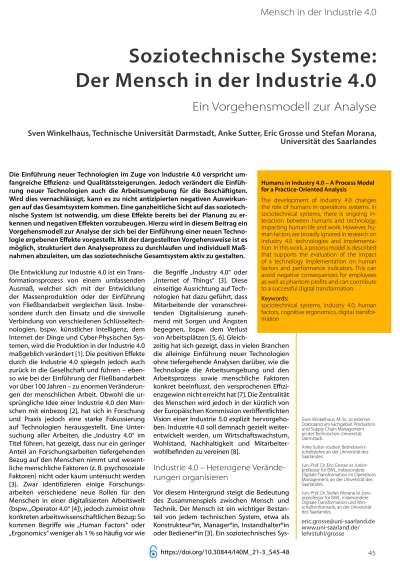
Humans in Industry 4.0

A process model for a practice-oriented analysis

JournalIndustrie 4.0 Management
Issue Volume 37, 2021, Edition 3, Pages 45-48
Open Accesshttps://doi.org/10.30844/I40M_21-3_S45-48
Bibliography Share Cite Download

Abstract

The development of Industry 4.0 changes the role of humans in operations systems. In sociotechnical systems, there is ongoing interaction between humans and technology, impacting human life and work. However, human factors are broadly ignored in research on Industry 4.0 technologies and implementation. In this work, a process model is described that supports the evaluation of the impact of a technology implementation on human factors and performance indicators. This can avoid negative consequences for employees as well as phantom profits and can contribute to a successful digital transformation.

Keywords


Bibliography

[1] Lu, Y., Industry 4.0: A survey on technologies, applications and open research issues. In: Journal of Industrial Information Integration 6 (2017), S. 1-10.
[2] Kagermann, H.; Wahlster, W.; Helbig, J.: Recommendations for implementing the strategic initiative Industrie 4.0, Securing the future of German manufacturing industry, Final report of the Industrie 4.0 Working Group. Berlin 2013.
[3] Neumann, W. P. u. a.: Industry 4.0 and the human factor – A systems framework and analysis methodology for successful development. In: International Journal of Production Economics 233 (2021), 107992.
[4] Romero, D. u. a.: Towards an Operator 4.0 Typology: A Human-Centric Perspective on the Fourth Industrial Revolution Technologies. In: Proceedings of the International Conference on Computers and Industrial Engineering. Tianjin, China 2016.
[5] Rohleder, B.: Digitalisierung der Logistik. Berlin 2019.
[6] Brynjolfsson, E.; McAfee, A.: The second machine age: Work, progress, and prosperity in a time of brilliant technologies. New York 2014.
[7] Rose, L. M.; Orrenius, U. E.; Neumann, W. P.: Work environment and the bottom line: Survey of tools relating work environment to business results. In: Human Factors and Ergonomics in Manufacturing & Service Industries 23 (2013) 5, S. 368-381.
[8] Breque, M.; De Nul, L.; Petridis, A.: Industry 5.0 – Towards a sustainable, human-centric and resilient European industry, European Union. Bruxelles 2021.
[9] Neumann, W. P.; Dul, J.: Human Factors: Spanning the Gap between OM & HRM. In: International Journal of Operations & Production Management 30 (2010) 9, S. 923-950.
[10] Shipton, H. J. u. a.: When promoting positive feelings pays: Aggregate job satisfaction, work design features, and innovation in manufacturing organizations. In: European Journal of Work and Organizational Psychology 15 (2006) 4, S. 404-430.
[11] Russell-Walling, E.: Scientific Management, in 50 Schlüsselideen Management. Heidelberg 2011.
[12] Waschull, S. u. a.: Work design in future industrial production: Transforming towards cyber-physical systems. In: Computers & Industrial Engineering 139 (2020), 105679.
[13] Lüdtke, A.: Wege aus der Ironie in Richtung ernsthafter Automatisierung, In: Botthof, A.; Hartmann, E. (Hrsg.): Zukunft der Arbeit in Industrie 4.0. Heidelberg 2015, S. 125-146.
[14] Peissner, M.; Hipp, C.: Potenziale der Mensch-Technik-Interaktion für die effiziente und vernetzte Produktion von morgen. Stuttgart 2013.
[15] Wieland, R.: Digitalisierung und der Mensch. In: Forschungsmagazin der bergischen Universität Wuppertal BUW.OUTPUT 21 (2019), S. 6-11.
[16] Dregger, J. u. a.: Challenges for the future of industrial labor in manufacturing and logistics using the example of order picking systems. In: Procedia CIRP 67 (2018), S. 140-143.
[17] Reiman, A. u.a.: Human factors and ergonomics in manufacturing in the industry 4.0 context – A scoping review. In: Technology in Society, 65 (2021), 101572.
[18] Ulich, E.: Arbeitspsychologie. 7. Auflage, Stuttgart 2011.
[19] Sgarbossa, F. u. a.: Human factors in production and logistics systems of the future. In: Annual Reviews in Control 49 (2020), S. 295-305.
[20] Kadir, B. A.; Broberg, O.; Conceição, C. S. d.: Current research and future perspectives on human factors and ergonomics in Industry 4.0. In: Computers & Industrial Engineering 137 (2019), S. 1-12.

Your downloads


You might also be interested in
Interoperable Data Access in Automotive Body Manufacturing

Interoperable Data Access in Automotive Body Manufacturing

Deterministic integration of structured target parameters into tact-time production
Tim Richter ORCID Icon, Robert Weidner ORCID Icon
AI has long been capable of analyzing production processes, yet why is it still so difficult to bring its insights back into production without intermediate steps? In automotive body-in-white mass production, the challenge is less a lack of data than the absence of holistic integration concepts that extend all the way to the machines. This paper demonstrates why bidirectionally communicative information systems are critical to addressing this challenge and identifies the design principles required to effectively integrate AI-generated results into production processes in the future.
Industry 4.0 Science | Volume 42 | 2026 | Edition 5 | Pages 34-42 | DOI 10.30844/I4SE.26.5.4
Audio-Immersive Learning in Continuing Vocational Education

Audio-Immersive Learning in Continuing Vocational Education

From linear audio playback to AI-supported conversational learning companions
Tim Beichter, Vanessa Hartmann, Katharina Hölzle ORCID Icon, Manuel Kaiser
Artificial intelligence is increasingly shaping continuing vocational education and training by enabling the personalization of individual learning experiences. At the same time, audio-based learning formats are attracting growing interest among learners because of their flexibility and suitability for workplace learning. However, a conceptual framework for AI-supported audio learning, as well as the potential of combining artificial intelligence with audio-based learning, has received little attention to date. This paper therefore presents a conceptual perspective on the design possibilities and educational potential of AI-supported audio learning formats.
Industry 4.0 Science | Volume 42 | 2026 | Edition 5 | Pages 102-108 | DOI 10.30844/I4SE.26.5.12
Generative AI in Organizational Knowledge Management

Generative AI in Organizational Knowledge Management

AI literacy as a prerequisite for augmentation
Uta Wilkens ORCID Icon, Valentin Langholf ORCID Icon, Niklas Obermann ORCID Icon
Generative Artificial Intelligence (GenAI) offers new opportunities for organizational knowledge management, particularly when it comes to learning processes at the interface between explicit, firm-specific, and tacit knowledge. Its use is therefore of particular interest for application areas such as industrial maintenance. Based on a mechanical engineering case study, this article demonstrates that augmenting both processes and employees with GenAI requires AI literacy combined with professional skills.
Industry 4.0 Science | Volume 42 | 2026 | Edition 5 | Pages 118-126 | DOI 10.30844/I4SE.26.5.14
Explaining AI in Industrial Production in an Accessible Way

Explaining AI in Industrial Production in an Accessible Way

Requirements for AI demonstrators to promote acceptance
Jennifer Link ORCID Icon, Markus Harlacher ORCID Icon, Colin Srebny, Sascha Stowasser ORCID Icon
Artificial intelligence (AI) offers a wide range of possibilities in industrial production, but it also presents challenges regarding employee acceptance. AI demonstrators are therefore of central importance, as they enable hands-on experience with AI. However, there has been a lack of systematically identified requirements for demonstrators that specifically promote acceptance and address negative emotions. Using a multi-stage research design, 69 requirements were identified, structured into functional requirements, quality requirements, and boundary conditions.
Industry 4.0 Science | Volume 42 | 2026 | Edition 5 | Pages 6-14 | DOI 10.30844/I4SE.26.5.1
AI-Based Building Inspection for Large Structures

AI-Based Building Inspection for Large Structures

A new approach to construction progress monitoring
Jan Sender, Konrad Jagusch, Michael Geist ORCID Icon, David Jericho ORCID Icon, Christian Scharr ORCID Icon
Monitoring construction progress, as required in the one-off production of large structures, is very time- and labor-intensive due to a high level of complexity and individuality. The goal of this article is to develop a sensor-based approach for capturing and evaluating multiple inspection characteristics. The use of machine learning models to detect objects and derive relevant information forms the basis for linking current condition to construction schedule. This enables a significant increase in efficiency during construction progress monitoring and a well-founded assessment of progress.
Industry 4.0 Science | Volume 42 | 2026 | Edition 5 | Pages 78-84 | DOI 10.30844/I4SE.26.5.9
Inclusive Work System Design

Inclusive Work System Design

Automation, standardization, and adaptability
Sebastian Schlund ORCID Icon
The design of inclusive work systems is gaining importance due to demographic change and the increasing digital penetration of value creation processes. While traditional ergonomic approaches are based primarily on percentile logic and thus address only a portion of the user population, the integration of digital technologies opens up new possibilities for the dynamic and individualized adaptation of work systems. This article presents a conceptual framework for inclusive work system design that integrates standardization, automation, and adaptability. Methodologically, the article is based on a conceptual analysis of existing approaches from ergonomics and human-centered design. The article makes a theoretical contribution to the systematization of inclusive work system design and identifies areas of focus for further research and industrial practice.
Industry 4.0 Science | Volume 42 | 2026 | Edition 5 | Pages 70-76 | DOI 10.30844/I4SE.26.5.8