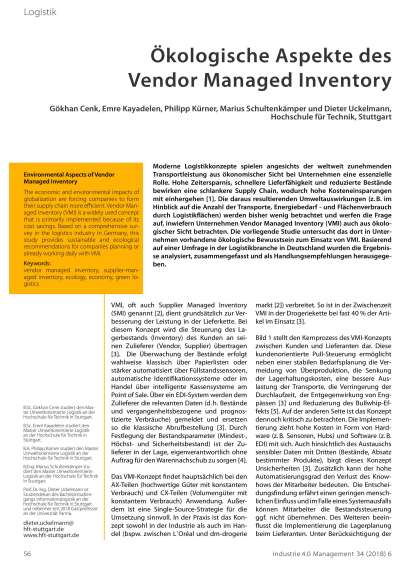
Environmental Aspects of Vendor Managed Inventory

JournalIndustrie 4.0 Management
Issue Volume 34, 2018, Edition 6, Pages 56-60
Open Accesshttps://doi.org/10.30844/I40M_18-6_56-60
Bibliography Share Cite Download

Abstract

The economic and environmental impacts of globalization are forcing companies to form their supply chain more efficient. Vendor Managed Inventory (VMI) is a widely used concept that is primarily implemented because of its cost savings. Based on a comprehensive survey in the logistics industry in Germany, this study provides sustainable and ecological recommendations for companies planning or already working daily with VMI.

Keywords


Bibliography

[1] Klaus, Peter: Lexikon Logistik. Wiesbaden 2008.
[2] Hausladen, Iris: IT-gestützte Logistik: Systeme – Prozesse – Anwendungen. Wiesbaden 2014.
[3] Werner, Hartmut: Supply Chain Management: Grundlagen, Strategien, Instrumente und Controlling. Wiesbaden 2017.
[4] Seidenschwarz, Werner: Marktorientiertes Prozessmanagement: Wie Process Mass Customization Kundenorientierung und Prozessstandardisierung integriert. München 2012.
[5] John, Wang: Management Innovations for Intelligent Supply Chains. Hershey 2012.
[6] Wagner, Stefan M.; Kemmerling, Rene: Handling Nonresponse in Logistics Research. In: Journal of Business Logi- stics 31 (2010) 2, S. 357-381.
[7] KfW Bankengruppe: KFW-Befragung zu den Hemmnissen und Erfolgsfaktoren von Energieeffizienz in Unternehmen. URL: https://www.kfw.de/Download-Center/Konzernthemen/Research/ PDF-Dokumente-Sonder- publikationen/Sonderpublikation.pdf, Abrufdatum 23.04.2018.
[8] Zenker, M.; Meers, S.; Ullmann, G.; Nyhuis, P.: Ökologische und logistische Bewertung und Auswahl von Anlieferkonzepten. In: Industrie Management 29 (2013) 2, S. 63-65.
[9] Wiese, Jonas: Slow Logistics: eine simulationsgestützte Analyse der ökonomischen und ökologischen Potentiale der Sendungsbündelung. Bamberg 2017.
[10] Angerer, A: Out-of-Stock im Handel: Ausmass-Ursachen-Lösungen. URL: https://www.gefahrgut-online.de/fm/3576/Angerer.pdf, Abrufdatum 25.04.2018.
[11] Schmied, M.: Umweltorientierte Logistikstrategien: Beweggründe, Ansatzpunkte, Instrumente. In: INFRAS/ Öko-Institut (Hrsg): Hochschule für Technik. Stuttgart 2017.
[12] Cernavin, Oleg; Schröter, Welf; Stowasser, Sascha: Prävention 4.0: Analysen und Handlungsempfehlungen für eine produktive und gesunde Arbeit 4.0. Berlin Heidelberg New York 2017.
[13] Vogel Communications Group GmbH & Co. KG: Vendor Managed Inventory optimiert Lagerdiposition. URL: https://www.mm-logistik.vogel.de/vendor-managed-inventory-optimiert-lagerdisposition-a-673607/, Abrufdatum 22.07.2018
[14] Verband der Automobilindustrie: RFID im Behältermanagement der Supply Chain. URL: https://www.vda.de/dam/vda/publications/2015/vda-5501-rfid-im-behaeltermanagement-v2-1/VDA_5501%20RFID%20Behaeltermanagement%20V%20 2%202%20Juli%202016.pdf, Abrufdatum 02.05.2018.
[15] Eßig, M.; Witt, M.: Öffentliche Logistik: Supply Chain Management für den öffentlichen Sektor. Berlin Heidelberg New York 2008.
[16] Umweltbundesamt: Postfossile Energieversorgungsoptionen für einen treibhausgasneutralen Verkehr im Jahr 2050: Eine verkehrsträgerübergreifende Bewertung. URL: https://www.umweltbundesamt.de/sites/default/files/medien/378/publikationen/texte_30_2015_postfossile_energieversorgungsoptionen.pdf, Abrufdatum 29.04.2018.

Your downloads


You might also be interested in

Enabling Digital Trust in Green Hydrogen Markets

Enabling Digital Trust in Green Hydrogen Markets

Trust-Building Information Systems and Mechanisms
Johanna Voß, Jens Pöppelbuß ORCID Icon
Building a global hydrogen economy requires more than technology and investment; it requires trust. As information systems (IS) increasingly mediate collaboration among unfamiliar, distributed actors, the question of how trust can be deliberately built becomes critical. This study systematically maps how IS enable different types of trust and reveals how these mechanisms can support trusting collaboration in emerging hydrogen value chains.
Industry 4.0 Science | Volume 42 | 2026 | Edition 4 | Pages 82-90
Classification of Digital Supply Chain Management Platforms

Classification of Digital Supply Chain Management Platforms

Review of existing classification approaches from a circular economy perspective
Sophia Botsch ORCID Icon, Eva Mante ORCID Icon, Marcel Papert ORCID Icon, Alexander Pflaum ORCID Icon
Assessing the impact of digital industrial platforms on the dynamics and resilience of supply chains requires clear classification of such platforms. This article examines the extent to which a current classification proposal from the field of supply chain management must be further developed in the context of digital platforms for implementing the circular economy (CE). The authors conclude that a fundamental revision is not necessary, as the digital CE platforms under consideration fit well into the existing classification system. However, new research questions arise regarding the distinction between digital service platforms and digital data-oriented platforms, as well as the link between the circular economy and supply chain management—particularly in connection with supply chain control towers, which are becoming increasingly established in supply chain management practice.
Industry 4.0 Science | Volume 42 | 2026 | Edition 4 | Pages 62-70 | DOI 10.30844/I4SE.26.4.7
Digital Factory Planning for Startups

Digital Factory Planning for Startups

A simulation-based production structure design
Herwig Winkler ORCID Icon, Tobias Isau
With the increasing complexity of production and logistics systems, traditional factory planning approaches are reaching their limits. In this context, digital factory planning offers a promising solution for enabling well-informed decisions, particularly during the early planning phases. For startups, the optimal planning of a production facility is challenging, as they often operate with limited financial and infrastructural resources. This paper presents a methodological approach to digital factory planning that utilizes VR simulation for the layout planning of a factory hall for a young company in the solar industry. The proposed approach demonstrates how simulations can support the design of flexible production structures, particularly in startup environments.
Industry 4.0 Science | Volume 42 | 2026 | Edition 3 | Pages 68-75
Site Assessment for Flexible Intralogistics in Brownfield Sites

Site Assessment for Flexible Intralogistics in Brownfield Sites

Innovative decision support in practice
Jolanda Schierbaum, Carsten Feldmann, Lars Renhof
Due to its dynamic environment, space planning in intralogistics is not a one-time task but a recurring decision-making process subject to numerous constraints imposed by existing infrastructure. Decisions are often based on incomplete data, resulting in a high risk of poor planning decisions and inefficient use of space. This paper presents a practice-oriented process model for space evaluation in brownfield projects. The proposed approach improves the standardization and consistency of space evaluation and promotes best practices among all stakeholders. By supporting systematic decision-making, the process model contributes to optimized planning and resource allocation, thereby reducing risks and avoiding costly implementation errors.The process model is demonstrated through a case study conducted at a commercial vehicle manufacturer.
Industry 4.0 Science | Volume 42 | 2026 | Edition 3 | Pages 124-133
Digital Twins for Emission Reduction

Digital Twins for Emission Reduction

Ex-ante case study on a pump test bench in industrial production
Felix Bischoff, Ingela Tietze ORCID Icon, Peter Hertweck, Nina van Hasz
Digital twins are frequently referred to as a promising approach for reducing greenhouse gas (GHG) emissions in industrial production; however, robust empirical evidence of their benefits under real-world conditions is largely lacking. In this case study, the emission reduction potential of a digital twin—as a conceptually described target system—is quantified ex-ante via the example of a test bench for hydraulic pumps. To this end, the GHG emissions of the original test plan for the year 2025 are determined based on actual measured energy consumption of the tested pumps and time-resolved grid electricity emission intensities. This is followed by a rule-based rescheduling, in which energy-intensive test processes are shifted to time intervals with lower emissions. The rescheduling takes operational constraints into account so that processes and equipment remain unchanged. The savings potential is determined by comparing the GHG emissions of the reference and the optimized case.
Industry 4.0 Science | Volume 42 | 2026 | Edition 3 | Pages 16-24 | DOI 10.30844/I4SE.26.3.2
Experiencing Digital Twins in Production and Logistics

Experiencing Digital Twins in Production and Logistics

The fischertechnik® Learning Factory 4.0 as a development platform for possible expansion stages
Jan Schickram, Tareq Albeesh, Deike Gliem ORCID Icon, Sigrid Wenzel ORCID Icon
The fischertechnik® Learning Factory 4.0 has proven to be a suitable experimental environment for testing digital twins. Depending on the targeted maturity stage, the functions of a digital twin range from status monitoring and forecasting to the operational control of production and logistics systems. To systematically classify these functions, this article presents a maturity model that serves as a framework for the development of a digital twin. Building on this, selected use cases are implemented in a test and development environment based on a system architecture with multi-layered logic structure. These initial implementations serve to highlight application purposes, relevant methods, and typical challenges and potentials in the transfer to real factory environments.
Industry 4.0 Science | Volume 42 | Edition 2 | Pages 30-37 | DOI 10.30844/I4SE.26.2.30