Enabling Digital Trust in Green Hydrogen Markets |
Trust-Building Information Systems and Mechanisms

| Journal | Industry 4.0 Science |
| Issue | Volume 42, 2026, Edition 4, Pages 82-90 |
| Open Access | https://doi.org/10.30844/I4SE.26.4.9 |
| Bibliography | Share | Cite | Download |
Abstract
Keywords
Article
Green hydrogen has become a central element of global decarbonization strategies, offering a carbon-neutral alternative to fossil fuels in hard-to-abate sectors such as steel, cement, and chemicals [1, 2]. Its large-scale deployment is widely regarded as critical for achieving the United Nations’ Sustainable Development Goals, such as SDG 7 (“Affordable and Clean Energy”) and SDG 13 (“Climate Action”) [3, 4].
Despite this momentum, hydrogen markets remain at an early stage of development and are characterized by substantial technological, organizational, and institutional uncertainty. A key challenge arises from the need to simultaneously develop hydrogen production capacities, transport infrastructure, and industrial demand, creating a substantial coordination dilemma [5]. This issue is further complicated by the heterogeneous composition of hydrogen markets, in which actors often lack prior interorganizational relationships and experience within emerging market structures [5].
At the same time, coordinated market development requires the exchange of sensitive technical and operational information as well as the alignment of decisions across geographically dispersed stakeholders operating under conditions of technological and market uncertainty, making effective collaboration particularly challenging [2, 5]. Finally, fragmented international regulatory frameworks and divergent certification approaches limit transparency regarding the carbon intensity and origin of hydrogen [1, 6].
Together, these conditions contribute to substantial knowledge gaps and increased market uncertainty across the hydrogen value chain. Under such circumstances, trust emerges as a critical enabling mechanism for facilitating coordination, collaboration, and information exchange, while simultaneously mitigating opportunistic behavior and supporting the development of stable, long-term interorganizational relationships [7–10]. Consequently, the establishment of trust constitutes a key success factor for the effective ramp-up and long-term development of hydrogen markets [11].
As stakeholders in hydrogen value chains are geographically dispersed and increasingly dependent on digital coordination and data exchange, information systems (IS) such as communication platforms, digital twins, and blockchain-based systems play an increasingly important role in mediating and supporting trust in dynamic value-creation systems [12, 13]. However, while prior research has examined trust in specific IS [e.g., 14], knowledge on how trust is built through IS remains fragmented. Existing studies typically focus on isolated tools or contexts, making it difficult to assess which types of trust are supported by which IS and through which mechanisms. A systematic understanding is essential for deliberately designing and governing trust-based interorganizational collaboration in dynamic value-creation systems, such as the hydrogen market.
This study addresses this gap by systematically reviewing trust-building IS and answering three research questions:
RQ1: Which categories of IS have been studied as enablers of trust in interorganizational relationships and in which contexts?
RQ2: Which types of trust do these IS support, and through which digital trust mechanisms?
RQ3: Which IS and digital trust mechanisms are transferable to emerging hydrogen markets?
By evaluating these questions, the study advances a coherent theoretical understanding of digital trust and provides practical guidance for designing IS that support collaboration in emerging markets.
Digital trust enabling dynamic value creation
Trust is a foundational concept across research disciplines and is commonly defined as a trustor’s confident expectations and willingness to accept vulnerability toward a trustee [15]. In business relationships, trust enhances communication, reduces uncertainty, improves coordination, and lowers transaction costs [10, 16]. These aspects are particularly critical in uncertain and complex market environments such as the emerging hydrogen sector.
Prior research conceptualizes trust as a multidimensional construct that can take different forms depending on its underlying sources and mechanisms. According to Rousseau et al. [15], three forms can be distinguished: (1) calculative trust, which arises from rational assessments of costs and benefits, relying on credible information, transparency, reputation, monitoring, and sanctioning mechanisms; (2) relational trust, which is developed through repeated interactions, grounded in mutual identification, familiarity, reliability, and goodwill; (3) institutional trust, which operates at an impersonal level, is enabled by formal and informal arrangements that reduce uncertainty beyond interpersonal relationships, such as norms, organizational structures, and legal frameworks.
In increasingly digitalized and globally distributed value-creation systems, trust can no longer be established solely through direct personal interaction or stable institutional arrangements. Instead, trust formation now tends to rely on IS that mediate interactions across organizational and geographical boundaries. While IS research has traditionally focused on trust in IS, digital technologies increasingly function as mediators of trust by shaping interaction, information exchange, coordination, and rule enforcement [17, 18]. This shift underscores the need to examine trust through IS and to understand the mechanisms through which IS enable different forms of trust in interorganizational relationships [19].
Systematic analysis of cross-context digital trust mechanisms
To identify studies examining trust-building IS in interorganizational relationships, we conducted a systematic literature review based on Webster and Watson [20]. We searched Scopus, Web of Science, and AIS eLibrary for peer-reviewed journal articles and conference proceedings in English, using a title-based keywords search related to trust and IS. The initial search yielded 242 publications, of which 179 remained after duplicates were removed. Subsequent title, abstract, and full-text screening, complemented by forward and backward searches, resulted in a final sample of 19 relevant studies. Only studies that conceptualized IS as mediators of trust were included. Studies focusing solely on surveys or experiments without explicitly analyzing trust mechanisms, as well as those confined to B2C and e-commerce contexts, were excluded. The relatively small sample indicates a fragmented and underdeveloped body of knowledge, which further underlines the relevance of synthesizing existing findings into a coherent conceptual framework. Figure 1 summarizes the review process.

The analysis reveals a diverse set of different IS types which display trust-building potential, including information and communication technologies (ICT), blockchain- and Internet of Things (IoT)-based solutions, and cryptographic technologies. Collectively, these systems support all three trust forms in Rousseau’s framework, often in hybrid combinations and through distinct mechanisms. Figure 2 provides an overview of the identified IS types organized according to the types of trust they support.
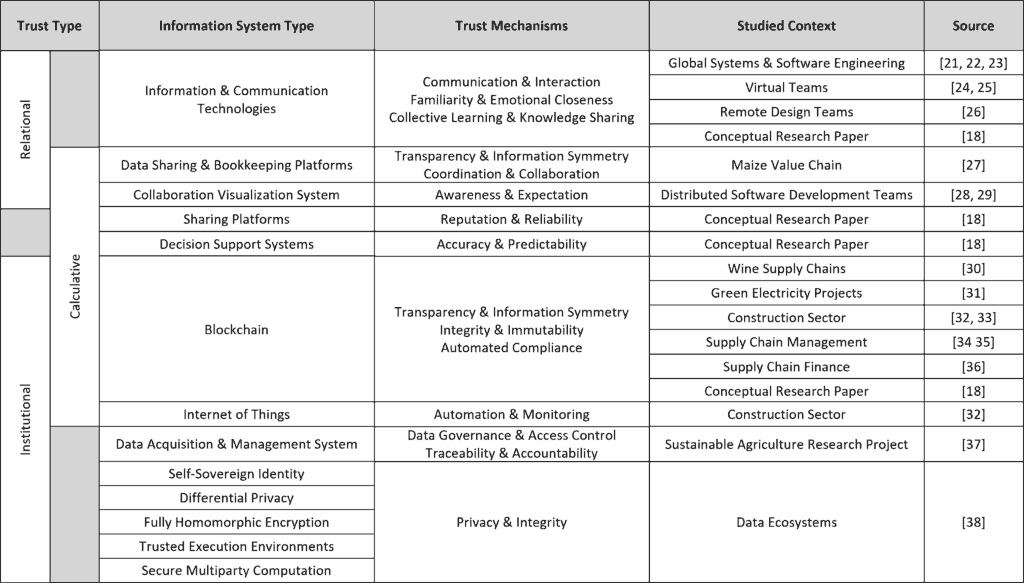
Relational trust is primarily supported by ICT, such as email, chat, videoconferencing, social media, wikis, and blogs. Studies in virtual teams, global software development, and remote design show that these systems foster trust through three digital trust mechanisms: (1) Communication & Interaction creates a shared context, reducing misunderstandings; (2) Familiarity & Emotional Closeness develops through digital social interaction and personal cues; (3) Collective Learning & Knowledge Sharing supports coordination and conflict resolution.
Relational and calculative trust—based on rational assessments of costs and benefits—are simultaneously supported by sector-specific data-sharing and bookkeeping platforms. These systems enhance Transparency & Information Symmetry through open data and monitoring (calculative) while fostering Coordination & Collaboration (relational). Visualization tools that display collaboration profiles in distributed teams increase Awareness (relational) of activities, availability, and expertise, enabling timely coordination and clearer Expectations (calculative).
Purely calculative trust is supported by IS that enhance predictability and risk assessment. Digital sharing platforms, such as Uber and eBay, use Reputation mechanisms to signal Reliability in task-specific interactions. Decision support systems similarly strengthen calculative trust by providing accurate, comparable data and analytically generated decision alternatives, thereby increasing Accuracy & Predictability in decision-making.
Blockchain technology has been extensively examined across different contexts and supports both calculative and institutional trust, rooted in formalized rules, processes, and safeguards. It fosters trust by enhancing Transparency & Information Symmetry, ensuring Integrity & Immutability, and enabling Automated Compliance through cryptographic validation, self-executing smart contracts, and tamper-proof records. These features both improve the calculability of interactions (calculative) and ensure compliance with technologically enforced rules (institutional). When combined with IoT technologies, those IS further strengthen trust by enabling real-time Automation & Monitoring through automated data collection and data-driven quality assurance, thereby reducing uncertainty in dynamic value-creation systems.
Institutional trust is further reinforced by IS that embed governance and compliance mechanisms. Data acquisition, management, and sharing platforms foster institutional trust through transparent rule- and role-based Data Governance & Access Control, supported by negotiated data ownership and informed consent. In addition, Traceability and feedback mechanisms enhance Accountability by increasing awareness of data management practices. Privacy & Integrity-enhancing technologies, such as self-sovereign identity, differential privacy, fully homomorphic encryption, trusted execution environments, and secure multiparty computation, serve as key enablers of institutional trust by ensuring verifiable identities, data confidentiality, and strict purpose limitation. As a result, they enable collaboration without exposing sensitive data.
Potentials of trust-building IS for the hydrogen market
The identified types of IS and trust mechanisms provide a strong foundation for trust-building in the hydrogen sector, which is characterized by strong interdependencies, high uncertainty, and heterogeneous, inexperienced actors [2, 5]. Mapping the identified challenges in hydrogen markets to corresponding trust requirements, trust mechanisms, and supporting IS provides a promising foundation for addressing these issues and accelerating market ramp-up. Figure 3 summarizes these relationships.
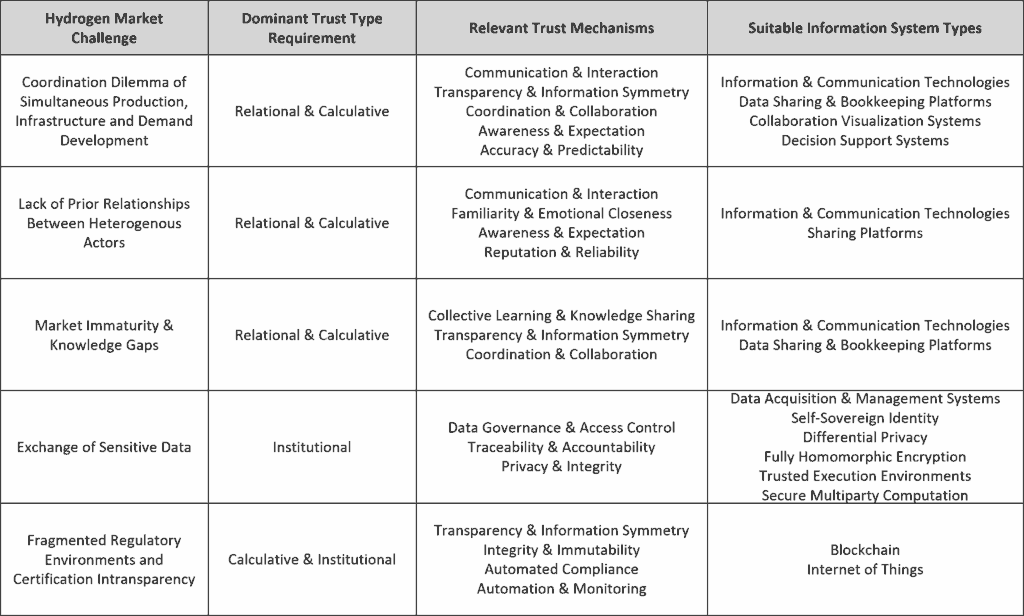
As outlined above, a central challenge of hydrogen market ramp-up lies in the simultaneous development of production capacities, infrastructure, and demand, which requires high levels of relational and calculative trust. Actors across the value chain must communicate transparently, coordinate interdependent activities, align expectations, and make informed decisions under conditions of uncertainty. In this context, IS, such as ICT solutions, data-sharing platforms, collaboration visualization systems, and decision support systems, can facilitate the coordinated development of interconnected value chain segments.
At the same time, hydrogen markets involve highly heterogeneous actors who often lack prior relationships and market experience. Strengthening relational and calculative trust through ICT solutions and data-sharing platforms can therefore help mitigate unfamiliarity, knowledge gaps and market immaturity. This can be achieved by facilitating communication, fostering emotional closeness and awareness among stakeholders, as well as enabling collective learning and information symmetry.
The exchange of sensitive technical and operational data represents an additional challenge, as coordinated market development depends on transparency across organizational boundaries. IS such as data acquisition and management systems, self-sovereign identity solutions, and differential privacy mechanisms can strengthen institutional trust by enabling secure data governance, controlled access management, traceability, and data protection.
Finally, fragmented regulatory frameworks and limited transparency regarding hydrogen origin and certification mechanisms further increase uncertainty within hydrogen markets. In particular, the combination of blockchain technology and IoT sensors has emerged as a promising approach for certifying green hydrogen, which is emphasized in recent literature [39]. By enabling transparent, immutable documentation, automated compliance and real-time monitoring, these technologies reduce uncertainty and strengthen confidence in climate-neutral hydrogen production.
Opportunities for future research
This study advances theory and practice by systematically identifying trust-building types of IS, categorizing them according to established trust types, and explicating the digital mechanisms through which trust is fostered across various contexts. Theoretically, it contributes to the literature on trust and IS by reconceptualizing IS as active mediators of trust formation rather than merely objects of trust. By consolidating fragmented research and integrating trust types, digital mechanisms, and application contexts, it provides a coherent framework for understanding trust as a structuring element of coordination in globally distributed, dynamic value-creation systems.
The findings offer guidance to practitioners and policymakers seeking to foster collaboration in sustainable energy markets. By clarifying how different IS categories support specific trust forms under varying conditions, the study informs design, implementation, and governance decisions for digital infrastructures supporting trust-based collaboration, resilience, and long-term viability in emerging hydrogen markets.
This study is subject to several limitations that also open promising avenues for future research. First, the analysis is limited to IS examined in prior academic studies and may therefore omit emerging or practice driven IS, such as market simulation tools, digital twins, or experimental coordination platforms, despite their potential relevance for trust formation.
Second, as a conceptual synthesis, the study does not include primary empirical data and thus cannot fully capture practitioners’ perspectives on trust-related challenges and IS requirements. Future research should therefore examine additional IS in use or under development. It should also complement the conceptual framework with qualitative approaches, such as interviews or workshops in the hydrogen sector, to gain deeper insights into context-specific trust concerns and to inform the design and evaluation of trust-building IS. Such work would help bridge the gap between theoretical frameworks and practical implementation in real-world value-creation settings, ensuring that digital infrastructures are aligned with the needs of emerging hydrogen markets.
This research was supported by the German Federal Ministry of Research, Technology and Space (BMFTR) under grant number 02J24A140.
This is an original article. The German translation can be accessed via DOI: 10.30844/I4SD.26.4.9
Bibliography
[1] Azadnia, A. H.; McDaid, C.; Andwari, A. M.; Hosseini, S. E.: Green hydrogen supply chain risk analysis: A european hard-to-abate sectors perspective. In: Renewable and Sustainable Energy Reviews 182 (2023), p. 113371. DOI: 10.1016/j.rser.2023.113371.[2] Hasankhani, M.; van Engelen, J.; Celik, S.; Diehl, J. C.: Unveiling complexity of hydrogen integration: A multi-faceted exploration of challenges in the Dutch context. In: Journal of Cleaner Production 434 (2024), p. 139927. DOI: 10.1016/j.jclepro.2023.139927.
[3] Olabi, A. G.; Abdelkareem, M. A.; Mahmoud, M. S.; Elsaid, K.; Obaideen, K. et al.: Green hydrogen: Pathways, roadmap, and role in achieving sustainable development goals. In: Process Safety and Environmental Protection 177 (2023), pp. 664–687. DOI: 10.1016/j.psep.2023.06.069.
[4] Strelkovskii, N.; Komendantova, N.: Integration of UN sustainable development goals in national hydrogen strategies: A text analysis approach. In: International Journal of Hydrogen Energy 102 (2025), pp. 1282–1294. DOI: 10.1016/j.ijhydene.2025.01.134.
[5] Schlund, D.; Schulte, S.; Sprenger, T.: The who’s who of a hydrogen market ramp-up: A stakeholder analysis for Germany. In: Renewable and Sustainable Energy Reviews 154 (2022), p. 111810. DOI: 10.1016/j.rser.2021.111810.
[6] Lebrouhi, B. E.; Djoupo, J. J.; Lamrani, B.; Benabdelaziz, K.; Kousksou, T.: Global hydrogen development – A technological and geopolitical overview. In: International Journal of Hydrogen Energy 47 (2022) 11, pp. 7016–7048. DOI: 10.1016/j.ijhydene.2021.12.076.
[7] Otto, D.; Chilvers, J.; Trdlicova, K.: A synthetic review of the trust-participation nexus: Towards a relational concept of trust in energy system transformations to net zero. In: Energy Research & Social Science 101 (2023), p. 103140. DOI: 10.1016/j.erss.2023.103140.
[8] Campbell, C.; Rasmussen, S.; Johnstone, K.: Addressing Organizational Change in the Evolving Energy Marketplace. In: Climate and Energy 38 (2022) 12, pp. 1–10. DOI: 10.1002/gas.22294.
[9] Steinbruch, F. K.; Da Nascimento, L. S.; Menezes, D. C. de: The role of trust in innovation ecosystems. In: Journal of Business & Industrial Marketing 37 (2022) 1, pp. 195–208. DOI: 10.1108/JBIM-08-2020-0395.
[10] Kwon, I.-W. G.; Suh, T.: Trust, commitment and relationships in supply chain management: a path analysis. In: Supply Chain Management: An International Journal 10 (2005) 1, pp. 26–33. DOI: 10.1108/13598540510578351.
[11] Keller; Jakob; Biniosek; Florian; Lasch et al.: Scaling up of hydrogen supply chains: The role of supply chain governance. In: Logistics Research 16 (2023) 7, pp. 1–20. DOI: 10.23773/2023.
[12] Adeyinka, M. A.; Solanke, B.; Onita, F. B.; Agho, M. O.: Integrating digital technologies for supply chain resilience in the energy industry. In: International Journal of Scientific Research Updates 3 (2022) 1, pp. 48–57. DOI: 10.53430/ijsru.2022.3.1.0032.
[13] Elliot, S.; Webster, J.: Editorial: Special issue on empirical research on information systems addressing the challenges of environmental sustainability: an imperative for urgent action. In: Information Systems Journal 27 (2017) 4, pp. 367–378. DOI: 10.1111/isj.12150.
[14] McKnight, D. H.; Carter, M.; Thatcher, J. B.; Clay, P.: Trust in a Specific Technology: An Investigation of its Components and Measures. In: ACM Transactions on Management Information Systems 2 (2011) 2, pp. 12–32. DOI: 10.1145/1985347.1985353.
[15] Rousseau, D. M.; Sitkin, S. B.; Burt, R. S.; Camerer, C.: Not So Different After All: A Cross-Discipline View Of Trust. In: Academy of Management Review 23 (1998) 3, pp. 393–404. DOI: 10.5465/AMR.1998.926617.
[16] Kramer, R. M.: Trust and Distrust in Organizations: Emerging Perspectives, Enduring Questions. In: Annual Review of Psychology 50 (1999), pp. 569–598. DOI: 10.1146/annurev.psych.50.1.569.
[17] Lumineau, F.; Schilke, O.; Wang, W.: Organizational Trust in the Age of the Fourth Industrial Revolution: Shifts in the Form, Production, and Targets of Trust. In: Journal of Management Inquiry 32 (2023) 1, pp. 21–34. DOI: 10.1177/10564926221127852.
[18] Bodó, B.: Mediated trust: A theoretical framework to address the trustworthiness of technological trust mediators. In: New Media & Society 23 (2021) 9, pp. 2668–2690. DOI: 10.1177/1461444820939922.
[19] Marczak, S.; Al Ani, B.; Redmiles, D.; Prikladnicki, R.: Designing Tools to Support Trust in Distributed Software Teams. In: Compilation publication of CSCW’13 proceedings & CSCW’13 companion: Conference on Computer Supported Cooperative Work (2013), pp. 1–4. URL: https://collab.di.uniba.it/trusttheorytools/wp-content/uploads/sites/4/2014/05/trust_cscw2013_Marczaketal_CR_submitted-01-02-13-08-53-56.pdf, accessed 03.02.2026.
[20] Webster, J.; Watson, R. T.: Analyzing the Past to Prepare for the Future: Writing a Literature Review. In: MIS Quarterly 26 (2002) 2, pp. xiii–xxiii. DOI: 10.2307/4132319.
[21] Al-Ani, B.; Marczak, S.; Redmiles, D.; Prikladnicki, R.: Facilitating contagion trust through tools in Global Systems Engineering teams. In: Information and Software Technology 56 (2014) 3, pp. 309–320. DOI: 10.1016/j.infsof.2013.11.001.
[22] Aranda, G. N.; Vizcaíno, A.; Hernández, J. L.; Palacio, R. R.; Morán, A. L.: Trusty: A Tool to Improve Communication and Collaboration in DSD. In: Lecture Notes in Computer Science, Collaboration and Technology, Berlin, Heidelberg 2011, pp. 224–231.
[23] Portillo-Rodríguez, J.; Vizcaíno, A.; Piattini, M.; Beecham, S.: Tools used in Global Software Engineering: A systematic mapping review. In: Information and Software Technology 54 (2012) 7, pp. 663–685. DOI: 10.1016/j.infsof.2012.02.006.
[24] Bos, N.; Olson, J.; Gergle, D.; Olson, G.; Wright, Z.: Effects of four computer-mediated communications channels on trust development. In: Proceedings of the SIGCHI Conference on Human Factors in Computing Systems (2002), pp. 135–140. DOI: 10.1145/503376.503401.
[25] Hacker, J. V.; Johnson, M.; Saunders, C.; Thayer, A. L.: Trust in Virtual Teams: A Multidisciplinary Review and Integration. In: Australasian Journal of Information Systems 23 (2019), pp. 1–36. DOI: 10.3127/ajis.v23i0.1757.
[26] Wang, X.; Love, P. E.; Kim, M. J.; Wang, L.: Studying the Effects of Information Exchange Channels in Different Communication Modes on Trust Building in Computer-mediated Remote Collaborative Design. In: Journal of Universal Computer Science 17 (2011) 14, pp. 1971–1990. DOI: 10.3217/jucs-017-14-1971.
[27] Agyekumhene, C.; Vries, J. R. de; van Paassen, A.; Macnaghten, P.; Schut, M. et al.: Digital platforms for smallholder credit access: The mediation of trust for cooperation in maize value chain financing. In: NJAS: Wageningen Journal of Life Sciences 86-87 (2018) 1, pp. 77–88. DOI: 10.1016/j.njas.2018.06.001.
[28] Trainer, E. H.; Redmiles, D. F.: Foundations for the design of visualizations that support trust in distributed teams. In: Proceedings of the International Working Conference on Advanced Visual Interfaces (2012) pp. 34–41. DOI: 10.1145/2254556.2254566
[29] Trainer, E. H.; Redmiles, D. F.: Bridging the gap between awareness and trust in globally distributed software teams. In: Journal of Systems and Software 144 (2018), pp. 328–341. DOI: 10.1016/j.jss.2018.06.028.
[30] Brookbanks, M.; Parry, G.: The impact of a blockchain platform on trust in established relationships: a case study of wine supply chains. In: Supply Chain Management: An International Journal 27 (2022) 7, pp. 128–146. DOI: 10.1108/SCM-05-2021-0227.
[31] Chen, Y.; Yu, Z.: Digitalization, trust, and sustainability transitions: Insights from two blockchain-based green experiments in China’s electricity sector. In: Environmental Innovation and Societal Transitions 50 (2024), p. 100801. DOI: 10.1016/j.eist.2023.100801.
[32] La Pena, J. de; Papadonikolaki, E.: From relational to technological trust: How do the Internet of Things and Blockchain technology fit in? Proceedings of the 2019 European Conference on Computing in Construction (2019) pp. 415–424. URL: https://www.researchgate.net/publication/337243847_From_relational_to_technological_trust_How_do_the_IoT_and_Blockchain_technology_fit_in, accessed 03.02.2026.
[33] Qian, X.; Papadonikolaki, E.: Shifting trust in construction supply chains through blockchain technology. In: Engineering, Construction and Architectural Management 28 (2021) 2, pp. 584–602. DOI: 10.1108/ECAM-12-2019-0676.
[34] Pattanayak, S.; Ramkumar, M.; Goswami, M.; Rana, N. P.: Blockchain technology and supply chain performance: The role of trust and relational capabilities. In: International Journal of Production Economics 271 (2024), p. 109198. DOI: 10.1016/j.ijpe.2024.109198.
[35] Yavaprabhas, K.; Pournader, M.; Seuring, S.: Blockchain as the “trust-building machine” for supply chain management. In: Annals of operations research 327 (2023), pp. 49–88. DOI: 10.1007/s10479-022-04868-0.
[36] Song, H.; Liu, W.; Yu, K.; Han, M.: Trusting the trust machine: How does blockchain-enabled governance configuration enhance financing credibility? In: Technovation 135 (2024), p. 103061. DOI: 10.1016/j.technovation.2024.103061.
[37] Raturi, A.; Thompson, J. J.; Ackroyd, V.; Chase, C. A.; Davis, B. W. et al.: Cultivating trust in technology‐mediated sustainable agricultural research. In: Agronomy Journal 114 (2022) 5, pp. 2669–2680. DOI: 10.1002/agj2.20974.
[38] Schäfer, F.; Rosen, J.; Zimmermann, C.; and Wortmann, F.: Unleashing The Potential of Data Ecosystems: Establishing Digital Trust through Trust-Enhancing Technologies. In: ECIS 2023 Research Papers 325 (2023), pp. 1–18. URL: https://aisel.aisnet.org/ecis2023_rp/325, accessed 03.02.2026.
[39] Heeß, P.; Rockstuhl, J.; Körner, M.-F.; Strüker, J.: Enhancing trust in global supply chains: Conceptualizing Digital Product Passports for a low-carbon hydrogen market. In: Electronic Markets 34 (2024) 10, pp. 1–20. DOI: 10.1007/s12525-024-00690-7.
You might also be interested in