Applied Knowledge and Augmented Reality |
Bridging the gap between learning and application

| Journal | Industry 4.0 Science |
| Issue | Volume 41, 2025, Edition 5, Pages 22-29 |
| Open Access | https://doi.org/10.30844/I4SE.25.5.22 |
| Bibliography | Share | Cite | Download |
Abstract
Keywords
Article
Digital transformation and Industry 4.0 significantly reshape industrial workplaces by introducing advanced technologies and increasing automation, fundamentally altering the nature of work and the competencies required of employees [1, 2, 3]. As production environments continue to evolve through interconnectivity and automation, workers are required to develop new skills, such as the ability to interact with sophisticated technologies, including artificial intelligence (AI) and digital systems, and engage in complex problem-solving. To keep up with the integration of new technologies and resulting process modifications, lifelong learning and training are crucial [4], and workers must stay flexible to apply new technologies effectively across dynamic and rapidly changing contexts [5].
Traditional educational methods, such as lectures and textbooks, often prove inadequate in developing these new competencies because they lack real-world applicability and the hands-on experience needed for effective skill acquisition [6, 7, 8]. To address these limitations, learning factories represent an alternative by offering applied, interactive training formats that more effectively support the development of practical skills and competencies in realistic, industry-aligned environments. Learning factories enable skill development through realistic simulations of manufacturing environments, allowing for practical competence-building similar to realistic environments [9, 10, 11].
Incorporating digital technologies into these simulation environments further enhances their effectiveness by enabling learners to directly engage with complex technological interfaces and decision-support systems. Augmented reality provides an opportunity for transferring applied knowledge [12]. It offers learning integrated in the work environment, with virtual cues and 3D elements [13] that enable step-by-step learning in a realistic environment [14, 15]. Building on this foundation, it provides a promising extension to learning factory environments by seamlessly integrating instructional content into real-world contexts, bridging the gap between abstract instruction and hands-on application.
So far, learning with augmented reality has been shown to be valuable in terms of improved learning outcomes, including increased performance [16], more positive learner attitudes, higher satisfaction with the training process [17, 18, 19], and reduced learning time [13]. While existing studies highlight the motivational and cognitive benefits of augmented reality-based learning, empirical evidence on its effectiveness in the transfer of applied knowledge to the workplace remains scarce.
Learning outcomes are often assessed through knowledge tests or questionnaires on motivation and perceived competence, which often fail to capture whether learners can effectively apply the acquired skills in practice. The present study addresses this gap with the following research question (RQ):
RQ: To what extent does training with augmented reality facilitate the transfer of applied knowledge into the production setting?
To answer the RQ, this paper applied an experiment using a realistic training and application scenario in which participants use augmented reality to learn a production process. The transfer of applied knowledge is subsequently evaluated based on their ability to apply the task without further instruction in the manufacturing environment. The methodology, results, and implications are presented below.
Methodology
The training scenarios are evaluated with the aim of validating the impact of applied augmented reality-supported training methods. Addressing the RQ,this study uses a one-factor between-subject design to compare people learning with augmented reality instruction with people learning with paper instructions. The study design complied with the approval of the ethics committee of the authors’ research institute.
The study took place at the authors’ university between November 2023 and May 2024. Before participation, individuals were informed of their rights, including voluntary participation and the ability to withdraw from the study at any time. Participants were then provided with a general explanation of the factory environment, which included the production setup and workstation. They were then randomly assigned to one of the instructional conditions: traditional paper-based instructions (control) or augmented reality-based instructions delivered via head-mounted display (HMD). All participants underwent a calibration procedure for the augmented reality HoloLens, which was used as an augmented reality HMD.
In the learning phase, participants completed three production cycles (referred to as learning rounds), each involving six production steps. Each learning round was triggered by the arrival of a workpiece at the station. Participants of both groups received identical instructional content. However, the delivery format differed: the control group used printed materials presented over three pages in the sequence of the production process, while the augmented reality groups accessed the same information via the augmented reality HMD (HoloLens), offering real-time digital guidance directly in their visual field (following [20]).
Upon completing the learning phase, participants completed a follow-up questionnaire, which included scales measuring usability and cognitive load. Following the learning phase, the study progressed to the application scenario, which served as a test of knowledge transfer and performance. Participants completed 15 production rounds without any instructional aid. The purpose was to evaluate how well participants could independently apply what they had learned.
Participants assumed the role of factory workers engaged in manufacturing optical lenses. The production tasks required participants to verify the accuracy of incoming orders, configure specific machine parameters, monitor ongoing production processes, and conduct thorough quality control checks. Participants underwent three learning rounds.


Assessment methods
The initial questionnaire captured demographic variables (for example age, gender, employment status), previous experience with augmented reality, and familiarity with production-related tasks.
After completing all three learning rounds, participants responded to the cognitive load scale developed by Klepsch et al. (2017). This instrument consists of eight items rated on a 7-point Likert scale from 1 (“completely untrue”) to 7 (“completely true”). Example statements include: “During this task, it was exhausting to find the important information,” “The design of this task was very inconvenient for learning,” and “During this task, it was difficult to recognize and link the crucial information.”
Additionally, participants completed the System Usability Scale (SUS; Brooke, 1986). The scale includes ten items rated on a 5-point Likert scale ranging from 1 (“strongly disagree”) to 5 (“strongly agree”). Sample items include statements such as “I found the system unnecessarily complex” and “I thought the system was easy to use.” In addition to the subjective evaluation of learning, objective data on learning duration were also collected. For each round, learning duration was defined as the time interval between the arrival of the workpiece and the completion of the final subtask.
Learning outcomes were assessed by task completion time and number of errors. This metric captured the total time required for participants to complete a production round without guidance. The task completion time was measured from the arrival of the workpiece to the participant’s final interaction with the production line. Errors were defined as any incorrect interactions within the workspace. These included, for instance, pressing the wrong button on the machine terminal, selecting incorrect parameters for machine calibration, or specifying the wrong number of lenses in the quality check.
Sample
Data from 87 participants (39 females and 46 males, two prefer not to say), on average 25 years old (SD=5.91), were integrated into the data analysis. The participants were recruited via mailing lists and announcements at several universities and randomly assigned to one group, either augmented reality (N= 69) or paper instructions (N=17). Before the experiment, people were asked about their experience with augmented reality HMD. 64.29% said they had never used augmented reality before, 34.29% said they had rarely used augmented reality, and 1.43% said they had used augmented reality occasionally. Additionally, the participants rated their experience with production environments: 13.79% had experience and 86.2% did not.
Results: Improved learning with augmented reality
This section outlines the examination of the gathered data, which was compared between the augmented reality and paper instruction groups. The entire learning lasted on average 7.24 minutes. Participants who learned with augmented reality needed 7 minutes, while those who learned with paper instructions needed 8.24 minutes. They required approximately 17.7% more time to complete the learning compared to those who learned with augmented reality instruction.
Complementing the objective data, they evaluated the usability of the learning instruction and the cognitive load they perceived during learning. The results show that learners prefer augmented reality (M=72.54, SD=19.57) over paper instructions (M=67.08, SD=17.75) in terms of usability and report less cognitive load arising from the instruction (augmented reality M=8.43, SD=4.28, paper instruction M=9.94, SD=4.15).
Addressing the RQ, how well the participants could transfer and apply the learned skills into the production process without receiving additional instructions, time and number of errors were considered. The time metrics reveal that participants who learned with the augmented reality instruction were able to apply the steps of the production process 1 minute faster (M=21.59, SD=4.5) than those who learned with paper instructions (M=22.58, SD=3.92). In addition, people who learned with the augmented reality instruction made fewer errors (M=4.48, SD=4.10) when they applied the production steps without instruction than people who had learned with the paper instruction (M=5.17, SD=4.31). Figure 2 presents all results.
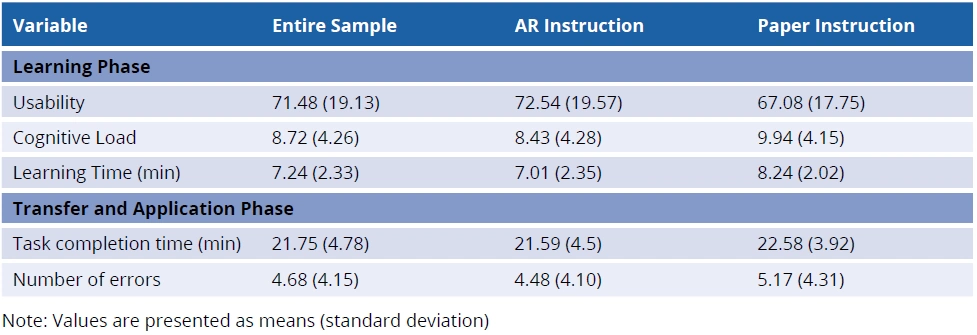
Answering the research question, the findings indicate that augmented reality facilitates the transfer of applied knowledge into real-world production settings. Participants who received augmented reality-based instruction applied the production task faster and with fewer errors in a realistic production setting than those who used conventional paper-based instructions. Not only did they need less time to apply the production without instruction, they also required less time during learning. The objective data was supported by a positive evaluation of the usability and cognitive load using augmented reality. Taken together, these findings provide empirical support for the effectiveness of augmented reality-based training in promoting more efficient learning processes and facilitating the transfer of applied knowledge to complex real-world production tasks.
Implications and future research
Based on the study’s findings, we suggest two implications: First, our findings indicate that augmented reality offers an opportunity to provide training directly within the work environment. Unlike traditional classroom or manual-based training, augmented reality can guide employees step-by-step within the production setting, making learning more context-relevant and reducing the gap between training and application.
In our study, learners applied the production process faster and with fewer errors in the production process without instruction. For companies, this suggests reducing initial errors, which can lead to significant cost savings. Secondly, our findings indicate that using AR for learning enables employees to reach operational readiness more quickly. Companies introducing new processes or technologies could benefit from augmented reality’s ability to lower the learning curve, especially for inexperienced workers who might otherwise struggle with abstract instructions, which means reduced onboarding time.
Nevertheless, the study’s limitations should be acknowledged for an accurate understanding of the findings. First, the relatively small sample size and unbalanced group assignment may limit the generalizability of the results and restrict the statistical power needed for more robust inferential analyses. Furthermore, potential distortions due to sampling variability or uncontrolled confounding factors may have influenced the observed effects. As a consequence, the decision was made to focus on descriptive statistics only, as the available data lacked sufficient power to support meaningful inferential calculations.
Second, although the study was conducted in a realistic production setting to enhance ecological validity, the sample was relatively homogeneous, which may limit the generalizability of the findings. Future research should seek to replicate these results using larger and more diverse samples to strengthen the empirical evidence and allow for more precise statistical analyses, including robust inferential testing.
This study contributes to the research on augmented reality in learning by offering a performance-based evaluation of applied knowledge transfer within a realistic industrial setting. The findings demonstrate that augmented reality can effectively support the transfer of practical skills, as participants who learned with augmented reality applied the production process more quickly and with fewer errors than those who received paper-based instruction.
The work was supported by the German Federal Ministry of Education and Research (BMBF), grant numbers 16DII137 (Weizenbaum-Institute) and 16DII131 (Weizenbaum-Institute).
This is an original article. The German translation can be accessed via DOI: 10.30844/I4SD.25.5.22
Bibliography
[1] Gronau, N.; Weber, E.: Reihenfolgeplanung im Zeitalter von Industrie 4.0 Optimierung in der Werkstattfertigung. In: prod 23 (2018) 1, pp. 1–26. DOI: 10.30844/3_2018-1_23-26.[2] Bright, A. G.; Ponis, S. T.: Introducing gamification in the AR-enhanced order picking process: A proposed approach. In: Logistics 5 (2021) 1, p. 14. DOI: 10.3390/logistics5010014.
[3] Gronau, N.: Modeling the Handling of Knowledge for Industry 4.0. In: Shishkov, B. (ed.): Lecture Notes in Business Information Processing. Cham: Springer International Publishing, 2021, pp. 207–223. DOI: 10.1007/978-3-030-79976-2_12.
[4] Sautter, B.; Daling, L.: Mixed Reality Supported Learning for Industrial on-the-job Training. In: Proceedings of the Conference on Learning Factories (CLF) 2021, Graz, Austria: SSRN, 2021. DOI: 10.2139/ssrn.3864189.
[5] Krzywdzinski, M.; Evers, M.; Gerber, C.: Control and Flexibility: The Use of Wearable Devices in Capital- and Labor-Intensive Work Processes. In: ILR Review 77 (2024) 4, pp. 506-534. DOI: 10.1177/00197939241258206.
[6] Gronau, N.; Ullrich, A.; Teichmann, M.: Development of the industrial IoT competences in the areas of organization, process, and interaction based on the learning factory concept. In: Procedia Manufacturing 9 (2017), pp. 254-261. DOI: 10.1016/j.promfg.2017.04.029.
[7] Teichmann, M.; Ullrich, A.; Wenz, J.; Gronau, N.: Herausforderungen und Handlungsempfehlungen betrieblicher Weiterbildungspraxis in Zeiten der Digitalisierung. In: HMD Praxis der Wirtschaftsinformatik 57 (2020), pp. 512-527. DOI: 10.1365/s40702-020-00614-x.
[8] Vladova, G.; Heuts, A.; Teichmann, M.: Dem Mitarbeiter zu Diensten. Weiterbildung und Qualifizierung als Personennahe Dienstleistung. In: HMD 57 (2020) 4, pp. 710-721. DOI: 10.1365/s40702-020-00626-7.
[9] Gronau, N.; Kluge, A.; Haase, J.; Thim, C.: Experiential learning factories: Bridging the gap between lab and field experiments. In: Proceedings of the 13th Conference on Learning Factories (CLF 2023), Rochester, NY: Social Science Research Network, 2023. DOI: 10.2139/ssrn.4469819.
[10] Teichmann, M.; Ulrich, A.; Gronau, N.: Subject-oriented learning – A new perspective for vocational training in learning factories. In: Procedia Manufacturing, Braunschweig, Germany: Elsevier, 2019, pp. 72-78. DOI: 10.1016/j.promfg.2019.03.012.
[11] Teichmann, M.; Lettkemann, V.; Gronau, N.: Digitalization, demographic change and decarbonization: Eight pivotal competencies for learning factories. In: Thiede, S.; Lutters, E. (eds.): Learning Factories of the Future, Cham, Switzerland: Springer, Cham, 2024, pp. 313-320. DOI: 10.1007/978-3-031-65411-4_37.
[12] Pfaff, A.; Spann, M.: Man and machine: AR-based vocational training for tacit knowledge tasks. In: ECIS 2024 Proceedings, Cyprus, Greece, 2024.
[13] Gonnermann-Müller, J.; Leins, N.; Gronau, N.; Kosch, T.: Value by design: Reducing cognitive load by using visual guidance in augmented reality—An eye-tracking study. In: ICIS 2024 Proceedings, 2024.
[14] Brunzini, A.; Ciccarelli, M.; Sartini, M.; Papetti, A.; Germani, M.: A comparative study for the assessment of marker-less mixed reality applications for operator training. In: International Journal of Computer Integrated Manufacturing (2024), pp. 1-23. DOI: 10.1080/0951192X.2024.2314793.
[15] Funk, M.; Bächler, A.; Bächler, L.; Kosch, T.; Heidenreich, T.; et al.: Working with augmented reality? A long-term analysis of in-situ instructions at the assembly workplace. In: Proceedings of the 10th International Conference on Pervasive Technologies Related to Assistive Environments, Island of Rhodes Greece: ACM, 2017, pp. 222-229. DOI: 10.1145/3056540.3056548.
[16] Leins, N.; Gonnermann-Müller, J.; Teichmann, M.: Comparing head-mounted and handheld augmented reality for guided assembly. In: J Multimodal User Interfaces 18 (2024) 4, pp. 313-328. DOI: 10.1007/s12193-024-00440-1.
[17] Drouot, M.; Le Bigot, N.; Bricard, E.; Bougrenet, J.-L. D.; Nourrit, V.: Augmented reality on industrial assembly line: Impact on effectiveness and mental workload. In: Applied Ergonomics 103 (2022), p. 103793. DOI: 10.1016/j.apergo.2022.103793.
[18] Buchner, J.; Buntins, K.; Kerres, M.: The impact of augmented reality on cognitive load and performance: A systematic review. In: Computer Assisted Learning 38 (2022) 1, pp. 285-303. DOI: 10.1111/jcal.12617.
[19] Yu, Z.: Meta-analyses of effects of augmented reality on educational outcomes over a decade. In: Interactive Learning Environments 32 (2023) 8, pp. 1-15. DOI: 10.1080/10494820.2023.2205899.
[20] Gonnermann‐Müller, J.; Krüger, J. M.: Unlocking augmented reality learning design based on evidence from empirical cognitive load studies—A systematic literature review. In: Computer Assisted Learning 41 (2024), p. e13095. DOI: 10.1111/jcal.13095.
Your downloads
Potentials: Training
You might also be interested in