



Digital Twins in Logistics |
Opportunities and barriers during implementation
 , Jan Kliewer
, Tobias Marc Wringe, Maximilian Bähring
, Frank Straube, Rüdiger Zarnekow
, Jan Kliewer
, Tobias Marc Wringe, Maximilian Bähring
, Frank Straube, Rüdiger Zarnekow| Journal | Industry 4.0 Science |
| Issue | Volume 41, Edition 3, Pages 34-40 |
| Open Access | https://doi.org/10.30844/I4SE.25.3.34 |
| Bibliography | Share | Cite | Download |
Abstract
Keywords
Article
Digital Twin systems in logistics
Supply disruptions, increasing complexity and strict sustainability requirements are adding external pressure on companies and presenting global supply chains with new challenges [1, 2, 3]. As a driver of industrial change, digitalization offers enormous potential for enhanced competitiveness. In logistics in particular, as a key function for fulfilling customer orders, digital technologies are creating new opportunities for more efficiency, flexibility and transparency [4].
One promising concept is the Digital Twin (DT), which virtually maps real systems and enables measures to be simulated prior to implementation. In logistics, these are referred to as Digital Supply Chain Twins (DSCT). DSCT facilitate optimization efforts on all levels—from individual locations to global networks (Fig. 1). DSCT are defined as “a digital simulation model of a real logistics system with a long-term, bidirectional and timely data connection” [5]. They create the basis for data-based decisions and provide a holistic overview of the customer order process.
Changes in the logistics system influence the DT and vice versa (bidirectional), whereby the exchange takes place flexibly and not necessarily in near real-time depending on the application (timely). DSCT are designed for continuous, long-term use and therefore differ from short-lived project models (long-term). Forecasts such as the DHL Logistics Trend Radar project that DSCT will be increasingly used in coming years [6]. In practice, however, it remains unclear to what extent companies are already prepared for the introduction of this technology and what challenges are associated with its implementation.
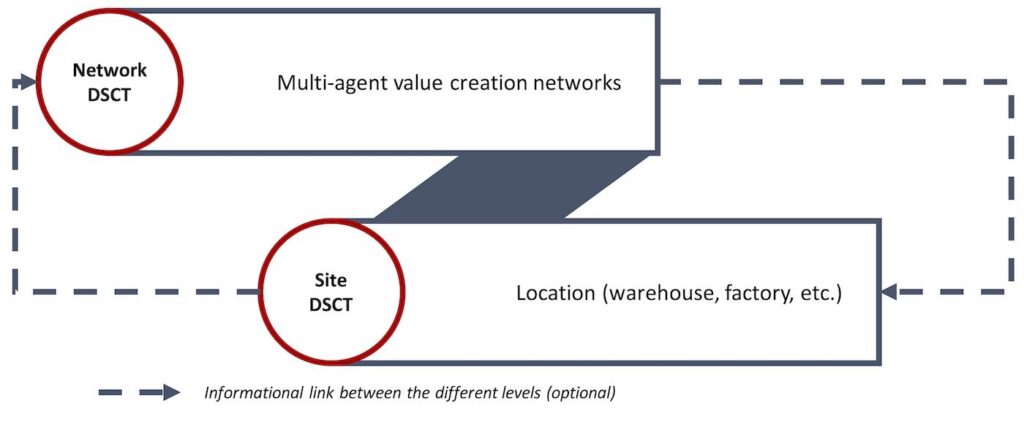
To address these questions, the digital maturity of companies regarding DSCT was examined as part of a workshop with industry experts. The aim was to determine the status quo of technology application in the companies represented, identify key challenges, discuss potential fields of application and align the findings with current research. The workshop was divided into two phases for this purpose: In the first phase, a survey [7] was conducted to investigate existing DSCT projects, while in the second phase—using the placemat method [8, 9]—expert assessments on selected topics were queried and discussed in depth. The following sections present the results of this study.
Status quo in industry
The survey set out to systematically record the current development status of DSCT in the companies represented. It was designed in such a way that a separate questionnaire was completed for each identified project. This ensured a detailed survey of project-specific characteristics. Nine experts took part in the survey. While four companies had no DSCT projects to date, five experts reported on a total of seven projects (Fig. 2). All of these projects were implemented or planned in large companies with more than 249 employees.
The analysis of project progress indicates that the majority of DSCT initiatives are still at an early stage. One project is already in operational use, another is being implemented, while five projects are still in the planning phase. In addition to the development status, the fulfillment of the scientific DSCT criteria according to Gerlach et al. was also examined. Two of the seven projects fully meet the defined requirements in terms of longevity, timelinessand bidirectionality. In contrast, the remaining projects show deviations in at least one of these characteristics.
In terms of areas of application, the projects can be divided into two groups. Four projects are situated at site level, while the remaining three projects pursue an overarching network perspective.
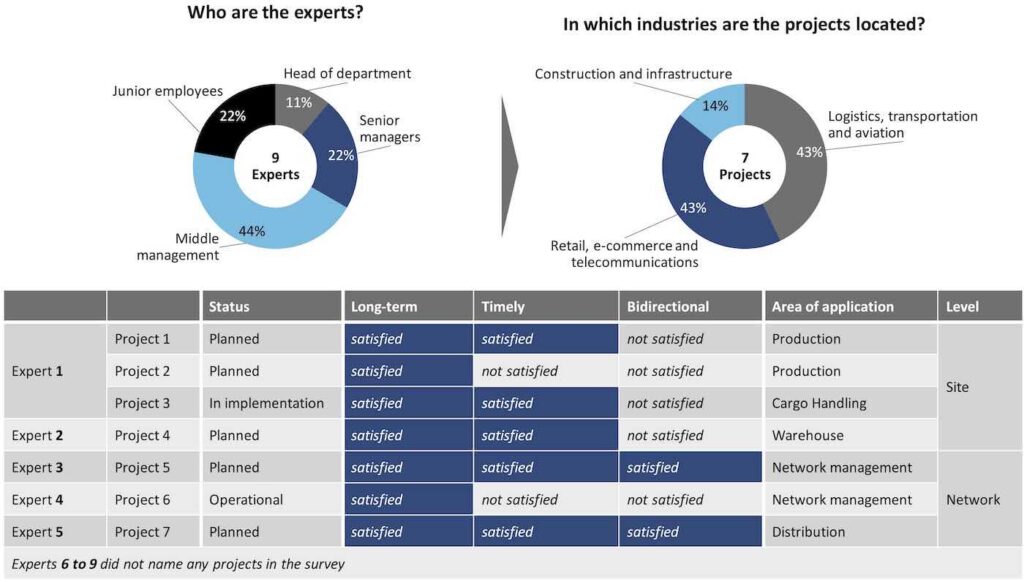
The low number of realized projects and the high proportion of projects that are still in the planning phase (Fig. 2) indicate that, although the technology is generally seen as promising, numerous challenges remain. Due to the low market penetration of DSCT technologies, further phases of the investigation took an explorative perspective, focusing on experts with many years of experience in the fields of logistics and digitalization.
In lieu of a large, statistically representative sample, a qualitative, theory-based selection was made in order to gather fundamental assessments of the current status of DSCT technology in practice. As part of a systematic and structured analysis according to Mayring (2014), opinions from practice were evaluated in connection with current research [10, 11, 12]. Thanks to the early theoretical saturation of the experts’ statements, it was possible to derive practical and valid findings despite the small sample size.
Challenges and applications of current DSCT industrial projects
The assessments of the industry experts were collected in the second workshop phase using the placemat method [8, 9] and similarities and differences were identified in the discussion. The survey focused on three central questions: the main implementation barriers, the framework conditions for data exchange and the fields of application of DSCT projects. The results of these discussions and assessments are presented below.
Companies face a number of economic, organizational and technical challenges when implementing DSCT. There is a clear consensus that business viability and financial incentives are decisive factors in making investment decisions for DSCT projects. To do justice to the high degree of digitalization of DSCT, existing processes and interfaces must be comprehensively adapted, which requires considerable organizational effort.
However, according to the results of the placemat method, the key challenges are of a technical nature. In particular, the availability and quality of the required data were identified as critical factors. Fragmented IT landscapes and inconsistent data standards make seamless integration into DSCT difficult. In particular, the willingness to exchange data across companies represents a barriers. The experts agree that the success of DSCT depends largely on whether companies are willing to share relevant data with their partners within the value creation network. This necessity is also emphasized in current research [13, 14].
One approach to meeting information sharing requirements is the establishment of data ecosystems in both polycentric and pyramidal-hierarchical value creation networks [15]. While polycentric networks place particular demands on trust, interoperability and cooperative governance due to the equal structure of the actors, pyramidal-hierarchical networks face challenges in dealing with asymmetric power relations and ensuring data sovereignty vis-à-vis dominant partners [15, 16].
In addition to the challenges already listed regarding the availability and quality of data, the experts also highlight the barriers in cross-company collaborations. In particular, legal uncertainties, confidentiality concerns and a lack of standards between companies must be resolved jointly. The discussion made it clear that clear framework conditions for data exchange must be created for the successful implementation of DSCT. Standardized interfaces, contractual agreements as well as economic incentives for data provision were discussed as potential solutions. Standardized interfaces enable data exchange, while contractual and economic incentives aim to add value for all stakeholders and promote cooperation.
In addition to the challenges, promising fields of application for DSCT were identified and evaluated. To systematically analyze and prioritize the use cases of DSCT in these areas, a four-quadrant matrix was developed based on their assessment (Fig. 3). Individual use cases were grouped thematically and presented as logarithmically scaled circles according to the average frequency of mentions and the benefit assessment of the respective group. This enables a classification in the dimensions expected usefulness and number of mentions. Four categories can be derived from this analysis:
- Main area of applications: These are high-priority use cases, such as warehouse and transport planning, with broad benefits. As central levers, they offer significant increases in efficiency with little effort.
- Wide-ranging applications: This category describes applications that are widely used, especially in network management, and are particularly focused on proven processes and scalability.
- Specialized applications: Here there is a high benefit with low awareness of the use cases. Examples include production logistics and goods handling. Use cases from this quadrant are ideally suited for pilot projects with a targeted focus on previously unrecognized opportunities.
- Peripheral applications: These applications are characterized by a lower expected benefit and a lower level of awareness. In particular, use cases with individual mentions, such as in construction logistics or logistics personnel management—which are not shown due to the low benefit assessment—fall into this area.

The experts considered the areas of warehousing, transportation and network management to be particularly promising. While DSCT enable optimized inventory management and process control in warehouse management, they can be used in network management to improve the coordination of material flows. Useful niche applications for pilot projects are particularly evident in production logistics and goods handling.
This survey aligns with research findings that the potential at network level (consisting of network management and transport optimization) occupies a prominent position [13]. Despite these expectations for applications at the network level, research has so far focused more on location-based DSCT solutions [5, 13].
Based on the results of this assessment, the expected added value of the various use cases can be further specified. The decisive advantages lie in the improvement of decision-making, through transparency of business processes and what-if scenarios, and also in economic savings. (Real-time) data enables processes to be coordinated more precisely, which reduces inventories, optimizes transport routes and shortens throughput times. Companies also benefit from improved flexibility and responsiveness. Transparent data makes it possible to react more quickly to disruptions or changes in demand, thereby increasing the robustness of supply chains. DSCT also contribute to sustainability goals by making resource use and emissions visible and then reducing them [17].
Implications for theory and practice
The potential of DSCT for logistics is clearly recognizable and is illustrated below using the automotive industry as an example. However, the findings can be transferred to other industries as well. In this context, three central fields of investigation can be identified:
Firstly, further quantitative studies are requiredto analyze the added value of DSCT in value creation networks. In automotive production, for example, they could enable more precise demand forecasting and thus reduce material buffers and capital commitment costs.
Secondly, strategic approaches are needed to address restrictions. Standardized interfaces, change management concepts and a clear legal framework are essential. An example from the automotive industry shows that software-controlled production planning can lead to efficiency gains in the long term despite initial resistance. However, a key prerequisite for success is the willingness to exchange data between companies across value creation networks. Barring such willingness, optimization potentials remain untapped.
Thirdly, linking logistics systems at site and network leveloffers far-reaching opportunities for optimization. For example, car manufacturers could identify bottlenecks earlier and examine alternative procurement channels. However, this requires trusting cooperation between suppliers and manufacturers to enable open data exchange. Despite initial scientific work, practical implementation remains sparse.
Willingness to exchange data as a decisive success factor
The results of the study show that DSCT are still at an early stage of development in practice. While the first implementations have already been realized, the majority of initiatives are still in the planning phase. The analysis has identified both key challenges and promising areas of application. In particular, data availability and data exchange are critical success factors.
DSCT are not only a tool for increasing operational efficiency, but also a strategic lever for the future competitiveness of value creation networks. An example from the automotive industry shows that they enable agile, data-driven production control and more flexible program planning cycles. Companies that make early-stage investments and initiate pilot projects can achieve significant competitive advantages, with the willingness to exchange data becoming a decisive success factor further down the road. While the automotive industry represents an initial application domain, the challenges and potentials identified are also relevant for other sectors.
Bibliography
[1] Shaw, S.: Using a Supply Chain Digital Twin to Improve Logistics. URL: https://clarkstonconsulting.com/insights/supply-chain-digital-twin/, accessed 21.01.2025.[2] Straube, F.; Nitsche, B.: Heading into “The New Normal”: Potential Development Paths of International Logistics Networks in the Wake of the Coronavirus Pandemic. In: International Transportation 72 (2020) 3, pp. 31-35.
[3] Von See, B.; Kersten, W. et al.: Trans and strategies in logistics and supply chain management 2023/2024. Triple transformation: digitalization, sustainability and resilience as guidelines for future-proof value chains – a study by the Bundesvereinigung Logistik e.V. and the TU Hamburg. Bremen Hamburg 2024.
[4] Junge, A. L.; Verhoeven, P. et al.: Pathway of Digital Transformation in Logistics: Best Practice Concepts and Future Developments. Berlin 2019.
[5] Gerlach, B.; Zarnitz, S. et al.: Digital Supply Chain Twins-Conceptual Clarification, Use Cases and Benefits. In: Logistics 5 (2021) 4, p. 86.
[6] DHL: The DHL Logistics Trend Radar 7.0. URL: https://www.dhl.com/discover/en-global/news-and-insights/reports-and-press-releases/logistics-trend-radar-2024, accessed 21.01.2025.
[7] Moosbrugger, H.; Kelava, A.: Test theory and questionnaire construction, 2nd edition. Berlin Heidelberg 2012, pp. 30-59.
[8] Reich, C.: Placemat method – method pool. URL: https://methodenpool.de/placemat-methode/, accessed 20.01.2025.
[9] Akbulut, M.; Schicker, S. et al.: NaWiKon – a simulated peer review process to promote scientific text competence. In: Textfeedback 47 (2023) 2, pp. 70-79.
[10] Mayring, P.: Sampling in qualitative social research. In Baur, N.; Blasius, J. (eds.): Handbuch Methoden der empirischen Sozialforschung. Wiesbaden 2014.
[11] Uhlenkamp, J.; Hauge, J. et al.: Digital Twins: A Maturity Model for Their Classification and Evaluation. In: IEEE Access 10 (2022), pp. 69605-69635.
[12] Zarnitz, S.; Straube, F.: Digital Twins in Logistics: Requirements, Application and Potentials. In: Schupp, F.; Wöhner, H. (eds.): Digitalization in Purchasing. Wiesbaden 2023.
[13] Zarnitz, S.; Straube, F. et al.: Digital Supply Chain Twins for Sustainable Planning of a Logistics System. In: Manufacturing Driving Circular Economy (2023), pp. 68-76.
[14] Ivanov, D.; Dolgui, A.: A digital supply chain twin for managing the disruption risks and resilience in the era of Industry 4.0. In: Production Planning & Control 32 (2021) 9, pp.775-788.
[15] Otto, B.; Jarke, M.: Designing a multi-sided data platform: findings from the International Data Spaces case. In: Electronic Markets 29 (2019) 1.
[16] Cappiello, C.; Gal, A.: Data Ecosystems: Sovereign Data Exchange among Organizations (Dagstuhl Seminar 19391). In: Dagstuhl Reports (2020) 9 (9), pp. 66-134.
[17] Spleth, P.; Korbel, J. J. et al.: Sustainability Effects of Digital Twins: A Review. In: PACIS (2024) Proceedings 5.
Your downloads
