Pathways to Responsible Use of AI at Work |
An organizational change perspective

| Journal | Industry 4.0 Science |
| Issue | Volume 40, 2024, Edition 5, Pages 58-66 |
| Open Access | https://doi.org/10.30844/I4SE.24.5.58 |
| Bibliography | Share | Cite | Download |
Abstract
Keywords
Article
Artificial Intelligence (AI) is a technology with a pervasive nature changing task inputs, processes, and operations as well as outputs in terms of data-generated solutions [1]. The use of AI-applications in organizational operations is thus a change issue and technology-based transformation that includes certain dimensions of the organizational process of value creation including technology, people and organizational structure and processes. Even though it is obvious that AI is a research topic of organizational change, there is no specification of change concepts in the key discourses of industrial management [2].
This is not surprising if one takes into consideration that most AI implementations take place in framed project settings instead of having large-scale effects in the current state of the art [3]. As this breakthrough can be expected to be a next step and as insights from certain projects can be summarized as lessons learned, it is the aim of our paper to specify how change processes in the face of AI integration in operations can be described and how they differ from established change models.
For this reason, we give a brief overview of existing concepts in change management and use an explorative inductive approach by comparing nine cases of AI implementation in work processes in order to propose a standard model of organizational transformation in the face of AI and its variations related to the use field.
State of the art in change management research
The change management literature [for an overview see 4, 5, 6] makes distinctions between change directions (top down, bottom-up, both directions), change entities (single, multiple), change scope (project-based, organization-wide), and change intensity (evolutionary & incremental vs. revolutionary & disruptive), whether it is planned or unplanned or at least shows unintended effects. Moreover, scholars distinguish periods of more evolutionary and more revolutionary development [7]. For change projects, normative concepts for planned intervention such as stages of unfreezing, moving and refreezing [8] or the eight steps of leading change with a focus on top management initiatives [9] are most popular.
The latter approach strongly reflects the importance of strategy for the overall change process. More participatory approaches emphasize the moderation of processes and consideration of people issues as a core responsibility of leading change [6]. These models propose different ideal types but have in common that change targets are a crucial point, that outcomes, intended and unintended, need to be monitored, that different actors and stakeholders are relevant, and that in the case of technology change, there is an interdependence and enactment of the technology indicating its integration [10].
It is also obvious that understanding change and its entire dynamics requires specific attention on the transitions, when individuals, teams, or organizations start to develop a new identity [11], and how much time it takes. In case of AI implementation this transition is related to the enactment of AI and might lead to certain outcomes of economic and social relevance. The frequently emphasized pervasiveness of AI means that AI deployment can rarely be regarded as a singular and separated project.
The management of AI has already been referred to as “managing frontiers of AI” due to the need for continuous development with the gradual expansion of performance and scope [12]. A shift in frontiers means a comprehensive change in work systems, which is often understood in terms of a socio-technical transformation so that questions of work design are emphasized as significant [13]. The associated change is often seen as a journey towards collaborative intelligence [14].
This target image can be accompanied by very different forms of collaboration between humans and AI, which are defined as counterpart, medium or tool [15]. Depending on the type of interaction, there are different implications for human agency and role development [16]. These aspects represent requirements for a suitable change management approach for the diverse changes brought about by new technologies.
Empirical research on the management of change for work with AI is still scarce. Some contributions remain industry-specific, such as principles for B2B sales [17], and are still decoupled from the established change management literature. Against this background, our analysis of nine case studies is based on the body of knowledge in the field of change management. The research question is how change processes involving the use of AI differ depending on the application context and which change management approaches are particularly suitable for these different change processes.
Analysis of nine use cases of responsible AI at work
The analysis of different AI projects was carried out based on nine use cases of the HUMAINE research project [18]. Each company case represents a change inquiry due to a specific AI application with several stakeholder groups involved. Even though it is not full theoretical sampling [19], each use case represents a specific contextualized AI application at one or more practice partners from the manufacturing or the healthcare sectors.
The focus on manufacturing and healthcare within the HUMAINE project results from the advancement of AI application in these industries. Moreover, they have high economic impact in the Ruhr area. The company representatives participate in a planned process intervention by scientific partners for a period of three years. Data results from interviews, workshops, company documentation, measures and evaluations related to implemented changes in work organization and/or value creation.
The aim of this qualitative data analysis is to systematically compare the pilots from a meta perspective in order to distinguish types of change and derive suitable standard models for managing change in AI endeavors. The analysis was carried out by two authors of the team who were familiar with the use cases and experienced in research on human-centered AI and change management.
In the first step, the authors classified all use cases based on the criteria strategic goals, scope of intervention and AI deployment, involved stakeholders and outcomes. Different assessments were resolved through intensive dialogue so that the resulting system reflects the authors’ common assessment.
In a second step, the authors grouped use cases that showed similar configurations of the criteria and classified them with reference to change literature as one of three emerging change types: (1) Supporting certain activities with AI, (2) Transforming work with AI, and (3) Exploring new paths with AI. In a third step, empirical evidence of the use cases of each change type and theoretical knowledge on change and change management were combined to distinguish and visualize three distinct variants of change management.
In a final step, the outcomes were discussed and cross-validated in discussions with the other two members of the author team. The analytical process was explorative and inductive and may reflect or overemphasize unique characteristics of the use cases. The authors tried to minimize this bias by making strong references to the change management literature.
Type of change depends on context of AI deployment – three distinct processes
The nine use cases examined differ considerably in terms of their fields of application. The spectrum ranges from industrial quality inspection and vehicle damage assessment to radiological findings and documentation in care. The projects differ greatly in terms of the targeted outcomes and the involved stakeholders. Despite this heterogeneity, three distinct scopes of AI deployment could be identified since AI was always used either in secondary activities, key activities, or new activities. AI was strategically initiated to primarily enhance outcome quality, increase process efficiency or obtain new strategic options. An overview of all use cases applying the criteria strategic goal, scope, stakeholders, and outcome can be found in Figure 1.

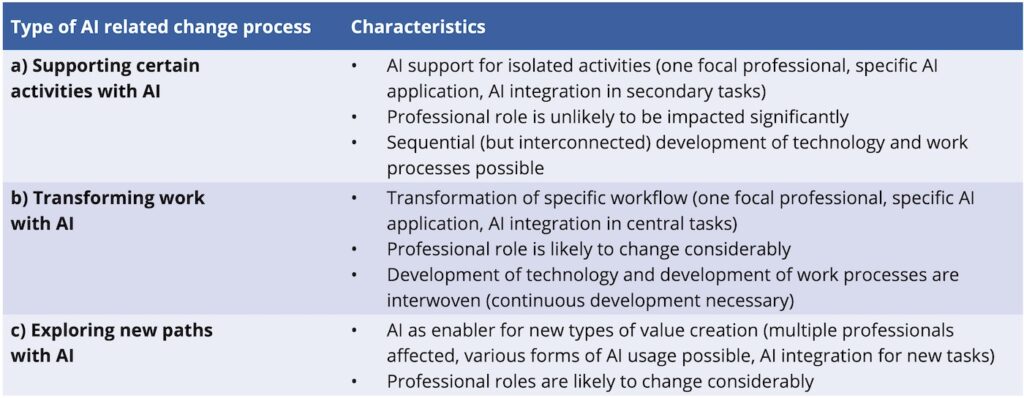
The comparison of the use cases based on the applied criteria yields three distinct types of AI-related change process. Despite the unique organizational settings and application contexts, similarities in change processes could be observed. In some change processes, AI is deployed for secondary tasks that are not crucial for the professional identity of the employees. For example, AI relieves nursing staff by enabling them to document their work using their natural speech in use case 2.
Domain experts in use case 1 are assisted in detecting quality deviations in different stations within the steel rolling process proactively and based on live data. An activity that previously was always triggered by sporadic occurrence of severe defects. These processes focus on a specific group and occur within a clearly defined project context. AI is, however, not expected to have a strong impact on employees’ professional roles. The use of AI here is more likely to be perceived as reducing the workload or simplifying work. We refer to this type of change process as Supporting certain activities with AI.
In contrast, other projects use AI to support, accelerate, or optimize core user activities. In use case 3, for example, an AI intervenes in the vehicle damage inspection process by carrying out an image analysis just like the damage inspectors and providing assessments of the type and amount of damage. Although this analysis is embedded in the workflow as a preliminary analysis and not as a substitute for the work of the damage inspectors, there is nevertheless a significant change in the professional role of the damage inspectors. Similarly, in use case 3, an AI learns the quality inspection for weld seams, and in use case 6, the detection of epileptogenic lesions.
Each of these cases had a clearly defined application and project framework, focused on a specific group of employees and a specific workflow in which AI was involved. Since the use of AI should be applied to the core activities of the persons concerned, this change process is expected to have a strong influence on the professional role of the employees. Although these cases differed in terms of their strategic focus on process efficiency or outcome quality, the aim was always to fundamentally improve a specific area of work through AI. We therefore call this type of change process Transformation of work with AI.
A third type of change process is only represented once in our small sample of use cases, but is clearly distinct from the other two types regarding its scope and strategy. In use case 9, AI is used to enable new activities by providing analyses on pump data to establish new forms of value creation for the company and its customers. This change process does not involve transforming a single work area or supporting a peripheral activity, but rather encompasses several work areas, several groups of operational experts, and has a more direct impact on the company’s overall strategy.
Here too, the professional roles of employees are strongly affected, as in the transformation of work with AI. However, role development here is more of a necessary building block in the overarching change process linked to upstream and downstream changes in the company. The focus is on using AI to change the direction of value creation and ways of working. We refer to this type as Exploring new paths with AI. The characteristics of the three types are summarized in Figure 2.
Managing AI related change depending on the change type
Based on the nine use cases of responsible AI applications and the criteria of scope, strategy, stakeholders, and outcome that relate to three distinct types of AI-related change processes, certain observations regarding change management activities can be made. Two of the three identified types are project-based change initiatives. This form of change can be aptly managed with existing change models that usually stress a stepwise progression of change activities [6, 8, 9].
All variations of these approaches include at least one step where change is decided on, prepared and initiated, a step where specific change activities are undertaken, people are involved and empowered and a step where change activities are sustained. In addition to this stepwise planning, modern approaches highlight the importance of constantly managing people issues, e.g. communicating, dealing with differing perspectives, moderating resistance, and constantly reviewing the state of the project to ensure that adjustments can be made in an agile way [9]. Insights from the nine use cases suggest that the importance of these aspects on top of stepwise change management vary depending on the nature of AI-related change.
In projects in which AI is Supporting certain activities, a stepwise approach proved successful. The management of people issues was important, but it was aligned with the stepwise logic and not necessarily in a continuous way. This went along without detrimental effects on project success. For example, in use case 7, data preparation and development of an AI backend took place without any involvement of the domain experts, as the technical scope had to be developed first.
As soon as the first AI outputs were usable, the expectations and assessments of the domain experts were obtained. Management of people issues is most crucial for front-end implementation, which makes methods of human-computer interaction and usability research particularly relevant. Interestingly, AI integration in this type of change followed a nonlinear pattern. After the projects were initiated and the planning was finished, technological developments were necessary, and change was not present within the work processes.
Only after considerable technological advancements, change within work processes was targeted again and AI users and domain experts were included again. This is notable since it is a deviation from typical change management approaches which made sense for these types of change and showed no negative consequences since AI integration did not happen at the center of the employees’ work activities and professional role.
In contrast, in the six use cases of the type Transforming work with AI, continuous attention to the changing work contents and work roles was crucial since AI was deployed in key activities. For instance, in use case 3, extensive studies were carried out with welding seam inspectors, to find out how an AI assessment affects their motivation and performance, and whether it is decisive at what point in the workflow the AI intervenes.
The issues addressed here go beyond human-machine interaction and touch on numerous aspects of personnel and organizational development, such as competence development, role development, knowledge management, safety culture and others. The management of people issues [9] was necessary throughout the change process to ensure that the AI solution did not only work in principle but in the specific work context. In addition, the frequent reviewing of problems and opportunities and corresponding refinements was very important.
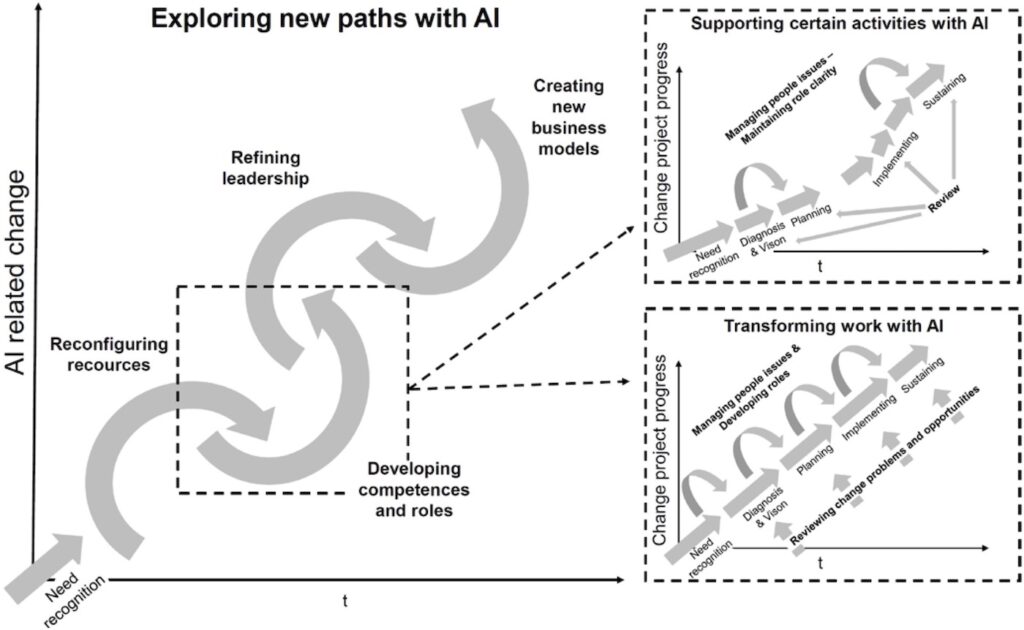
For instance, in use case 1, acceptance is primarily addressed via explainability, but investigations into other acceptance conditions are also carried out and their results can shift project planning and priorities. The progress of the change projects was linear in continuous development of work activities towards AI-assisted work activities. Both project-based approaches (Supporting certain activities with AI and Transforming work with AI) are displayed in boxes in Figure 3.
The third AI related change process has a wider scope than one situated AI related project and anticipates the shifting frontiers of scope and performance. This type of change can be aptly described using the concentric circles from a change model of agile organizational transformation [20]. The overall change can be described as several smaller change projects that are interwoven and follow the same strategy and intent.
For instance, in use case 9 the development of the cloud for pump data can be considered a change project that was managed similarly to the type Transforming work with AI. The development of business models was a subsequent change project that is building on the cloud but involves additional stakeholders and specific expertise. Role development of the technical service experts can be regarded as an additional but strongly related change project that builds on the cloud and the new business models.
The exploration of new paths with AI requires technological innovations with adequate measures of change management (see project-based change processes) but simultaneously requires organizational measures to integrate endeavors of technological, organizational and personnel development. The central requirement for this overarching change is the continuous interplay of several change initiatives, which are related to each other through suitable forms of coordination and collaboration. This is a cross-project and cross-departmental effort in organizational development. The model for Exploring new paths with AI is depicted in Figure 3.
Contribution and implication for AI related change initiatives
AI related change can take different forms depending on application context, strategy, and scope. Our analysis of nine use cases of responsible AI applications led to a distinction of project-based change and organizational change that corresponds to characterizations of AI related change as shifting frontiers of scope and performance [12]. This distinction makes it clear that AI-related change in organizations can be initiated in the form of individual AI projects. These can be supported by step-by-step change management, considering people issues and continuous review.
It makes sense to reflect on the extent to which the core activities of the employees concerned are changing and to take this into account in the extent and subject matter of participation. However, the inherent dynamics of AI projects require overarching change management that goes beyond purely project-related, step-by-step planning.
This overarching perspective and foresight can decisively support the long-term success of a transformation of work with AI. By linking change management research with specific use cases of human-centered AI development, this article proposes an approach that makes it possible to distinguish specific change processes for work with AI and to transfer findings from individual use cases more easily to other contexts.
The study was funded by Competence Center HUMAINE: Transfer-Hub of the Ruhr Metropolis for human-centered work with AI (human-centered AI network); funding code: BMBF 02L19C200.
Bibliography
[1] Von Krogh, G.: Artificial Intelligence in Organizations: New Opportunities for Phenomenon-Based Theorizing. In: Academy of Management Discoveries 4 (2018) 4, pp. 404-409.[2] Bilan, S.; Šuleř, P.; Skrynnyk, O.; Krajňáková, E.; Vasilyeva, T.: Systematic bibliometric review of artificial intelligence technology in organizational management, development, change and culture. In: Business: Theory And Practice 23 (2022) 1, pp. 1-13.
[3] Benbya, H.; Davenport, T. H.; Pachidi, S.: Artificial Intelligence in Organizations: Current State and Future Opportunities. In: MIS Quarterly Executive 19 (2020) 4.
[4] Van de Ven, A. H.; Poole, M.S.: Explaining Development and Change in Organizations. In: Academy of Management Review 20 (1995) 3, pp. 510-540.
[5] Staehle, W. H.; Conrad, P.; Sydow, J.: Management: Eine verhaltenswissenschaftliche Perspektive. Vahlen 2014.
[6] Hayes, J.: The Theory and Practice of Change Management, 6. Auflage. London 2022.
[7] Greiner, L. E.: Evolution and revolution as organizations grow. In: Harvard Business Review 50 (1972) 4, pp. 37-46.
[8] Lewin, K.: Frontiers in Group Dynamics: Concept, Method and Reality in Social Science; Social Equilibria and Social Change. In: Human Relations 1 (1947) 1, pp. 5-41.
[9] Kotter, J. P.: Leading change: Why transformation efforts fail. In: Harvard Business Review (1995) 73, pp. 59-67.
[10] Orlikowski, W. J.: The Duality of Technology: Rethinking the Concept of Technology in Organizations. In: Organization Science 3 (1992) 3, pp. 398-427.
[11] Bridges, W.: Managing Transitions: Making the Most of Change. Reading 1991.
[12] Berente, N.; Gu, B.; Recker, J.; Santhanam, R.: Managing artificial intelligence. In: MIS quarterly 45 (2021) 3, pp. 1433-1450.
[13] Parker, S. K.; Grote, G.: Automation, algorithms, and beyond: Why work design matters more than ever in a digital world. In: Applied Psychology 71 (2022) 4, pp. 1171-1204.
[14] Wilson, H. J.; Daugherty, P. R.: Collaborative intelligence: Humans and AI are joining forces. In: Harvard Business Review 96 (2018) 4, pp. 114-123.
[15] Anthony, C.; Bechky, B. A.; Fayard, A. L.: “Collaborating” with AI: Taking a system view to explore the future of work. In: Organization Science 34 (2023) 5, pp. 1672-1694.
[16] Galsgaard, A.; Doorschodt, T.; Holten, A. L.; Müller, F. C.; Boesen, M. P.; Maas, M.: Artificial intelligence and multidisciplinary team meetings; a communication challenge for radiologists’ sense of agency and position as spider in a web?. In: European Journal of Radiology 155 (2022), 110231.
[17] Paschen, J.; Wilson, M.; Ferreira, J. J.: Collaborative intelligence: How human and artificial intelligence create value along the B2B sales funnel. In: Business Horizons 63 (2020) 3, pp. 403-414.
[18] HUMAINE research project. URL: https://humaine.info/.
[19] Eisenhardt, K. M.: Building theories from case study research. In: Academy of management review, 14 (1989) 4, pp. 532-550.
[20] Herrmann, T.; Wilkens, U.: Erweiterte Analyse- und Gestaltungsperspektiven für die Digitalisierung soziotechnischer Arbeitssysteme. In: Proceedings GfA Frühjahrskongress 2017: Soziotechnische Gestaltung des digitalen Wandels – kreativ, innovativ, sinnhaft. Gesellschaft für Arbeitswissenschaft e.V. Zürich (2017).
Your downloads
Potentials: Leadership Management Training
You might also be interested in